Back in 2023, in connection with the tenth anniversary of the founding of the Society for One-Place Studies, I proposed the blogging prompt Ten (hashtag #OnePlaceStudies10). One of the ideas I put forward for blogging on that theme was ‘the top ten surnames of your OPS’ and, having suggested it, I decided to have a go myself. So began a deep dive into the surnames of Waters Upton’s residents, and in due course a blog post. Originally shared on the Society’s website, I am now adding a longer version of it to the Waters Upton website.
The first question that arose when I embarked on this quest was: “How exactly do I work out what the ‘top ten’ surnames of Waters Upton were?” I decided to use data from the nine censuses from 1841 to 1921 inclusive. Counting variants of any given last name (e.g. Brown and Browne, or Picken and Pickin) as a single family name, I established that 236 different surnames were recorded at Waters Upton on the nine censuses. Of those, 192 occurred less than ten times in total – including 92 which appeared only once.
The number of people enumerated in Waters Upton parish on each census from 1841 to 1921 was, on average, just 201. As a result of this, looking at surnames on any one census, while interesting, did not lead to any meaningful conclusions. In many years a surname could get into the ‘Top Ten’ by virtue of it being borne by just six people!
The method I finally arrived at for calculating the Top Ten Surnames of Waters Upton was based on counting the number of individual surname holders enumerated in the parish across all of the nine census years, counting each individual only once regardless of the number of censuses they appeared in.
So, I would establish the Top Ten surnames of Waters Upton over the period from 1841 to 1921. After a fashion, that is. My chosen method would fail to include any of the people who lived in the parish between censuses. However, given that it would be impossible to identify all of those ‘in-betweeners,’ using the decennial snapshots of the parochial population provided by the censuses was the only way to go.
The Top Ten
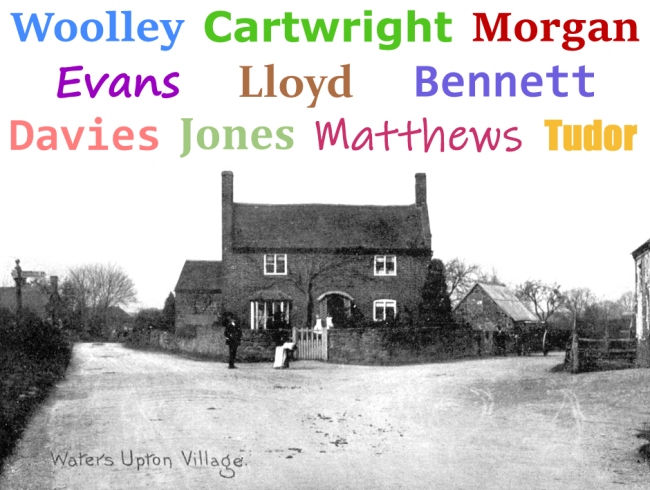
The results of my calculations (with the number of surname holders in brackets) were as follows:
1.
2.
3.
4 =
6.
7 =
9 =
Wooley (52)
Cartwright (32)
Morgan (31)
Evans and Lloyd (29 each)
Bennett (27)
Davies and Jones (26 each)
Matthews and Tudor (25 each)
Looking at this list, one of the first things that struck me was that six out of the ten surnames – Morgan, Evans, Lloyd, Davies, Jones and Tudor – had Welsh origins. This was no great surprise given that Waters Upton lies in a county on England’s border with Wales. These family names do of course occur at high frequencies elsewhere too. “Commonly occurring surnames dominate Top Ten” would hardly be a shocking finding – but to what extent was that the case?
In checking my data to make sure that I didn’t double-count individuals who were recorded on more than one census, I found many who were enumerated on multiple occasions. The record was held by a William Matthews, enumerated at Waters Upton eight times from 1851 to 1921 inclusive; he appears in the story A fatal tricycle accident at Waters Upton.
It wasn’t just individuals who were ‘long-stayers’ in the parish – there were families which remained in (or returned to) Waters Upton over two or more generations. The long-term presence of such families would certainly have an impact on the Top Ten surnames.
So, high frequency surnames occurring, erm, frequently, and ‘faithful families’ perpetuating their family names – to what extent did each of these two factors influence the final results? In the discussion that follows, the term ‘descendants’ includes women who ‘married in.’
Cartwright and Jones
At one end of the scale there were the Cartwrights and the Joneses. The 26 Joneses were comprised of a family of eight, two families of four, a married couple, a mother and her child, and six other individuals. None of the families were represented by more than two generations (i.e. parents and children). The surname Jones appears to have made it into my Top Ten almost entirely because it was a very high frequency surname.
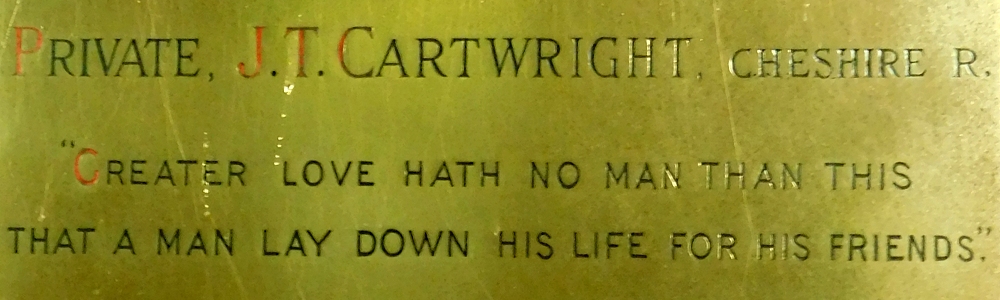
As for the Cartwrights, Sarah the widow of George Cartwright and her descendants account for 10 of 32 people bearing that surname on census returns; the rest were from four other families. Two of the families had members of three generations enumerated in Waters Upton. I suspect that further research might find that two or more of the apparently separate Cartwright families were in fact related. As things stand however, the surname probably appears in the Top Ten largely – but not entirely – because it was a commonly occurring one.
Morgan, Lloyd and Davies
With around half to two thirds of their numbers represented by members of three to four generations of single families, the surnames Morgan, Lloyd, and Davies claim their places in the Top Ten through a combination of factors. All are fairly high-frequency family names, but their presence in the parish was strengthened by families who were present in the parish for three or four generations.

The leading contributor to the Morgans’ success was the family of John Morgan, surgeon and apothecary of Waters Upton, and his wife Emma, née Woodfin. The first appearance by this family on a census at Waters Upton was in 1851. These Morgans were represented in the parish censuses from 1881 by John and Emma’s son Robert Flower Morgan, his wife Eliza (née Blantern) and their descendants. Two sons of Robert and Eliza, John Stanley Morgan and William Edward Morgan, then carried the surname through to the 1921 census (and beyond). The surgeon’s family accounted for 22 of the 31 Morgans recorded on censuses at Waters Upton.
14 of the 29 Lloyds enumerated at Waters Upton were members of a family headed by Wiiliam and his wife Elizabeth, née Wild. This couple and their children first appear in the parish on the 1861 census, with William transitioning from agricultural labourer to small farmer, at The Terrill, by 1871.
The surname Davies was as frequent as Jones across the nine censuses (each being borne by 26 individuals). However exactly half of the Davies representatives (13) were from one family, that of the Rev John Bayley Davies (who features in several blog posts here including In support of the school at Waters Upton) and his wife Susan Anslow, née Juckes.
Evans, Bennett and Tudor
In the case of the Evanses, the Bennetts and the Tudors, over 80% of the holders of each of those surnames were members of single families, each with four to five generations enumerated at Waters Upton across all nine censuses from 1841 to 1921. The progenitors in question were:
- William Evans, a shoemaker in 1841, and wife Mary, née Higgins; with their descendants they contributed 24 of the 29 Evanses recorded on Waters Upton censuses
- Charles Bennett, enumerated as a servant in 1841, whose son Thomas, a shoemaker, married Martha Icke and took up residence by 1841 at what would become number 17 Waters Upton; this Bennett family accounts for all but one of the 27 Bennetts enumerated at Waters Upton
- Samuel Tudor, a bricklayer in 1841, and wife Eleanor, née Humphreys; this couple and their descendants together made up 22 of the 25 Tudors on Waters Upton censuses
Matthews and Woolley, the ‘faithful families’
Finally, two surnames recorded on Waters Upton’s censuses were each borne exclusively by members of a single family, spanning five generations. Down at the bottom of the Top Ten in joint ninth place, everyone with the surname Matthews was descended from William (baptised 1743 at Waters Upton) and Mary (born around 1737).
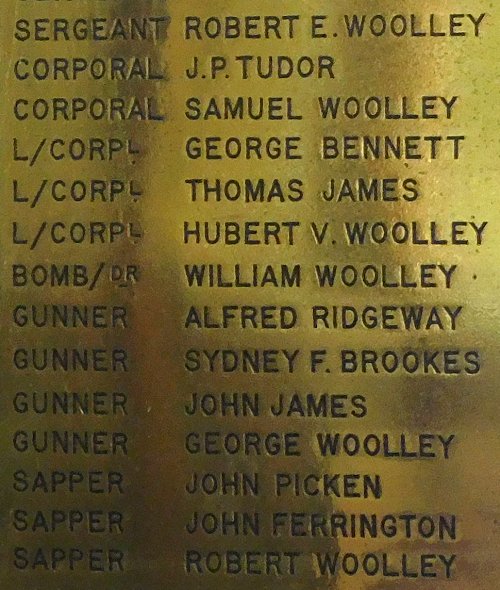
The ultimate example of surname borne by a ‘faithful family’ however was Woolley, the clear leader of the Top Ten chart. All 52 of Waters Upton’s Woolleys enumerated from 1841 to 1921 were descended from, or married to men descended from, William Woolley (baptised in 1759 at High Ercall) and Elizabeth, née Downes (probably the one baptised at Waters Upton in 1760).
In conclusion, although the idea of compiling a ‘Top Ten Surnames of my One-Place Studies’ article seemed like a bit of fun, I found the exercise to be fascinating. It focussed my mind on Waters Upton’s census data and made me analyse it in new ways, generating a number of ideas for further study in the process.

