My previous post, The Top Ten surnames of Waters Upton, revealed that Woolley was the ‘top’ surname in the parish across the censuses taken from 1841 to 1921. This was illustrated with a photo showing part of the Roll of Honour which is mounted in the porch of St Michel’s church in Waters Upton. Of the 40 men from the parish whose service during the First World War was commemorated on that memorial, a full quarter bore the surname Woolley. So, for Remembrance Sunday, I’m going to start telling the stories of the Waters Upton Woolleys who went to war.
Rather than diving straight in to the individual stories of the Woolley servicemen, I’m going to start by looking at them as a group – exploring what the men had in common, and some of the things that made each of their experiences unique. Let’s begin with one big thing they all shared, aside from (but connected with) their surname.
Brothers (and cousins) in arms
Another of the take-aways from my ‘Top Ten’ surnames post was that the Woolleys of Waters Upton, at least through what I call the ‘census era’ (1841 to 1921), were one big family. With the exception of the women who ‘married in,’ every Woolley enumerated by those censuses was descended from a couple who married at Waters Upton in 1783. The ten Woolley men named on the parish Roll of Honour were all 3x great grandsons of that couple.
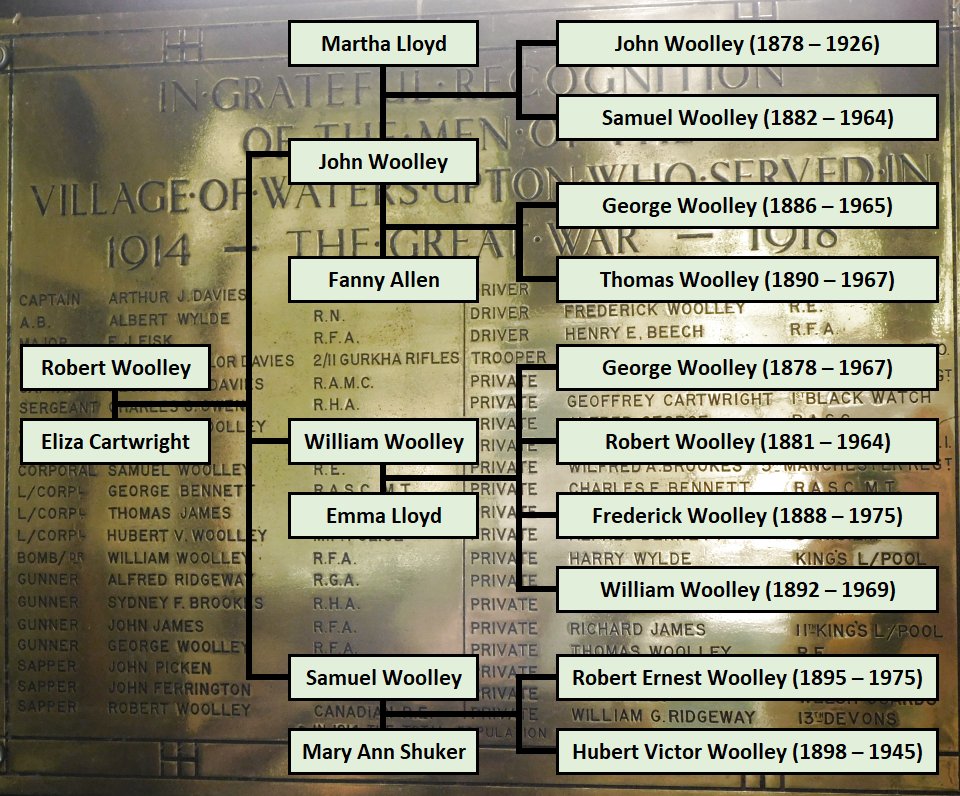
So, they were all related – but more than that, they were closely related. All of them were grandsons of Robert Woolley (alias Birch, 1818 – 1891) and Eliza (née Cartwright, 1818 – 1897). Three of that couple’s sons begat the Woolleys whose names would be inscribed on the Waters Upton Roll of Honour:
- John (1845 – 1929), who married Martha Lloyd (1842 – 1885) and, after her death, Fanny Allen (1853 – 1936)
- William (c1851 – 1939), who wed Emma Lloyd (1852 – 1931)
- Samuel (1863 – 1936), who tied the knot with Mary Ann Shuker (1871 – 1947)
Each one of the three groups of ‘brothers in arms’ were therefore first cousins of the other two groups.
Before the Great War
Let’s now look at the lives of our cohort of closely-related Woolleys before they joined up. Where were they born? Where were they living and what jobs were they engaged in when they decided to enlist? The latter questions are usually easy to answer for those whose service records survived the Blitz 🡕 of World War 2 and have been digitised. Including ‘burnt records’ (which are intact but not necessarily complete due to fire damage), and one Canadian personnel file (which was not at risk of enemy bombing in WW2), five of the 10 Woolleys have such service records. For some of the others, I have found alternative sources of information.
In the following table, names follow the order in the family tree chart above, counties (or, in two cases, countries) are given only for places outside Shropshire.
| Name | Birth year | Birth place | Pre-war residence | Pre-war occupation |
| John | 1878 | Waters Upton | Newtown, Montgomeryshire | Innkeeper |
| Samuel * | 1882 | Cherrington | Buenos Aires, Argentina | Engine Driver |
| George | 1886 | Gnosall, Staffordshire | NK (Moreton Say in 1911) | Gardener |
| Thomas * | 1890 | Gnosall, Staffordshire | Staffordshire | Blacksmith |
| George * | 1878 | Waters Upton | Yorkshire | Gardener |
| Robert * | 1881 | Waters Upton | Ottawa, Canada | Ironworker |
| Frederick | 1888 | Waters Upton | NK (Sedgwick, Westmorland in 1911) | NK (Servant in 1911) |
| William | 1892 | Waters Upton | NK (Belbroughton, Worcestershire in 1911) | NK (Groom in 1911) |
| Robert Ernest * | 1895 | Waters Upton | Birmingham, Warwickshire | Police Officer |
| Hubert Victor | 1898 | Waters Upton | NK (Waters Upton in 1911) | NK |
Seven out of our ten subjects were natives of Waters Upton, but three, all sons of John Woolley, were born elsewhere. I have found no records to show that Samuel or Thomas ever set foot in the parish, but their father John and mother / stepmother Fanny lived at Waters Upton from about 1915, so they may well have visited. (This seems a tenuous connection for them to have appeared on the parish Roll of Honour, but there are other examples.)
While most of the Woolley boys were Waters Upton born, almost all of them (and all of those born elsewhere) left their native parish to find work when they grew up. As a result, they were living in a variety of places during the first years of the Great War. Furthest from home were Samuel and Robert, on the other side of the Atlantic. George left his employment with the Great Western Railway in 1911 “to take situation on Buenos Ayres & Pacific Rwy” while Robert emigrated to Canada with his wife and infant son in 1912. Those who did not leave these shores were distributed over as many as seven counties in England and Wales.
Even the youngest of the ten Wooley men, Hubert Victor Woolley, might have left his home parish before Britain entered the war. He would have been 16 at that time, and almost certainly working – but where, and as what? A lack of service records (or alternative sources) for two of Hubert’s cousins means that I cannot be certain about the work they were engaged in either. For both Frederick and William Woolley, I only have the 1911 census to tell me about their circumstances a few years before the war.
The other Woolleys held a variety of occupations, including blacksmith, engine driver, innkeeper and ironworker, with only two doing the same job: both Georges were gardeners. Almost all of these men gave up their employment voluntarily to join the war effort – but Robert Ernest Woolley’s short-lived stint as a police officer ended when he was dismissed. He enlisted eight days later.
Soldiers of the King
Finally, let’s look at a few aspects of the ten Woolley men’s wartime service. In the following table, the first two columns are the same as in the one above, any post-war military service is ignored, and GSW is an abbreviation of Gunshot Wound.
| Name | Birth year | WW1 – Regiment(s) joined | WW1 – Overseas service | WW1 – Injuries etc sustained |
| John | 1878 | Welsh Guards | France | Trench Fever |
| Samuel * | 1882 | Royal Engineers | France | Gassed |
| George | 1886 | Royal Field Artillery | France? | GSW to elbow |
| Thomas * | 1890 | Royal Army Service Corps | East Africa, France | Malaria |
| George * | 1878 | Yorkshire Regiment, Labour Corps | France | Gassed, GSW |
| Robert * | 1881 | Canadian Engineers | France | Finger Crushed (accident) |
| Frederick | 1888 | Royal Engineers | NK | NK |
| William | 1892 | Royal Field Artillery | NK | NK |
| Robert Ernest * | 1895 | Middlesex Regiment | Salonika, Balkans | Dysentery |
| Hubert Victor | 1898 | KSLI, Welsh Regiment | France | NK |
The range of places where the Woolleys ended up living and working played a part in the variety of regiments they joined when they answered the call to serve their King and country. Only one, Hubert Victor Woolley, enlisted the regiment of his county of birth. Having done so, he was transferred from the King’s Shropshire Light Infantry to the Welsh Regiment soon after he arrived in France.
Two more who joined regiments local to where they were living were John, of Newtown (Welsh Guards), and George (son of William), of Yorkshire (Yorkshire Regiment). The latter went on to serve later in the war with the Labour Corps. George’s brother Robert enlisted with his adopted country’s army, and became a Sapper with the Canadian Engineers. Back in Britain, cousins Samuel and Frederick both joined the Royal Engineers, while the Royal Field Artillery recruited cousins George (son of John) and William Woolley.
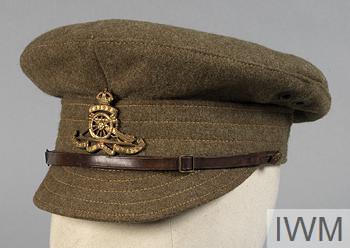
Two more who joined regiments local to where they were living were John, of Newtown (Welsh Guards), and George (son of William), of Yorkshire (Yorkshire Regiment). The latter went on to serve later in the war with the Labour Corps. George’s brother Robert enlisted with his adopted country’s army, and became a Sapper with the Canadian Engineers. Back in Britain, cousins Samuel and Frederick both joined the Royal Engineers, while the Royal Field Artillery recruited cousins George (son of John) and William Woolley.
Robert Ernest Woolley had been living in Birmingham, so why did he go to London and enlist there with the Middlesex Regiment? Possibly because the reason why his employment with the Birmingham City Police ended was published in the local press. Robert may have believed that by moving away he would stand a better chance of being taken on as a soldier. This decision would lead to service in the Balkans during the Salonika Campaign, attacks of dysentery, and the award of a medal from the King of Italy.
Service records are the best source of information about time spent overseas, and about any injuries or illnesses leading to hospital admissions. In their absence, other sources can often fill in some of the gaps; those alternatives have helped me with three of the Woolleys. As a result, I know that at least six – possibly seven – of the ten Woolley brothers (and cousins) in arms served in France. Of those six or seven, Thomas also spent time with the Army Service Corps in East Africa.
At least seven of the Woolleys ended up with injuries or illnesses as a result of their military service. Robert Ernest Woolley’s dysentery I have already mentioned. Thomas was infected with Malaria. Samuel was gassed, George (son of John) received a gunshot wound, while the other George (son of William) was suffered from both of those misfortunes. John with Trench Fever and Robert, whose finger was crushed in an accident, round off the list of casualties.
Each of the ten Woolley men honoured on the Waters Upton Roll of Honour have very different tales to tell about their lives before, during and after the Great War. I hope to build on the overview provided here by telling their stories in more detail in future articles.

