Waters Upton Woolleys in World War One (Part 1)

My previous post, The Top Ten surnames of Waters Upton, revealed that Woolley was the ‘top’ surname in the parish across the censuses taken from 1841 to 1921. This was illustrated with a photo showing part of the Roll of Honour which is mounted in the porch of St Michel’s church in Waters Upton. Of the 40 men from the parish whose service during the First World War was commemorated on that memorial, a full quarter bore the surname Woolley. So, for Remembrance Sunday, I’m going to start telling the stories of the Waters Upton Woolleys who went to war.

Rather than diving straight in to the individual stories of the Woolley servicemen, I’m going to start by looking at them as a group – exploring what the men had in common, and some of the things that made each of their experiences unique. Let’s begin with one big thing they all shared, aside from (but connected with) their surname.

Brothers (and cousins) in arms

Another of the take-aways from my ‘Top Ten’ surnames post was that the Woolleys of Waters Upton, at least through what I call the ‘census era’ (1841 to 1921), were one big family. With the exception of the women who ‘married in,’ every Woolley enumerated by those censuses was descended from a couple who married at Waters Upton in 1783. The ten Woolley men named on the parish Roll of Honour were all 3x great grandsons of that couple.
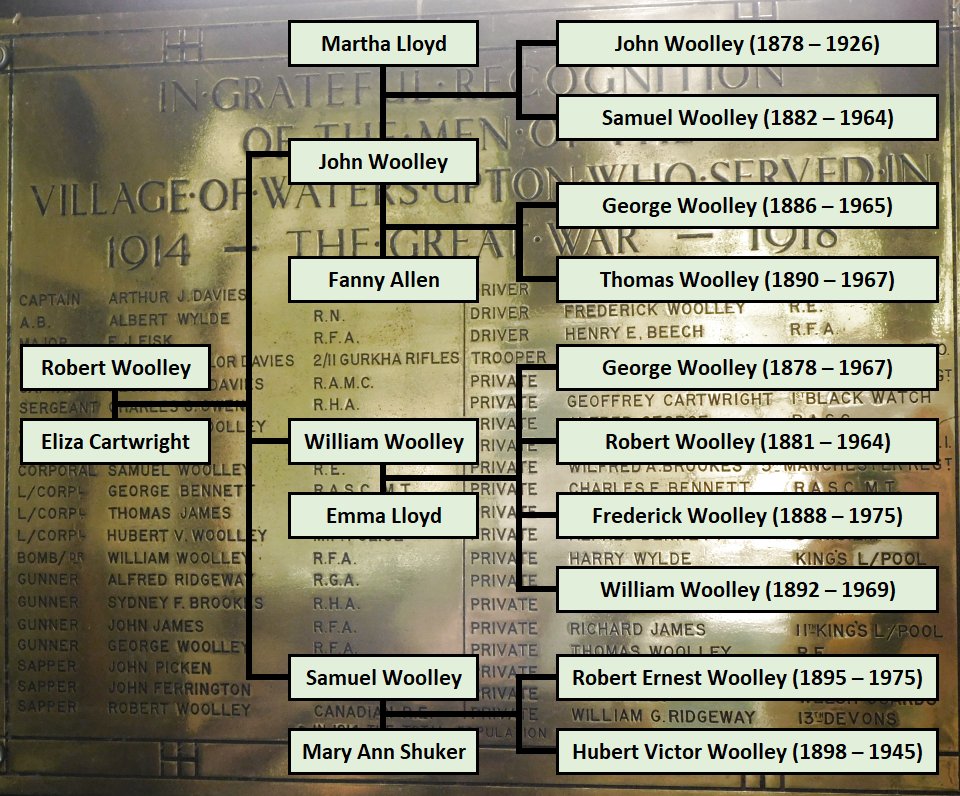
A chart showing the names of the ten Woolley men discussed in this article, with their dates of birth, and lines connected each to their parents and, via their parents, to their shared grandparents. In the background is a photo of the brass Roll of Honour in Waters Upton church, on which all ten Woolley men are named along with 30 other men connected with the parish.
Relationships between the Woolley men whose names are on the Waters Upton Roll of Honour. Image by the author.

So, they were all related – but more than that, they were closely related. All of them were grandsons of Robert Woolley (alias Birch, 1818 – 1891) and Eliza (née Cartwright, 1818 – 1897). Three of that couple’s sons begat the Woolleys whose names would be inscribed on the Waters Upton Roll of Honour:

  • John (1845 – 1929), who married Martha Lloyd (1842 – 1885) and, after her death, Fanny Allen (1853 – 1936)
  • William (c1851 – 1939), who wed Emma Lloyd (1852 – 1931)
  • Samuel (1863 – 1936), who tied the knot with Mary Ann Shuker (1871 – 1947)

Each one of the three groups of ‘brothers in arms’ were therefore first cousins of the other two groups.

Before the Great War

Let’s now look at the lives of our cohort of closely-related Woolleys before they joined up. Where were they born? Where were they living and what jobs were they engaged in when they decided to enlist? The latter questions are usually easy to answer for those whose service records survived the Blitz 🡕 of World War 2 and have been digitised. Including ‘burnt records’ (which are intact but not necessarily complete due to fire damage), and one Canadian personnel file (which was not at risk of enemy bombing in WW2), five of the 10 Woolleys have such service records. For some of the others, I have found alternative sources of information.

In the following table, names follow the order in the family tree chart above, counties (or, in two cases, countries) are given only for places outside Shropshire.

NameBirth
year
Birth
place
Pre-war residencePre-war occupation
John1878Waters UptonNewtown, MontgomeryshireInnkeeper
Samuel *1882CherringtonBuenos Aires, ArgentinaEngine Driver
George1886Gnosall, StaffordshireNK (Moreton Say in 1911)Gardener
Thomas *1890Gnosall, StaffordshireStaffordshireBlacksmith
George *1878Waters UptonYorkshireGardener
Robert *1881Waters UptonOttawa, CanadaIronworker
Frederick1888Waters UptonNK (Sedgwick, Westmorland in 1911)NK (Servant in 1911)
William1892Waters UptonNK (Belbroughton, Worcestershire in 1911)NK (Groom in 1911)
Robert Ernest *1895Waters UptonBirmingham, WarwickshirePolice Officer
Hubert Victor1898Waters UptonNK (Waters Upton in 1911)NK
* Service records survived and are online

Seven out of our ten subjects were natives of Waters Upton, but three, all sons of John Woolley, were born elsewhere. I have found no records to show that Samuel or Thomas ever set foot in the parish, but their father John and mother / stepmother Fanny lived at Waters Upton from about 1915, so they may well have visited. (This seems a tenuous connection for them to have appeared on the parish Roll of Honour, but there are other examples.)

While most of the Woolley boys were Waters Upton born, almost all of them (and all of those born elsewhere) left their native parish to find work when they grew up. As a result, they were living in a variety of places during the first years of the Great War. Furthest from home were Samuel and Robert, on the other side of the Atlantic. George left his employment with the Great Western Railway in 1911 “to take situation on Buenos Ayres & Pacific Rwy” while Robert emigrated to Canada with his wife and infant son in 1912. Those who did not leave these shores were distributed over as many as seven counties in England and Wales.
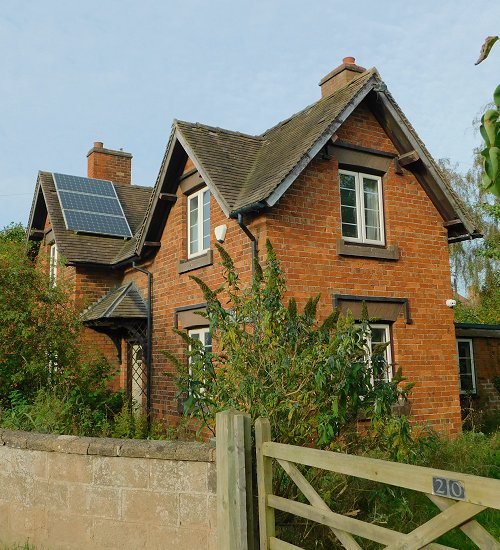
Photo of numer 20, Waters Upton, known as Sutherland Cottage. A three-nay, two-storey cottage made from red bricks, with a tiled roof from which two chimney stacks rise. Set in garden behind a low stone wall and a wooden gate.
20 Waters Upton (Sutherland Cottage), home of Robert Ernest and Hubert Victor Woolley. Photo by the author.

Even the youngest of the ten Wooley men, Hubert Victor Woolley, might have left his home parish before Britain entered the war. He would have been 16 at that time, and almost certainly working – but where, and as what? A lack of service records (or alternative sources) for two of Hubert’s cousins means that I cannot be certain about the work they were engaged in either. For both Frederick and William Woolley, I only have the 1911 census to tell me about their circumstances a few years before the war.

The other Woolleys held a variety of occupations, including blacksmith, engine driver, innkeeper and ironworker, with only two doing the same job: both Georges were gardeners. Almost all of these men gave up their employment voluntarily to join the war effort – but Robert Ernest Woolley’s short-lived stint as a police officer ended when he was dismissed. He enlisted eight days later.

Soldiers of the King

Finally, let’s look at a few aspects of the ten Woolley men’s wartime service. In the following table, the first two columns are the same as in the one above, any post-war military service is ignored, and GSW is an abbreviation of Gunshot Wound.

NameBirth
year
WW1 – Regiment(s) joinedWW1 – Overseas serviceWW1 – Injuries etc sustained
John1878Welsh GuardsFranceTrench Fever
Samuel *1882Royal EngineersFranceGassed
George1886Royal Field ArtilleryFrance?GSW to elbow
Thomas *1890Royal Army Service CorpsEast Africa, FranceMalaria
George *1878Yorkshire Regiment, Labour CorpsFranceGassed, GSW
Robert *1881Canadian EngineersFranceFinger Crushed (accident)
Frederick1888Royal EngineersNKNK
William1892Royal Field ArtilleryNKNK
Robert Ernest *1895Middlesex RegimentSalonika, BalkansDysentery
Hubert Victor1898KSLI, Welsh RegimentFranceNK
* Service records survived and are online

The range of places where the Woolleys ended up living and working played a part in the variety of regiments they joined when they answered the call to serve their King and country. Only one, Hubert Victor Woolley, enlisted the regiment of his county of birth. Having done so, he was transferred from the King’s Shropshire Light Infantry to the Welsh Regiment soon after he arrived in France.

Two more who joined regiments local to where they were living were John, of Newtown (Welsh Guards), and George (son of William), of Yorkshire (Yorkshire Regiment). The latter went on to serve later in the war with the Labour Corps. George’s brother Robert enlisted with his adopted country’s army, and became a Sapper with the Canadian Engineers. Back in Britain, cousins Samuel and Frederick both joined the Royal Engineers, while the Royal Field Artillery recruited cousins George (son of John) and William Woolley.
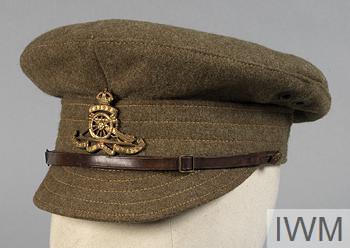
Royal Field Artillery 1917 Pattern Field Cap, Other Ranks. Copyright: © IWM, (UNI 12681 🡕); used under the IWM Non-Commercial Licence 🡕.

Two more who joined regiments local to where they were living were John, of Newtown (Welsh Guards), and George (son of William), of Yorkshire (Yorkshire Regiment). The latter went on to serve later in the war with the Labour Corps. George’s brother Robert enlisted with his adopted country’s army, and became a Sapper with the Canadian Engineers. Back in Britain, cousins Samuel and Frederick both joined the Royal Engineers, while the Royal Field Artillery recruited cousins George (son of John) and William Woolley.

Robert Ernest Woolley had been living in Birmingham, so why did he go to London and enlist there with the Middlesex Regiment? Possibly because the reason why his employment with the Birmingham City Police ended was published in the local press. Robert may have believed that by moving away he would stand a better chance of being taken on as a soldier. This decision would lead to service in the Balkans during the Salonika Campaign, attacks of dysentery, and the award of a medal from the King of Italy.

Service records are the best source of information about time spent overseas, and about any injuries or illnesses leading to hospital admissions. In their absence, other sources can often fill in some of the gaps; those alternatives have helped me with three of the Woolleys. As a result, I know that at least six – possibly seven – of the ten Woolley brothers (and cousins) in arms served in France. Of those six or seven, Thomas also spent time with the Army Service Corps in East Africa.

At least seven of the Woolleys ended up with injuries or illnesses as a result of their military service. Robert Ernest Woolley’s dysentery I have already mentioned. Thomas was infected with Malaria.  Samuel was gassed, George (son of John) received a gunshot wound, while the other George (son of William) was suffered from both of those misfortunes. John with Trench Fever and Robert, whose finger was crushed in an accident, round off the list of casualties.

Each of the ten Woolley men honoured on the Waters Upton Roll of Honour have very different tales to tell about their lives before, during and after the Great War. I hope to build on the overview provided here by telling their stories in more detail in future articles.

Waters Upton 1921: a post-war parish (part 2)

⇐ Back to Part 1

Edgar Percy Davies now retraced his steps back along the village road, heading towards and then beyond the church. Soon he was passing the White House, his destination being the next house along.


Number 11 was occupied by newcomers to the village, the Rowberry family. Thomas Henry Rowberry may well have served during the war – there are two sets of medal award records (one from the Machine Gun Corps and one from King’s Royal Rifle Corps), either of which might be his, but no pension index/ledger cards or surviving service record to confirm this.


Beyond number 11 lay the semi-detached residences numbers 10 and 9, headed respectively by (post-war incomers?) Joseph Ralphs and his son Frank Ralphs. I am not aware of any wartime military service being undertaken by members of this family, but it would not surprise me if Frank or one (or more) of his brothers had served.


Why did the enumerator cross the road? To collect the household schedules on the other side. Number 31 (Clematis Cottage) was the home of Arthur Ball and his sister Elizabeth Emma, neither of whom had connections with military service that I know of. The same cannot be said of the next house however.


Photo showing two names on a brass memorial plaque listing men of Waters Upton parish who died while serving in the Great War: Private W. James, K. Liverpool Regt., Private J. H. Jones, Royal Welsh Fusiliers.

At number 32 lived widower Charles George, along with two of his daughters, both war widows, and their children. Jane’s husband William James, a native of Waters Upton, I have already mentioned (his mother lived at number 23 Waters Upton). Kate’s husband John Herbert Jones was a Liverpudlian, who was killed in action while fighting with the Royal Welsh Fusiliers in France. A few years after this census was taken Jane and Kate would both emigrate, with their children, to start new lives New Zealand.


On went enumerator Davies to numbers 33 (William and Matthews) and 34 (William Edward Morgan and family), and then, after crossing road, to number 8. The occupant of this house, Alfred Ridgway, I have already mentioned (his first cousin Charles, the blacksmith, lived at number 15). Alfred, a carpenter and wheelwright, had two sons who, despite having no medals to show for it, had ‘done their bit’ during the war: William George Ridgway (Devonshire Regiment and Labour Corps) and Alfred John Ridgway (Royal Garrison Artillery).


Back across the road to Malt House Farm and, just to the North of that, Lower House Farm, both occupied by (unrelated, as far as I know) Powell families. These farming families had no wartime military connections that I know of, but one of the servants at Lower House Farm did: Thomas Hall (who would marry his employer’s sister in 1922) served with the Royal Army Veterinary Corps. His brother, Pryce Hall, also played his part in the Great War. Having emigrated to Australia in 1912, Pryce served with the Australian Imperial Force from 1915.


On leaving Lower House Edgar Davies continued along the road, which now left the village of Waters Upton, and headed towards Harebutt Bank. He called next on number 39, which was occupied by the Cartwright family. John, the head of the household, had no military record but his younger brother James did. James Cartwright enlisted with the Monmouth Regiment, then transferred to the South Wales Borderers after entering France with the British Expeditionary Force. He was discharged after receiving a gunshot wound to the left thigh in 1917, and died in 1919.

Photo of a Poppy flower, with large, scarlet petals and dark centre.
Poppy. Public domain (CC0) image by Travel Photographer, from negativespace.co

Edgar had already visited one home where relatives of John Evans lived (number 25), and now he called on another, number 40, where John’s uncle and aunt Samuel and Martha Evans lived. After that, he went to Harebutts Farm (number 38), home of the Casewell family. The Casewells’ servant, agricultural worker Alan Furnivall, had joined the Royal Flying Corps in 1917 and transferred to the RAF on its formation in 1918. Alan worked on aircraft rather than flying them, and he was discharged in 1920 with a record featuring a long list of civil convictions and prison sentences.


As he began to head back towards the Waters Upton village, Edgar the enumerator collected a final schedule from a Harebutt Bank household (The Harebutts, number 37, home of John Stanley Morgan and family). Then he continued along the road, past Lower House Farm, and turned left onto Catsbritch Lane.


On the right as he entered the lane was a dwelling divided into three, numbers 7, 6 and 5. These households were occupied by Elizabeth Matthews (at number 7), Frank and Annie Battman (at number 6), and William Beech with his wife Elizabeth and son Thomas (at number 5). Thomas Beech had been a Private with the Shropshire Yeomanry and then a Driver with Royal Field Artillery during the Great War, while his brother Henry Eddowes Beech (now living elsewhere) had emulated the latter part of his service.


Just a little further along Catsbritch Lane and on the same side of the road was a terrace of four houses where Waters Upton’s street numbers began: number 4 (Charles James and family), number 3 (Ernest Edward Austin and family), number 2 (Joshua Cartwright and family), and number 1 (Thomas Bennett and family). All but one of these (number 3) houses had connections with military service in the Great War. Of those three, two have already been mentioned: Charles James at number 4 (a brother of Thomas James at number 23, of John James and the late Williams James, and a brother-in-law of William’s widow Jane James at number 32), and Thomas Bennett at number 1 (a brother of Alfred, George and Charles Edward Bennett at number 17).

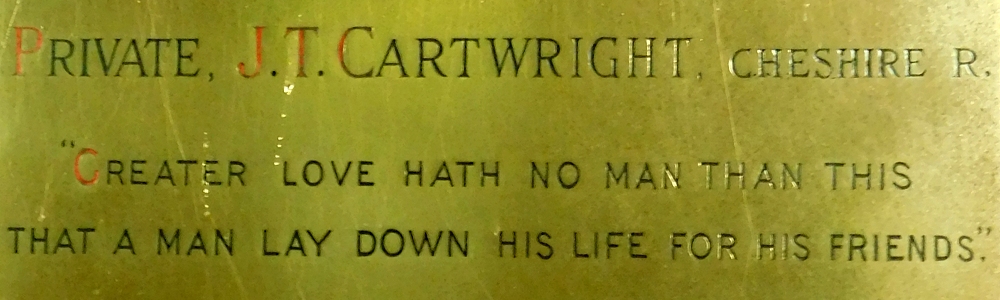
That leaves number 2 Waters Upton, the last household Edgar Davies would visit in which a family member had been lost during the war: Joshua and Priscilla Cartwright’s son John Thomas Cartwright was killed in action while fighting with the Cheshire Regiment during the Second Battle of the Somme on 27 March 1918.

Photo showing the last name on a brass memorial plaque listing men of Waters Upton parish who died while serving in the Great War: Private J. T. Cartwright, Cheshire R. Beneath that name is inscribed: "Greater love hath no man than this, that a man lay down his life for his friends."

A little further along Catsbritch Lane, and set back from it on the other side, was The Grange Farm (number 41?). The head of this household was Ferdinand Heyne, a naturalised British Subject born in Germany. Ferdinand was a pork butcher in Shrewsbury from at least 1901 until 1913 (when he listed in that year’s Kelly’s Directory) and possibly a little later, but not in 1917. Had anti-German sentiment during the war pushed him out of the town and into the countryside?


The next house at which Edgar Davies stopped to collect a census schedule was number 48. I must admit that I’m not entirely clear about the numbering along Catsbritch Lane, but I suspect that number 48 was the cottage now known as Manor Lodge, which sits beside one of the entrances to Waters Upton Manor (which might be number 49). It was occupied by James Evans, his wife, and their children, one of whom was John Evans. John had enlisted with the RAF in July 1918, just 11 days after his 18th birthday and a little over three months before the war ended.


At the Manor itself – not that it was named (or numbered) on the schedule – was Arthur Lea Juckes. Arthur had a little military service to his name, in the form of a brief spell as a Lieutenant with the Surma Valley Light Horse in India, but that was in 1898. During the Great War he took on another role, chairing military tribunals at Wellington – and ruthlessly enforcing the rules under which men could be conscripted.


As he got closer to The Terrill, the end of our enumerator’s tour of Waters Upton was nearly over. He visited number 42 (farmer Richard Allen and his housekeeper – was this Melverley House or Linden Lea?) and then number 44 (Thomas Edward Harris and family; I’m guessing that number 43 – Grange Cottage? – was unoccupied).


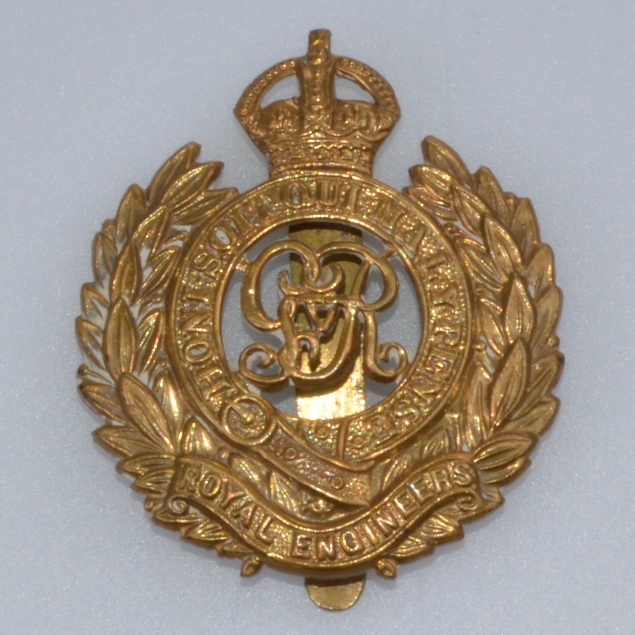
Photo of a Royal Engineers cap badge. It is bronze in colour. In the centre are the ornate initials G. R. (the King), surrounded by a belt with a barely legible inscription. Above that is a crown. A wreath extends from the bottom (where a banner bears the words Royal Engineers) and up both sides.
Royal Engineers cap badge. Public domain image from getarchive.net

Edgar Davies’ penultimate house call was to number 45, The Terrill Farm, occupied by septuagenarian farmer William Woolley, his wife Emma, two of their daughters, and three visiting relatives. Four of William’s sons had participated in the Great War: George Woolley (Yorkshire Regiment and Labour Corps), Robert Woolley (Canadian Royal Engineers), Frederick Woolley (Royal Engineers), and William Woolley (Royal Field Artillery).


Finally came number 46, a cottage just North of the Terrill Farm (number 47, a little further to the North, was most likely unoccupied). This was the home of widow Sarah Cartwright and two of her grandsons, one of whom was Geoffrey Henry Cartwright. It appears that Geoffrey first enlisted with the Black Watch (possibly before the war), then fought with the Worcester Regiment (when he was wounded at Gallipoli), and went on to serve with the Oxfordshire and Buckinghamshire Regiment and finally, post-war, with the King’s Shropshire Light Infantry (Territorial Army). He was the third resident of Waters Upton parish to declare himself as being out of work – all three were former servicemen.


Life went on in Waters Upton after the First World War, as it did elsewhere, but without those who paid the ultimate price to help deliver victory over the Central Powers, and with many who came home bearing physical injuries, mental scars, memories of battle which would never fade. Directly and indirectly, the lives of many of Waters Upton’s inhabitants were forever changed. More than a century later, we remember those who died, those who returned, and the families and communities they belonged to.


Picture credits: All photos by the author except where otherwise credited.