Waters Upton 1921: a post-war parish (part 2)

⇐ Back to Part 1

Edgar Percy Davies now retraced his steps back along the village road, heading towards and then beyond the church. Soon he was passing the White House, his destination being the next house along.


Number 11 was occupied by newcomers to the village, the Rowberry family. Thomas Henry Rowberry may well have served during the war – there are two sets of medal award records (one from the Machine Gun Corps and one from King’s Royal Rifle Corps), either of which might be his, but no pension index/ledger cards or surviving service record to confirm this.


Beyond number 11 lay the semi-detached residences numbers 10 and 9, headed respectively by (post-war incomers?) Joseph Ralphs and his son Frank Ralphs. I am not aware of any wartime military service being undertaken by members of this family, but it would not surprise me if Frank or one (or more) of his brothers had served.


Why did the enumerator cross the road? To collect the household schedules on the other side. Number 31 (Clematis Cottage) was the home of Arthur Ball and his sister Elizabeth Emma, neither of whom had connections with military service that I know of. The same cannot be said of the next house however.


Photo showing two names on a brass memorial plaque listing men of Waters Upton parish who died while serving in the Great War: Private W. James, K. Liverpool Regt., Private J. H. Jones, Royal Welsh Fusiliers.

At number 32 lived widower Charles George, along with two of his daughters, both war widows, and their children. Jane’s husband William James, a native of Waters Upton, I have already mentioned (his mother lived at number 23 Waters Upton). Kate’s husband John Herbert Jones was a Liverpudlian, who was killed in action while fighting with the Royal Welsh Fusiliers in France. A few years after this census was taken Jane and Kate would both emigrate, with their children, to start new lives New Zealand.


On went enumerator Davies to numbers 33 (William and Matthews) and 34 (William Edward Morgan and family), and then, after crossing road, to number 8. The occupant of this house, Alfred Ridgway, I have already mentioned (his first cousin Charles, the blacksmith, lived at number 15). Alfred, a carpenter and wheelwright, had two sons who, despite having no medals to show for it, had ‘done their bit’ during the war: William George Ridgway (Devonshire Regiment and Labour Corps) and Alfred John Ridgway (Royal Garrison Artillery).


Back across the road to Malt House Farm and, just to the North of that, Lower House Farm, both occupied by (unrelated, as far as I know) Powell families. These farming families had no wartime military connections that I know of, but one of the servants at Lower House Farm did: Thomas Hall (who would marry his employer’s sister in 1922) served with the Royal Army Veterinary Corps. His brother, Pryce Hall, also played his part in the Great War. Having emigrated to Australia in 1912, Pryce served with the Australian Imperial Force from 1915.


On leaving Lower House Edgar Davies continued along the road, which now left the village of Waters Upton, and headed towards Harebutt Bank. He called next on number 39, which was occupied by the Cartwright family. John, the head of the household, had no military record but his younger brother James did. James Cartwright enlisted with the Monmouth Regiment, then transferred to the South Wales Borderers after entering France with the British Expeditionary Force. He was discharged after receiving a gunshot wound to the left thigh in 1917, and died in 1919.
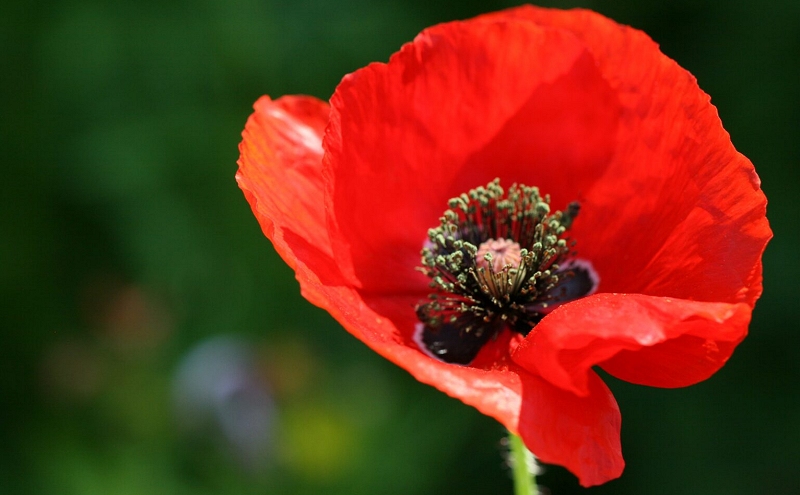
Photo of a Poppy flower, with large, scarlet petals and dark centre.
Poppy. Public domain (CC0) image by Travel Photographer, from negativespace.co

Edgar had already visited one home where relatives of John Evans lived (number 25), and now he called on another, number 40, where John’s uncle and aunt Samuel and Martha Evans lived. After that, he went to Harebutts Farm (number 38), home of the Casewell family. The Casewells’ servant, agricultural worker Alan Furnivall, had joined the Royal Flying Corps in 1917 and transferred to the RAF on its formation in 1918. Alan worked on aircraft rather than flying them, and he was discharged in 1920 with a record featuring a long list of civil convictions and prison sentences.


As he began to head back towards the Waters Upton village, Edgar the enumerator collected a final schedule from a Harebutt Bank household (The Harebutts, number 37, home of John Stanley Morgan and family). Then he continued along the road, past Lower House Farm, and turned left onto Catsbritch Lane.


On the right as he entered the lane was a dwelling divided into three, numbers 7, 6 and 5. These households were occupied by Elizabeth Matthews (at number 7), Frank and Annie Battman (at number 6), and William Beech with his wife Elizabeth and son Thomas (at number 5). Thomas Beech had been a Private with the Shropshire Yeomanry and then a Driver with Royal Field Artillery during the Great War, while his brother Henry Eddowes Beech (now living elsewhere) had emulated the latter part of his service.


Just a little further along Catsbritch Lane and on the same side of the road was a terrace of four houses where Waters Upton’s street numbers began: number 4 (Charles James and family), number 3 (Ernest Edward Austin and family), number 2 (Joshua Cartwright and family), and number 1 (Thomas Bennett and family). All but one of these (number 3) houses had connections with military service in the Great War. Of those three, two have already been mentioned: Charles James at number 4 (a brother of Thomas James at number 23, of John James and the late Williams James, and a brother-in-law of William’s widow Jane James at number 32), and Thomas Bennett at number 1 (a brother of Alfred, George and Charles Edward Bennett at number 17).

That leaves number 2 Waters Upton, the last household Edgar Davies would visit in which a family member had been lost during the war: Joshua and Priscilla Cartwright’s son John Thomas Cartwright was killed in action while fighting with the Cheshire Regiment during the Second Battle of the Somme on 27 March 1918.
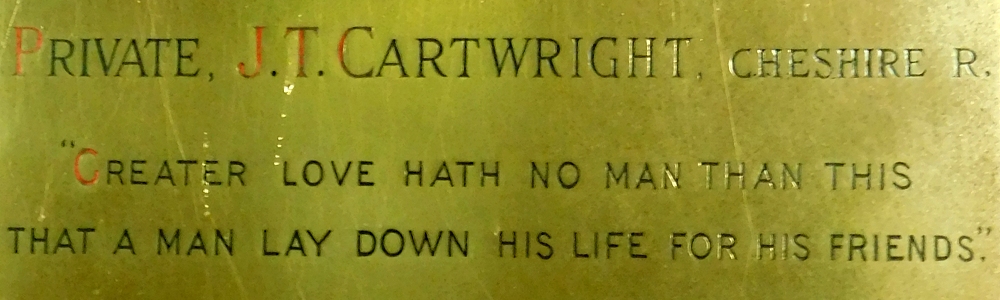
Photo showing the last name on a brass memorial plaque listing men of Waters Upton parish who died while serving in the Great War: Private J. T. Cartwright, Cheshire R. Beneath that name is inscribed: "Greater love hath no man than this, that a man lay down his life for his friends."

A little further along Catsbritch Lane, and set back from it on the other side, was The Grange Farm (number 41?). The head of this household was Ferdinand Heyne, a naturalised British Subject born in Germany. Ferdinand was a pork butcher in Shrewsbury from at least 1901 until 1913 (when he listed in that year’s Kelly’s Directory) and possibly a little later, but not in 1917. Had anti-German sentiment during the war pushed him out of the town and into the countryside?


The next house at which Edgar Davies stopped to collect a census schedule was number 48. I must admit that I’m not entirely clear about the numbering along Catsbritch Lane, but I suspect that number 48 was the cottage now known as Manor Lodge, which sits beside one of the entrances to Waters Upton Manor (which might be number 49). It was occupied by James Evans, his wife, and their children, one of whom was John Evans. John had enlisted with the RAF in July 1918, just 11 days after his 18th birthday and a little over three months before the war ended.


At the Manor itself – not that it was named (or numbered) on the schedule – was Arthur Lea Juckes. Arthur had a little military service to his name, in the form of a brief spell as a Lieutenant with the Surma Valley Light Horse in India, but that was in 1898. During the Great War he took on another role, chairing military tribunals at Wellington – and ruthlessly enforcing the rules under which men could be conscripted.


As he got closer to The Terrill, the end of our enumerator’s tour of Waters Upton was nearly over. He visited number 42 (farmer Richard Allen and his housekeeper – was this Melverley House or Linden Lea?) and then number 44 (Thomas Edward Harris and family; I’m guessing that number 43 – Grange Cottage? – was unoccupied).
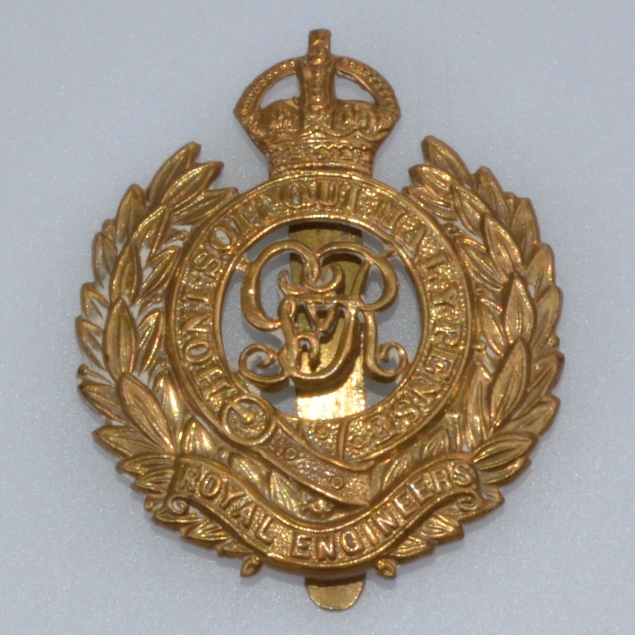

Photo of a Royal Engineers cap badge. It is bronze in colour. In the centre are the ornate initials G. R. (the King), surrounded by a belt with a barely legible inscription. Above that is a crown. A wreath extends from the bottom (where a banner bears the words Royal Engineers) and up both sides.
Royal Engineers cap badge. Public domain image from getarchive.net

Edgar Davies’ penultimate house call was to number 45, The Terrill Farm, occupied by septuagenarian farmer William Woolley, his wife Emma, two of their daughters, and three visiting relatives. Four of William’s sons had participated in the Great War: George Woolley (Yorkshire Regiment and Labour Corps), Robert Woolley (Canadian Royal Engineers), Frederick Woolley (Royal Engineers), and William Woolley (Royal Field Artillery).


Finally came number 46, a cottage just North of the Terrill Farm (number 47, a little further to the North, was most likely unoccupied). This was the home of widow Sarah Cartwright and two of her grandsons, one of whom was Geoffrey Henry Cartwright. It appears that Geoffrey first enlisted with the Black Watch (possibly before the war), then fought with the Worcester Regiment (when he was wounded at Gallipoli), and went on to serve with the Oxfordshire and Buckinghamshire Regiment and finally, post-war, with the King’s Shropshire Light Infantry (Territorial Army). He was the third resident of Waters Upton parish to declare himself as being out of work – all three were former servicemen.


Life went on in Waters Upton after the First World War, as it did elsewhere, but without those who paid the ultimate price to help deliver victory over the Central Powers, and with many who came home bearing physical injuries, mental scars, memories of battle which would never fade. Directly and indirectly, the lives of many of Waters Upton’s inhabitants were forever changed. More than a century later, we remember those who died, those who returned, and the families and communities they belonged to.


Picture credits: All photos by the author except where otherwise credited.
Waters Upton 1921: a post-war parish (part 1)

Taken two and a half years after the end of the Great War, the census of 1921 provides a picture of what life was like in that conflict’s aftermath. In this look at the parish of Waters Upton at the point when that census was taken, my main focus is on the households which were impacted by military service.

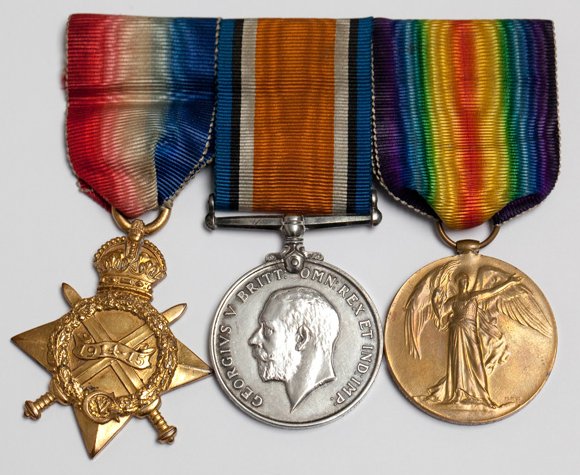
Photo of the three most commonly awarded medals of the First World War. From left to right: A 1914-15 Star (a four-pointed star of bright bronze, with crossed swords, surmounted with a crown; the ribbon has bands of red, white, and finally blue)); a British War Medal (a silver disc bearing an effigy of the head of King George V; the ribbon has a wide central orange band, on each side of which are narrow bands of white, then black, and finally blue); a UK Victory medal (a bronze disc, with the winged, full-length, full-front, figure of 'Victory,' or 'Victoria'; the ribbon has a central stripe of red, on each side of which are further stripes of yellow, then green, then blue, and finally purple).
Pip, Squeak and Wilfred. Photo credit: Europeana 1914-1918 project photo, taken from Wikimedia Commons ⇗ and adapted, used, and made available for reuse under a Creative Commons licence ⇗.

47 households in the parish of Waters Upton returned census schedules to the enumerator on the morning of Monday, 20 June 1921. In 15 of those households (a fraction under 32%) there were one or more occupants who had served with the armed forces during the Great War. Three of those households also had one or more occupants with immediate family members, by then dead or living elsewhere, who had served.

In another 13 (or 27.7%) of Waters Upton’s households which did not fall into the above category, there were one or more occupants with immediate family members (husband / son / father), by then dead or living elsewhere, who had served.

Taking these two categories together, at least 59.6% of Waters Upton’s households (28 out of 47) had occupants with direct or close connections to wartime military service – including five with immediate family members (seven men in total) who were killed during the war or died shortly afterwards. “At least”? Well, there was one more household which included someone who I suspect was an ex-serviceman. There may also have been others amongst those who came to village after the war. And it is quite possible that other households included occupants with immediate family members whose service I am not aware of. Further information boosting the total (and percentage) above may yet come my way.

Of the remaining 19 Waters Upton households, three had one or more occupants with more distant family members who served: a nephew, a first cousin, and a first cousin once removed. Another had an occupant who contributed to the war through involvement in military recruitment.

Enough of the numbers. Let’s meet the people and the families of Waters Upton whose lives were never quite the same after the first world war – and let’s do that by following the enumerator for the parish, Edgar Percy Davies, as he visited the homes of Waters Upton and collected the householders’ census schedules. This will provide us with brief introductions to the families of the parish in 1921, and to most of those individuals from the parish who served during the war. I hope to expand upon these introductions in future posts.


Edgar first called on the pubs and houses situated alongside the Wellington to Market Drayton road, starting with the southernmost, the Lion Inn (number 16 Waters Upton). Here, Lucy Price is our person of interest. She had two sons by her first husband, both born at Waters Upton, who had served during the war: Henry Wylde (King’s Liverpool Regiment and Labour Corps) and Albert Wylde (Royal Navy).


Next was number 23, home of widow Anne James and her adult children Thomas and Lizzie. Three of Anne’s sons had enlisted: John James (Royal Field Artillery), William James (The King’s Liverpool Regiment), and the aforementioned Thomas James (Shropshire Yeomanry). Sadly, William died on 17 November 1917 from wounds received while serving in France. Edgar Davies would later call at William’s former home, number 32, where his widow and sister-in-law were living; he would also visit the home of another James brother, Charles, at number 4.


Heading briefly up the main road running through the village took Edgar to number 22, another household with an ex-serviceman: John Picken was a Sapper with the Royal Engineers during the Great War.


Returning to the Wellington to Market Drayton road and crossing it took our enumerator to number 17, a house occupied by three former soldiers. Alfred Bennett had served with the King’s Shropshire Light Infantry, while his brothers George Bennett and Charles Edward Bennett had both been members of the Royal Army Service Corps. Edgar would later visit their brother Thomas Bennett (who had not served) at number 1 Waters Upton.

Photo showing three names on a brass plaque commemorating men from Waters Upton who served in and survived the Great War: Private Charles E. Bennett, R.A.S.C. M.T; Private William Bennett, R.A.S.C. M.T; Private Alfred Bennett, 8th K.S.L.I.

Back across the road to the Austin family at number 21 and then to number 24 next door, the abode of former Private (with the Oxfordshire and Buckinghamshire Light Infantry) Thomas Cartwright.


Next was number 20, also known as Sutherland Cottage. This was the home of Samuel and Mary Anne Woolley, two of their sons, and their only surviving daughter. Three sons were no longer at home, two of whom had been military men during the war: Robert Ernest Woolley was demobbed at a Sergeant in the Middlesex Regiment; Hubert Victor Woolley was still with Military Foot Police (and was enumerated at Cologne in Germany with the British Army of the Rhine).


After one final trip across the Wellington to Market Drayton road (to the Beeches, number 18) and back, Edgar Davies visited the last house in this part of Waters Upton village, the Swan Inn (number 19). Minnie Harper Owen was the innkeeper here, with her sister Emma Louisa Pierce providing domestic help. Emma was a widow, but not (as far as I can tell) a war widow. The sisters did have a connection to military service in the recent war however: their brother Charles Gordon Owen had been a Sergeant in the Royal Horse Artillery.


After he left the Swan, enumerator Davies headed up River Lane to the main road through the village, where he turned left and arrived at the Rectory (number 27). William Astbury Meakin, the rector, had not taken part in the war but his son, the Rev George Astbury Meakin, had briefly served with the Royal Army Medical Corps.


The next port of call was The Hall (number 28), home of Ernest James Fisk, who had ended the Great War as a Major in the Royal Field Artillery.


Photo showing two names on a brass plaque commemorating men from Waters Upton who died while serving in the Great War: Lieut. G. H. Davies, 3rd K. Shropshire L. I; 2nd Lieut. W. L. Davies, 7th K. Shrops. L. I.

Crossing the road and walking past the parish church took Edgar Davies to the White House (number 12). Of all the households in Waters Upton, I think it is fair to say that this one had contributed most to the war. This was the home of Susan Anslow Davies, widow of rector John Bayley Davies. Five of this couple’s sons had gone to war: Arthur John Davies (Royal Navy), Walter Llewelyn Davies (King’s Shropshire Light Infantry), Reginald Wynyard Davies (Royal Army Medical Corps), George Herbert Davies (King’s Shropshire Light Infantry), and Andrew Taylor Davies (Gurkha Rifles).

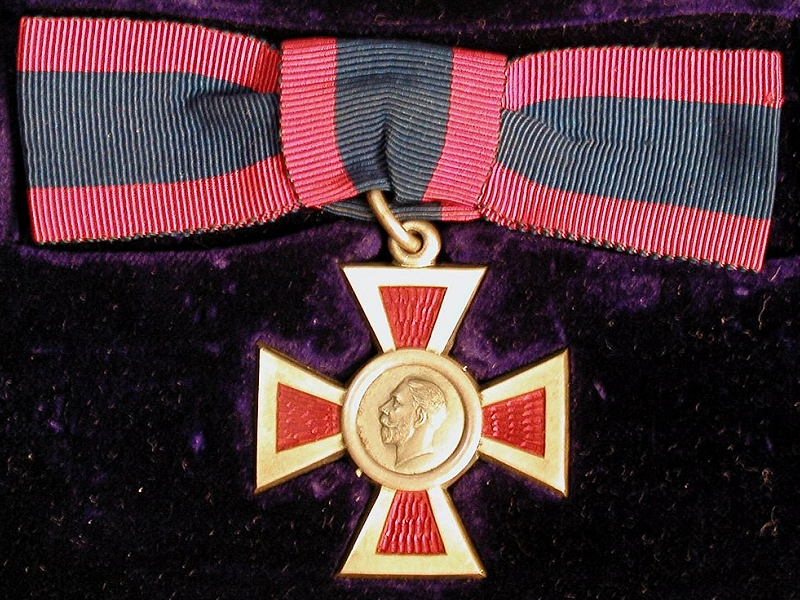
Two of the Davies brothers did not come home. George Herbert Davies was killed in action at Hooge on 9 (some sources say 10) August 1915; Walter Llewelyn Davies died of his wounds at the Somme on 15 July 1916. Annie May Davies, living at home with her mother, had served during the war too – she was awarded the Royal Red Cross Second Class in 1918 “in recognition of [her] valuable services with the British Forces in Mesopotamia” with Queen Alexandra’s Imperial Military Nursing Service Reserve.

Photo of a badge of the Royal Red Cross, Second Class. The badge is in the shape of a golden cross, with a circular medallion at its centre, bearing an effigy of the King's head. The ribbon, in the form of a bow, is dark blue (that colour appears black in this image) with crimson edge stripes.
Royal Red Cross Second Class. Image credit Auckland Museum, licence CC BY.

Crossing the road again took our enumerator to an abode which was not numbered on the schedule; it appears to have been in the vicinity of The Hall and might have been what is now either 29a or Groom’s Cottage. Another Woolley family lived here: John, Fanny, and their son George Woolley, a “Discharged Soldier” who had been working for Lady Mary Herbert but was now out of work. During the war George had been a Gunner with the Royal Field Artillery. His brother Thomas Woolley had served too, with the Army Service Corps; in 1915 he gave his father John’s address as “Oldhall Cottages” in Waters Upton.


The next residence visited was number 29, where Joseph Shakeshaft had one of the more distant connections with wartime military service: his first cousin Joseph Baxter Shakeshaft, born at Waters Upton in 1885, had toiled with the Labour Corps.


The Crescent (Crescent House, number 30) was Edgar’s next stop. Frederick Walter Godfrey Starling was probably a post-war resident of Waters Upton; he brought with him memories of being a Private with the Army Service Corps.


After he left The Crescent, enumerator Davies doubled back to visit the houses in the vicinity of the smithy – he could have saved himself some legwork by turning right when he entered the main street from River Lane. The village blacksmith was the first person called upon on this little detour: Charles John Ridgway lived at number 15, next to his workplace. Charles was another resident whose connections with those who had served during the war was more distant. That connection was with two of his first cousins once removed. They were sons of Charles’ first cousin Alfred Ridgway at number 8 Waters Upton, so I will mention them later.


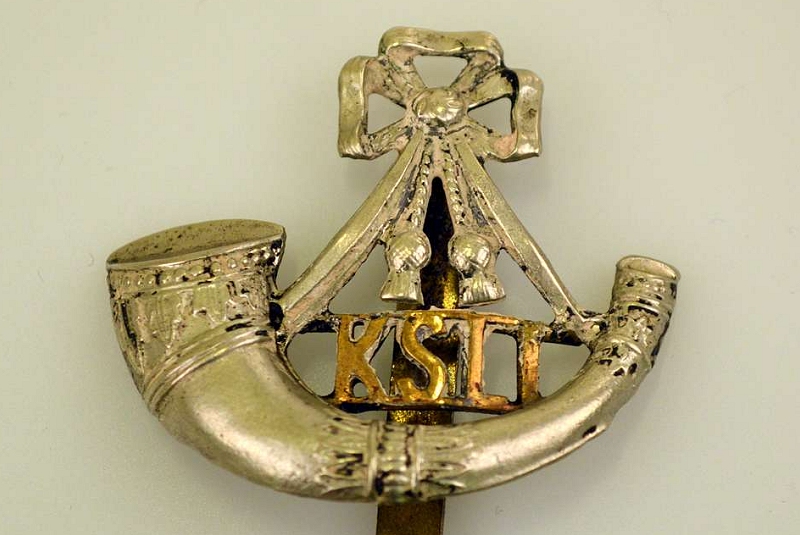
Photo of a King’s Shropshire Light Infantry cap badge (or, as my caption for the image original said, cap badger. The Imperial war Museum describes this as a "Bi-metal badge in the form of a stringed bugle-horn (in white metal) within the cords of which are, the brass letters 'KSLI' on bars."
King’s Shropshire Light Infantry cap badge. Public domain image from getarchive.net

Across the road to number 25, home of James Buckley and his family. James had enlisted with the King’s Shropshire Light Infantry in 1910 so he was already in the Army when the Great War began. His brother-in-law John Evans had also served – Edgar Davies would call at John’s home, and meet another of John’s relatives, later.


Continuing back along the village road and crossing it once more to our enumerator to numbers 14 and 13, both inhabited by former soldiers. At the first house was John Halford Ferrington, formerly of the Royal Engineers, and his family; next door at number 13 lived Hannah Cartwright with her niece Gertrude Tudor and nephew Ernest Samuel Tudor. Ernest was another ex-military man (Cheshire Regiment and Labour Corps) who was now unemployed.

The last of this group of houses near the smithy, on the other side of the road, was number 26, the home of war widow Edith Mabel Parry and her three children. Edith’s late husband Edward Lewis Parry, formerly Waters Upton’s grocer and sub-postmaster, was killed in action in Northern France on 30 September 1918 while fighting with the Lancashire Fusiliers.

Photo showing two names on a brass plaque commemorating men from Waters Upton who died while serving in the Great War: Private E. Parry, Lancashire Fus.

Picture credits: All photos by the author except where otherwise credited.

On to Part 2

Analysis: Kinship in the parish of Waters Upton in 1841 (Part 2)

⇐ Back to Part 1

On now to the second of the two extended groups of Waters Uptonians with kinship connections.

Titley, Atcherley, Wase, Dickin, Icke, Griffiths, Harper, Shakeshaft, and Gregory connections

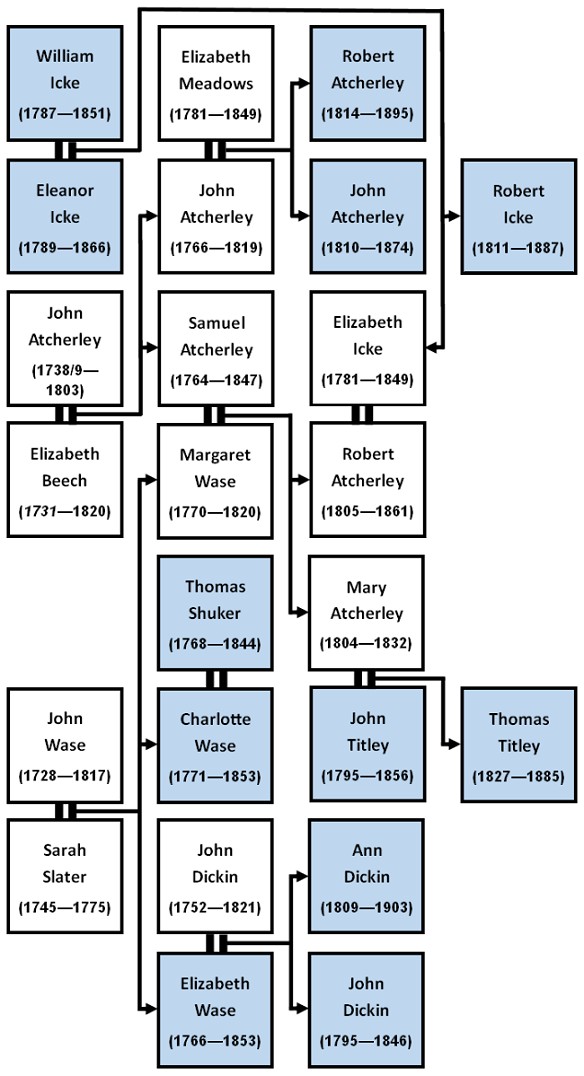
These are the relatives and others who were linked in one way or another to 14 year old Thomas Titley, living in household 27 in 1841 with his father John Titley (and a servant, Mary Griffiths, regarding whom I will say more shortly). The first sub-group of these people are those to whom Thomas was related (however remotely) through his late mother Mary Titley née Atcherley (who was also my 2x great grandmother).

A family tree diagram showing 24 people, all connected by blood and/or marriage, 12 of whom were living in Waters Upton when the 1841 census was taken. Further details are provided in the article.

Here we see these Waters Upton residents:

  • Mary Atcherley’s maternal aunt Charlotte Shuker (née Wase) in household 25 with her husband Thomas Shuker (who was of independent means) and a servant. Whether these Shukers were related to William, Alice and Thomas of household 26 I do not know, but what a coincidence if they weren’t!
  • Mary’s maternal aunt Elizabeth Dickin (née Wase), widow of John Dickin, in household 2 with her son and daughter John Dickin (a landowner and farmer with 7 servants, one of whom – John Pidgeon – appears later in this article) and Ann Dickin, neither of whom were married.
  • Mary’s first cousin John Atcherley, a tailor, the sole occupant of household 7.
  • Mary’s first cousin Robert Atcherley, an agricultural labourer, the only denizen of household 37.
  • The parents-in-law of Mary’s brother Robert Atcherley, William Icke and Eleanor (née Icke, almost certainly a relative of her husband) in household 41, a public house, with their son, Mary’s brother-in-law, Robert Icke, and three servants.

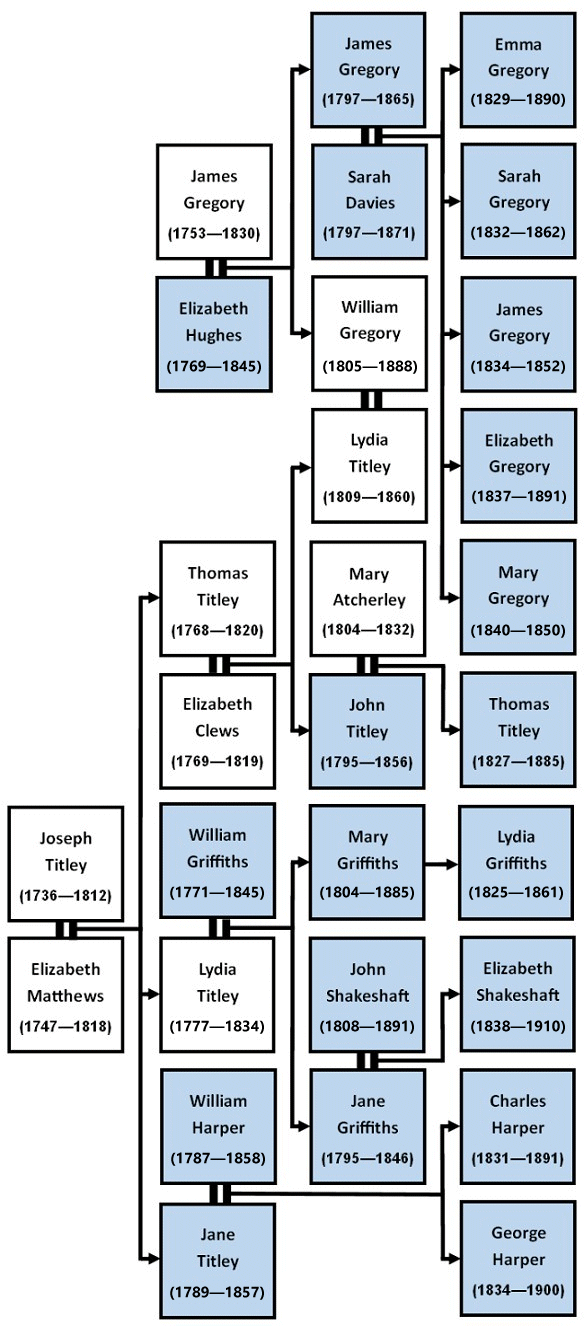
The second sub-group of Thomas Titley’s kin are those related to him through his father John.

A family tree diagram showing 29 people, all connected by blood and/or marriage, 20 of whom were living in Waters Upton when the 1841 census was taken. Further details are provided in the article.

In this, our final chart, the following are shown:

  • John Titley’s brother-in-law James Gregory in household 34, with his widowed mother Elizabeth Gregory née Hughes, wife Sarah (née Davies), and children Emma, Sarah, James, Elizabeth and Mary (plus servant Samuel Allen, who we will see again soon).
  • John’s paternal aunt Jane Harper née Titley in household 3, with husband William Harper and children Charles and George. I am not aware of any connection between these Harpers and those of household 8 (William, wife Martha, and children Elizabeth and Sarah).
  • John’s uncle William Griffiths, widower of John’s paternal aunt Lydia, in household 35 with granddaughter Lydia Titley (age 15), married daughter Jane Shakeshaft, son-in-law John Shakeshaft, and their daughter Elizabeth (plus a guest, Samuel Harrison, who does not appear to have been a relative). There was also one other person in this household, who was definitely a relative – I will return to her later!
  • In the Titley’s own home the aforementioned servant was John’s first cousin Mary Griffiths; a daughter of William Griffiths and (unmarried) mother of Lydia Griffiths.

That’s a group of 30 people spread across 9 households (2, 3, 7, 25, 27, 34, 35, 37 and 41) with varying degrees of kinship between them. And if the Elizabeth Matthews (1747–1818) who married Joseph Titley was related to the Sarah Matthews (1766–1815) who wed William Pascall (see Part 1 of this article), this group would link up with the first one. That’s an intriguing possibility as it would give us a single group of 65 people (out of a total of 226) across 19 household (out of 41)!

Update (Feb 2026): Further research has shown that Elizabeth Titley née Matthews (1747–1818) was related to Sarah Pascall née Matthews (1766–1815) – Sarah was Elizabeth’s niece. Her father William Matthews (baptised 1743 at Waters Upton) was one of Elizabeth’s brothers.

Less complex connections

Having looked at the more tangled trees, let’s move on to the less complicated cases of kinship within and across households. Mary Worrall for instance, a resident of household 24 with Joseph and Martha Wilks (or Wilkes), was that couple’s granddaughter through their daughter Elizabeth Wilkes (wife of James Worrall), who was not resident in the parish.

Elizabeth Pickin, wife of John Pickin in household 36, was the daughter of Thomas and Ann Felton, who lived close by in household 33.

As we have seen, some of the young servants of Waters Upton were children of families living in other households in the parish; two more examples follow. First, residing with farmer John Dickin in household 2, was teenager John Pidgeon whose family was living in household 19. The young Pidgeon had evidently flown the nest but settled not far away. Incidentally, William Cowley, part of the Pidgeon household in 1841, was the pre-marital son of William Pidgeon’s wife Martha, née Cowley.

Another servant of interest is 11-year-old Samuel Allen, who in 1841 was ensconced with tailor James Gregory and family in household 34. Despite his seemingly low status, Samuel appears to have been a member of the agricultural Allens who farmed in the neighbouring parish of Ercall Magna. Specifically, it looks like his parents were Samuel (a farmer at Cotwall in 1841 and a retailer of wines and spirits in 1851) and Emma. If this was the case, farmer Charles Allen in household 11 was, I believe, Samuel’s paternal uncle.

William Pritchard was, along with the Morris family, an occupant of household 38. He was a son of Ann Morris, formerly Pritchard, née Jackson, born between her marriages to Messrs Pritchard and Morris.

Another child born out of wedlock was two-year-old James Andrews, enumerated in household 31 with the Cureton family, was, not surprisingly, the son of Deborah Andrews, aged 25 or more, who was also a member of that household. Like his mum, James was born in Suffolk – but who was his father? Ladies and gentlemen of the jury, I call William Howard, living in household 41 with the Icke family. I’m going beyond the 1841 census with my evidence here, but what the heck: William Howard went on to marry Deborah Andrews, and by 1851 James Andrews had become James Howard. I put it you that on the balance of probabilities, William was the father of James.

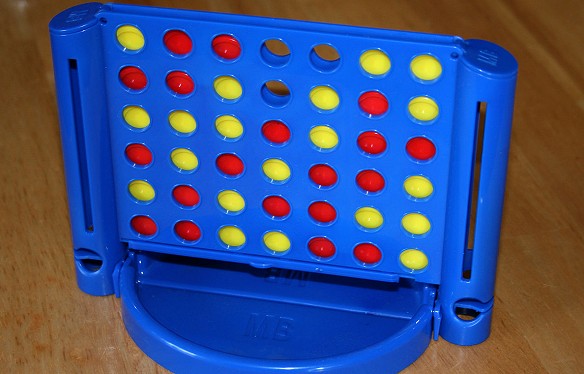
Colour photo of a 'Connect 4' game. It has a vertical 'game board' with 7 columns, into each of which up to 6 plastic discs can be dropped so that stack one above the other, each visible through a circular hole in the 'game board'. This board has discs, some red, and some yellow, occupying all but three of the available spaces. Neither the player using red discs, nor the player using yellow discs, has managed to win the game by getting four of their discs lined up in a horizontal, vertical or diagonal row.

Connected, or not?

There were several people enumerated on the 1841 census at Waters Upton whose surnames suggest the possibility of connections with others, which I have not yet been able to verify (or dismiss). The Harpers, the Lloyds and the Shukers I have already mentioned, but there were also the Williamses, some of whom coincidentally had a connection with the Lloyds who appeared at the end of Part 1 of this article. Was John Williams of household 23 related to Sarah Lloyd, formerly Edge, née Williams in household 12 or servants Charles Williams (in household 41) or Emma Williams (in household 28), or any of the latter to each other? The frequency with which the surname occurs makes the question less than straightforward to resolve, but in time I may have an answer.

Update (Feb 2026): Further research has connected some of those named above to The Waters Upton ‘Big Tree’. This is the case with the Harpers, and also John Williams and his family. In the case of the Harpers, their connection to the Big Tree came after 1841. In the case of John Williams and family however, all the links in the long chain of marriages and blood relationships were prior to 1841, so they were linked to many of their fellow parishioners at the time of that year’s census.

In conclusion

More than half of the households in Waters Upton at the time of the 1841 census had at least one occupant related in some way to one or more occupants of another household. This leaves the following households inhabited by people with no confirmed links to others in the parish: 1 (Corfield family and servants), 5 (Anslow family), 6 (Edwards family & guests), 8 (Browns and servant), 9 (Evans), 10 (Dodd family), 14 (Woodhouse family and guests), 15 (Davies family), 23 (Williams / Lloyd family), 24 (Wilkes family), 26 (Shuker family), 28 (Tudor family and guest), 30 (Moore family), 32 (Ridgway family), 38 (Morris family), 39 (Bennett family).

Update (Feb 2026): Further research has connected many of those named above to The Waters Upton ‘Big Tree’. This is the case with the Evans family (household schedule 9), the Dodd family (10), the Davies family (15), the Williams / Lloyd family (23), the Wilkes family (24), the Tudor family (28), the Ridgway family (32), the Morris family (38) and the Bennett family (39). Some of those links however may only have been established after the 1841 census was taken – I need to look into those connections in more detail.

Just one more thing …

… as TV detective Columbo ⇗ used to say. I said I would return to another person in the household of William Griffiths. She features in this genealogical version of Only Connect ⇗, but I left her off the relevant family tree chart. Her name was Elizabeth Griffiths and she was the daughter of teenager Lydia Griffiths, the granddaughter of Mary Griffiths (John Titley’s servant), and the great granddaughter of William. This made her a first cousin twice removed from John Titley and a second cousin once removed from John’s son Thomas Titley. But she also had another, closer relationship to the two Titleys – and therein lies a story which requires a separate article.

Second family tree chart updated (corrections, plus birth/death dates found by further research) Feb 2026.


Picture credits: Family tree charts by the author. Photo of Connect 4 game by Wikimedia Commons ⇗ contributor Popperipopp; modified, used and made available for re-use under a Creative Commons licence ⇗.

Analysis: Kinship in the parish of Waters Upton in 1841 (Part 1)

One element of the research I carried out for my two-part article Analysis: The 1841 census of Waters Upton was further work on my Waters Upton family tree at Ancestry. ‘Forest’ might actually be a better word than ‘tree’ in this situation however, given that what I have established is in fact a collection of numerous separate trees growing in one place. As I traced the roots of those trees more deeply however, some of them began to merge. Quite a few of those trees were not ‘separate’ after all.

Colour photo of part of a woodland. Almost all of the trees here were coppiced (cut down to the roots) a good few years ago, so that each one has multiple slim trunks rising from their bases.

In adding people to the Waters Upton ‘forest’ my primary goal was to link other records to them besides the census and so find information vital to establishing who they were – their identities. For example, where and when were they born? This is not always easy to establish even for those enumerated on the more detailed censuses of England and Wales taken from 1851 onwards, due in part to inaccuracies in the information supplied, recorded, and transcribed. In the case of the 1841 census we have different levels of vagueness to contend with too, particularly with regard to places of birth. In most cases however, I have overcome these problems in respect of the Waters Uptonians of 1841. As a result, my analysis of that year’s census includes the geographic origins of the parishioners.

Another key component of each individual’s identity is how they are related – through blood and/or marriage – to others. So for each person in my Waters Upton ‘forest’ an important task was to find and link them with their parents, any siblings and, where applicable, spouses and children. Again the limitations of the 1841 census adds to the workload here, as relationships between the ‘head’ of each household and other residents were not recorded, and neither was marital status. Thankfully in the course of my research other records have cleared up any doubts, in most cases but certainly not in all.

There remains a sizeable minority of people on the 1841 census of Waters Upton whose full identities are still unknown to me (because I have not so far managed to track them down in other records), some of whom might yet turn out to be related to one or more of their fellow parishioners. These include many of the young servants and also boarders / lodgers (particularly those with high-frequency surnames) who were living away from their immediate families.

In one case even the ‘head’ of a household (household 8) has eluded me: I have yet to discover who 40 (or so) year old farmer John Brown was, and I don’t know whether the younger Elizabeth Brown enumerated with him was his wife or his sister.

Confirmed – and complex – connections

Returning to the people whose identities and families I have established, as my work on them progressed a number of families became larger in size and/or multi-generational and/or connected to other families. Consequently some of those families were split between two or more households, and more and more distant and complex relationships between some of the people present in the parish in 1841 became apparent.

I’ll begin my exploration of all these links with the largest of two extensive groups of connected people, for whom I have prepared family tree charts to make their kinships clearer. In both cases I have picked one person as the centre of the ‘web’, and I have also split the groups down into two further sub-groups to make things a little easier.

Pascall, Matthews, Austin, Woolley and Lloyd connections

Mary Woolley, née Pascall, was enumerated in household 21 on the 1841 census of Waters Upton along with her husband Robert Woolley, her unmarried sister Sarah Pascall, and a servant (Emma Juckes, unrelated as far as I know).

It appears that Robert and Mary had no children, but there were lots of people in the parish to whom they were linked – by blood, marriage, and more tenuous connections. Here is the first sub-group of those people.

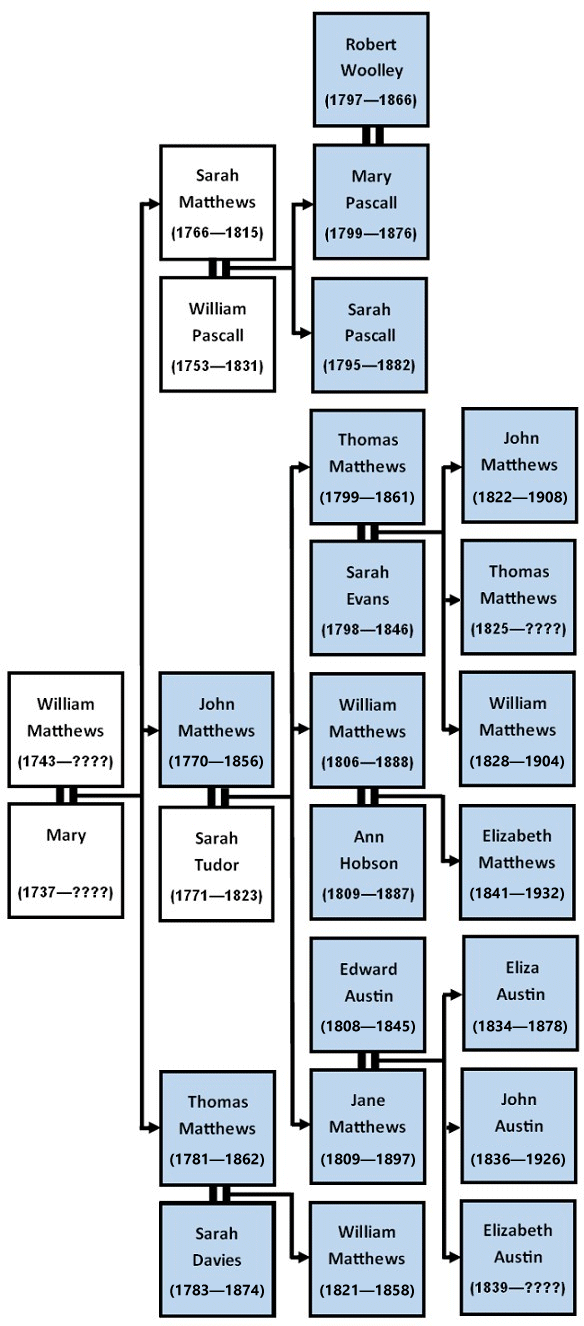
A family tree diagram showing 25 people, all connected by blood and/or marriage, 20 of whom were living in Waters Upton when the 1841 census was taken. Further details are provided in the article.

This family tree chart (like the others illustrating this article) does not include every member of the families shown, just those who were connected to Mary Woolley née Pascall (and to each other) who were residing in Waters Upton parish in 1841 (names in boxes with a blue background) plus the immediate ancestors from whom those relatives were descended. In addition to Mary, her husband and her sister we can see:

  • Mary Woolley’s maternal uncle John Matthews, sharing household 22 with his daughter (Mary’s first cousin) Jane Austin née Matthews, Jane’s husband Edward Austin, and that couple’s children Eliza, John and Elizabeth Austin.
  • John Matthew’s son Thomas Matthews in household 20 with his wife Sarah (née Evans) and their children John, Thomas and William.
  • John Matthew’s son William Matthews in household 16 with his wife Ann (née Hobson) and their infant daughter Elizabeth.
  • Mary Woolley’s maternal uncle Thomas Matthews in household 17 with his wife Sarah (née Davies) and their son William.

The second sub-group of people are connected to Mary Woolley – some quite loosely! – through her husband Robert.

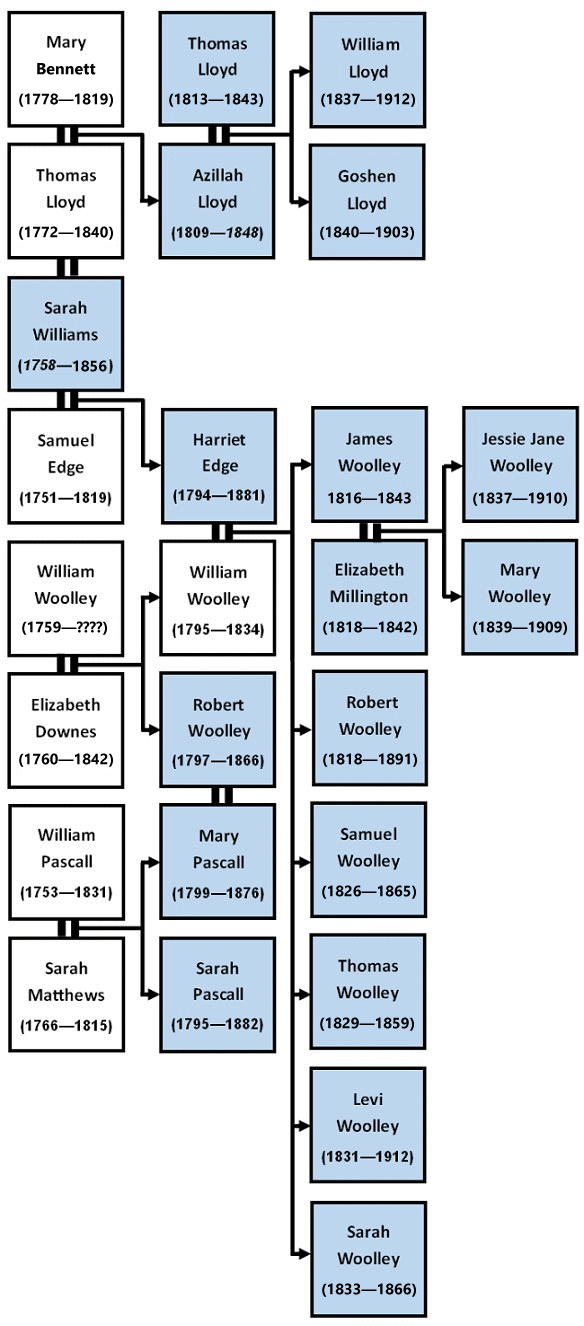
A family tree diagram showing 26 people, all connected by blood and/or marriage, 18 of whom were living in Waters Upton when the 1841 census was taken. Further details are provided in the article.

In this tree we have the following:

  • Mary Woolley’s sister-in-law Harriet Woolley (née Edge), widow of William Woolley, in household 40 with her children Robert, Thomas and Sarah.
  • Harriet Woolley’s 9 year old son Levi in household 11, where he was working for farmer Samuel Allen as a servant.
  • Harriet Woolley’s son Samuel (age 14) in household 13, another farmer’s servant who was employed by Thomas Whitfield.
  • Harriet Woolley’s son James in household 29, with his wife Elizabeth (née Millington) and their children Jessie Jane and Mary.
  • Harriet Woolley’s twice-widowed mother Sarah Lloyd, formerly Edge, née Williams in household 12 with her step-daughter Azillah Lloyd, Zillah’s husband Thomas Lloyd (who may or may not have been related), their children William and Goshen, plus two other Lloyds (Thomas and William, both in their 20s) whose relationship to the others I have yet to determine. Similarly, at this point I don’t know whether, or how, any of these Lloyds were connected to those with that surname in households 4 (Elizabeth, Joseph and Harriet), 23 (Joseph, Elizabeth and William, children of Ann Williams, formerly Lloyd, née Taylor) and 41 (Mary).

In total, that’s 35 people spread across 10 households (11, 12, 13, 16, 17, 20, 21, 22, 29 and 40) who had links to each other.

Family tree charts updated (with birth/death dates found by further research) Feb 2026.


Picture credits: Family tree charts by the author.

On to Part 2

Analysis: The 1841 census of Waters Upton (Part 2)

⇐ Back to Part 1

Employment

Work in Waters Upton: who was engaged in it, what types of employment were there, and – in the case of jobs ‘in service’ – who provided that work, in 1841? These are questions I set out to answer by analysing data from the census.

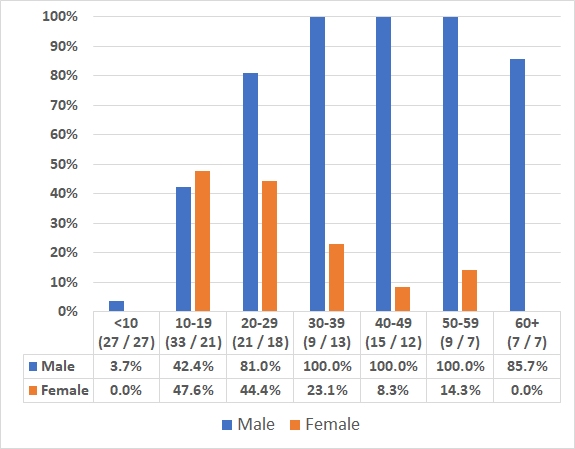
A twin bar chart based on data from the 1841 census of Waters Upton, showing the proportion of males and females recorded as being in employment, broken down into 10 year age groups. Further explanation in article.

Employment rates for those enumerated on the 1841 census at Waters Upton, broken down by age and sex.

It is readily apparent from the chart above that gender and age were major factors determining whether or not you were in employment – as recorded by the census – in early Victorian Waters Upton. You were highly unlikely to be working if aged under 10 whatever your gender – unless you were a 9-year-old boy named Levi Woolley, in which case you were employed as a servant by farmer Charles Allen.

In the age group 10-19, between 40 and 50% of both males and females were in work, with a slightly higher proportion of females (though this difference may not be statistically significant). From age 20 upwards there were sharp differences between the sexes in their rates of employment. 81% of men (17 out of 21) aged 20-29 and 100% of men aged 30+ were earning a crust in one way or another, with one Thomas Shuker (aged between 70 and 74, and of independent means) being the sole exception.

For women, rates of employment (employment in fields deemed worthy of inclusion on the census at any rate) began to fall once the age of 20 was reached. Not by much at first – from 47.6% (10 out of 21) in the age group 10-19, to 44.4% (8 out of 18) in the 20-29 range – but then down to 23.1% (3 out of 13) at 30-39 and less than 20% from 40 to 59. None of the 7 women aged 60 or more who were enumerated at Waters Upton in 1841 (2 of whom were, like Mr Shuker, of independent means) were employed.

Marriage and motherhood no doubt played a large part in the different rate of adult employment for women compared with men. You can bet your life however that many of those apparently unemployed women were working very hard indeed, and not just bringing up the children and carrying out ‘domestic duties’ or ‘household work’. With regard to the wives of farmers, for example, Joseph Plymley in his General View of the Agriculture of Shropshire (published 1813) quoted a Mr Price as saying:

[In] the farm-houses, there seems to be a greater exertion of industry than I have remarked in most other counties. Besides brewing, baking, providing for the family, where workmen are maintained in the house, and managing the dairy, the farmer’s wife, with the assistance of her maid-servants, in the evenings, at spare hours, carries on a little manufacture, and gets up a piece of linen cloth for sale, every year. [Page 123]

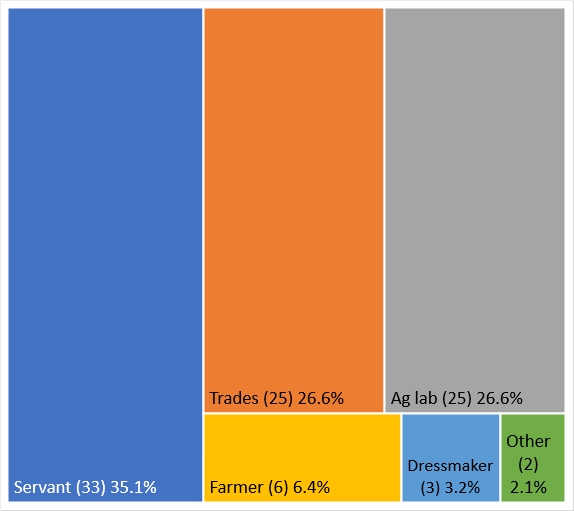
A chart, based on data from the 1841 census of Waters Upton, showing the number and proportion of those recorded as in work, in six categories of employment. Further explanation in article.

Types of employment in which those enumerated on the 1841 census at Waters Upton were engaged. The area of the chart taken up by each type equates to the percentage of those 94 people in employment who were engaged in them. With numbers and percentages shown for each type.

This chart provides a broad overview of the types of work in which the working population of Waters Upton (41.6% of the total) was engaged in 1841. Just over a third of all of those in work were servants, a type of employment I will explore in more detail shortly.

The next most ‘popular’ fields of employment were, each giving work to slightly more than a quarter of the working population, were the humble and ubiquitous agricultural labourer, and what I have called ‘trades’. Both of these areas of work were male-dominated, to the almost total exclusion of women – the only women working in either of them being Ann Morris, who like her husband William was recorded as an ‘Ag Lab’.

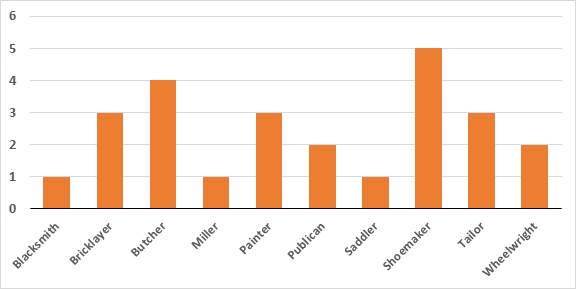
A bar chart, based on data from the 1841 census of Waters Upton, showing the number of people employed each type of employment in my category of 'trades' (blacksmith, bricklayer, butcher, miller, painter, publican, saddler, shoemaker, tailor, wheelwright). Further explanation in article.

A breakdown of the numbers engaged in the various occupations included in ‘trades’.

The trades, as I have termed them, included a variety of different occupations. The majority of these were skilled or semi-skilled and would earn their practitioners a place in the lists of trades people in the county directories which became increasingly popular during the Victorian era. Clustering these occupations together in this way certainly makes for a much less cluttered employment types chart!

6 men in Waters Upton were described as farmers on the 1841 census, a ‘field’ of employment (pun intended) very much limited by the small size of the parish. The remaining workers were 3 dressmakers (all female, ages given as 15, 20 and 35), a schoolmistress (the widowed Harriet Woolley), and the parish clergyman William Corfield (who could in fact be considered as a farmer, as his position brought with it some 35 acres of farmland for his use).

Servants

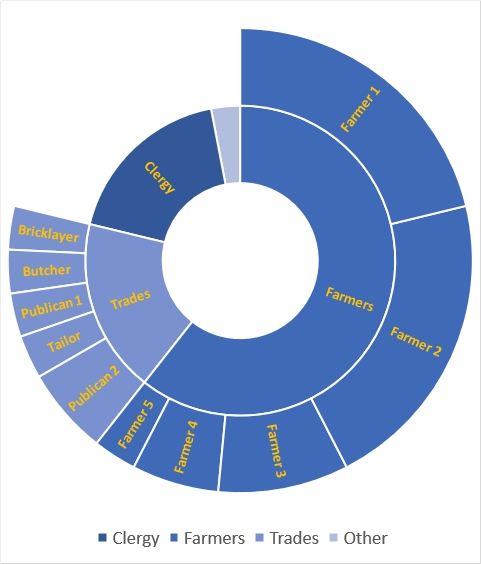
A ring chart, based on data from the 1841 census of Waters Upton, showing the proportion of servants employed by people in four categories of employer (farmers, trades, clergy, and other). Further explanation in article.

Employers of the servants enumerated on the 1841 census of Waters Upton. Each of the smallest segments on the outer ring represents one servant employed by an employer, with the larger segments in proportion.

I said I would return to the servants, and here we see who employed them. The majority worked for the parish’s farmers, those identified as farmers 1 through to 5 being: John Dickin (7 servants), Thomas Whitfield (also 7), Thomas Matthews (3), Charles Allen (2, including the above-mentioned Levi Woolley), and John Brown (1 servant) respectively. Honorary farmer William Corfield, the Rector, employed 6 servants, who were probably divided between domestic and farming services. A further 6 servants were in the employ of 5 of the parishioners who were engaged in trades, including both publicans. Finally, in the inevitable ‘Other’ category, man of (independent) means Thomas Shuker employed 14-year-old Staffordshire-born Mary Pritchard to assist in the household he occupied with his wife Charlotte.

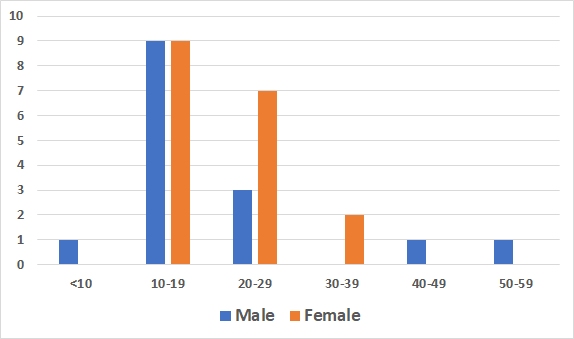
A twin bar chart, based on data from the 1841 census of Waters Upton, showing the number of males and females in 10 year age groups (under 10 to 50 - 59) employed as servants. Further explanation in article.

Numbers of servants on the 1841 census at Waters Upton, broken down by age and sex.

Finally in this section, a closer look at servants which provides information of some relevance to the employment rates (for females in particular) in the age groups of 10-19 and 20-29, and also to migration in those age groups.

All but 5 of Waters Upton’s servants in 1841 fell into the 20 year age range of 10-29. Of the 10 females aged 10-19 who were employed – none of whom were born in the parish – 9 were servants, and all but 1 of the 8 women in the 20-29 age group – only 1 of whom was born in the parish – were also servants.

The situation for males was rather different, with 9 out of 14 working 10-19-year-olds employed as servants (5 of the 14, of whom 2 were servants, were born in the parish), and only 3 of 17 working 20-29-year-olds (6 of the 17, only 1 of whom was a servant, were born in the parish).

All of which leads us quite neatly on to…

1841 to ’51 – who were the ‘remainers’?

(Maybe I should have given this section a more scientific-sounding title like ‘Residential fidelity’?)

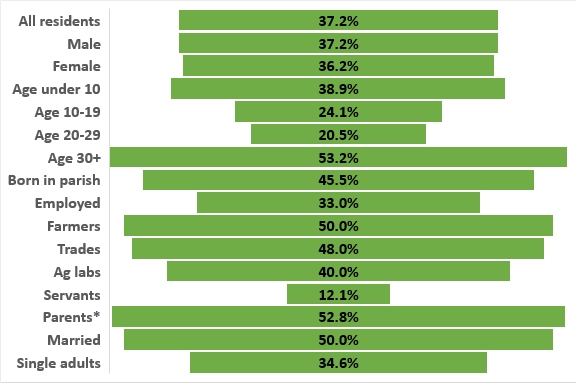
A chart, based on data from the 1841 and 1851 censuses of Waters Upton, showing the percentage of people in each of 16 categories who were enumerated in the parish in both 1841 and 1851. Further explanation in article.

Percentages of various categories of people enumerated on the 1841 census at Waters Upton, who were also enumerated in the parish on the 1851 census. ‘Parents’ I defined as those who, whether married or single, had children aged under 20 at home with them.

As my 1841 census abstract includes links to the 1851 abstract for those who were also present at Waters Upton on the latter census, it was an easy task for me to identify the ‘remainers’ (or in some cases perhaps, to borrow an expression from family historian John Titford ⇗, the ‘bounce-backers’) and add that information to my 1841 census spreadsheet. And then to analyse the data to see if there were any factors which made people enumerated in 1841 more or less likely than on average to remain, or return…

As you can see, the average percentage of all residents of 1841 who were also present in 1851 was 37.2%. Of the 15 categories of people from 1841 which I looked at, there were several for which there was no significant difference from that overall rate of ‘remaining’. These were: sex (male or female), age under 10 in 1841 (only a slightly higher likelihood of remaining), working as an agricultural labourer in 1841 (just slightly more likely to remain), employed (regardless of employment type) in 1841 and single adult in 1841 (both of the latter giving a slightly lower likelihood of remaining).

Natives of Waters Upton who were present in the parish in 1841 were rather more likely to remain (6% more than the average), while those who were married, or parents, were significantly more likely to enumerated there again in 1851 (many people in the former group would also have fallen into the latter). The ‘remain rate’ for these categories (50% and 52.8%) was very similar to that for the 30+ age group (see next) – a category with which there was likely to have been a fair degree of overlap.

Those aged 30+ in 1841 were significantly more likely to stay (53.2% in this category remained), perhaps because many of them had by that age established strong ‘roots’ – such as ties of kinship and/or security of employment – in the community. I have not divided this category further in the chart above because I found very little difference between the various 10-year age groups within it.

Those aged from 10 to 29 in 1841 on the other hand were significantly less likely to remain, with 20-29-year-olds showing even less attachment than the 10-19-year-olds. People in both of these groups were, I suspect, more likely to leave to take up work elsewhere and, particularly in the 20-29 age group, to join marriage partners and raise a family in a location which could accommodate them.

Regarding work, we have already seen that being employed in itself made a person less (but not significantly less) likely to remain, while being an ‘ag lab’ only very slightly raised a person’s chances of staying. Employment in certain other categories did however make a significant difference, with those engaged in trades much more likely to remain. The same goes for farmers, although with only 6 of them in the parish that conclusion can only be accepted with caution (if just one more had left, their remain-rate would have dropped to 33.3%).

Of all the categories I have examined, servants were the least likely to stay in the parish – just 12.1% of those enumerated in 1841 were still in Waters Upton (as servants or otherwise) ten years later!

Analysis: The 1841 census of Waters Upton (Part 1)

The census is not just for genealogy and family history, it’s for local history too – including the specialised form of local history known as one-place studies. In the UK, a decennial national census began in 1801. The information recorded was rather limited in the first few decades (that is, up to 1831). Furthermore, with relatively few exceptions, the enumerators’ schedules from those censuses have not survived and we are left with collated summaries of the data collected.

The census of 1841 was the first which aimed to record every person, by name, in every household (along with their age, sex, occupation and – to a limited extent – their place of birth). It is also the earliest census for which the enumerators’ schedules have been retained. The information it recorded – as you will see in my 1841 census abstract – was not as detailed as in the censuses which followed, but genealogical research can add much of what was missed. Having carried out that research, and having analysed it with the aid of a trusty Excel spreadsheet, I now present what I have learned about the community of Waters Upton at the first census of the Victorian era.

Population

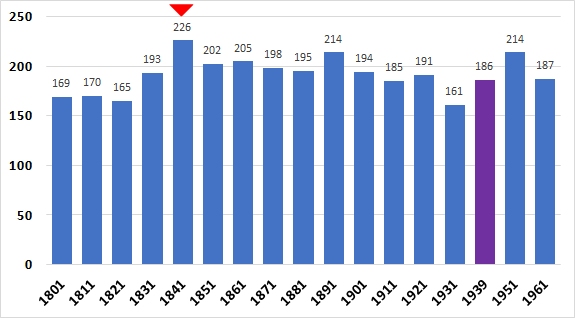
A bar chart showing the population of the parish of Waters Upton as recorded by the decennial census from 1801 to 1961. Further explanation in article.

The population of Waters Upton parish as recorded in the national census of England and Wales at 10-yearly intervals from 1801 to 1961 (with the 1939 National Identity Register filling in for the cancelled census of 1941). Based on official figures taken from A Vision of Britain Through Time ⇗, with the exception of those for 1841 (adjusted by me, see below), 1861 and 1871 (my own figures as they are not given by the aforementioned source), and 1939 (derived by me from the National Identity Register).

As you can see, the population of Waters Upton in 1841 (even though I have lowered it by 2 from the official figure of 228) is the highest recorded in the 160 year period from 1801 to 1961. Hopefully when I analyse later censuses, this will shed some light on why that was – a random ‘baby boom’ in the 1830s?

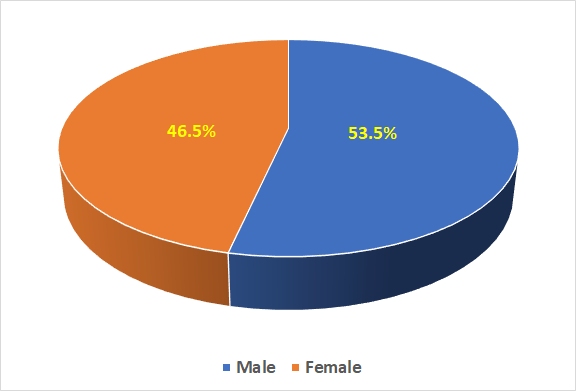
A pie chart showing the proportion of males and females enumerated in the 1841 census of Waters Upton: males 46.5%, females 53.5%.

The proportion of males and females in Waters Upton in 1841. Of the 226 people enumerated in Waters Upton in 1841, 121 (53.5%) were male and 105 (46.5%) were female.

The bias towards males shown here is in contrast to the national figures: females have predominated in all census years (in 1841 the census of England and Wales showed a national split of 48.85% males and 51.15% females). Was this contrast the result of Waters Upton being a rural parish, with greater employment opportunities for men? Or was it perhaps an artefact resulting from a random fluctuation in a very small population unit? Perhaps it was a little of both. In Shropshire as a whole the male/female split in 1841 was almost equal (49.9% males / 50.1% females), while in Ercall Magna (Waters Upton’s larger, but still rural, neighbour) it was 50.9%/49.1% and in Shrewsbury St Chad (predominantly urban) it was 45.2%/54.8%. (Percentages based on figures from A Vision of Britain Through Time – Male and Female totals for England and Wales, Shropshire, Ercall Magna, Shrewsbury St Chad ⇗).

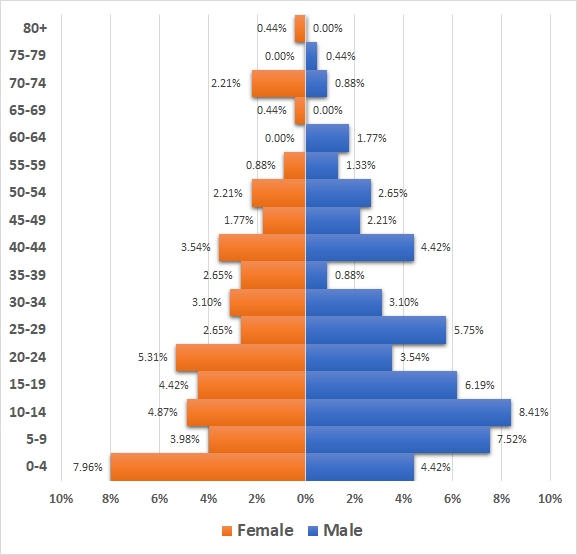
A population (or age-sex) pyramid chart based on 1841 census data for Waters Upton. It shows the proportion of males and females in each 5-year age group from 0-4 (at the bottom) to 80+ (at the top) The resulting chart does not actually bear much resemblance to a pyramid. Further explanation in article.

A population pyramid (or age-sex pyramid) diagram showing the population of Waters Upton in 1841 split by age and sex. Yes, I know it’s usual to display the males on the left!

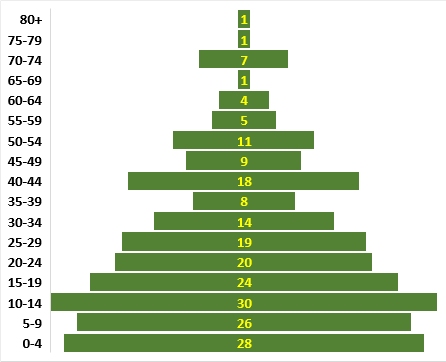
Dividing a population of just 226 people into a chart with 34 categories (17 age groups split into male and female) has made a rather ragged Christmas tree instead of a pyramid! But as a friend and former work colleague of mine would say, it is what it is. Reducing the number of categories should smooth things out a little, so here is a funnel chart displaying the age categories alone (with a dark green colour to ensure the Christmas tree effect is not entirely lost):

A variation on the population (or age-sex) pyramid chart - a funnel chart - based on 1841 census data for Waters Upton. It shows the total number of people in each 5-year age group from 0-4 (at the bottom) to 80+ (at the top). Further explanation in article.

Apart from some obvious fluctuations from the broad trend, the chart has a wide base and narrow top. This is indicative of a population with high birth and death rates (according to The Data Visualisation Catalogue ⇗), which was probably the case at the beginning of the Victorian era generally and not just in Waters Upton.

Of course, population size and structure in any given area is affected not just by birth and death rates, but also by rates of immigration and emigration. These factors – especially emigration – would certainly have been at play in Waters Upton, a small, rural parish with very limited scope to support an increased population.

Immigration

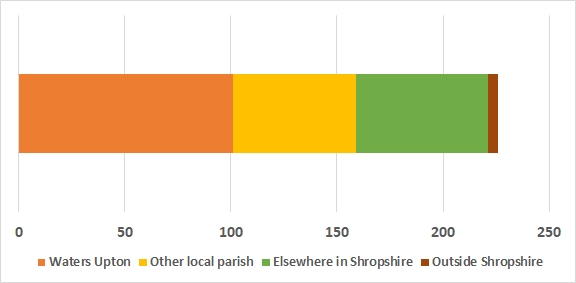
A single horizontal bar chart based on my research into the people enumerated at Waters Upton on the 1841 census, showing their geographic origins. Further explanation in article.

The geographic origins of the people enumerated on the 1841 census at Waters Upton. This not an analysis which can be performed by reference to that year’s census alone, as it only recorded whether or not people were born in the county in which they were then living (or, if born outside of England and Wales: Scotland, Ireland, or ‘Foreign Parts’). However through genealogical research I have established with reasonable certainty the birthplaces (to at least parish level) of 179 of the 226 people enumerated at Waters Upton. Identification of those born in the parish, by reference to baptism records, was relatively easy but some may have been missed. ‘Other local parishes’ are those within a radius of about 7 miles (or thereabouts) from Waters Upton: Hodnet, Stoke on Tern, Great Bolas, Childs Ercall, Hinstock, Chetwynd, Edgmond, Longford, Lilleshall, Kinnersley, Preston, Eyton, Wombridge, Wellington, Wrockwardine, Longden on Tern, Withington, Rodington, Ercall Magna, Shawbury and Stanton on Hine Heath. It is likely that a fair proportion of those whose births I have assigned to ‘elsewhere in Shropshire’ were in fact born in one of the ‘other local parishes’ just listed.

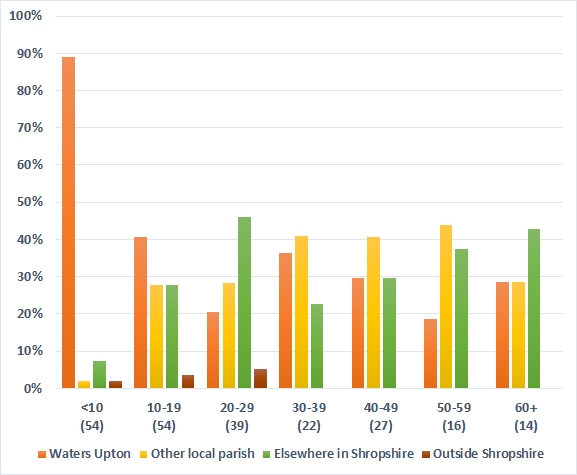
As you can see, in 1841 close to half of the people enumerated in Waters Upton were born in the parish. This does not necessarily mean that they had lived all their lives in the parish up to that point, but I suspect many (especially the younger ones) would have done. The rest came almost exclusively from elsewhere in Shropshire, with about half of them (in reality, probably at least two thirds) from the local parishes listed above. This indicates both immigration to and emigration from the parish, with incomers originating from the local area or further afield within Shropshire. Just 5 people were born outside of the county: 1 from neighbouring Staffordshire, 3 from Suffolk (there’s a story there!), and 1 from an extra-Salopian county which I have not been able to pin down.

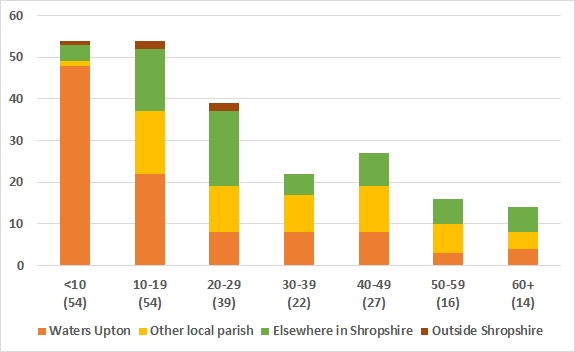
A bar chart based on my research into the people enumerated at Waters Upton on the 1841 census, by age group, showing their geographic origins. Further explanation in article.

Two charts showing the geographic origins of the people enumerated on the 1841 census at Waters Upton, broken down by age group. Notes for the first chart in this section apply. The first chart shows actual numbers in each age group, the second shows percentages.

In a small parish unable to accommodate a growing population you would expect that, all things being equal, the chances of any given individual moving away will increase as they get older (not to mention the chances of them dying). A higher proportion of natives within the younger element of the population rather than within the ‘oldies’ is therefore not a surprise – but the actual extent of this within the under-10s (88.9% of whom were born in the parish) I find somewhat staggering! The dramatic drop to 40.7% for those aged from 10 to 19 is also quite striking. For older age groups although the proportion of natives fluctuates, the actual number in the 20-29, 30-39 and 40-49 groups is equal (8 for each group). Clearly, all things were not equal when it came to the chances of someone leaving the parish!

On to Part 2