A Man Found: Thomas Plant, of the Parish of Waters Upton

⇐ Back to Part 1 (A Man Missing)

It appears that Thomas Plant of Waters Upton originated from Mucklestone, a parish which back then included parts of both Shropshire and Staffordshire. The baptism of “Tho: Plant Son of John Plant & Eliz: his wife” took place on 18 September 1726 ⇗ (making Thomas just under 50 rather than “upwards of” that age at the beginning of 1776). Then, on 4 September 1750 ⇗ and also in Mucklestone, the wedding of “Thomas Plant & Ann Thomas both of this Parish by Banns” took place.
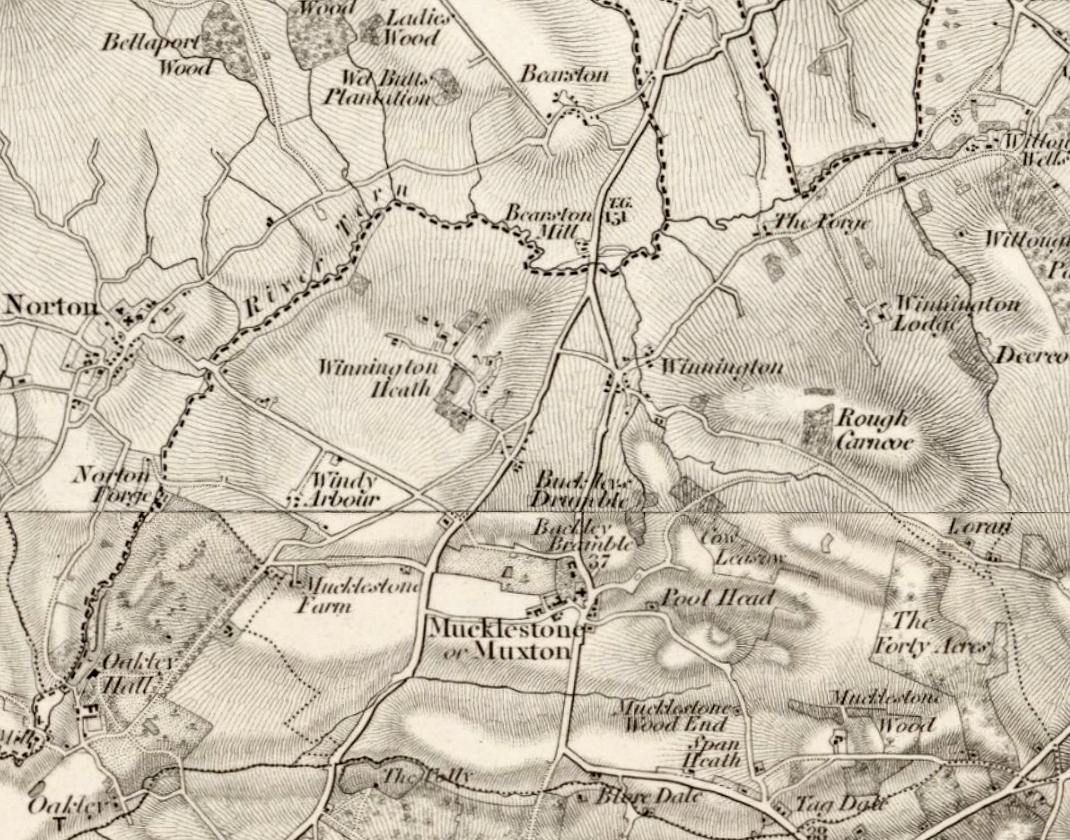
Image created from two map extracts, showing "Mucklestone or Muxton" and nearby settlements and features including Oakley Hall, Winnington, Norton, the River Tern, Bellaport Wood, and Mucklestone Wood.
Mucklestone and nearby settlements, as mapped in the 1800s. Image created from two maps, reproduced with the permission of the National Library of Scotland ⇗ under a Creative Commons licence ⇗.Click on the image to view a larger version.

The Thomas Plant who was baptised in 1726 would have been 23 or maybe 24 years old when the above marriage took place, so I think the chances are good that he was the groom. What, though, are the odds that he was also the Thomas Plant who, with wife Ann, had children at Waters Upton a few years later and, later still, went a-wandering just before the snowfall of the century?

Another question: there was a gap of about five years between the marriage of Thomas Plant and Ann Thomas in 1750, and the first baptism of a child of Thomas and Ann Plant at Waters Upton in 1755 – were there any children born in that gap who might belong to this family?

In my attempt to answer the second question, I turned to Findmypast. This website has excellent collections of digitised and indexed parish registers from both Shropshire and Staffordshire (although oddly, while there are images of the register containing Thomas Plant’s baptism, that register has not been indexed). In addition, they have a very useful way for subscribers to search for vital events from across their record sets. This allows us to look for events falling within a range of distances from a particular place.

“Daughter[s] of Thomas & Ann Plant of Chetwyn Parish”

After using this search functionality I found myself focussing on two of the baptisms it revealed, both falling in the period from 1750 to 1755, and both at Hinstock (about seven miles away from Mucklestone, as the crow flies). First, on 6 Aug 1751 ⇗, there was Mary. Then, on 20 May 1753 ⇗, there was Elizabeth. Each of these girls was described in the parish register as being a “Daughter of Thomas & Ann Plant of Chetwyn Parish”.

For ‘Chetwyn,’ by the way, read Chetwynd: the Plant family had probably, erm, planted themselves somewhere in the north of that parish, such as Sambrook. At that time Hinstock’s church would have been closer than the one in Chetwynd village (Sambrook St Luke ⇗, shown on the map below, was not built until 1856).

Depending on exactly where in the northern part of Chetwynd parish the Plants were living, the distance by road from their abode to Waters Upton might have been somewhere between six and eight miles, or thereabouts. Did the Plant family of Chetwynd travel those roads and become the Plant family of Waters Upton? After researching their children, I believe they did.

Extract from an Ordnance Survey map showing the villages of Hinstock, Sambrook and Pickstock, along with other smaller settlements, roads, the River Meese, and areas of heathland including Ercall Heath and Chetwynd Heath.
Hinstock and parts of the neighbouring parishes of Childs Ercall and Chetwynd, as mapped in the late 1800s. Map reproduced with the permission of the National Library of Scotland ⇗ under a Creative Commons licence ⇗. Click on the image to view a larger version.

My attempts to find out what happened to the Plant children have met with mixed results. The fate of Thomas Plant junior was all too easy to determine. Turn over a leaf of the Waters Upton parish register, from the pages showing his baptism in 1759, and you find the burial of the same “Thomas Plant the Son of Thomas and Ann Plant”. He was laid to rest on 11 August 1761, his second birthday having been his last. As for the sisters of this unfortunate boy, I’ll look at them in order, from the youngest to the eldest.

Margaret Plant was baptised in the month following her brother Thomas’s burial. It appears that she may have married in her home parish – at the age of 42. Banns of marriage between “Thomas Groom of the Parish of Bolas, Bachelor, & Margaret Plant of this Parish, Spinster” were published on three successive Sundays, May 1, 8 and 15, prior to the nuptials at Waters Upton on Monday 16 May 1803.

I have looked for baptism records for any children who may have been born of this union, in case the bride was another, younger Margaret Plant, but have found none.  Neither, sadly, have I found death or burial records that I can link with any certainty to Thomas or Margaret, confirming their ages.

Even more speculative are my conclusions regarding Martha Plant. She may have married Edward Podmore at Chetwynd on 29 December 1781 ⇗. If she did, she might have ended her days in that parish: Martha Podmore of Chetwynd End, age 70, was buried at Chetwynd on 6 December 1824 ⇗.

“Elisabeth, the base-born Daughter of Ann Plant”

For Ann, there is another entry in the Waters Upton parish register besides her baptism which almost certainly relates to her – and to her daughter. On 7 March 1776 “Elisabeth, the base-born Daughter of Ann Plant by Edward Jones of Kidderminster” was baptised.

I am not at all certain what happened to baby Elizabeth, although I hope she survived, thrived, and was supported financially by the man who fathered her out of wedlock. I don’t think Ann married Edward Jones. She may have been the Ann Plant who wed a man whose name has been transcribed as John Esbury, at Stoke Upon Tern on 23 June 1778 ⇗.

Further guesswork is all that I can offer in the case of Ann’s sister Elizabeth Plant. She was possibly the bride of Thomas Talbot, in a marriage solemnised at Church Aston on 28 December 1776 ⇗. She might then have been the widowed Elizabeth Talbot of Chetwynd Heath who was buried 6 April 1783 ⇗ at Chetwynd.

For the firstborn child of Thomas and Ann Plant I believe I can offer greater certainty. Following the publication on 20 and 27 November and 4 December 1774 of Banns between “Thomas Cartledge and Mary Plant both of this Parish”, that couple were married at Waters Upton shortly afterwards on 15 December. Both parties made their marks rather than signing the register. One of the witnesses who likewise made her mark was Ann Plant, who was likely to have been either the mother or the younger sister of the bride.

Mary, you might remember, was one of the two Plant girls baptised at Hinstock. This marriage, I think, confirms her (and her sister Elizabeth) as part of the Plant family of Waters Upton. In which parish Thomas and Mary Cartledge remained after their wedding. Five children, Sarah, Mary, John, Elizabeth and Thomas, were born to this couple, all baptised in the church of St Michael in the latter half of the 1770s and the early 1780s, the surname in each case written as Cartlidge.

“Thos. Plant a Pauper”
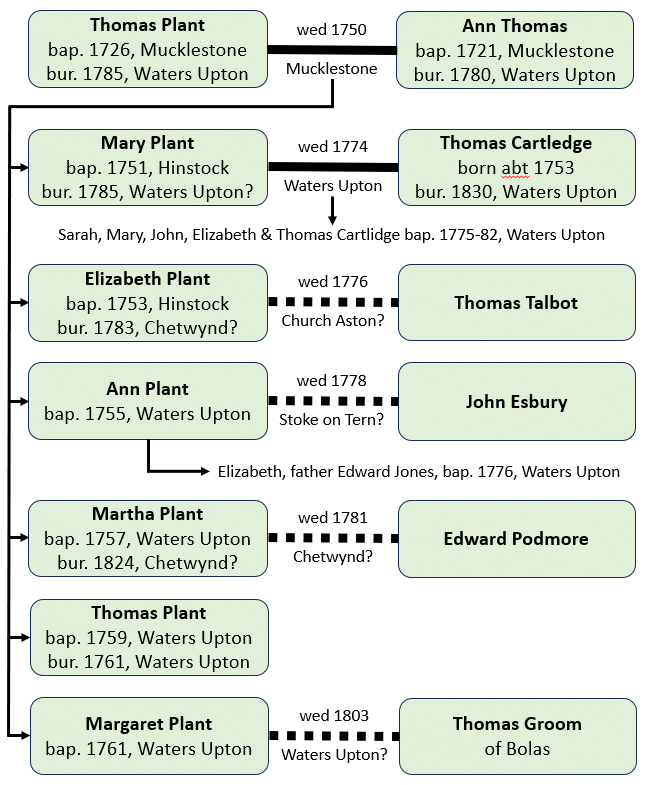
A diagram showing the family of Thomas Plant (1726 - 1785) and Ann Thomas (1721 - 1780), with the marriages and spouses (many speculative) of their children, as described in the text of this blog post.

Let’s return to the parents of these children, Thomas and Ann. There are burials for both of them in the Waters Upton register. “Ann, the Wife of Thomas Plant, aged 62” was interred on 9 May 1780. Despite the slight age discrepancy, I think that makes her “Ann ye daughter of John Thomas of [probably Napley – part of the page is missing] Laborour”, baptised 30 January 1720/21 ⇗ at Muckleton.

Notice that the register entry for Ann’s burial refers to her as the wife, not the widow, of Thomas Plant. Thomas did survive the spectacular snowfall of January 1766, and at some point he did return to Waters Upton. His burial, on 27 December 1785, was entered in the parish register as “Thos. Plant a Pauper, aged”. Possibly the clerk meant that Thomas was aged as in old, but more likely I think is that Thomas’s age was never ascertained and the register entry was left incomplete.

Wait though – Thomas, a farmer in 1776, was a pauper at the time of his death? This is entirely possible. He may have been what we would now call a smallholder, renting and cultivating (and/or grazing livestock on) a  relatively small acreage. And he may have suffered a setback, in the form of crop failure, diseased livestock, or personal ill-health for example, which left him unable to keep the farm and support himself in his later years.

Perhaps Thomas’s trip to Staffordshire (or wherever he actually went!), followed by his failure to return home for a couple of months or more, was the first sign that things were not well with him, with his farm, or with his finances. In which case, a cynic might take the view that Thomas’s ‘afflicted friends’ were actually creditors trying to track down the man who owed them money.

I prefer to believe that Thomas had friends who genuinely cared about him. Friends within his local community who were so concerned by his disappearance in the dreadful winter weather of January 1776, that they were prepared to pay for notices in newspapers in the hope of finding him alive and reuniting him with his family. Thomas Plant, the blue-suited ‘stout made man’ of Waters Upton, may have ended his days financially impoverished, but well off in that priceless commodity known as friendship.
A puzzling postcard from Waters Upton

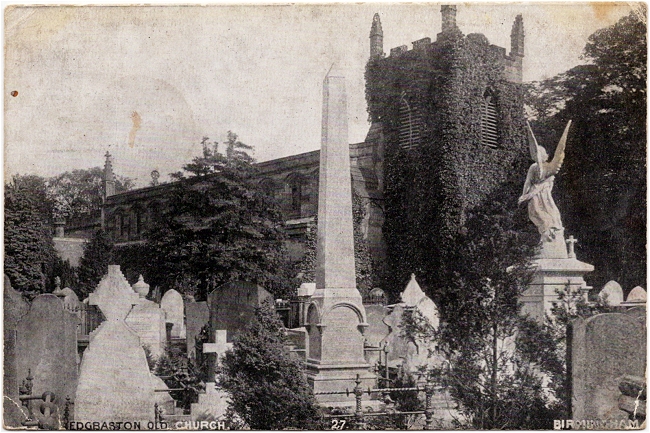
A little while ago I bought a postcard which bears a Waters Upton postmark. It does not add to my limited collection of village views – the scene on the rather grubby front of the card depicts Edgbaston Old Church, Birmingham. But it was probably posted by someone living in Waters Upton, or at least close enough for their mail to be franked there, someone named Elizabeth. Who was she?

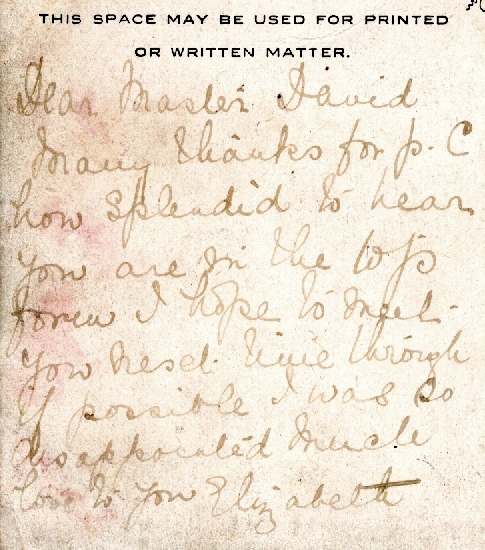
“Dear Master David” wrote Elizabeth, “Many thanks for P.C how splendid to hear you are in the top form I hope to meet you next time through [= though?] if possible I was so disappointed Much love to you”. The postcard was franked on 11 May 1908.

Scanned image of the reverse of the postcard that is the subject of this article, cropped to show only the message. That message is transcribed in the article.

The recipient

At least the identity of the postcard’s recipient was fairly easy to establish. The card was addressed to Master D. G. Loveday, care of W. Deedes Esq, Mill Mead, Shrewsbury. At the top of the list of results when searching the 1901 census at Findmypast for D* G* Loveday is 4-year-old David G Loveday. He was living at the Manor House in Williamscote, in the Oxfordshire parish in which he was born: Cropredy.

The birth of David Goodwin Loveday, mother’s maiden name Cheape, was registered in the second quarter of 1896 in Banbury registration district ⇗. Googling David’s full name generates results from Wikipedia ⇗ and other websites, showing that he was born on 13 April 1896, was educated at Shrewsbury School, and was an Anglican bishop who died 7 April 1985.

I decided to find out more about David Loveday and his family in the hope that this might help to reveal the identity of Elizabeth. David’s father was John Edward Taylor Loveday. John was born in the first half of 1845 at East Ilsley in Berkshire, where his father (as per the censuses of 1851 ⇗ and 1861 ⇗) was Rector. He seems to be best known for printing, “with an Introduction and an Itinerary”, a manuscript by his great grandfather John Loveday ⇗: Diary of a Tour in 1732 through parts of England, Wales, Ireland, and Scotland. (This tour was probably number 23 in a list of 126 Tours by John Loveday ⇗ compiled by some of his descendants.) He was educated at Exeter College, Oxford ⇗, where he matriculated on 11 June 1862, aged 17.

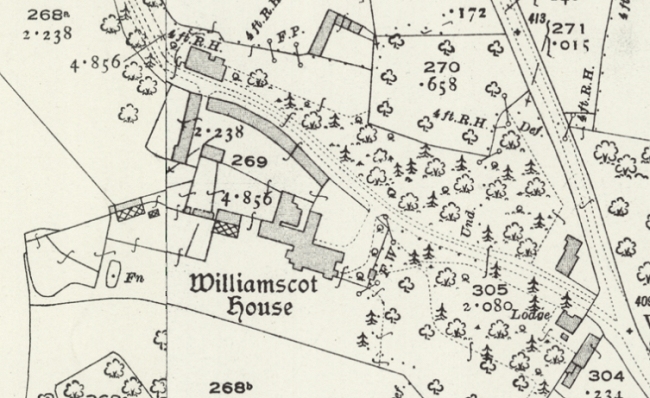
John Edward Taylor Loveday married ⇗ Edinburgh-born Margaret Cheape on 15 Oct 1874 at Cameron, in Fife, Scotland. The couple made their home at Williamscote House (the above-mentioned ‘Manor House’), where they were enumerated with their first five children in 1881 ⇗. John was described as a “Landed Proprietor & Magistrate for Counties of Oxford & Warwick”. They had five more children over the course of the next 15 years, of whom David Goodwin Loveday was the youngest.

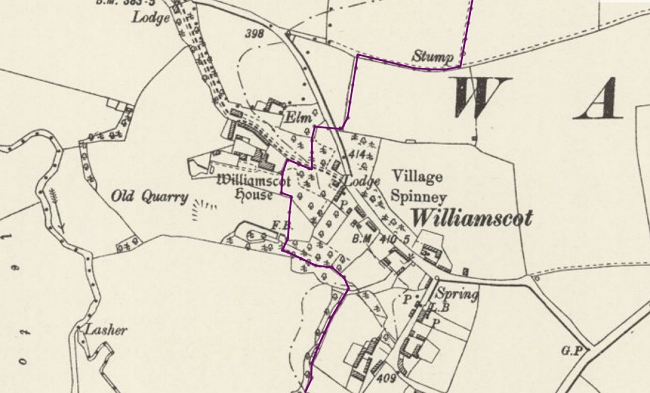
Extract from a large-scale Ordnance Survey map showing Williamscot House, its surrounding buildings, and its wooded grounds, with open fields to the West, and a road running from the top of the map to its South-east corner, to the East.

It turns out that David was not the first of the Loveday children to spend time in Shrewsbury. The 1901 census ⇗ records his brother Henry Dodington Loveday, then aged 20 and an articled clerk to a solicitor, lodging with the family of clergyman William Leeke at the Abbey Foregate Vicarage. Another brother, Alexander, was also living in Shrewsbury when the 1901 census ⇗ was taken. Aged 12, he was boarding at the school his brother David would later attend, Mill Mead, a private establishment under the headmastership of Wyndham Deedes.

Elizabeth . . . who?

The Lovedays’ connections with Shrewsbury might explain how the mysterious Elizabeth became a friend of the family. Was there a lady of that name living in Waters Upton in the early 1900s who looks like a suitable candidate? Of the several Elizabeths on the 1901 and 1911 census returns for the parish, one stands out: Elizabeth Yonge.

Elizabeth Mary Hombersley Yonge, née Groucock, was the wife of the Rev Lyttleton Vernon Yonge. Rev Yonge was a son of Vernon George Yonge, also a clergyman, and part of a prominent Staffordshire family which had its seat at Charnes Hall. Lyttleton was born at the Rectory in Great Bolas, received his education at Cambridge, and although he resided at Waters Upton he was vicar of Rowton, in Ercall Magna parish. Elizabeth, who was also from the parish of Bolas Magna, was a daughter of Thomas Groucock (a farmer of 180 acres in 1881), and of Elizabeth Groucock née Dickin, who was descended on her mother’s side from the Wase family of Waters Upton Hall.

The social standing of the Yonges (and perhaps also the subject of the postcard’s picture) makes Elizabeth my top ‘suspect’ in a case which is not so much a ‘whodunnit’ as a ‘whopostedit’. All I am lacking is any direct evidence that the Yonges and the Lovedays actually knew each other!

A scanned image showing the photo on the front of the postcard that is the subject of this article.  It depicts Old Edgbaston Church, with its tower on the right, behind a churchyard packed with gravestones and monuments along with several trees and shrubs.
The front of the postcard sent to Master D G Loveday by Elizabeth.

Maybe one day I will find that David Goodwin Loveday’s early education, before he went to Shrewsbury School, was as a pupil boarding either with Lyttleton Vernon Yonge or with his fellow clergyman and Waters Upton resident, John Bayley Davies? Or perhaps I will find a document written (or least signed) by Elizabeth, so that I can compare it with the writing on the postcard at the centre of this mystery. Her signature should appear in the Waters Upton marriage register, but the register begun in 1837 is still in use and has not been deposited at Shropshire Archives. The probate copy of her will, a digitised version of which I have obtained from HMCTS via the Gov.UK website ⇗, is typewritten and bears no signature.

So is this the end of my investigation? Not quite. Because while looking at the other Elizabeths of Waters Upton, I found a further line of enquiry.

Coincidence or connection?

The Elizabeth who piqued my interest was Elizabeth Emma Ball. She was a daughter of William Abraham Richard Ball and his wife Sarah, née Cureton. This Elizabeth spent the early part of her adult life working as a servant before moving back to Waters Upton between 1901 and 1911. There is nothing to suggest that she met the Lovedays unless perhaps she worked for one or more of them as a servant, but if that was the case the development a postcard-exchanging relationship with David Goodwin Loveday seems unlikely. However, if she didn’t know the Lovedays personally, Elizabeth may have known of them, through her younger sister…

Mary Ann Ball was born at Waters Upton on 13 February 1877. By 1891, when she was 14, she was in service, working as a nurse for the family of John Bayley Davies at Waters Upton Rectory. A decade later she was in Shrewsbury, living and working as a housemaid at a house in Belle Vue Road. Then, in 1909, she married Thomas Henry Kimnell.

Thomas was born at Wardington in Oxfordshire on 25 August 1878 and was enumerated there with his family on the censuses of 1881 ⇗, 1891 ⇗, and 1901 ⇗. When the latter census was taken, Thomas was 22 and, like his father, he was an agricultural labourer. Whether his fortunes changed before or after his marriage is unclear, but change they most certainly did. The 1911 census ⇗ recorded him not as a labourer but as a farmer, working on his own account. With wife Mary Ann and daughter Eva Mary (born 14 March 1910) he was living at Williamscote in Wardington parish.

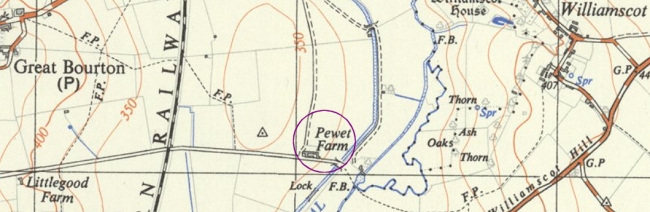
Extract from a colour Ordnance Survey map dating from the mid-1900s, showing part of Great Bourton on the left and Williamscot on the right. Between those settlements is open countryside, a few roads and farm tracks, a railway running North-South near Great Bourton, and a canal and a river running roughly North-South just right of centre. Just West of the canal, in the centre of the map, is Pewet Farm.

A second daughter, Helen Elizabeth, was born at Williamscote on 22 February 1914, but the Kimnells’ third and last child, Alice, was born at the end of 1917 or in the first quarter of 1918 on the other side of the River Cherwell in the parish of Bourton. Almost certainly the family was living there when the Banbury Guardian of 5 Jul 1917 reported on a military tribunal at which Thomas, a farmer of 107 acres, successful claimed exemption. From the 1921 census and National Identity Register of 1939 it appears that the family remained there for more than 20 years, at Pewet / Peewit Farm (highlighted on the map above).

Thomas Henry Kimnell of Williamscote died on 16 June 1965 at Woodford Halse in Northamptonshire; his estate was valued at £4531. Mary was also of Williamscote at the time of her death on 17 February 1969; given that her death was registered at Daventry she too may have died at Woodford.

Did the references to Williamscote in the preceding paragraphs cause you to think back to the earlier part of this story, relating to the Loveday family? The hamlet of Williamscote, although lying in the parish of Wardington, is a stones-throw from Williamscote House in neighbouring Cropredy parish (the boundary is shown in purple on the map below). The 1911 Kelly’s Directory ⇗ of Oxfordshire lists Thomas H Kimnell right after John Edward Taylor Loveday under Williamscote! Coincidence? Quite possibly, but I think there’s a good chance that it isn’t.

A large-scale Ordnance Survey map showing the village of Williamscot, with Williamscot House immediately to the North-west of it, surrounded by fields, with roads, a few spinneys, and (to the West) part of a river. The parish boundary between Wardington parish on the right (in which Williamscot lies) and Cropredy parish (in which Williamscot House is situated) on the left, is highlighted in purple.

William Ball was well known in Waters Upton so both the Davies family and the Yonges would have been familiar with his daughters, all the more so in the case of Mary Ann given her employment at the Rectory. If, as I have theorised, Elizabeth Yonge was a friend of the Lovedays, this might mean that she was in a position to help bring about the union of Thomas Henry Kimnell (who the Lovedays may have known, perhaps as an employee?) and Mary Ann Ball.

Ultimately, this is speculation and does not prove anything conclusively. The puzzle of the postcard’s sender remains officially unsolved – a one-place study ‘X File’. At least for now. One further possibility for acquiring a sample of Elizabeth Yonge’s handwriting and/or signature remains. Dave Annal recently reported on Twitter that he managed to obtain a copy of an original will from HMCTS – although he did have to wait 16 months!


Picture credits: Front and back of postcard, author’s own images. Extract from Ordnance Survey 25 Inch mapping (1892-1914) showing Williamscot House ⇗ reproduced with the permission of the National Library of Scotland ⇗ under a Creative Commons licence ⇗. Extract from Ordnance Survey 1:25,000 mapping (1937-61) showing Great Bourton, Pewet Farm and Williamscot ⇗ reproduced with the permission of the National Library of Scotland ⇗ under a Creative Commons licence ⇗. Extract from Ordnance Survey 6 Inch mapping (1888-1913) showing Williamscot House and Williamscot ⇗ reproduced with the permission of the National Library of Scotland ⇗ under a Creative Commons licence ⇗.

Waters Upton Tragedies: The Death of William Lloyd

Shocking Discovery at Eyton-On-The-Wild-Moors
On Sunday considerable excitement was created in the town of Wellington and the district of Eyton by a report that the mutilated remains of a man had been found in a haystack at Eyton-on-the-Wild-Moors. The statement proved to be true, but the idea that a brutal murder had been committed was soon dispelled. Deputy Chief-constable Ivins, as soon as the information reached him, took the investigation under his own personal direction.

So began a particularly sad story which appeared in the Shrewsbury Chronicle on 29 June 1883. A slightly sensationalised story too, I think, for not only was the deceased not murdered, his body had not been mutilated. What were the circumstances of the body’s discovery? Who was the unfortunate man? And, since I’m telling his story here, how was he connected to Waters Upton? Let’s return to the Chronicle’s report (to which I have made one small correction).

The stack, under which the body was found, is on the farm of Mr. E. W. Bromley, Eyton House Farm, and situate at some distance from the farm-house or any road, but is easy of access from a footpath and the towing-path of the canal, which runs parallel with the field in which the stack is. When found the body was dressed and partially covered with hay. Owing to the advanced state of decomposition in which the body was the features were unrecognisable, and Mr Ivins, with a view to finding out who the man was, issued a notice which he had extensively circulated in the district. The following is a copy of the same:—
“County Constabulary Office, Wellington, D Division, 24th June, 1883. Found dead on the 24th inst. by a hay stack in a field on the Eyton Moors, parish of Eyton, by two lads, a tramp, about 50 years of age, 5ft. 6 or 7 inches high, dark whiskers and moustache going grey; dressed in old brown hard hat, dark round pilot jacket, blue guernsey, old cord trousers, old lace-up boots, all very much worn and very shabby, had no shirt or stockings on. Supposed to have been dead about a month as he was seen in the same place on the 27th May, and complained of being ill.”
This notice was seen by a man named Joseph Rogers, in the employ of Messrs Barber and Son, Wellington, who recognised it as the description of a man named William Lloyd, about 50 years of age, a native of Waters Upton […]

Poor William! How did he end up living, and dying, in such wretched circumstances?

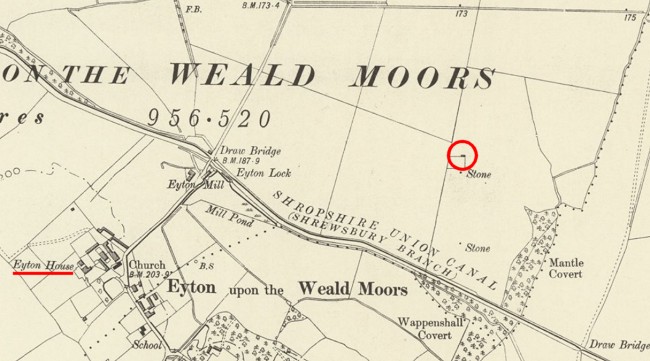
An extract from a large-scale Ordnance Survey map showing field boundaries. It depicts the village and part of the parish of Eyton upon the Weald Moors. The village is near the bottom left corner. The Shropshire Union Canal (Shrewsbury branch) extends from near the top left corner, to a point close to the bottom right corner. I have marked on the map: Eyton House (on the West side of Eyton village), and the approximate location, North of the canal and on the right side of the map, where William Lloyd died.
Map of Eyton upon the Weald Moors (or Wild Moors). Circled: The possible location of the shed (and haystack) where William Lloyd was found dead. Underlined: Eyton House, a.k.a. Eyton Farm House, where the inquest took place.

A native of Waters Upton

Piecing together the story of William Lloyd’s origins and early years is not straightforward, so bear with me while I assemble all the evidence – or skip to the next section if you wish! If, as Joseph Rogers stated, William was about 50 at the time of his death, he would have been born around 1833. I believe that Joseph’s estimate of William’s age was a ‘rounding up’ and that William was the 5-year-old William Lloyd who was enumerated on the 1841 census, at Waters Upton, with John and Ann Williams (ages rounded down to 50 and 40 respectively), Joseph Lloyd (12), and Elizabeth Lloyd (7).

Unfortunately the 1841 census did not record the relationships between household members so this record provides fairly limited information about William and those he shared a home with. There’s no baptism record for him that I can find either, nor does there appear to be one for Elizabeth Lloyd. Joseph Lloyd however was baptised at Waters Upton on 22 June 1828, his parents were William Lloyd (a labourer) and Ann, whose abode was in the parish. Were these two also the parents of Elizabeth and of the younger William Lloyd?

The most likely marriage for Joseph’s parents was that which took place at Wellington on 3 February 1827 ⇗. The parish register described the couple as “William Lloyd of this Parish and Anne Taylor of this Parish”. William died in 1835, at the age of 37, and was buried at Waters Upton on 23 Sep that year. (His age at death (37) likely makes him the the son of William and Elizabeth Lloyd who was baptised at Waters Upton on 19 Jun 1798.) Ann then remarried in 1840, to widower William Taylor, their entry in the register naming Ann’s father as James Taylor.

The 1851 census shows John and Ann Williams as husband and wife, but with none of the Lloyd children from 1841 living under their roof. John, aged 63 and an agricultural labourer (as he had been in 1841), was born in Waters Upton; the relevant baptism is likely that of John, son of William and Mary Williams, “in ye Sch: Room” on 1 June 1789. Ann, 51, was born in Cherrington; almost certainly she was “Anne Daur of James & Anne Taylor, Cherrington” baptised at Tibberton ⇗ on 21 April 1799.

William Lloyd too was living in Waters Upton in 1851. Aged 15, he was a hostler residing with and working for publican William Matthews. The pub is not named on the census schedule but there is little doubt that it was the Lion, as the Swan Inn – the only other hostelry in the village – was identified by the enumerator elsewhere.

The census of 1861 adds to the evidence relating to William Lloyd’s family, as well as providing an update on his fortunes. Household schedule 42 recorded agricultural labourer John Williams, 72, with his wife Ann, 61, and two sons (actually, stepsons), Joseph and William Lloyd. Joseph, aged 32 and unmarried, was by this time working as a gardener. William, 25, also unmarried, was an ‘ag lab’ like his stepfather.

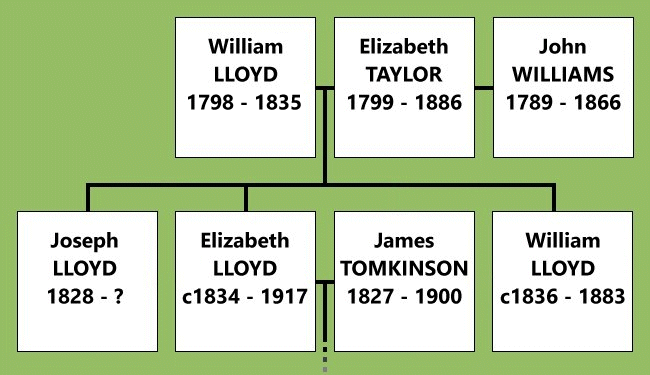
A small family tree diagram. The top line shows William Lloyd (1798 to 1835), his wife Elizabeth Taylor (1799 to 1866), and Elizabeth's second husband John Williams (1789 to 1866). The second line shows children of William and Elizabeth: Joseph Lloyd (born 1828), Elizabeth Lloyd (about 1834 to 1917) plus her husband James Tomkinson (1827 to 1900), and William Lloyd (about 1836 to 1883).

Elizabeth Lloyd had married by this time, and the record of that event ⇗ – naming her father as William Lloyd – adds further evidence to back the theory that she, Joseph, and William Lloyd junior were siblings. She wed James Tomkinson on 6 November 1854, probably at Chetwynd where she had been enumerated as a servant on the 1851 census ⇗ (name transcribed as Mary Hary by FamilySearch!!). She and James spent the rest of their days in nearby Newport, where they had 11 children.

John Williams of Waters Upton died on 26 November 1864, aged 75. The death of Ann Williams, formerly Lloyd, née Taylor, was registered in Wellington Registration District, in the last quarter of 1886; she was 87 but her age was recorded as 86. Joseph Lloyd’s story, which involved duck stealing, I will continue another time. That leaves William Lloyd, whose story I will now conclude.

A vagrant life

William Lloyd’s next appearance on a census, in 1871, seems to have been his last. He had left Waters Upton by this time, and was once more working, this time as a labourer, for an inn keeper: James Brown of the Green Dragon at Hadley. At some point over the next ten years however, something happened which changed William’s way of life – he became homeless. I have not found him on the 1881 census, but I can’t rule out the possibility that was enumerated as a nameless tramp found sheltering under a hedge or in a barn or outbuilding.

The report from the Shrewsbury Chronicle, part of which I quoted at the beginning of this story, was one of several arising from the inquest into William Lloyd’s death; others appeared in the Shrewsbury Journal, 27 June 1883, and the Wellington Journal, 30 June 1883. Together, they provide snippets of information which taken together give us a feel for how William spent his last years, and in particular his final months. It was said that William “had led a vagrant life for some years, sleeping in outbuildings and picking up a living as best he could.” Joseph Rogers, who “had known the deceased from a lad”, also stated that for a long time William “had been going about the country labouring with thrashing machines, and was formerly in the employ of Mr Price, of The Lees, near Walcot.” He was not married, and “had been in the habit of sleeping out.” I can only guess that at some point in the 1870s a spell of unemployment left William without the means to pay for accommodation and led to him taking advantage of whatever shelter and odd jobs he could find, whenever and wherever he was able to. Returning to the Shrewsbury Chronicle:

Rogers states that about a month ago the deceased called at his lodgings, and he had a conversation with him, when Lloyd complained of being ill, and he advised him to go to the Workhouse. He said he would, but Rogers had since ascertained that he did not do so. William Phillips, of the Ercall Hotel, also recognised the body as that of Lloyd, and states that about a month ago he engaged him to do some gardening, but Lloyd never came to do it, and he had not seen him since. A man named Beech, residing at Kynnersley, also saw the deceased about a month ago, and said that he complained of being unwell.

Another witness was John Thomas, described by one paper as a waggoner and by another as a cowman. He worked for Mr Bromley, at whose house the inquest was heldOn Sunday, the 27 May 1883, Mr Thomas saw William Lloyd lying down “on the top of an old stack bottom” with “some hay partially thrown over him.”

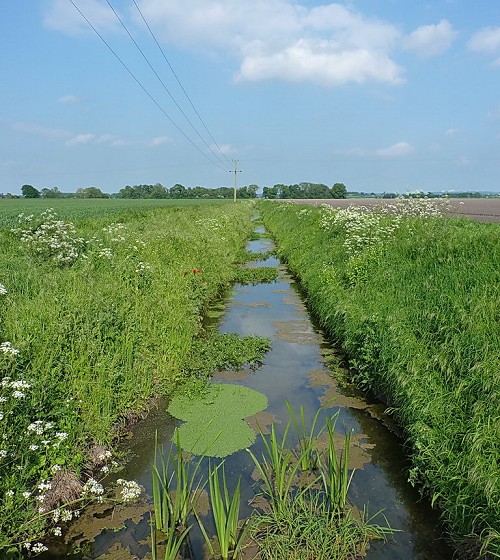
Colour photo of a wide, flat vista in the Weald Moors of North-east Shropshire. In the centre, running from the foreground into the distance, is a man-made water channel or drain, from which aquatic plants emerge at intervals. The shallow banks of the drain are covered with grass and herbage. The field to the left appears to have a green crop in it, the field to the right appears to have been ploughed. Across most of the horizon is a line of trees. The sky above is blue, with some white clouds.
A drain on Eyton Moor

The two men had a conversation, in which William said that he had gone to the place where John found him “on the Saturday night, that he lay in the shed, and that he had come out to sun himself. He said he had been very poorly for some time, suffering from bronchitis”, and as a result of that illness “he had a bad cough”. William also said that “he had been following machines belonging to Mr. Nicholls and Mr. Powell, of Shrewsbury” and that “most of his food had consisted of water.”

A most melancholy case

John Thomas was probably the last person to see William Lloyd alive – and the last person to see him at all for several weeks. There was no public road where William had settled, although the canal and a path leading to Kynnersley were not far away. With the hay in which William slept not being needed at that time, no one went near the stack until Sunday 24 June 1883.

William Lloyd’s body was found that day by two boys. One of them, Walter Ruscoe, lived at Sidney (or Sydney) in the parish of Kynnersley (or Kinnersley) and was, like John Thomas, employed by Mr Bromley. On the day in question he took a bull down to the weald moors, and on his return he found the body by the haystack, half covered with hay. He quickly gave the alarm which led to the police becoming involved, and an inquest taking place the next day.

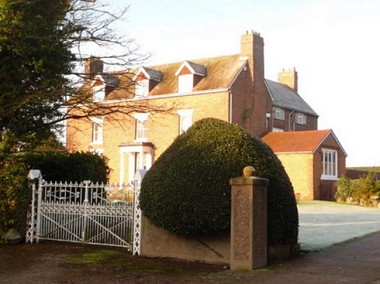
Colour photo of Eyton House. The main house is of two storeys, with dormers, and three bays, with a chimney at each end of the roof. A small, single-storey extension extends to the right, and there is what looks like another extension, of two storeys, extending from the rear. In the foreground there is a short section of wall, with a shrub behind and partially overgrowing it, in the middle, a pair of white-painted iron gates to the left of that, and the beginning of a hedge to the left of that.
Eyton House, home of farmer Edward William Bromley and location of the inquest into the death of William Lloyd in 1883

At that inquest the jury gave a verdict of “Found dead” or, according to the Wellington Journal, “Death from natural causes.” The Coroner said “that it was a most melancholy case; but there was no ground whatever to suppose that deceased had met with any violence. He had apparently laid down and been overcome. It was a matter of regret that deceased had not taken the advice of one of the witnesses, and gone to the Workhouse.”

Article updated Feb 2026.


Picture credits. Map: Extract from Ordnance Survey Six Inch map Sheet XXXVI.NW ⇗ published 1902; reproduced with the permission of the National Library of Scotland and used under a Creative Commons licence ⇗. Family tree diagram: By the author. Drain on Eyton Moor: Photo © Copyright Richard Law; taken from Geograph ⇗ and modified, used and made available for reuse under a Creative Commons Licence ⇗. Eyton House: Photo © Copyright Chris Downer; taken from Geograph ⇗ and modified, used and made available for reuse under a Creative Commons Licence ⇗.

Late Victorian Christmases in Waters Upton – Part 2

⇐ Back to Part 1

Christmas carols (and other entertainments)

Pleasant Evenings with the Children.—On Wednesday and Thursday evenings, a miscellaneous entertainment was provided by the children attending Waters Upton School, consisting of duets, dialogues, musical drills, songs, in character, &c. The Rev. J. B. Davies, rector of the parish, presided each evening. The whole of the children acquitted themselves admirably, and gave much credit to Miss Taplin’s careful training. On the proposition of the Rector, hearty votes of thanks were accorded to Miss Taplin (head-teacher), Miss Union [actually Miss M Minor] for presiding at the pianoforte, and to the children for their entertainments, which were heartily applauded. The proceeds are for providing prizes for the children.
Wellington Journal, 23 December 1893.

Miss Taplin was not enumerated at Waters Upton on any of the censuses, but the entry for Waters Upton in the 1895 Kelly’s Directory includes “Miss Sarah Ann Taplin, mistress”. She had embarked on a teaching career early on, the 1881 census ⇗ showing Banbury-born Sarah at the age of 19 as an Assistant Schoolmistress lodging, with two other young women of the same profession, in the Hinckley, Leicestershire household of Schoolmaster and Schoolmistress Alfred and Fanny Webb. Ten years later in 1891 ⇗, Sarah was (along with another School Mistress) a visitor in a household at Wivenhoe in Essex. Her short spell at the National School in Waters Upton followed.

The newspaper report from 1893 quoted above does not explicitly connect the entertainments provided by the schoolchildren with Christmas. The timing of the events makes the association fairly clear however, and this account for the festivities of 1894 (published on 5 Jan 1895) leaves us in no doubt: “The Christmas Season has been kept in this village in the usual way. Before the Christmas holidays began the children of the Parish School gave two evenings’ entertainments of amusing songs and dialogues, in which they were well instructed by their teacher, Miss Taplin.”

I have not yet established exactly when Sarah Taplin left Waters Upton, but by 1901 ⇗ she was living and teaching at Shilton in her native county of Oxfordshire. The following year she was married ⇗, in Nuneaton, Warwickshire, to London & North West Railway worker William Meers. This did of course mean that her 20 year teaching career was over – but it also meant that Sarah was able to have children of her own.

An illustration of Holly leaves and berries.

The Wellington Journal’s summary of the seasonal celebrations of 1894 in Waters Upton continued by noting the beautiful decorations in the church “for the Christmas services by Mrs. L. V. Yonge, Mrs. Percival, and Miss M. Minor.” The offertories from these services were given to the Salop Infirmary, an institution I have written a partial history of (in four parts, so far) on my Atcherley family history website ⇗. The Journal’s report concluded:

At the end of the Christmas week there was also held a most successful entertainment in the Parish School. The room was well filled, and the proceeds, which realised over £5, went to pay for new church gates at the entrance to the churchyard. The programme was as follows:—Piano duet, Misses Annie and Alice Davies; song, Miss M. Minor (encored); song, Mr. Crewe; song (encored), Miss Lucy Rider; song (encored), Mr. Crewe; song (encored), Miss Sutton; piano solo, Miss Crewe; song (encored), Mr. Percival; song (encored), Miss Sutton (in place of Miss Nock, who was unable to be present). During the interval the rector (Rev. J. B. Davies) gave a short reading, and afterwards a very amusing piece was performed by four ladies and three gentlemen, the acting in which was of the highest character and was greatly appreciated. The performers were Rev. W. P. Nock, Dr. White, Mr. Ernest Rider, Mrs. L. V. Yonge, Miss Taylor, Miss Lucy Rider, and Miss Emmeline Heatley. At the conclusion the Rector proposed a hearty vote of thanks to all who had so ably taken part in the entertainment.

A whole cast of characters there, and what festive fun they had! Six of them (the Rev Davies and his daughters Annie and Alice, Mrs Yonge née Groucock, Miss Margaret Minor, and Miss Taylor) we have already met, in Part 1 of this story. Of the others, there are some I cannot identify with certainty: Doctor White, and Mr and Miss Crewe, may reveal themselves with further research. As was the case with some of their fellow celebrants, they may not have been Waters Upton residents. Emmeline Heatley appears from the 1901 census ⇗ to have been from nearby Eaton upon Tern (upstream from Waters Upton), where she was born around 1875, while the 1891 ⇗ and 1901 ⇗ censuses show that the Rev William P Nock (born around 1861) was Rector of Longdon upon Tern (downstream from Waters Upton).

Lucy Catherine Rider was from Wellington, where she was born and baptised in 1872 ⇗. She was a daughter of surgeon John Rider and his wife Mary, née Tennant. The Rider family had connections with Waters Upton parish – both John (born at nearby Crudgington) and Mary were buried at there (in 1887 and 1919 respectively, see Memorial Inscriptions: Rider). Ernest Rider, from Shawbury parish, was Lucy’s first cousin, his father being John Rider’s brother Thomas.

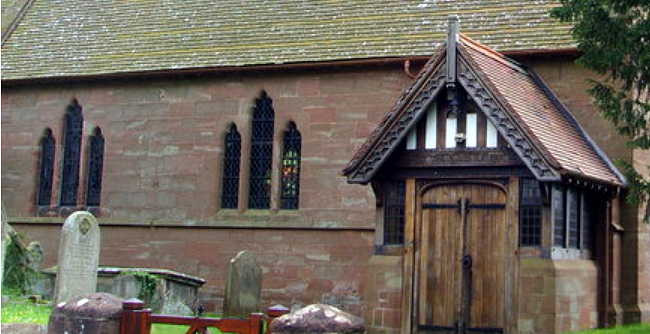
A photo showing part of the North side of St Michael's Church in Waters Upton. On the right is the porch, to the left of which there are two 3-light windows. Part of the roof can be seen, and also part of the churchyard with gravestones and a chest (or table) tomb.
A Holmes / St Michael’s Church / CC BY-SA 2.0 / Modified

That leaves Mr Percival, and also his wife (who helped to decorate the church). Herbert France Percival was born, surprisingly enough, in France (at Pau, now in Pyrénées-Atlantiques, Nouvelle-Aquitaine), on 7 March 1863 according to the Visitation of England and Wales ⇗ (Volume 2) published in 1894. Mary Jane Cornes was born at Longsight in Lancashire on 26 August 1859 and baptised ⇗ at Manchester Cathedral one month later. After a series of moves the Cornes family finally relocated to Crudgington where, on 3 August 1887, Mary Jane was married to Herbert Percival at Waters Upton. The couple settled (and Herbert farmed) in the parish where they wed, were enumerated there on the 1891 census, and their first two children (Geoffrey James France Percival and Sybil Mary France Percival) were born there in 1890 and 1892 respectively.

Herbert France Percival was included in the entry for the Waters Upton in the 1895 Kelly’s Directory, but he and Mary Jane had moved to Crudgington by the time their third and last child, Arthur Stanley France Percival ⇗, was born on 21 November that year. Possibly they had moved in with Mary Jane’s parents (Joseph Cornes, Mary’s father, died on 4 July 1897 and was buried at Waters Upton; see Memorial Inscriptions: Cornes).

Although the Christmas of 1894 was the last one the Percivals spent as residents of Waters Upton, it was not the last time they participated in the parish’s celebrations. The Wellington Journal of 1 January 1898 tells us this about an event which took place at Waters Upton on 29 December 1897:

Entertainment.—A concert was given in the school room, on Wednesday evening, by the church choir, assisted by a few friends. The performances were highly appreciated by a large audience, and credit is due to Miss M. Minor, the organist at the church, who had trained many of the choir to sing in public for the first time. The following took part:—The Choir, Miss A. Minor, Mr. P. Minor, Rev. L. V. Yonge, Mr. George Hall, Mr. Sam Dickin, Mr. Percival, the Misses Davies, Mr. W. A. R. Ball, Mr. Crewe, Willie Bennett, Mr. Tom Madeley, Mr. Tom Bennett.

The Percivals were still living at Crudgington in 1901 ⇗, but by 1911 had moved (with Mary Jane’s widowed mother) to Towyn in Merionethshire. As for the other performers besides Mr Percival, we have already met Margaret Minor, the Rev Yonge and the Misses Davies. How wonderful to see so many other names, of people from within and outwith the parish! In the latter category were A and P Minor (relatives of Margaret of Meeson no doubt, though I have yet to identify them), and Tom (Thomas) Madeley (probably the one born about 1872 at Crudgington, a farmer’s son who was still living there in 1901 ⇗ when he was a butcher).

George Hall was born in the neighbouring parish of Ercall Magna in 1878 but was probably by 1897 a resident of Waters Upton; certainly he was recorded there on the 1901 census when he was working as a sawyer. Samuel Robert Dickin was born a little further away at Little Ness, in 1875; he too must have moved to Waters Upton by 1897, and the 1901 census enumerated him there as a farmer, living with his sister Annie who was his housekeeper.

Brothers Willie (William) and Tom (Thomas) Bennett were both born at Waters Upton, in 1885 and 1880 respectively. They were sons of shoemaker Samuel Thomas Bennett and his wife Alice, née Lucas. Both were with their parents when the 1891 census was taken, and while William had moved on by 1901, Thomas remained (pursuing his father’s – and grandfather’s – profession, and appearing on the censuses of 1901 and 1911, and on the 1939 Register, at Waters Upton). Now there’s a man who saw a lot of Waters Upton Christmases!

An illustration of Holly leaves and berries.

All I want for Christmas is . . . a servant

WANTED, at Christmas, a General Servant, to do plain cooking, and make butter.—Apply, Mrs. J. B. Davies, Waters Upton Rectory, Wellington, Salop.
Wellington Journal, 17 November 1883.

While searching for stories of Christmas at Waters Upton, I came across advertisements for servants wanted “at Christmas” or “for Christmas”. The “most wonderful time of the year ⇗” (as Christmas was christened in the well-known song penned in 1963) was also one of the busiest times, especially for servants. More relevant to the phenomenon of yuletide recruitment however is the fact that Christmas Day was one of the four Quarter Days ⇗ in England and Wales, when rents were due – and servants were hired.

So as we have seen, at the end of 1883 the Rector’s wife Mrs John Bayley Davies (Susan Anslow Davies, née Juckes) was looking for a general servant who would cook, and make butter. The source of the milk for that butter was most likely cows kept on glebe land associated with the rectory.

In the Wellington Journal of 18 December 1886, two more ladies with Waters Upton addresses sought servants for Christmas. I was puzzled at first by Mrs Hoole, who was looking for a “trustworthy Servant” for “milking (two cows), attention to poultry, and plain cooking” for a family of two (“wages about £12”). Further research in the newspapers and then the censuses (e.g. that of 1881 ⇗) showed that Mr and Mrs Hoole were in fact living at Wood Farm, around 2 miles or so North of Waters Upton, in the parish of Stanton on Hine Heath. Presumably their post went through Waters Upton.

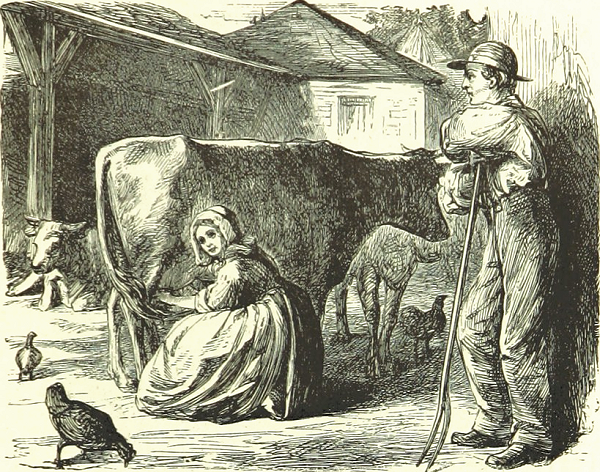
An old drawing of a maid milking a cow in a farmyard. Other cattle, and poultry, can also be seen, and on the right of the picture is a man leaning on a long-handled, two-pronged tool.

Mrs Shepherd, on the other hand, who wanted a “Servant Girl, at Christmas, age 15 to 16, who can milk or willing to learn” was definitely a Waters Upton resident. Jane Shepherd, née Rider, was recorded there on the 1891 census along with her husband Hugh, a farmer. The census shows that Hugh Shepherd was born at Old Deer (Aberdeenshire) in Scotland and that he was 15 years younger than his wife, who was born at Tattenhall in Cheshire. Baptism records for Hugh (in 1823 ⇗) and Jane (at Harthill in 1803 ⇗, the register giving the family’s abode as Broxton and a birth date for Jane of 8 December 1802) show that the age gap between the two was actually more than 20 years. When they married ⇗ on 12 Jan 1857 at Acton in Cheshire (by which time Hugh was already resident in Shropshire), both stated that they were of full age. Hugh was 33 and Jane was 54.

The 1891 census reveals something else about Jane – she was blind. This fact had also been recorded in 1881 ⇗ (when the Shepherds were living at Wrockwardine), but not on censuses from previous years. Presumably she lost her sight through an age-related condition such as macular degeneration or cataracts. Whatever the cause, it is clear that Jane’s inability to see did not prevent her from running household affairs. In these matters she may have been assisted by her niece Mary Lewis, who was enumerated with her at Waters Upton in 1891 as a “Ladies Companion”. Jane Shepherd died, and was buried at Waters Upton, in 1894 (see Death notices etc. and Wills & probate after 1858).

WANTED, Girl, between 14 and 16, as General, either now or at Christmas; character required.—Apply, Miss Walker, Waters Upton.
Wellington Journal, 6 December 1890, page 4.

I originally thought that the word ‘servant’ was accidentally omitted from the above notice, but having since compiled a page of Situations Vacant and Wanted adverts I have found several other examples of Waters Uptionians seeking a ‘general’. Did this ‘small ad’ result in the hiring of Sarah Ann Wilkes, the 16-year-old Lancastrian who appears on the 1891 census as a general servant in the Waters Upton household of Sarah Ann Walker? I have found no other records for Sarah Wilkes, but she may have been Sarah Ann Walker’s niece, enumerated as part of the Walker household in 1881; both aunt and niece shared the same name. The elder Sarah Walker ran a private school in Waters Upton for more than 30 years and so saw many Waters Upton Christmases. I will write about her in more detail another time.


Additional picture credits: Uncredited images all from the British Library Flickr photostream; no known copyright restrictions.

Late Victorian Christmases in Waters Upton – Part 1

The Children’s Christmas

There’s gladness and loud animation
In cottage and palace to-day;
And the children, in warmest elation,
Trill their songs, bright, merry and gay.
The floodgates of joy are now open—
Old Christmas gives out his best store;
For the season of mirth the children
Returns with its hight, hallowed lore.

The star of the far distant ages
Still gleams like a diadem rare;
Still songs of both shepherds and sages
Tell the story of Bethlehem fair.
The children ‘mid innocent pleasure
Re-echo the joyous refrain.
And, swelling the old gladsome measure,
Tell Yuletide’s sweet tale once again.

“J. T.”, Shrewsbury.
Wellington Journal, 20 December 1890.
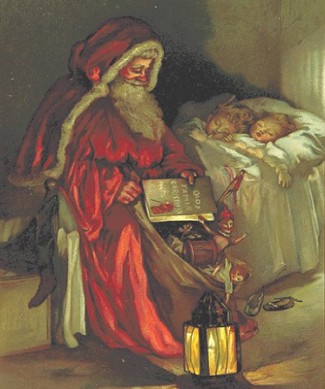
A colour illustration of Father Christmas in his white-trimmed red cloak, with a sack full of gifts, sitting at the end of a small bed in which two young children are sleeping.

During the 1800s, and particularly over the course of Victoria’s reign, the celebration of Christmas in Britain evolved and was enriched by innovations and importations. As a result, towards the end of the century the traditions of the ‘Victorian Christmas ⇗’ were all in place – cards, carols and crackers, decorations and dinners, a red-robed, full-figured Father Christmas / Santa Claus, and a somewhat incongruous combination of commercialism and Christian values.(The image here is from a book published in 1888. Taken from the British Library Flickr photostream ⇗; no known copyright restrictions.)

From the newspapers of the time we can learn what late Victorian Christmases were like in towns and villages across the country, and gain glimpses of the ways in which the season was celebrated in Waters Upton.

Decking the halls (and churches)

The holly berries all aglow
Are wreathed in wonted Christmas brightness
Aloft is hung the mistletoe
In all its pearly whiteness.

“Olive”
Wellington Journal, 22 December 1888.

By longstanding tradition, homes were decorated with Christmas greenery ⇗: holly, mistletoe, garlands of fir, kissing boughs, with wreaths or ‘welcome rings’ hung on front doors. From newspaper reports viewed at the British Newspaper Archive it seems that flowers too were an element of Christmas decorations, at least in public institutions such as infirmaries, workhouses and churches (such reports are easier to come by for those establishments than for private homes). Thus we learn from the Wellington Journal of 26 December 1885 that:

The Parish Church [of Waters Upton] was very tastefully decorated for Christmas, the work being executed as follows:—Pulpit, lectern, and candlesticks, Miss F. Minor; chancel text, “Behold thy King cometh;” Miss F. Minor; banners and wall decorations, Miss E. Taylor and Miss L. Groucock; font, Mrs. Davies and Miss L. Groucock; windows, school children. Mr. J. B. Davies, rector, preached at both morning and evening services.

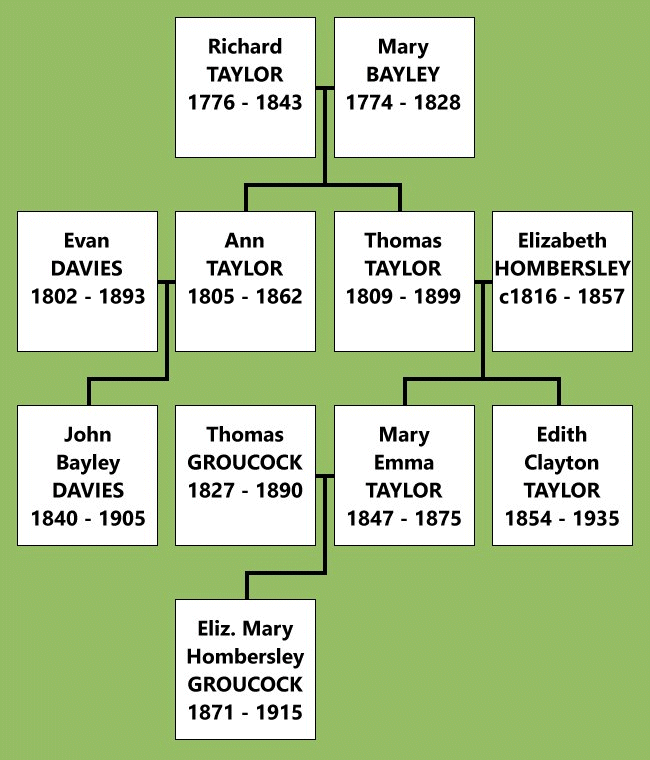
John Bayley Davies was educated at Shrewsbury School ⇗ and became Rector of Waters Upton in 1866. Mrs Davies, formerly Susan Anslow Juckes, was married to the Rev Davies in 1875. If I have correctly worked out who the above-mentioned Misses E Taylor and L Groucock were – Edith Clayton Taylor and Elizabeth (a.k.a. Lizzie?) Mary Hombersley Groucock, the Rev J B Davies was related to both of them (first cousin and first cousin once removed, respectively). The family (Christmas) tree shown here illustrates how the three were related.

A small family tree diagram, showing four generations. First, Richard Taylor (1776 - 1843) and his wife Mary Bayley (1774 - 1828). Next, their children Ann Taylor (1805 - 1862) and Thomas Taylor (1809 - 1899), and the spouses of those children: Ann married Evan Davies (1802 - 1893), and Thomas wed Elizabeth Hombersley (about 1816 - 1857). Evan Davies and Ann begat John Bayley Davies (1840 - 1905). Thomas Taylor and Elizabeth begat Mary Emma Taylor - who married Thomas Groucock (1827 - 1890) - and Edith Clayton Taylor (1854 - 1935). Finally, the fourth generation is Elizabeth Mary Hombersley Groucock (1871 - 1915), daughter of Thomas and Mary Emma.

The Groucock family was originally of Meeson in the neighbouring parish of Bolas Magna, but by 1881 the widowed Thomas Groucock had moved to Waters Upton along with his sister. Mary Emma Groucock née Taylor was born at Burleigh Villa in Bolas Magna, where her father Thomas was still living (see Kelly’s Directory 1891 ⇗).

I have not identified Miss F Minor, but members of family with that surname were resident at Meeson at this time – and we will shortly meet Miss M Minor, almost certainly Margaret Elizabeth Minor of that place. Another demonstration of the links between Meeson and Waters Upton came in 1897.

Christmas at the latter village that year was “observed at the Parish Church in the usual way” according to the New Year’s Day edition of the Wellington Journal in 1898. Celebrations of Holy Communion took place at 8.30am and 11am, with a shortened evening service at 6.30pm at which “the choir sang several carols.” “The church was prettily decorated by the ladies of the congregation, beautiful lilies and camelias being sent from Meeson Hall for the chancel decoration.”

Four years later in 1901, the year of Queen Victoria’s death, the Wellington Journal stated on 28 December that “Christmas in the churches has been kept this year with a heartiness which has probably never been surpassed, notwithstanding those who contend that its celebrations are falling into disuse.” It went on to say that “the decorations have been exceedingly appropriate and ornate, reflecting great credit the busy and untiring efforts of those responsible for the work.” With regard to Waters Upton:

The decorations in this church were, as usual, tastefully arranged. The pulpit and lectern were decorated by Mrs. L. V. Yonge, the east end windows by Miss M. Minor, and the font and nave by the Misses Davies, assisted by Miss Tompkin, Daisy Pritchard, Dolly Austin, Dorothy Tompkin, and S. H. and R. W. Davies. The choir sang carols at the morning and evening services, and the sermons were preached by the rector, the Rev. J. B. Davies.

Mrs L V Yonge was the above-mentioned Elizabeth Mary Hombersley Groucock, now married. Elizabeth had ‘tied the knot’ with the Rev Lyttleton Vernon Yonge, vicar of nearby Rowton in Ercall Magna parish, in 1892 and the couple resided at Waters Upton. I have yet to work out for certain who Dolly Austin was, but she may have been Mary Elizabeth Austin, enumerated (aged 8) with her family at Waters Upton in 1901. On the same census, Daisy Pritchard was recorded ⇗ at nearby Cold Hatton in Ercall Magna parish. Then aged 13, she was the daughter of agricultural labourer Edward Pritchard and his second wife Ellen, née Gough. At first I thought Daisy had no connections with Waters Upton, but her father Edward, although born in Wolverhampton, had Shropshire ancestry and was enumerated at Waters Upton with his parents in the censuses of 1871 and 1881.

The Tompkin girls were most likely Dorothy and Maggie (born 1891 and 1894 respectively), daughters of Robert Tompkin and Mary Margaret Sutton (née Barlow) Tompkin. The Tompkins had not been in Waters Upton for very long at this point, having been enumerated on the census back in April in their native county of Staffordshire. The family was still living in Waters Upton in 1911. That year’s census shows that Robert was a farm bailiff – Kelly’s Directory for 1909 shows that he was working in that capacity for the Rev L V Yonge. Sadly, Robert passed away at the age of 42 on 29 June 1911; he was buried at Waters Upton (see Memorial Inscriptions: Tompkin).

The Misses Davies would have been the Rev John and Mrs Susan Davies’ daughters Annie May (born 1879) and Alice Elizabeth (1880); with the two Davies boys “S. H. and R. W.” being Stephen Harris (1883) and Reginald Wynard (1885) – all of them were recorded on the 1901 census at Waters Upton. I will be devoting several future stories to this family, in which I will explore their lives in and beyond Waters Upton in more depth. But, as you are about to find out, that doesn’t mean they won’t get any further mentions in this one.

A colour illustration showing three bushy sprigs of Holly, with green, spiky leaves and red berries.
Adapted from a Public Domain image at Wikimedia Commons ⇗.

Rev John Bayley Davies saves Christmas

I freely admit to over-egging the (Christmas) pudding a little with that heading. However the Rev Davies, in his capacity as a member of the Wellington Poor Law Union’s Board of Guardians, did help to ‘save Christmas’ for the inmates of the Union Workhouse in Wellington in 1882.

John was present at the fortnightly meeting of the Board which took place on Thursday 14 December that year, at which the subject of “the paupers’ Christmas dinner” arose…

Mr. Lawrence said that as the master’s book was now before them, he was going to ask the Board to allow Mr. Minor to put on the book instructions that the inmates of the House should have their usual Christmas treat. It was done in all the gaols and workhouses in the country, and he did not see why their Board should set aside a custom which had been honoured in the observance ever since the Board was established. He moved that the inmates have the same treat they had last year. (Wellington Journal, 16 December 1882.)

The Clerk of the Board then “read from the minute book the allowance of beef and pudding sanctioned by the Board for the last Christmas dinner”, after which further conversation took place. I imagine, but can’t say for certain, that the Rev John Bayley Davies of Waters Upton contributed to that exchange of views, supporting the principles of Christian charity which had become a part of the Victorian Christmas. I don’t doubt at all that he was heartily pleased when Mr Lawrence’s proposition was, eventually, carried.

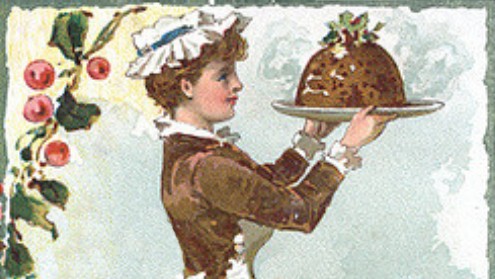
A colour illustration showing a maid carrying a steaming Christmas pudding on a plate, which she is holding so that the pudding is level with her head. The maid is wearing a white hat with frills around the edges, and a white pinafore over a brown top garment.
From a Public Domain image at Picryl ⇗. This is probably not an accurate depiction of the pudding served to the Wellington Union Workhouse inmates at Christmas, nor of the manner in which it was served to them…..

On to Part 2

Researching the Waters Upton one-place study on Ancestry

When I started putting this article together it was with the intention of writing about a particular couple who were living in Waters Upton at the beginning of World War 2, and how I found out more about their lives, beginning with the information I had transcribed from the 1939 Register. However it turned into a much more detailed description of how I use of Ancestry for my one-place study research, so I now present a rather different article. It’s not a ‘masterclass’, just an insight (for whatever that’s worth) into my research modus operandi, with some personal opinions along the way. Is there method in my madness, or madness in my method? I’ll let you decide!

The Waters Upton ‘family forest’

My methods, I should make clear, avoid some of the cornerstones of ‘proper’ genealogical research. In particular, when working on the family histories of hundreds of people in a one-place study (as opposed to my own family tree), the purchase of birth, marriage and death certificates in any quantity is an expense which I can’t justify. People and their relatives may grow on (family) trees, but money doesn’t; my heart and soul are committed to the project, my wallet, not so much!

Image containing text: Ancestry, discover your family's history [with the 'story' part of 'history' in bold].

So, my favourite way of researching my own family tree, and the family trees of my Atcherley cousins (in my one-name or surname study) and my DNA matches, is to build their trees at Ancestry, attaching relevant records as I go and adding Tags, notes and details of records not held by Ancestry itself. That’s also what I am doing for my Waters Upton one-place study. The ‘tree’ is not a single family tree but a collection of them, a ‘family forest’ if you like, featuring people who lived in Waters Upton at any point in their lives, plus their families, and some of their ancestors and descendants.

If you have an Ancestry subscription you can visit A One-Place Study – Waters Upton ⇗ at Ancestry.co.uk (or use these links for the .ca ⇗, .com ⇗, and .com.au ⇗ iterations). If you don’t have an Ancestry subscription but have an interest in Waters Upton and its people, and would like to view the ever-growing ‘forest’, let me know and I can send you a link giving you access through Ancestry, by email.

Working with multiple trees in a single Ancestry ‘tree’ is an interesting experience. For example, Ancestry trees aren’t really geared up for the addition in a straightforward way of people who aren’t a parent, spouse or child of a person already in a tree – and to be fair, why would they be? You can find a record for the person you want to add, and from there you can add them to the tree as a new person, but that method doesn’t create an event based on the record. So I usually add my new person as a parent or child of an existing person, then quickly edit their relationship to leave them as an isolated leaf cut off from the rest of the forest.

Take a Hint – or maybe not

Once I’ve added a new person to the tree, perhaps with other family members, I check out any ‘Hints’ that Ancestry might suggest. These Hints – records selected by Ancestry’s algorithms as possibly relating to the person concerned – are very much a double-edged sword. They seem to be based partly on the information you have entered for the person, name first and foremost, and partly on the records which have been attached to people in other Ancestry trees who might be the same as the person you are working on; both of these have the capacity generate some spectacularly inaccurate hints. The results, at their best, have the potential to help you. At their worst, they can completely mislead you.

Ancestry Hints are an anathema to many experienced (and especially professional) genealogists, primarily because they are often inaccurate, and maybe also because using them is seen as laziness. To me, Hints are another search tool to be used, the results of which are to be evaluated carefully and either:

  • discarded if they clearly don’t relate to the person being researched or would disrupt the space-time continuum (sorry about the Trek-speak, I will explain later, honest!),
  • accepted (sometimes provisionally) if they look like a good fit with what I already know about the person, or
  • neither discarded nor accepted initially, but left where they are until I can build up a more complete picture of the person (with other records) and make a better judgement as to whether or not they are relevant.

Over the years that I have been working with Ancestry trees, I have dismissed a huge number of Hints (often with an audible groan or even a curse), but I have also been pleasantly surprised on many occasions by the records they have accurately flagged up in collections or record sets which I would not have thought about looking in.

Image containing text: All Hints.

Other people’s trees

Among the Hints provided by Ancestry – at the top of the list in fact, if they exist – are other Ancestry members’ public family trees featuring the person you are working on (or people with similar names born around the same time). They vary hugely in quality, but because of the number of them built on the back of poor research and lack of critical thinking, Ancestry member trees are the subject of much wailing and gnashing of teeth within the wider genealogical community.

And I am there wailing and gnashing with the best of them when I see trees featuring people with records attached for events which happened after the person allegedly died, or before they were born, or in two widely separated places at the same time. Children born to ‘parents’ who were under 10 or not even alive at the time can be found (one tree I’ve seen, containing over 48,000 people, has a mother and child of the same age), along with mothers giving birth to two children well within 9 months of each other, sometimes on different continents. In one Ancestry tree I have seen a man who was his own father (or his own son, depending on which way you look at it).

Wail. Gnash. See what I mean about disrupting the space-time continuum? Some people’s enthusiasm runs far ahead of their logic, and in my head right now I can see Spock raising a Vulcan eyebrow at the very thought of it.

Part of the problem is that many people accept the aforementioned Hints without evaluating them. Many also copy the contents of other trees (either directly, or through accepting Hints based on those trees) without questioning their accuracy. At the end of the day though, while these practices are frustrating to people who undertake more meticulous genealogical research, in the grand scheme of things what actual harm is being done? There are after all far worse things that people could be up to instead, like axe-murdering or drug dealing, although having said that, when I look at some of the dodgier Ancestry trees I do sometimes wonder whether mind-altering drugs might have been involved.

Dragging myself back to the subject and looking at the positives, there are some well-researched trees on Ancestry. Even the trees which become increasingly questionable as they go further back in time, as people make best guesses based on incomplete evidence (see Beyond Ancestry below), can contain useful and accurate information on the generations closest to the tree builder (typically because they knew them, or have family members who did).

So yes, I look at the trees of others to see what records and family members they have attached to the people I’m researching. And I look at their conclusions to see whether they stand up to scrutiny, often carrying out my own research to see if the evidence I can find supports or contradicts those conclusions. I do the same with the pedigrees compiled and published by people like the Burkes in the 1800s, because they too got things wrong sometimes.

One more thing about Ancestry trees, and it’s another positive. Many people attach photos of their ancestors to their Ancestry tree profiles – and those ancestors can include people you too are descended from, or people in your one-place study. Yes, people also upload images of flags, buildings and other things which can clutter up Hints and search results but hey, Ancestry subscribers have paid good money and can put what they like in their own trees!

For the record, I don’t claim that any of my family trees (on Ancestry or elsewhere) are perfect. My advice is you should always treat with caution, and double check with your own research, other people’s trees – including mine.

Just click Search

There’s another way to get Ancestry to do some of the heavy lifting, and that’s by clicking on the Search button near the top right corner of the profile page of any person in an Ancestry tree. It’s not laziness I tell you, it’s a tool, one that I’m paying for and which you can be sure I make full use of!

Screen grab of part of an Ancestry family tree profile page, showing three buttons labelled Search, Tools, and Edit.

The long and complicated URL in the web address bar of the search results page this generates shows that this search is based on pretty much all of the information held on that person and their immediate family in their profile (whether input directly or pulled in with attached records). That info includes their forename(s), their surname (or surnames if they had more than one, e.g. women who married), their parents’ names, their spouse’s name, their children’s names, their sex, their birth and death dates and places, the places of other events attached to them (censuses), and the default ‘collection focus’ (e.g. All Collections, or UK and Ireland, etc).

This search usually generates a much longer list of results than is seen in Hints (the latter only return results from a limited proportion of Ancestry’s record sets), with the most relevant tending to be at or near the top of the list. But those results depend on the data (including the spellings) submitted, and the data (again including the spellings) in the records indexed by Ancestry. Badly mistranscribed records will usually be missed, unless another Ancestry user has managed to find them and has kindly submitted corrections.

Once I have that results page I examine it for records which look relevant, often looking at associated record images (where they exist) to check that the names (of people and places) match what’s been indexed, and to see what other information is there. If the record looks like it relates to my person, I attach it, and usually I then run the search again to see how the new information affects the results.

If the results don’t at first contain records which appear to relate to my person, I will most likely change the parameters and have another go. I tend not to modify the Search Filters (the Broad to Exact sliders), but I do click on Edit Search and add, remove or modify things in an attempt to improve the accuracy of the search. Sometimes I bypass the Edit Search feature and monkey around with the URL, modifying or deleting parts of it to suit before hitting Enter to rerun the search. In the case of women who married, if the search isn’t picking up records from the years before their marriage removing their husband’s (and children’s) details can help. In the case of a woman who ‘disappears’ after a certain point in time, where I haven’t identified a potential marriage (or have identified several!), deleting her surname altogether and running the search might bring up records showing her under her married name.

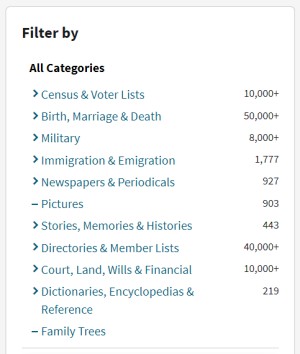
Screen grab of part of an Ancestry search page, showing categories of filters available. These include Census and Voter Lists; Birth, Marriage and Death; Military; and so on.

Search results can also be narrowed down by Category, which can bring to the fore records which otherwise don’t show up on the first page or two of results. If I’m thinking a man might have served in WW1 for example, I click on Military in the list of Category filters and see what comes up. Might they have left a will? Click on Court, Land, Wills & Financial. Did they maybe emigrate, or take trips overseas for business or pleasure? Click on Immigration & Emigration. Birth, marriage or death records not looking they relate? Click on Birth, Marriage & Death (and then filter further, down to an individual record set if need be) to see if a more focused search yields a more likely set of results.

Beyond Ancestry

A frequent (and accurate) refrain amongst genealogists who know the value of archives is “Not everything is online.” To which I must add, having looked so far entirely at one provider, “Not everything that is online is on Ancestry.” Even those records which Ancestry does have aren’t always easy to find, typically due to transcription errors. Some of the record sets on Ancestry are on other sites too, with different ways to search them, or more detailed indexing.

Because of this, while I’m working on a tree at Ancestry I usually have numerous other tabs open so that I can use other sites in parallel. FreeBMD ⇗ continues to stand the test of time when it comes to searching English and Welsh BMD records up to 1984. Because of its inclusion of mother’s maiden names in birth records and reported ages at death on death records right the way back to 1837, the GRO birth and death register indexes ⇗ are also indispensable. Shropshire BMD ⇗ is growing all the time and can help with finding the exact location of a marriage for which the two previous sites only give a registration district (and the same goes for the Staffordshire ⇗ and Cheshire ⇗ BMD websites).

Parish registers for Shropshire, Staffordshire, Cheshire and Wales – all of which are vital when researching the people who made their way to and from a north Shropshire parish – are online at Findmypast, a site which often enables me to find people on the census in a year in which I can’t locate them at Ancestry. (Once I’ve done that, I use the Piece, Folio and Page numbers to search the relevant census collection at Ancestry, and look for the mistranscribed name in the results – then I can at last attach the record to the relevant person’s profile.) FamilySearch ⇗, the Shropshire Archives collections catalogue ⇗, the British Newspaper Archive ⇗, Streetmap.co.uk ⇗, National Library of Scotland maps ⇗, Google and Google Books ⇗, the list goes on, and on (and it includes pages from this website!).

A montage of logos / brand names of some genealogy website: Free BMD, Find my Past, National Library of Scotland, FamilySearch, and The British Newspaper Archive.
Other websites are available!

Building families

As I follow the above processes I’m usually working not just on one person but the rest of their family too, adding them to the tree as I go. Some family members I add manually (perhaps after searching for relevant birth or baptism records), others are added automatically when census records (for example) are attached to an individual. Caution is needed with the latter approach. Post-1841 censuses recorded how people in a household were related to its Head – those described as sons and daughters of a male Head of a household were not necessarily all children of his then wife. Former wives (and their role as mothers) can all too easily be missed. There are many other pitfalls which can beset attempts to accurately reconstruct of families, but they are beyond the scope of this article. I hope to illustrate some of them with examples in later stories.

A line has to be drawn somewhere in adding people to a tree within the one-place forest, but I have no hard and fast rules about where I draw it. Ultimately I want to know about the connections within and between the families of those who were born in the parish or came to live there at some point, and what happened to those who left (as so many did), in order to better understand the influence of the family on these movements. I also want to pursue interesting stories when I see them. So for example when I found a Waters Upton family which had twins in two successive generations, I followed them a further generation back, before they lived in the parish, and found twins in that generation too (plus a family member who briefly worked as a servant in the village and so appeared there on a census!).

To conclude, although Ancestry is much maligned (sometimes by myself, and often with good reason), for working on family trees and finding records which help to map out and understand the lives of the people within them – including those in my Waters Upton one-place study – I wouldn’t be without it.

Note (added Feb 2026): Ancestry is always tinkering and messing about with the appearance and functionality of their family tree offering (sorry, I mean that their family tree offering is always evolving…). As a result, as time goes on, some of the images above, and some of my descriptions of processes used when building the Waters Upton tree/forest at Ancestry, have (and will) inevitably become outdated. I may come back at some point and update this article. In the meantime, you might be interested in Kinship, continued: The Waters Upton ‘Big Tree’.


Picture credits. Screen grabs from Ancestry: Used for illustrative purposes only, all rights remain with Ancestry.com. FreeBMD, Findmypast, National Library of Scotland, FamilySearch and The British Newspaper Archive logos: Composite image made from screen grabs from the respective websites, used for illustrative purposes only, all rights remain with the companies and organisations which own the logos.

John Morgan, surgeon and apothecary of Waters Upton – Part 1

John Morgan was not a native of Waters Upton (nor even of Shropshire), but he lived in the parish for almost three decades prior to his death in 1878. During that time, while conducting business as a surgeon and apothecary, he also took on two public roles. What’s more, he and his wife have descendants living in Waters Upton today.

Westcountry origins

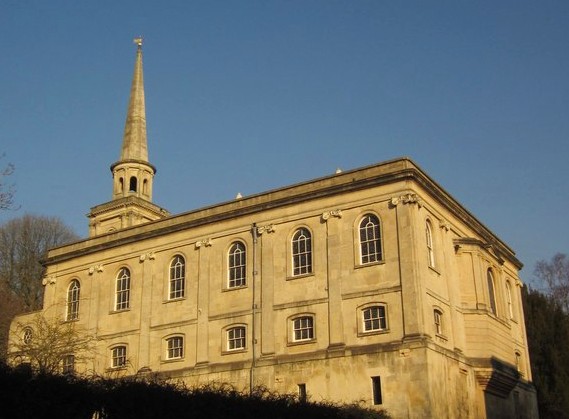
A colour photo of the church of Walcot Saint Swithin at Bath. This is a large building with three rows each of six of windows on the side wall. There is also a tower topped with a spire.

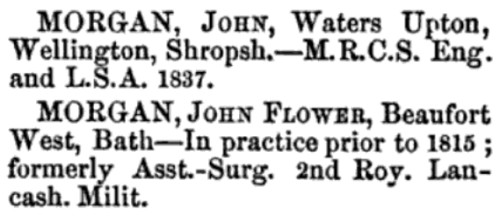
I have not found a baptism record which can be attributed with certainty to John, but census records show that he was born at Bath in the county of Somerset, probably in 1807 or in the early part of 1808. He may have been the John Morgan, born April 30th, who was baptised at Walcot St Swithin (pictured above). The register gives the father, also named John, the prefix “Mr.”, indicating that he was a gentleman, but names the mother as Mary. It is the mother’s name (which may of course have been recorded incorrectly) that doesn’t fit the known facts regarding John junior’s parentage: John Flower Morgan, “of the Parish of Walcotes in the City of Bath, a batchelor”, married ⇗ Rebecca Worrall of Kineton in Warwickshire on 24 Apr 1806 in the bride’s parish.

There seems to be no record of John Flower Morgan’s baptism either, but he is said ⇗ (by a source that is not altogether accurate about other aspects of his life) to have been a son of Philip Morgan and Mary Flowers, a couple who were married at Bristol St Philip & St Jacob on 12 January 1785. “John Flower Morgan, Gent.” was appointed as an Ensign ⇗ in the ‘Kington’ (Kineton) Volunteer Infantry in 1804. As John Flowers Morgan he then received a Commission as Lieutenant in the Royal Cheshire Militia ⇗ on 17 June 1808 (Gazetted 25 June 1808 ⇗). He later accepted an Ensigncy in the 2nd Battalion of the Lancashire Militia to which he was appointed on 21 Oct 1813 (Gazetted 22 January 1814 ⇗). One source ⇗ states that John served in that Regiment as a Surgeon’s Mate (Assistant Surgeon), but in a draft release ⇗ dated 25 March 1814 (at which time he was stationed at Plymouth) he was described as “John Flower Morgan, surgeon”. (His position as Assistant Surgeon – as we will soon see – is confirmed by later records.)

Family life continued alongside John Flower Morgan’s service in these various militia units. A second child, “Mariah, dr of John & Rebecca Morgan” was baptised at Kineton on 6 March 1809. Sadly, this happy event was evidently followed not long afterwards by the untimely death of Rebecca Morgan née Worrall. John took a second wife in a wedding held on 12 September 1812 at Wells in Somerset, the marriage register of which recorded the bride’s name as Mary Goldesbrough. This lady was “Mary Daughter of Mr. Edward Goldesborough and Rebekah his Wife born 4th. July” in 1786, who was privately baptised at Wells on 10 July that year and “received into the Church 18th. January 1787”. A family tree ⇗ published in Memorials of the Goldesborough family shows that Edward was a Postmaster, and that he had as elder brothers two clergymen, a Rear-Admiral – and two surgeons.

In addition to taking on John’s children by his former wife, Mary added three children of her own to the Morgan family. Charles Henry Morgan was baptised ⇗ at Wells on 8 May 1816; tragically, he drowned ⇗ at the Cleveland Pleasure Baths in Bath on 5 August 1840 aged just 23. He did at least live a lot longer than his sister Emma Charlotte Morgan: baptised ⇗ at Wells on 23 July 1818, she was buried there on 8 October that same year, having died at the age of three months.

By the time Frederick Williams Morgan was baptised on 28 September 1822, the Morgans had moved to Walcot, at Bath. Frederick survived into adulthood, married, settled in Leamington, Warwickshire and pursued a career as a dentist, according to information I have extracted (pun intended) from the censuses. John Flower Morgan meanwhile remained in his favourite part of Bath for the rest of his life, as was shown by his entry in successive editions of The London and Provincial Medical Directory – which always followed the entry for his son, John Morgan, M.R.C.S., L.S.A. The snippet below is from the 1857 edition ⇗ of that publication.

A small extract from the  London and Provincial Medical Directory of 1857 showing: Morgan, John, Waters Upton, Wellington, Shropsh.—M.R.C.S. Eng. and L.S.A. 1837. Morgan, John Flower, Beaufort West, Bath—Surg. to 2nd Roy. Lancash. Milit.

Getting out of Bath (or, One good Tern deserves another)

WATERS UPTON.
TO BE LET,
With immediate possession,
A Genteel RESIDENCE, situate in the pleasant Village of WATERS UPTON, the county of Salop, with two parlours in front, kitchen, back kitchen, cellar, pantry, and five good lodging rooms, with stable, cow-house, piggeries, and all other convenient out-offices, together with three acres of capital grass land. This is a very desirable situation for a small retired family, or a Medical Gentleman, as there is no one in the profession within six miles of the Village. The above premises have been recently built, and are in an excellent state of repair, and the situation is beautiful, having a commanding view of the Wrekin and surrounding country.—For further particulars, and to treat for the same, apply to Mr. Felton, Rowton, near Wellington, Shropshire; if by letter, post-paid.—This advertisement will not be continued.
Shrewsbury Chronicle, 2 October 1835, page 1.

Within two years of the above notice being published there was a ‘Medical Gentleman’ within six miles of Waters Upton. I doubt that the former led to the latter, although exactly why and when John Morgan came to settle in Shropshire I do not know.

The earliest evidence I have found of John’s presence in the county are records of his marriage ⇗ to Emma Woodfin at Stoke upon Tern in 1837 – the same year in which he became a Member of the Royal College of Surgeons and a Licentiate of the Society of Apothecaries. The marriage register stated that he, like his bride, was “of Stoke”. A notice of the wedding in the Shrewsbury Chronicle of 9 June 1837 (page 3) read: “23d. ult. at Stoke-upon-Tern, by the Rev. S. H. Macauley, John, eldest son of Mr. Morgan, surgeon, Bath, to Emma, only daughter of Thomas Woodfin, Esq. of Petsey, in this county.”

Extract from an Ordnance Survey map, showing Stoke upon Tern (near the top left corner), Eaton upon Tern  (just right of centre at the bottom of the image), and other settlements in the area including Peplow, Ollerton, and Childs Ercall.

Emma had been baptised in the same church some 20 years earlier on 27 July 1817. Her marriage there was followed in due course by the birth of her first child with John, a son named after his father (and grandfather). John junior was also baptised ⇗ at Stoke Upon Tern (on 12 April 1838), as was the next addition to the family, Sarah (baptised ⇗ 20 October 1839), who was named for her maternal grandmother. Both of these children were born at Eaton upon Tern, situated about 3½ miles south of Stoke. This is where the members of the Morgan family – John Morgan, age 34, a Surgeon, with Emma (25), John (3) and Sarah (2), plus three servants – were enumerated on the 1841 census. As the maps above and below this paragraph (both to the same scale) show, Eaton is closer to Waters Upton (less than 3 miles away) than it is to the village after which the parish it lies in was named.

Extract from an Ordnance Survey map, showing Waters Upton (at the bottom left corner), Eaton upon Tern (just right of centre at the top of the image), Great Bolas (on the road between the two villages already mentioned) and other settlements in the area.

Downriver to Waters Upton

Ten years later in 1851, the Morgans were enumerated in Waters Upton itself, a different parish, but still adjacent to the River Tern. They had not been there for very long – perhaps about four years. Four of the five children added to the family since the previous census were born at Eaton upon Tern and three of those were baptised at Stoke upon Tern. They were: Thomas (age 9, baptised ⇗ as Thomas Woodfin Morgan after his maternal grandfather on 26 September 1841), Rebecca (8, named after her paternal grandmother and baptised ⇗ on 20 July 1843), and Robert (6, baptised ⇗ as Robert Flower Morgan on 24 July 1845; his second forename presumably given in honour of his father’s paternal grandmother Mary Flowers).

Based on his age on the 1851 census (4), William Edward Morgan was born – at Eaton upon Tern – in 1846-47. He was not baptised there however, and neither, it seems, was his birth registered. Perhaps these matters were forgotten in the midst of a house move? This may be borne out by the fact that John Morgan’s name first appeared in the register of voters at Waters Upton in the 1847-48 edition of the register (for the Northern Division of Shropshire, prepared in the latter part of 1847). John was, incidentally, not an elector at that time but was named as the occupant of a freehold house and land which belonged to a Robert Blantern (and which entitled said Mr Blantern to vote there). John Morgan was listed as an elector himself in the electoral registers from 1850-51 onwards, but it was not until the register of 1860-61 that the location of the property he was renting from Robert Blantern became clear. “Herbert Bank”, otherwise known as Harbut or Harebutt Bank, was situated to the north-east of Waters Upton village on the road to Bolas.

William Edward Morgan was finally baptised at Waters Upton on 13 February 1848 – along with his older brother Robert Flower Morgan who had been baptised already at Stoke upon Tern!

The newest addition to the Morgan family recorded on the 1851 census was 11-month-old Emma, named after her mother. She was the first member of the family to be born in the parish of Waters Upton, and she was baptised there on 1 May 1850. One of the three servants in the household in 1851, Jane Wooley (actually Jessie Jane Wooley, or Woolley), was there specifically to look after baby Emma as she was employed as a nurse. (The other two servants in the household – Henry Cartwright, age 25, a groom and gardener, and Mary Cliff, 20, a house servant – went on to marry and raised their own family in Waters Upton – a story for another time.)

Distress and delight: the death and delivery of daughters

Sadly, little Emma was not only the first member of this Morgan family to be born at Waters Upton, she was also the first to die there – less than a week after the 1851 census was taken. On 11 April 1851 the death notices published on page 5 of the Shrewsbury Chronicle included the following: “5th inst. at Waters Upton, near Wellington, aged eleven months, Emma, daughter of Mr. Morgan, surgeon.” No hint there that nurse Woolley was in any way to blame thank goodness, but I wonder how the loss of the babe in her care affected her – not to mention the impact on the rest of the Morgan family. Infant mortality was commonplace at that time, but amongst other things I wonder how a surgeon and apothecary dealt with being unable to save the life of his own child?

The grief and the feelings of helplessness and loss that I imagine John and Emma Morgan experienced in 1851, were things they had to go through all over again the following year. This time it was their eldest daughter, Sarah, who was taken from them by death. “9th inst., aged 12 years, Sarah, eldest daughter of Mr. Morgan, surgeon, of Waters Upton, in this county”, reported the Shrewsbury Chronicle on 16 July 1852 (page 4).

At the time of her daughter Sarah’s death, Emma Morgan née Woodfin was pregnant with her next child. Mary Ann Morgan was baptised at Waters Upton on 24 January 1853 – with her mother named in the register as Hannah. And to add to the errors associated with the recording of Mary Ann, according to the General Register Office’s online index of births her mother’s maiden name was Woodvine!

It does not appear that the latter error described above occurred in respect of John and Emma’s next – and last – child, another Emma born, I suspect, in December 1857. I say this because I have not found a registration of her birth. She was however baptised, at Waters Upton, on New Year’s Day 1858 . . . although her mother was once again named as Hannah in the baptism register. John and Emma Morgan were most likely blissfully unaware of the above errors – and, even more importantly, delighted to have brought two healthy baby girls into the world after the sad loss of two of their other three daughters.

Part of the title page of a book published in 1858: The New Medical Act With Explanatory Notes for the Guidance of the Medical Practitioner and Student.

Having begun with the baptism of the daughter who completed John Morgan’s family, 1858 continued with a development of significance to John from a professional point of view. After years of campaigning and sixteen unsuccessful attempts over the previous eighteen years ⇗ to enact legislation on medical reform, the Medical Act was passed and the “legally qualified Medical Practitioner” was recognised by law. It is John Morgan’s life as a Medical Practitioner, Surgeon and Apothecary – to use the description he gave himself on the 1861 census – that I will look at in the next instalment of this article.

To be continued.


Picture credits. Walcot St Swithin, Bath: Photo © Derek Harper; taken from Geograph ⇗ and modified, used and made available for reuse under a Creative Commons licence ⇗. Extract from London and Provincial Medical Directory, 1857: Taken from digitised copy at Google Books ⇗ (original publication out of copyright). Maps showing Stoke upon Tern, Eaton upon Tern and Waters Upton: Extracts from Ordnance Survey One Inch map Sheet 138 ⇗ published 1899; reproduced with the permission of the National Library of Scotland ⇗ and used under a Creative Commons licence ⇗ (CC-BY-NC-SA) licence. Extract from the title page of The New Medical Act (published 1858): From a public domain work at Internet Archive ⇗.

Lucy Alice Wylde and her secret admirer

A puzzling postcard

“Has your #OnePlaceStudy been photographed?” As you might guess from the hashtag, this question was posed on Twitter. Pam Smith’s tweet prompted me to make another online search for old photos of Waters Upton, a search which turned out to be fairly fruitful. Not only did I find an old photo, I also happened upon an intriguing postcard sent to a young lady of Waters Upton, from someone who appears to have been a secret admirer.

The pictorial side of an old postcard, described in the text of the article.

The postcard was one of many being offered for sale on the British Family Tree Research ⇗ website, and naturally I soon snapped it up. As you can see, the front of the card has a black and white photo of a young man standing on one side of a garden fence, looking at a young woman standing on the other side. Below the photo the following verse is printed:

GOODBYE MY LADY LOVE.
So you’re going away, because your heart has gone astray,
And you promised me that you would always faithful be;
Go to him you love, and be as true as stars above;
But your heart will yearn, and some day you will return,
Goodbye my lady love, farewell my turtle dove,
You are my idol and darling of my heart;
But some day you will come back to me and love me tenderly,
So goodbye my lady love, goodbye.

Powerful stuff, so let’s go over to the other side of the postcard for the all-important details of the sender and the recipient. The lamenter of lost love was, as I suspected, anonymous. Not only was no name given, the message is almost illegible in places! That message simply said:

Thanks for paper
hope allis [= all is] well
from Your’s

The side of an old postcard bearing a message and the name and address of the intended recipient, detailed in the article.

OK, what about the postmark – a vital clue or a red herring? Well, it shows that the postcard was posted at Watford, in Hertfordshire, on 24 February 1906. Did the sender live in Watford but visit Waters Upton, or live in the latter and visit the former (through employment, or maybe because of family connections), or did the sender live in Waters Upton but know someone who lived in Watford, who agreed to post the card to make its origins more mysterious? The one person whose identity I knew, from the details provided on the BFTR website, was of course the addressee: Miss A Wylde of the Lion Inn, Waters Upton. Without a doubt Lucy Alice Wylde, who was known as Alice – presumably to avoid confusion as her mother’s name was also Lucy.

The life of Lucy Alice Wylde: part 1

Lucy Alice Wylde was born at Waters Upton in 1889, most likely in the Lion Inn; her birth was registered at Wellington in the second quarter of that year. She was the third child and first daughter of John and Lucy (née Strefford) Wylde, and appears with them at the Lion on the 1891 census, along her elder brothers Frederick and Joseph (twins) and younger sister Sarah Ann (aged 7 months).

Sadly, Lucy Alice and her siblings lost their father on 2 April 1900 (a headstone in Waters Upton churchyard surviving to tell the tale). Their widowed mother took on the running of the Lion, and she was enumerated in that capacity on the 1901 census, with her children Frederick, Joseph, Alice (the forename Lucy dropped by that time), Harry and Albert (but not Sarah who, as we will see, was staying elsewhere).

The Wellington Journal of 27 July 1901 shows that Alice took part in the Bolas and Waters Upton Flower Show, held on the afternoon of Friday 6 July. In the Children’s Division of the show she was awarded fourth place for her collection of grasses; if she entered a wild flower bouquet she was not placed. There were also sporting events held in conjunction with the show (reported on in the following week’s edition of the Journal), including egg and spoon races for married ladies and spinsters; Alice competed in the latter and came second.

The next event in Alice’s life that I know of was the delivery of the postcard from her secret admirer, which quite possibly prompted giggles from Alice’s siblings, and maybe blushes from Alice herself? Alice, who at that time was nearly 17 years old, may well have known who the sender was – but we can only guess. Was it perhaps William James or his younger brother Thomas, sons of Alfred James the butcher and his wife Ann, whose household was enumerated immediately before the Lion on the censuses of 1901 and 1911? Even if I had samples of handwriting to compare (sadly I don’t) it would probably be difficult to prove one way or the other. One reader of the first incarnation of this story suggested “a teasing card from female friends or [an] elder brother.”

In an attempt to find out more, I endeavoured to piece together what happened to Alice after 1906. The first part of this project was easy. By 1911 Alice had indeed left home and she was not with her family at the Lion Inn on that year’s census. Like her elder twin brothers, Alice had found railway-related work – she was enumerated at Manchester’s Central Station on Lower Mosley Street (pictured below in the 1910s) where she was one of seven single ladies working as bar attendants.

An old, sepia-toned photograph of Manchester Central Train Station. The station is in the background, the foreground being the street outside, with a cyclist on the road and around 20 people on the footpath.

The life of Lucy Alice Wylde: part 2

Alice’s life after 1911 was something which, at first, I was not 100% certain about. With the aid of Ancestry and then also Findmypast, I tentatively pulled together the following sequence of events. As all the records I have found use her full name, I too will from this point refer to Lucy by her original given name.

In the last quarter of 1919, the marriage of Lucy A Wylde and John Crompton was registered ⇗ in Wellington Registration District, Shropshire. Judging by his surname ⇗, John was probably a Lancashire lad whom Lucy met while working in that part of England; I think it very likely that the couple wed at Waters Upton, which was not only the bride’s native parish but also where her mother still lived and worked.

Very soon after their nuptials, the newlyweds emigrated. The passenger list for the Saxon, departing Southampton on 19 December 1919, included a Mr and Mrs J Crompton who were contracted to land at Cape Town. I have to point out that there are a number of things in this record which suggest that it relates to another couple – Mrs Crompton’s age is given as 20 (30 would have been more accurate), and the “country of last permanent residence” was indicated as being “British Possessions” for both parties (I have found no evidence of any previous periods abroad for either of them). However, Mr Crompton’s occupation was given as “Clerk”, and his age as 35, both of which tie in with later records.

On 31 May 1926 Lucy A Crompton, a housewife aged 37, arrived at London from Cape Town aboard the P&O Steamship Balranald from Sydney, Australia. The country of her last permanent residence was recorded as “Africa” – which of course is not a country. (As one of my former geography teachers said many years ago when someone gave “Africa” as an answer to a question, “Damnit man, Africa’s a big place!”) Lucy’s proposed UK address was the Grapes Hotel in Liverpool, but her intended future permanent residence was “Other parts of the British Empire”. Sure enough, on 2 September 1926, 37-year-old housewife Mrs Lucy Alice Crompton, whose last UK address was the Glasgow Arms Hotel in Deansgate, Manchester, departed London for Cape Town aboard the P&O Steamship Borda. Her country of intended future permanent residence was “S. Africa”.

A further brief visit to the UK was made in 1935. This time, 46-year-old Lucy Alice Crompton was accompanied by her husband, John Crompton, a Secretary, aged 50. The couple, whose last and intended future residences were South Africa and “Other parts of the British Empire” respectively, arrived at Southampton on 29 July, aboard the Carnarvon Castle (pictured below). Their proposed UK address – and these details are worth remembering – was “c/o Mr Doughty, 12 Hayes Ave, Bournemouth”. The Cromptons left just over a fortnight later, on the Carnarvon Castle’s return trip to South Africa which began when it departed Southampton on 9 August 1935.

Black and white photo of a steam-powered passenger liner, with two relatively short funnels, and masts for and aft. The vessel is heading towards the right.

Lucy A Crompton, aged 64, returned to the UK for what appears to have been the last time in 1954. The passenger list for the Edinburgh Castle shows that she arrived at Southampton on 9 April. John Crompton was not with her (I have yet to establish his fate, not to mention who he worked for in South Africa, and whereabouts in that country he and Lucy lived). Lucy was once again heading for 12 Hayes Avenue in Bournemouth – and she intended to remain in England permanently.

According to the National Probate Calendar for 1966, Lucy Alice Crompton of 18 Lansdowne House, Christchurch Road in Bournemouth died on 12 May that year at Christchurch Hospital. Probate was granted to the Westminster Bank, and Lucy left effects valued at an impressive £12,766.

Not a bad life for a publican’s daughter – assuming all the above records actually relate to ‘our’ Lucy Alice Wylde! How to be certain, without purchasing Lucy’s marriage certificate, or her death certificate, or perhaps a copy of the aforementioned will? I decided to follow the fortunes of Sarah Ann Wylde, the younger sister of Lucy, and see what information that turned up.

Wylde at heart: sister Sarah Ann

Sarah, as we have seen, was not with her siblings and her widowed mother at the Lion Inn, Waters Upton, at the time of the 1911 census. Instead, she was staying with her cousin William Lawrence Wylde (a son of Sarah’s late uncle Lewis Wylde) at 52 Stafford Street in Hanley, Staffordshire. William, incidentally, was a Beerhouse Manager, so his (public) house was, aside from being in an urban rather than a rural environment, ‘home from home’ for 10-year-old Sarah.

In my initial searches I failed to find Sarah on the 1911 census, but I managed to catch up with her in 1922 – on her wedding day. The marriage register of Stanmore Church in Middlesex, described by Ancestry as Harrow St John, shows that on 29 June 1922 Sarah Ann Wylde of Stanmore, a spinster aged 31 and a daughter of John Wylde deceased, married Albert Ishmael Doughty of Harrow, son of John Doughty deceased. John, who had retired from business, was a bachelor aged – wait for it – 56 (perhaps there’s hope for me yet!).

Extract from an Ordnance Survey map showing part of Bournemouth. The sea can be seen at the bottom of the map, with three piers jutting out into it. The land shown on the map is almost entirely built up, with grey blocks representing houseing and other buildings, and red, orange and yellow lines representing roads.  There is however some open space, including a golf course, around the top right corner.

Does the surname Doughty ring any bells? If it doesn’t, how about the address where Sarah and Albert were living when the National Identity Register was compiled in 1939? Albert I Doughty, a retired pawnbroker born 26 August 1865, and Sarah A Doughty, born 19 August 1890, were – along with Albert’s unmarried sister Marion – residing at 12 Hayes Avenue, Bournemouth (Hayes Avenue lies within the purple circle on the map above). Boom! Clear evidence that Sarah’s sister Lucy Alice Wylde had indeed married clerk / secretary John Crompton and emigrated with him to South Africa.

Albert Ishmael Doughty of 12 Hayes Avenue Bournemouth died on 28 November 1942; the National Probate Calendar for 1943 shows that probate was granted to the National Westminster Bank and that Albert effects were valued at a whopping £30,883 4s. 3d. His widow Sarah Ann Doughty, née Wylde, remained at the couple’s home in Bournemouth but died at Strathallan Nursing Home in Owls Road on 12 August 1962. She had evidently been the primary beneficiary of her late husband’s will, as her effects (according the National Probate Calendar of 1962) were valued at £26,901 14s. 5d.

So far away, yet so close

Lucy Alice and Sarah Ann, two sisters from Waters Upton, led very different lives, and for a large part of those lives were half a world away from each other. But despite the distance they were clearly very close to each other. Not only did they keep in touch, they also spent their last years in the same seaside resort on the south coast of England.

What of Lucy Alice’s secret admirer? That postcard wasn’t thrown away, it was kept and it was presumably only after Lucy’s death that it found its way into the old postcard trade, so it must have meant something. Well over a century after it was posted, it came to my notice and has led to a little of Lucy Alice’s life, and that of her sister Sarah, being explored and remembered. But who sent the card?

Thanks to genealogy guru Dave Annal (Lifelines Research ⇗), I think we now have a pretty good idea. Dave did a more thorough job of searching for Sarah in 1911 than I did, and guess where he found her? Living (and working as a general domestic servant) in the household of Ellen Hester Boulter at 2 Loates Lane in Watford, that’s where. Lucy Wylde’s ’secret admirer’ was her sister!


Picture credits. Postcard sent to Miss A Wylde: Posted in 1906 and therefore believed to be out of copyright. Central Train Station, Manchester: From a 1910s postcard and therefore believed to be out of copyright. The Union-Castle Royal Mail Motor Vessel “Carnarvon Castle”: From an out-of-copyright image at State Library of Queensland ⇗ (John Oxley Library), Australia. Map of Bournemouth showing the location of Hayes Avenue: Extract from Ordnance Survey One Inch map Sheet 179 ⇗; reproduced with the permission of the National Library of Scotland and used under a Creative Commons licence ⇗.

A fatal tricycle accident at Waters Upton – Part 2

⇐ Back to Part 1

PC Thomas Alexander Lee

Thos. Alexander Lee deposed: I am a police-constable, stationed at Waters Upton. On Tuesday night [11 August 1891], at 10-35, I saw William Matthews and the last witness at Matthews’s wicket [= gate]. There were two tricycles and a man on the ground. I asked “What’s up?” and Matthews said, “Sammy Dodd’s had a drop of beer and fallen off his machine.” I examined the deceased, but did not think he was hurt. The only mark I saw was a scratch on the hand. I saw that the machine was broken.
I went to my rooms, close by, and fetched some matches. Matthews also fetched light. While he was away I lit the lamp of the tricycle, and examined the deceased. I satisfied myself that no bones were broken. I told Matthews that if deceased was hurt it must be about his head, but I could find no marks. Deceased had been vomiting, and smelt strongly of drink. I asked him several times to get up, and he muttered that he should be all right directly if let alone. I was under the impression that he was drunk, and not hurt.
Matthews asked the deceased if he was going home, and he said something about bed. Matthews said, “What have you been doing, Sammy, to get into this state? I’ll not have you in my bed in this form, but I’ve plenty building, and will bed you down.” On that I left them. Owen followed me and said that deceased would be all right—that Matthews would look after him. I did not think deceased capable of going home, but I did think Matthews would take care of him.— [Questioned by] Mr. Superintendent Galliers: I knew deceased to be a friend of Matthews, and believed that Matthews would take him into his house.

Thomas Lee (Police Constable 107) was one of a number of people whose appearance on the 1891 census at Waters Upton was the only time they were enumerated at that place. He was a native of Whitchurch in Shropshire, where he was baptised ⇗ on 24 February 1864; his parents were farmer William Lee and his wife Mary, née Robinson.

Colour photo of 'The Old House' and neighbouring houses along a street in Whitchurch , Shropshire. Both The Old House and the adjoining house are lovely half-timbered buildings, with white- or lime-washed walls broken by vertical and horizontal black timbers.
The Old House in Whitchurch, Shropshire.

Newspaper reports of the proceedings of the Petty Sessions at Wellington in 1890 and 1891 give the (probably misleading) impression that PC Lee’s duties while stationed in Waters Upton revolved mainly around dealing with drunken patrons of the local hostelries. The earliest such report that I have found so far, in the Wellington Journal of 5 April 1890 (page 6), shows that PC Lee charged two men with drunkenness at Waters Upton on 22 March 1890. Later that year he charged one man with being drunk and disorderly at High Ercall on 11 September and two men for the same offence at Waters Upton on the 20th (Wellington Journal, 4 October 1890, page 3).

A variation on the regular theme was the man summoned by PC Lee to appear at the Petty Sessions on 15 December 1890 “for being drunk and asleep while in charge of a horse and trap on the 8th inst., on the road leading from Crudgington to Waters Upton”. It was ‘business as usual’ on Boxing Day however (two men drunk at Waters Upton, and in May 1891 Thomas charged two men with drunkenness in the village, and another with “being drunk and refusing to quit the Swan Inn, Waters Upton”. (Wellington Journal, 20 December 1891, page 6; 10 January 1891, page 2; 30 May 1891, page 3; and 13 June 1891, page 6.)

PC Lee was clearly used to seeing the effects of alcohol on people, but should he have known better in Samuel Dodd’s case? He did not remain stationed at Waters Upton for long after Dodd’s demise. A round-up of cases heard at the Wellington Petty Sessions on 28 September (Wellington Journal, 3 October 1891, page 2) indicates that he had been transferred to Wellington itself by then. I cannot help wondering whether this move was connected with his conduct on the night of Sam Dodd’s fatal accident, or if the timing was simply a coincidence.

At some point over the next ten years, Thomas and the Shropshire Constabulary parted company. He was enumerated in 1901 ⇗ at Whitchurch, his birthplace, where he was living with his sister (also unmarried) and working as a County Court Bailiff. The only thing that had changed when the 1911 census was taken (apart from Thomas’s age of course) is that he was living with his widowed mother Mary. The death of Thomas Alexander Lee, aged 68, was registered ⇗ in the Atcham Registration District of Shropshire in the last quarter of 1932.

Robert Nicholls, Joseph Jones, Walter Welsh and Jane Jones

Robert Nicholls said: I am a labourer, and live at Waters Upton. Yesterday morning, at five o’clock, I looked out of my bedroom window, and saw some one lying on the footpath. At half-past five I went out to see who it was, and found deceased lying on his side. He was then alive. I thought he was drunk. I spoke to him but he made answer. I called Joseph Jones, and he came and helped me to put him in a pigsty close by. Jones said thought deceased would be better after a lie down. Other people came and saw him, and I then left—[Questioned by] the Foreman: I have heard of deceased being drunk, and I thought he was drunk then. He breathed rather heavily.
Walter Welsh said: I am a blacksmith, and live at Waters Upton. Yesterday morning, shortly before six o’clock, I saw deceased in Matthews’s pigsty. He was breathing very heavily. I knew that Nicholls had put him in the pigsty. I did not know the deceased intimately, but have seen him drunk.
Jane Jones said: Yesterday morning I went into Matthews’s house. Deceased was there on sofa. Directly after I got into the house deceased passed away. I did not lay the body out I put him straight.

The 1891 census shows that Joseph Jones was a farm waggoner, and Jane was his wife. Both were residents of Waters Upton from the mid-1860s – I will return to them in another article. Robert Nicholls and Walter Welsh on the other hand were, like Samuel Owen and Thomas Lee, short-term inhabitants of the parish. I have written very briefly about Walter in Blacksmiths in Waters Upton – Part 2.

Robert Nicholls was born in the small settlement of Sleap, to the south of both Waters Upton and neighbouring Crudgington, and was baptised ⇗ at the parish church of Ercall Magna on 3 June 1855. He was named after his father, and like his dad he worked as an agricultural labourer.

The church of Rowton All Hallows. The stone-built church is partially obscured by a tree in the churchyard, but most of one end of the building, with a porch protecting its entrance and a small bell turret on the roof above, can be seen.
Rowton All Hallows.

Robert married Emma Teece in 1882, the wedding being registered ⇗ in the first quarter of that year in Wellington Registration District. (Emma, who was born and baptised in Waters Upton in 1856, has a story of her own to be told).

The 1891 census shows that the couple’s first two children were born at Rowton while the next two were born in Waters Upton, giving 1887 or thereabouts as an approximate timing for the family’s relocation. In similar fashion the 1901 census ⇗ suggests that the Nicholls family had moved to their next home, at Crudgington Green, in the middle of the 1890s; Robert was a waggoner at this time. They were still there in 1911, by which time Robert was a farm labourer again. The death of an 83-year-old Robert Nicholls, quite possibly this former Waters Uptonian, was registered in Wellington Registration District in the first quarter of 1939.

Medical evidence

Dr. George Hollies deposed: I am a physician and surgeon, practising in Wellington. Yesterday morning I received a telegram asking me to come to Waters Upton to a bicycle accident. I arrived about 11 o’clock. The man was then dead. He was lying on a couch in Matthews’s house. I made an external examination of the body. I found an abrasion on the back of the right hand, with sand and soil in the palm. There was also an abrasion on the left hand, and a slight abrasion on the left elbow. There was a slight scratch on the forehead, above the right eyebrow. I found blood mixed with sand and soil about three inches above the right ear. There was an abrasion of the scalp, larger than shilling. The scalp was swollen and bruised. I consider that such an accident as a fall from a tricycle would cause the injuries described.
From the evidence I have heard, and from the external examination I made, I should judge that the man died from compression of the brain, following concussion, but of course l am unable exactly say from mere external examination. It is difficult to say whether the exposure would have made any great difference in this case. No doubt the danger would be increased the fact of the deceased being moved about. I could not say that death was accelerated in this particular case. It is a common error to mistake the condition in which this man was for a state of drunkenness.

William Matthews’ deposition

William Matthews said: I am a sawyer, and live at Waters Upton. On Tuesday evening I and deceased went for a ride on our tricycles. We called at the Buck’s Head, Long Lane, had some drink there, and remained about an hour. We left about a quarter-past nine, and rode together to Crudgington Road. Deceased then went on in front of me.
I met Mr. Percival [Purcell] by the Post Office, and stopped to talk to him. Samuel Owen came to us by the Rectory, and told us that the deceased had been upset. I asked if he was hurt, and Owen said the machine was worse hurt than the man. I came down to my wicket. Deceased was then under the tree. I stayed with him for some time.
Afterwards Police-constable Lee came, and Owen left. I remained with the deceased until 11-30. I asked him stop with me, and he said he would go home. I did not think he was hurt. He had had some beer, but came as far as I rode with him all right, and I thought he was quite able to get home. I did not think that be wished to stop. I have seen him drunk before. I found him in my pigsty next morning about eight o’clock.
I went to try and get a conveyance to take him home, and sent a telegram to Dr. Hollies. I then got deceased into my house, and did all I could for him. I saw deceased’s father when he came. Dr. Hollies afterwards came, but the man was dead then. I have known and worked with the deceased for some time, and he was an intimate acquaintance of mine.
Colour photo of the Bucks Head at Long Lane. It appears that original two-bay, two-storey building was extended twice (to the left side as we look at it), with those extensions then having single storey extensions  of their own (one of them very modern looking) added to to their fronts. The building for the most part has white- or lime-washed walls.
The Buck’s Head at Long Lane as it appears today.

The verdict, and a reprimand

The Coroner then summed up, and the jury, after a short deliberation, returned a verdict to the effect that the deceased died from the result of injuries received by accidentally falling from a tricycle. They added a rider the effect that the witness Matthews was greatly to blame for not taking the deceased into his house, and requested the Coroner to censure him.—Matthews was then called in, and the Coroner severely reprimanded him for his conduct.

Was the censure of Thomas Matthews fair – was he really at fault? What would you have done in his position, and would it have made a difference? Hypothetical questions aside, would you recognise the symptoms of head injury and concussion ⇗ (and know what to do) if you saw them today?

After the inquest

Two letters appeared in the Wellington Journal of 22 August 1891 (page 3). One was sent by Samuel Dodd’s sister, Margaret Wood, of Bolas Magna. She had “worked the tricycle” from which Sam had fallen, back to Bolas Magna – and found it was in good working order. She expressed, in terms which made her distress and bitterness clear, her disbelief that anyone examining the machine could say it was broken, “unless the witnesses kindly mended the machine, whilst leaving my brother to mend himself.”

The other letter was submitted by “one of the jurymen”, who was sympathetic to those who had not been able to tell that Samuel Dodd had been suffering from concussion rather than the effects of drink. Concerned that “Waters Upton is situate five miles from any medical man”, he suggested that “ambulance classes in country districts” should be established. How wonderful that his proposal was, in time, acted upon by the Waters Upton resident whose home was used for Sam Dodd’s inquest (and who may have been the anonymous juryman). The following report appeared on page 8 of the Wellington Journal of 22 October 1892:

WATERS UPTON.
Ambulance Class.—An ambulance class in connection with the Wellington Technical Instruction Committee has been established here by Mr. Wm. A. R. Ball, and the first lecture was delivered at the schoolroom on Monday evening by Dr. Hollies, Wellington. The register contains 25 members, and 22 of these answered to their names. The committee consists of Messrs. Walter Dugdale, H. F. Percival, J. N. Cornes, Humphreys, the Revs. J. B. Davies, L. V. Yonge, and H. T. Tetlow. The secretarial part of the duties are performed by Mr. William A. R. Ball.

Picture credits. The Old House in Whitchurch: Photo by Wikimedia Commons ⇗ contributor Jaggery; modified, used, and made available for reuse under a Creative Commons licence ⇗. All Hallows church at Rowton: Photo © A Holmes; taken from Geograph ⇗ and modified, used and made available for reuse under a Creative Commons licence ⇗. The Buck’s Head at Long Lane: Photo © Row17; taken from Geograph ⇗ and modified, used and made available for reuse under a Creative Commons licence ⇗ licence.

A fatal tricycle accident at Waters Upton – Part 1

FATAL TRICYCLE ACCIDENT AT WATERS UPTON.
DYING, NOT DRUNK.
A fatal tricycle accident, under most painful circumstances, occurred in the village of Waters Upton, on Tuesday night. A carpenter named Samuel Dodd had been out with a companion, William Matthews, both riding tricycles. On their way they called at the Buck’s Head Inn, Long Lane, after which they returned towards home, Matthews and Dodd parting company at Crudgington Road, the latter proceeding on his way to his lodgings. Later on, Dodd was discovered on the side the road at Waters Upton, with his tricycle on the top of him, and in a partially insensible condition. Matthews and others, including a police-officer, subsequently came up, and arrived at the conclusion that Dodd was drunk. The unfortunate man was, under this impression, left where he fell, and it was not until the following morning that it was found he had sustained serious injuries, when he was removed to the house of Matthews, where he died.
Colour photo of two tricycles in a museum; one dates from the late Victorian period and the other a little later, possibly Edwardian.
Frankby Tricycle dating from 1880-1890 (left) and a Victorian/Edwardian Tricycle (right) at Clitheroe Castle Museum.

So began a detailed report in the Wellington Journal of 15 August 1891 (page 6), on the tragic death of Samuel Dodd three days before. Samuel was not a resident of Waters Upton. He was born at Wrockwardine in Shropshire and baptised ⇗ there on 18 December 1859; by 1871 ⇗ his family had moved to his father’s native parish of Bolas Magna. There they remained, with Sam ‘flying the nest’ some time after the census of 1881 ⇗ to move into lodgings. But Samuel was clearly well known in Waters Upton, his untimely demise took place there, and the events surrounding his death involved several of the parish’s inhabitants. We’re going to get to know some of those people in this story, starting with Samuel’s drinking (and tricycling) buddy.

William Matthews.

When the census was taken earlier in 1891, William Matthews was enumerated as an unmarried, 43-year-old sawyer living alone at Waters Upton. I have found no record of his baptism in the relevant register but William’s first appearance on a census schedule, in 1851, shows that he was the son of William Matthews senior, a cordwainer (or shoe maker), and Ann (née Hobson), and born about 1848. His birth was registered in the first quarter of 1848 at Wellington.

By 1861 William junior, age 13, was a shoe maker like his father, but ten years on in 1871 he was enumerated as an agricultural labourer. Over the course of the next decade he adopted another type of employment, one which he seems to have settled on, as the 1881 census (like that of 1891) shows he was working as a sawyer. He seems to have liked a drop of beer too, an aspect of his life that I will explore in more detail another time.

The Inquest begins

The next resident of Waters Upton to appear in the Wellington Journal’s report is someone else to whom I will have to return in another article. For now, I will simply say that William Abraham Richard Ball appeared on the 1891 census as a 42-year-old tailor, living with his Waters Upton-born wife and children.

An inquest on the body was held at the house of Mr. W. A. R. Ball, Waters Upton, on Thursday morning, before J. V. T. Lander, Esq., coroner, and a jury of which Mr. J. Cornes was foreman.—The first witness called was Thomas Dodd, who deposed: l am a gardener, and live at Bolas Heath. The body which the jury have just viewed is that of my son, Samuel Dodd, who was a carpenter, and 31 years of age. He was living in lodgings at Long Waste. I last saw him alive on Monday morning. Yesterday morning I was sent for to see him at Waters Upton. I came, and found him dead.
I saw Matthews, who said he and the deceased had gone out with their tricycles after leaving work, and went to Long Waste. Deceased stayed to get his tea at his lodgings, and then they both rode to the Buck’s Head Inn, Long Lane. After a time they left together on their way to Waters Upton. Matthews said deceased rode in front of him, and that he thought he had gone to my house at Bolas. He further added that he saw no more of him that night.
Matthews also stated that on his getting up next morning he saw the deceased in his pigsty, and that he was very sorry for it; if he had known what was the matter he should have taken him into his house. I asked Matthews what had killed my son, and he said he did not know. Matthews said they had had no beer except at the Buck’s Head, and that the deceased was not drunk.—[Questioned by] the Foreman: Matthews said they had worked the usual time, and afterwards went to the Buck’s Head.
Extract from a large-scale Ordnance Survey map showing Waters Upton at the top, Crudgington and Sleap a little to the South, Sleapford near the bottom right (Southeast) corner, plus 'Longwaste' (Long Waste) and Longdon upon Tern near the bottom left (Southwest) corner.
Map showing locations visited by Samuel Dodd on the evening before he died, including Long Waste, the Buck’s Head at Long Lane (centre of circle, between the fork in the road and the canal), and Waters Upton.

J Cornes, incidentally, was almost certainly Joseph Cornes of nearby Crudgington in the parish of Ercall Magna. Although he never lived within the parish of Waters Upton (as far as I know), he was buried there (in 1897); his gravestone and a little more information about him can be found on his Memorial Inscription page.

Samuel Owen . . .

. . . was the next to give evidence. Although he was recorded (with his wife and three young children) as a resident of Waters Upton on the 1891 census, he had not lived there for long, and would not remain there for much longer either. Born ‘next door’ in the parish of Ercall Magna in 1857, Samuel still had his abode there when he married ⇗ Rosa Fanny Mary Tanswell at nearby Wellington (where the bride lived, at Street Lane) on 9 September 1884. He was a joiner at that time, and a joiner still in 1891; the fact that his and Rosa’s eldest child Ellen was then, according to the census, 5 years old and born in Waters Upton suggests that the couple settled there very soon after they wed. Their other, younger offspring Emily (3) and Frederick (1) were also born in Waters Upton.

By 1901 however the Owens were living at Walton in Samuel’s native parish, with Samuel’s occupation recorded in the census ⇗ as “Joiner (Carpenters)”. The same census shows that the next child born into the family after Frederick (aged 11) was 8 year old Rosa junior, at Waters Upton. The births of younger sons Owen, Harold and Charles however, aged 6, 3 and 1 respectively, all took place at Walton, suggesting that they relocated to that hamlet sometime around 1893. With four of the aforementioned children plus another addition, John, the Owen family was still at Walton in 1911. Samuel’s death was registered ⇗ in Wellington Registration District in the last quarter of 1915; he was 57.

Let’s return to the Wellington Journal and find out what Samuel had to say about the events of the evening of 14 August 1891…

Samuel Owen deposed: l am a joiner, and live Waters Upton. On Tuesday night I left home about nine o’clock and went to the Swan Inn. I was returning home by the Post Office when I saw Matthews talking to the stationmaster, Mr. Perceval. I walked up the road with them. Matthews got off his tricycle and pushed it up the bank. At the top of the bank Matthews and the stationmaster stopped talking. I took Matthews’s tricycle and pushed it down the road, and as I came past Miss Walker’s I saw something on the right-hand side of the road, on the footpath, and I went to see what it was.
I found the deceased on the ground, and a tricycle on top of him. The tricycle was bent, and the wheel would not turn. I picked up the deceased and asked if he was hurt, and he replied, “None of your old tricks.” I told him the machine was broken, and he said, “Bother,” or something of that sort. He could walk with my assistance. I helped him to the wall and left him by it. I went to look for his hat, and when I came back I found he had been vomiting. I did not think he was hurt, but that he was drunk.
I went back to Mr. Perceval and Matthews and told them that “Sammy had had a spill.” They asked if deceased was hurt, and I said I thought the tricycle was smashed up more than Sam. Matthews then came with me to where the deceased had fallen from the wall, and was then in a sitting position against the wall. I asked deceased if he was going home, and he said, “Wait five minutes, and then I’ll come.” Police-constable Lee then arrived, and picked the deceased up, and said he thought he was drunk. I tried again to start him off home, but still he asked to be allowed to stop. Matthews was there, but I heard no mention of deceased’s going to Matthews’s house.
I did not know that deceased had been out with Matthews. Deceased made no complaint. I thought he was simply drunk, and that he had run against the kerbstone and upset the machine. Matthews had had beer, but he was not drunk, and seemed capable of taking care of himself. I left him with the deceased, who was then standing against the wall, and Matthews was talking to him. I heard Matthews tell him he had better go home. I quite thought he was starting home when I left. I have seen him before when he has been in beer, and have started him home several nights.

The stationmaster

Extract from a large-scale Ordnance Survey map showing the village of Crudgington and, to the South of it, the hamlet of Sleap., as well as the network or roads and lanes within and around those settlements. To the West of both settlements is a railway line, running North-northwest - South-southeast. To the the West of that railway a river (the Tern) follows a similar, though much more winding course. Another river (the Strine) flows from East to West across the map, between Crudgington and Sleap, to join the Tern near the bottom of the map.
Map published 1886 showing Crudgington, Sleap, and Crudgington railway station.

Who was Mr ‘Perceval’, the stationmaster? The only other trace of him I found when I searched the British Newspaper Archive was a report in 1889 in which it was mentioned that he sent flowers to the funeral of John Bertie Davies, who had been employed at the station as a telegraph clerk (Wellington Journal, 7 September 1889, page 8). There was a Mr Herbert F Percival living in Waters Upton in 1891, but he was a farmer. The nearby railway station – with its stationmaster’s house – was at Crudgington, situated south of Waters Upton and in the parish of Ercall Magna (the track and the station are now long gone, but the house and a railway bridge ⇗ remain).

The entry for High Ercall in the 1891 Kelly’s Directory ⇗ provided me with the answer: the name of the Crudgington stationmaster was actually James Purcell (which reinforces the old saying that you shouldn’t believe everything you read in the papers!). The Wellington Journal did at least get his name right in their edition of 31 October 1891 when they included “Mr. Purcell, the popular and obliging stationmaster at Crudgington” among those who attended a concert at Crudgington. The concert had been organised at James Purcell’s request, to raise money for the Widows’ and Orphans’ Fund of the Great Western Railway. Attendees included Waters Upton residents John Bayley Davies (the rector) – and the aforementioned Mr Percival (the farmer).

James Purcell, a Railway Station Master born at Cox Bank in Audlem, Cheshire, was enumerated on the 1891 census ⇗ at Crudgington. He appears to have knocked a few years off his age for that census – although he said he was 34, in 1881 ⇗ when he was a stationmaster at Adderley near Market Drayton, he was 27. We get to the truth by going back another ten years to the 1871 ⇗ census, when James was a railway porter living with his parents and siblings in the place of his birth and his age was given as 19: a son of shoemaker James Purcell and his wife Charlotte, née Worrall, James junior was baptised ⇗ at Audlem on 6 July 1851.

James’s employment took him to Shrewsbury in 1892, a report in the Wellington Journal of 26 November that year noting that: “Mr. Purcell has been stationmaster at Crudgington for upwards of 12 years [10 years at most in reality!], and his leaving seems to be generally regretted throughout the district.” James Purcell, 44, was still living in Shrewsbury when the 1901 census ⇗ was taken, and was employed as a railway clerk (or more specifically, as a “Railway Canvasser”). He remained in Shrewsbury and in that employment until his death on 26 March 1912.

On to Part 2


Picture credits. Victorian / Edwardian tricycles: Photograph by Mike Peel ⇗; taken from Wikimedia Commons ⇗, modified, used and made available for reuse under a Creative Commons licence ⇗. Map showing Waters Upton, Crudgington, Long Lane, and Long Waste: Composite image made from extracts of Ordnance Survey One-Inch to the mile map sheets 138 and 152 published 1899; reproduced with the permission of the National Library of Scotland ⇗ under a Creative Commons licence ⇗. Map showing Crudgington, Sleap, and Crudgington railway station: Extract from Ordnance Survey Six-inch map sheet XXIX.SE published 1886; reproduced with the permission of the National Library of Scotland under a Creative Commons licence ⇗.