Blacksmiths in Waters Upton – Part 2

⇐ Back to Part 1

James Ridgway, husband and father

He goes on Sunday to the church,
And sits among his boys;
He hears the parson pray and preach,
He hears his daughter’s voice,
Singing in the village choir,
And it makes his heart rejoice.

It sounds to him like her mother’s voice,
Singing in Paradise!
He needs must think of her once more,
How in the grave she lies;
And with his hard, rough hand he wipes
A tear out of his eyes.

— The Village Blacksmith, by Henry Wadsworth Longfellow, published 1840.

Illustration from 1885, showing an external view of the entrance to a smithy. The door is open and the blacksmith stands inside, behind a barrel and, next to that, a tall block on which stands and anvil. There are several horseshoes at the foot of the block. Outside, there is a tree, under which, and next to the smithy door, stands a horse.

James fathered six children in all. His first wife Ann née Jones bore him two daughters and three sons before her death, when aged just 39, on 6 March 1846. Those children were Harriet Ridgway (baptised 30 September 1838), Ellen (baptised 16 February 1840), William (baptised 17 October 1841), George (born in 1843, but no baptism record found), and James junior (baptised 26 January 1845).

None of these five children remained in Waters Upton. William did not stray far: like his father he became a blacksmith, but in a move which was the complete opposite of that made by James, after a spell of smithing at Ollerton (1861 census ⇗) he settled in Ercall Magna parish (1871 ⇗, 1881 ⇗, 1891 ⇗ and 1901 ⇗ censuses). William married ⇗ Emma Lawley, a daughter of fellow blacksmith Henry Lawley and his wife Jane, who I mentioned in Part 1 of this article. I did promise that I would return to them!

Ellen’s various jobs in service are took her to Staffordshire (1861 census ⇗), Yorkshire (1871 census ⇗), and quite possibly other parts of the country too (I have yet to find her on the 1881 census), before she returned to Shropshire and, like her brother William, settled in Ercall Magna (1891 ⇗, 1901 ⇗ and 1911 ⇗ censuses). Ellen did not marry. Her sister Harriet on the other hand wed ⇗ coach builder Richard Denchfield at Edgbaston, Warwickshire, on 24 May 1868, and lived with him at Balsall Heath (1871 ⇗, 1881 ⇗, 1891 ⇗, 1901 ⇗ and 1911 ⇗ censuses).

The Ridgway siblings who moved the furthest however were without doubt George and James junior, who emigrated to New Zealand and became farmers (a story for another time perhaps).

Some five and half years after the loss of his first wife, James Ridgway married ⇗ Harriet Mayne Knot, daughter of cooper Richard Knott, at Birmingham St Phillips on 3 November 1851. James stated that he was living in Bull Street at the time, but that was likely only a short term residence purely for the purposes of the nuptials.

Ridgway and Knott: Keeping it in the family

Harriet, incidentally, was James’s sister-in-law, his younger brother George Ridgway having wed ⇗ Harriet’s younger sister Elizabeth Mayne Knott on 29 December 1846, also at Birmingham St Phillips. George, whose baptism at Waters Upton on 30 May 1824 I have already mentioned, followed James’s example and became a blacksmith like their father, but he remained in Cold Hatton (1851 ⇗, 1861 ⇗, 1871 ⇗, 1881 ⇗ and 1891 ⇗ censuses).

I wonder how much of a surprise it was when Harriet discovered that she was pregnant and due to give birth to her first child at the age of 42. Charles John Ridgway was baptised at Waters Upton on 15 Apr 1855, and as we have seen he remained with his parents and entered the family business. He was enumerated as John Ridgway, a 16-year-old blacksmith’s assistant, when the 1871 census was taken, and as a fully-fledged blacksmith (26 and still known as John) ten years later in 1881.
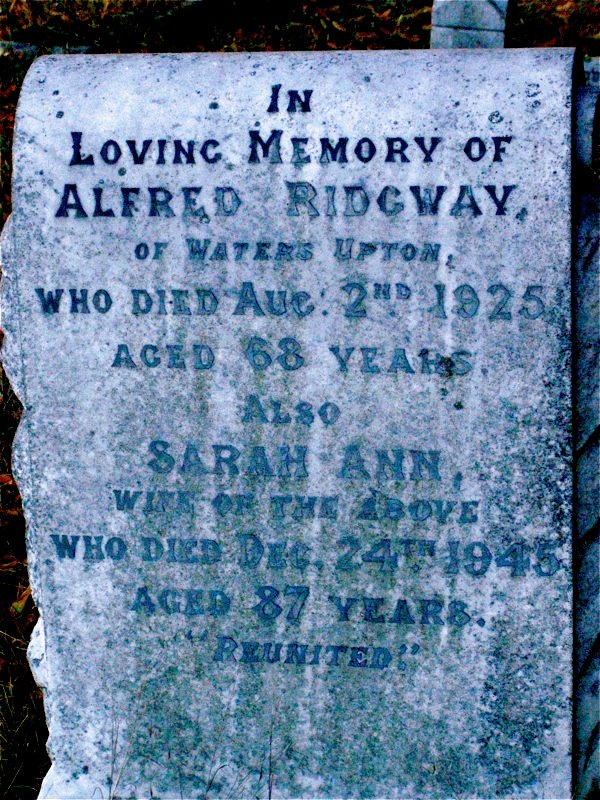
Photo of the gravestone of Alfred Ridgway of Waters Upton (died 1925 aged 68) and his wife Sarah Ann (died 1945, aged 87).

Another Ridgway family was also living in Waters Upton in 1881, headed by 26-year-old Alfred Ridgway. Alfred was James and Harriet’s nephew and (Charles) John’s double first cousin, a son of George Ridgway and Elizabeth, née Knott. He was a wheelwright, so it is entirely possible that he worked in conjunction with his uncle James and cousin Charles John at the Waters Upton Smithy. Like his uncle, after settling in Waters Upton he stayed there until he died. He appeared on the 1891 census as a wheelwright once more, but the censuses of 1901, 1911 and 1921 show that he had broadened his business and became a carpenter and wheelwright.

The 1921 census showed that Alfred was then living at 8 Waters Upton. An entry in the National Probate Calendar for 1925 ⇗ shows that he continued to reside at the same address up to his death (on 2 August that year). His wife Sarah Ann, née Woolley, survived him and was still living at Number 8 when the 1939 Register was taken on 29 September 1939. She lived right through the Second World War before following her late husband to grave on Christmas Eve 1945.

Carry On Smithing: Charles John Ridgway takes over

James Ridgway, blacksmith to the people of Waters Upton from at least 1837,  died on 24 February 1890 aged 78. Did he carry on smithing right to the end? In 1887 he was named as the occupier of “A FREEHOLD HOUSE and BLACKSMITH’S SHOP, with Garden and Appurtenances, situate in the Sandholes, in the village of Waters Upton” when these properties were once again put up for sale by auction. So it is entirely possible that he was still toiling at the forge in his mid-70s. On the other hand, it is perhaps also possible that as the senior Ridgway the occupancy of these properties would still have been under his name even if he had retired.

On James’s death, if not a little before, Charles John Ridgway took over the ‘family business’ and supported his widowed mother Harriet, who lived with him until her own passing on 21 March 1903 at the grand old age of 90.
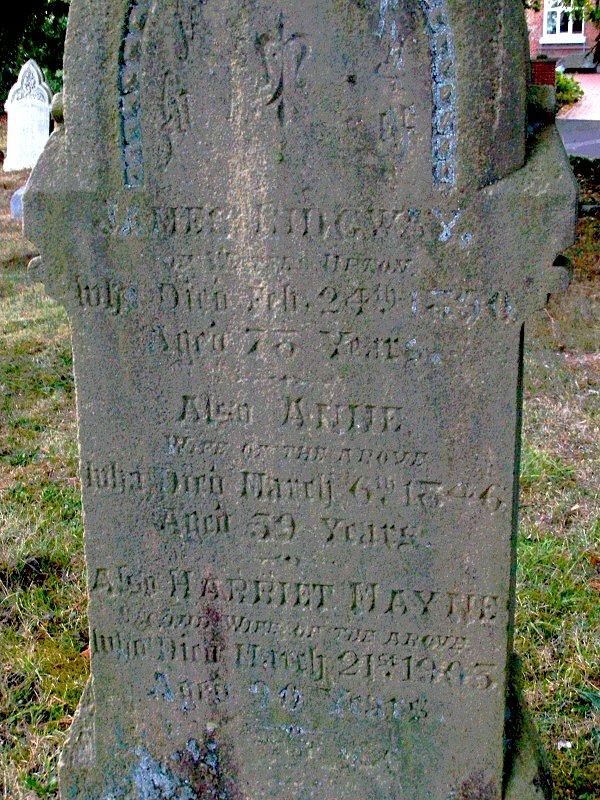
Photo of the gravestone of James Ridgway of Waters Upton (died 1890, aged 73), his wife Anne (died 1846, aged 39), and his second wife Harriet (died 1903, aged 90).

Under the name John Ridgway, he appeared in the 1891 census and in trade directories for 1891 and 1895 as the blacksmith of Waters Upton. He was not always the only blacksmith in the village during that period. An inquest held at Waters Upton in 1890 (about which I will shortly post an article) received evidence from, amongst others, Walter Welsh who began his short statement by saying “I am a blacksmith, and live at Waters Upton.” I suspect he was working at the Ridgway smithy, but had not been doing so for very long as he was not enumerated in the parish on the 1891 census. (He may have been the 22-year-old Walter G Welch living with his parents and a sister at Marbury in Cheshire when that census was taken; both he and his father were blacksmiths.)

By census time in 1901 Charles had reclaimed his original forename, being enumerated as Charles J Ridgway. And having reclaimed his birth name, for the most part he kept it. He was plain John in Kelly’s Directory of 1905, but appeared as Charles John Ridgway, blacksmith, in the directories of 1909, 1913, 1917 and 1922, and on the 1911 and 1921 censuses. Did he actually retire, or did he keep working to the end? He died, unmarried, at the age of 68, on 11 February 1924, leaving effects valued at £1803 19s 10d. I think it is fair to conclude that the Ridgway ‘Vulcans’ of Waters Upton lived long and prospered.

Toiling,–rejoicing,–sorrowing,
Onward through life he goes;
Each morning sees some task begin,
Each evening sees it close
Something attempted, something done,
Has earned a night’s repose.

Thanks, thanks to thee, my worthy friend,
For the lesson thou hast taught!
Thus at the flaming forge of life
Our fortunes must be wrought;
Thus on its sounding anvil shaped
Each burning deed and thought.

— The Village Blacksmith, by Henry Wadsworth Longfellow, published 1840.

Tools of the trade

At the time when I published this article in 2020, my searches of the British Newspaper Archive ⇗ have not produced any newspaper reports relating to the Ridgway blacksmithing business in Waters Upton. I had however found items relating to blacksmiths in Shropshire more generally, including the fact that when established rural smiths advertised for men to work for them, they tended to look for those who were “steady”, “used to country work”, and a “good shoer” or a “good nailer on”.

Since 2020, additions to the BNA have enabled me to find advertisements placed by the Ridgways of Waters Upton. James, in 1882, wanted “a steady Man, for the country; must be a good shoer, and one used to the implement trade preferred.” (Charles) John, when advertising for a young man to work for him in 1889, did not include any requirements regarding experience. In 1891 however, he stated that he wanted a young man who was “a good shoer. and used to country work.” He had identical requirements in 1899, 1903, and in 1919 (when he sought a “steady Man” rather than a young one).

I have still not found any references to the tools used by of Waters Upton Vulcans, so the notice I found relating to a sale by auction elsewhere in Shropshire, in 1884, is still the next best thing. The sale consisted of “a Capital Lot of BLACKSMITHS’ TOOLS (in good condition), excellent anvil (nearly new), 4cwt. 1qr. 15lbs; Pair of 36in. Bellows (with frame and piping), 4 Blacksmiths’ Vices, &c., 75 dozen new Horse Shoes (various), a 3ft, 6in. Grindstone and frame, Drilling Machines, and other useful lots.” (Wellington Journal, 12 April 1884, page 1.)

Postscript: After the Ridgways

Kelly’s Directories for 1926, 1929, 1934, 1937 and 1941 show that the successor to Charles John Ridgway as blacksmith of Waters Upton was John Leech. The 1939 Register provides more details: John H Leech, born 6 August 1897, occupation “Shoeing & General Smith” was living with his wife and children at 4 Hanford Terrace in Waters Upton. A native of Shrewsbury, by 1911 John Henry Leech was living with his parents and siblings in the parish of Stanton on Hine Heath. Aged 13, he was an apprentice wheelwright. Maybe he switched masters after that and became an apprentice to a blacksmith, or perhaps as a wheelwright he picked up metal working skills which stood him in good stead when he later turned his hand to shoeing and smithing. He died on 3 January 1982, his death being registered in Shrewsbury Registration District, and was buried at Waters Upton.

I ended the original version of this article with questions regarding John Leech and the final decades of the blacksmith trade in Waters Upton, and concluded by saying there was: “still more to find out before I can close the book on the blacksmiths of Waters Upton.” With information that has come to light since then I have answers to some of my questions, and possibly enough material for “Blacksmiths in Waters Upton – Part 3!”

Updated Feb 2026.


Picture credits. Blacksmith in his smithy: From an 1885 edition of Longfellow’s The Village Blacksmith; taken from the British Library Flickr photostream ⇗, no known copyright restrictions. Gravestones of Ridgway family members at Waters Upton: Both photos by the author.

Blacksmiths in Waters Upton – Part 1

V is for Vulcan

This article is an extended version of a post ⇗ I wrote as a contribution to the Society for One-Place Studies ⇗’ employment-themed A to Z Blogging Challenge in April 2020. One of the two letters I volunteered to cover was ‘V’. According to an online Dictionary of Old Occupations ⇗, “Vulcan [is] a term for a Blacksmith, possibly derived from the name of the Roman god”. So naturally I starting out by explaining: “I know what you’re thinking. I’m a big Star Trek fan, and it would be just my style to work out some way of shoehorning a green-blooded, pointy-eared alien into a one-place studies blog post! But as my Place is earth-bound Waters Upton, that would be illogical …”

A colour illustration of the interior of a blacksmith's shop in the late 1800s. The blacksmith is standing with his back to us, his right hand (holding a hammer) held high, while his left hand hold, probably with a pair of tongs, an item on top of an anvil (which itself stands on top of a square block). To the left is the blacksmith's forge, topped with flames.

Under a spreading chestnut-tree
The village smithy stands;
The smith, a mighty man is he,
With large and sinewy hands;
And the muscles of his brawny arms
Are strong as iron bands.

His hair is crisp, and black, and long,
His face is like the tan;
His brow is wet with honest sweat,
He earns whate’er he can,
And looks the whole world in the face,
For he owes not any man.

— The Village Blacksmith, by Henry Wadsworth Longfellow, published 1840.

The blacksmith, with his forge, hammer and anvil, is probably one of the first people we think of when considering village occupations – even a village as small as Waters Upton had one. The earliest evidence I know of confirming the presence of a blacksmith in the parish is a baptism recorded in the parish register covering the early 1600s, when one child’s father was described as a “blakesmith.”

Blacksmiths worked with iron to make everything from nails to horseshoes, and they repaired tools and farm implements, so their importance to the communities they served can easily be imagined. Many also worked closely with wheelwrights, as the wooden components of wheels for carts, wagons and carriages were held together by an outer rim of metal. Originally the metal took the form of strakes, lengths of iron which were nailed to the outside of wheels. In the mid-1800s however strakes were replaced by tyres, each one a single ring of iron made to fit the wheel tightly once it was cooled, with tire-bolts added to ensure it remained in place.

Death of a blacksmith

With the fires in their forges burning all day, blacksmiths were used to working in hot conditions. Not all blacksmiths received a warm welcome at Waters Upton however. According to newspaper reports, on the night of Sunday the 2nd of October 1785 “a very rash and fatal Affair” occurred when a blacksmith from Ruyton with the amazing appellation of Octavius Caesar Augustus Hithcot visited the Waters Upton watering hole of innkeeper John Gower (the surnames of these two were actually Hitchcock and Gore). Unfortunately “an Affray arose about some trifling Matters, when the Landlord took his Gun and shot the Blacksmith dead on the Spot.” Gower (Gore) then absconded, with a 10 guinea reward on offer for his apprehension. This is definitely a story which deserves its own post!

The Ridgway family of Cold Hatton

Thankfully Waters Upton’s own blacksmiths, at least in the 19th and 20th centuries, seem to have fared rather better. Prior to the census we can use the parish’s baptism register to trace some of those smiths – but only from 1815 when the new-style printed register (which recorded the occupations of all the fathers named therein) was adopted by the newly-installed incumbent Richard Hill. The first blacksmiths recorded in that register lived in the nearby hamlets of Cold Hatton and Rowton, situated in the adjacent parish of Ercall Magna.

Among the blacksmiths of that parish who had their children baptised at Waters Upton was John Ridgway of Cold Hatton, whose wife was named in the register as Ann. Their daughters Sarah and Charlotte were baptised on 27 February 1820, and that joint ceremony was followed by the baptisms of sons George on 30 May 1824 and Robert on 20 March 1827. I will return to the Ridgways later.

Extract from an Ordnance Survey map showing Waters Upton near the centre, with other nearby villages and hamlets around it (clockwise from top): Cold Hatton Heath, Great Bolas, Meeson, Crudgington, Sleap, Moortown, Rowton, and Cold Hatton. Plus roads and rivers. The map dates from the early 1800s.
Map showing Waters Upton and nearby settlements, including Cold Hatton, Rowton and Crudginton.

Humphreys, Fox and Robinson in Waters Upton

The first blacksmith who I can say for sure was a resident of Waters Upton in the 1800s was John Humphreys. He and his wife Elizabeth were living in nearby Crudgington (again in Ercall Magna parish) when their son Henry was baptised at Waters Upton on 22 April 1821. By 25 May 1823 however, when the couple’s next son, Ambrose, was baptised there, the family’s abode was Waters Upton. They were still there when daughter Rachael was baptised on 9 October 1825 – and when Elizabeth, wife of John, died in 1828; she was buried at Waters Upton on 4 January that year. At some point after his bereavement John returned to Crudgington with his children, where he was enumerated on the censuses of 1841 and 1851. His burial at Waters Upton, presumably in the same grave as his late wife, took place on 25 Oct 1857.

It appears that another blacksmith was working in Waters Upton for at least part of the period when John Humphreys was there (whether the two were competitors, or worked alongside each other, is unclear). Marianne, the daughter of blacksmith Richard Fox and his wife Elizabeth (née Jones), of Waters Upton, was baptised at St Michael’s on 11 September 1826. Two years later, on 8 September 1828, the same ceremony was performed for another Fox ‘cub’, Martha.

Richard Fox was from neighbouring Great Bolas (he was baptised there on 31 Aug 1806 ⇗), to which place he returned and where he continued working as a blacksmith. He is recorded there on the censuses of 1841 ⇗, 1851 ⇗ and 1861 ⇗. The schedule for the first of those three censuses also records ⇗ Richard’s widowed mother, Justina Fox, living close by – her age given as 70, and her occupation as Blacksmith. Was she wielding a hammer, or operating her late husband’s business with others (primarily her son Richard) doing the actual smithing?

After Humphreys and Fox, no more Waters Upton blacksmiths appear in the baptism register until 2 March 1833, at which point it seems the village forge was being tended by a Thomas Robinson.

Vickers and Buttery of Rowton and Lawley of Cold Hatton

Another gap follows, during which time it is not clear who the village blacksmith was. Three baptisms for children of two more blacksmiths living beyond the parish boundary are worthy of mention here. On 17 April 1835 Wright Willett, the Curate, seethed as he recorded the baptism of Elizabeth the illegitimate daughter of George Vickers and Ann Buttery of Rowton. He described George as a “Blacksmith & Married Man!!!” and Ann as a “Widow & Sister in law to Vickers!!!” (It looks like the wayward Ann’s late husband had followed the same trade, as Mary, daughter of Joseph Buttery, blacksmith, and Ann, of Rowton, had been baptised at Waters Upton on 12 Sep 1830.)

The other two baptisms of a blacksmith’s babies that I want to mention are those of Andrew and Ann, children of Henry and Jane Lawley of Cold Hatton, which took place on 8 June 1834 and 27 Mar 1836 respectively. The Lawleys will feature in this article again, in connection with the Ridgway family – to which I will now return.

James Ridgway, blacksmith of Waters Upton

Week in, week out, from morn till night,
You can hear his bellows blow;
You can hear him swing his heavy sledge,
With measured beat and slow,
Like a sexton ringing the village bell,
When the evening sun is low.

And children coming home from school
Look in at the open door;
They love to see the flaming forge,
And hear the bellows roar,
And catch the burning sparks that fly
Like chaff from a threshing-floor.

— The Village Blacksmith, by Henry Wadsworth Longfellow, published 1840.

James Ridgway was an elder son of the above-mentioned John and Ann Ridgway of Cold Hatton, and was baptised at Waters Upton on 10 March 1811. He followed in his father’s footsteps by becoming a blacksmith, and he took his trade with him when he moved to Waters Upton. I don’t know exactly when he ‘set up shop’ there, but he was a resident of the village by 1837 when he married Ann Jones at Cound in Shropshire on 20 June.

The Tithe Commutation records and map for Waters Upton produced in 1837 show that James Ridgway occupied a “House Buildings & Garden” on the North / West side of the village’s main thoroughfare which was owned by George Jones. The “Smith’s Shop” occupied by James, more or less directly opposite on the South / East side of the road, was owned by John Dickin Esq (one of the larger landowners in the parish, with quite a few tenants). Both of these properties are shown (numbered 101 and 150s respectively) on Tithe Apportionments – Houses etc.

Extract from a large-scale Ordnance Survey map showing part of the village of Waters Upton. The Church, Rectory, Smithy, Swan Inn, and other, unnamed houses and buildings can be seen.
Map showing the Smithy in Waters Upton, and the house across the road which was occupied by James Ridgway and his family.

In May 1848 the properties occupied by James were put up for sale by auction, and were described as “Lot 2.—All that BRICK and TILE DWELLING HOUSE, erected within a short period, together with the Blacksmith’s Shop, Pent-house, Piggeries, Gardens, Pond, and Croft of Land thereto adjoining, pleasantly situate, and adjoining the Turnpike Road in Waters Upton aforesaid, containing by admeasurement 2R. 11P., now in the several possessions of Samuel Tudor and James Ridgway. This lot is exceedingly well situated for a Blacksmith […]”. The sale did not mean that James’s occupancy of the house and blacksmith’s shop came to end, in all probability the only impact was that he paid rent to someone else afterwards. One question I have, given that the dwelling house was said to be “erected within a short period”, is how long had the blacksmith’s shop been in that location?

Census records (for 1841, ’51, ’61, ’71 and ‘81) and trade directories (for 1851, ’63, ’71 and ‘80) show that James Ridgway remained in Waters Upton, working as a blacksmith, for the rest of his life. The only other blacksmiths I have discovered pursuing the same trade in the village during that time were Henry Cheshire (wife Elizabeth), who probably worked briefly for James and whose son Charles was baptised on 14 November 1848, and James’s son Charles John Ridgway.

Updated Feb 2026.

On to Part 2


Picture credits. Blacksmith’s shop, late 1800s: Painting by Albert Brument; public domain image taken from Wikimedia Commons ⇗. Map showing Waters Upton and nearby settlements: This work is based on data provided through www.VisionofBritain.org.uk ⇗ and uses historical material which is copyright of the Great Britain Historical GIS Project and the University of Portsmouth; it is used under a Creative Commons ⇗ licence. Map of Waters Upton showing the location of the smithy: From Ordnance Survey 25 Inch map XXIX.8 published 1901; reproduced with the permission of the National Library of Scotland ⇗ under a Creative Commons licence ⇗

Analysis: The 1841 census of Waters Upton (Part 2)

⇐ Back to Part 1

Employment

Work in Waters Upton: who was engaged in it, what types of employment were there, and – in the case of jobs ‘in service’ – who provided that work, in 1841? These are questions I set out to answer by analysing data from the census.

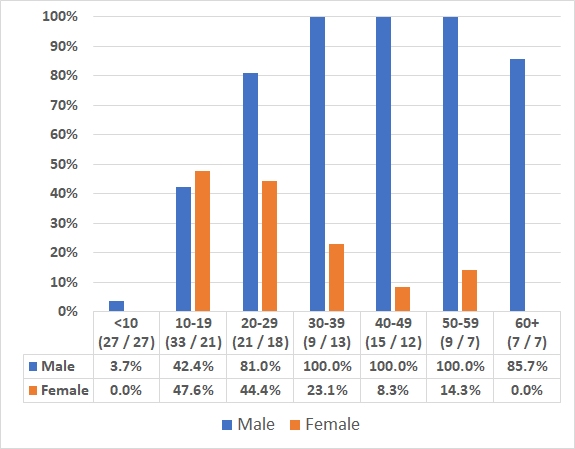
A twin bar chart based on data from the 1841 census of Waters Upton, showing the proportion of males and females recorded as being in employment, broken down into 10 year age groups. Further explanation in article.

Employment rates for those enumerated on the 1841 census at Waters Upton, broken down by age and sex.

It is readily apparent from the chart above that gender and age were major factors determining whether or not you were in employment – as recorded by the census – in early Victorian Waters Upton. You were highly unlikely to be working if aged under 10 whatever your gender – unless you were a 9-year-old boy named Levi Woolley, in which case you were employed as a servant by farmer Charles Allen.

In the age group 10-19, between 40 and 50% of both males and females were in work, with a slightly higher proportion of females (though this difference may not be statistically significant). From age 20 upwards there were sharp differences between the sexes in their rates of employment. 81% of men (17 out of 21) aged 20-29 and 100% of men aged 30+ were earning a crust in one way or another, with one Thomas Shuker (aged between 70 and 74, and of independent means) being the sole exception.

For women, rates of employment (employment in fields deemed worthy of inclusion on the census at any rate) began to fall once the age of 20 was reached. Not by much at first – from 47.6% (10 out of 21) in the age group 10-19, to 44.4% (8 out of 18) in the 20-29 range – but then down to 23.1% (3 out of 13) at 30-39 and less than 20% from 40 to 59. None of the 7 women aged 60 or more who were enumerated at Waters Upton in 1841 (2 of whom were, like Mr Shuker, of independent means) were employed.

Marriage and motherhood no doubt played a large part in the different rate of adult employment for women compared with men. You can bet your life however that many of those apparently unemployed women were working very hard indeed, and not just bringing up the children and carrying out ‘domestic duties’ or ‘household work’. With regard to the wives of farmers, for example, Joseph Plymley in his General View of the Agriculture of Shropshire (published 1813) quoted a Mr Price as saying:

[In] the farm-houses, there seems to be a greater exertion of industry than I have remarked in most other counties. Besides brewing, baking, providing for the family, where workmen are maintained in the house, and managing the dairy, the farmer’s wife, with the assistance of her maid-servants, in the evenings, at spare hours, carries on a little manufacture, and gets up a piece of linen cloth for sale, every year. [Page 123]

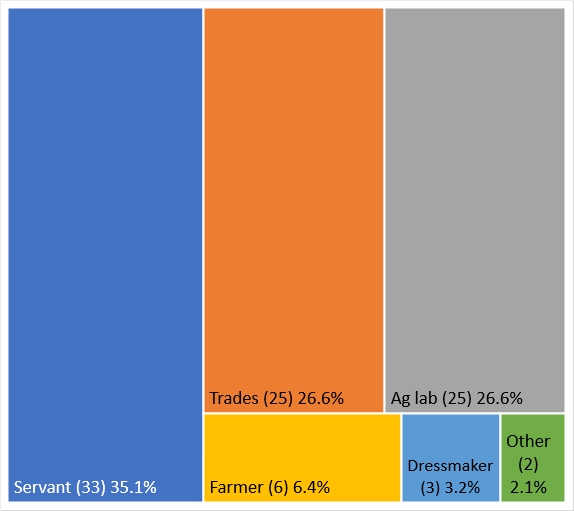
A chart, based on data from the 1841 census of Waters Upton, showing the number and proportion of those recorded as in work, in six categories of employment. Further explanation in article.

Types of employment in which those enumerated on the 1841 census at Waters Upton were engaged. The area of the chart taken up by each type equates to the percentage of those 94 people in employment who were engaged in them. With numbers and percentages shown for each type.

This chart provides a broad overview of the types of work in which the working population of Waters Upton (41.6% of the total) was engaged in 1841. Just over a third of all of those in work were servants, a type of employment I will explore in more detail shortly.

The next most ‘popular’ fields of employment were, each giving work to slightly more than a quarter of the working population, were the humble and ubiquitous agricultural labourer, and what I have called ‘trades’. Both of these areas of work were male-dominated, to the almost total exclusion of women – the only women working in either of them being Ann Morris, who like her husband William was recorded as an ‘Ag Lab’.

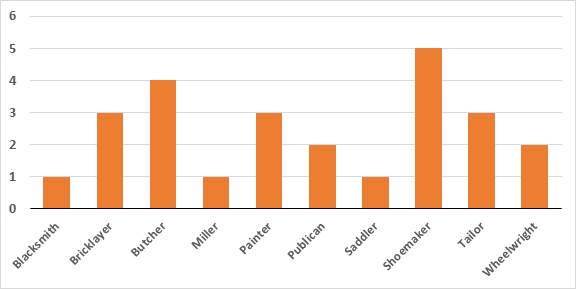
A bar chart, based on data from the 1841 census of Waters Upton, showing the number of people employed each type of employment in my category of 'trades' (blacksmith, bricklayer, butcher, miller, painter, publican, saddler, shoemaker, tailor, wheelwright). Further explanation in article.

A breakdown of the numbers engaged in the various occupations included in ‘trades’.

The trades, as I have termed them, included a variety of different occupations. The majority of these were skilled or semi-skilled and would earn their practitioners a place in the lists of trades people in the county directories which became increasingly popular during the Victorian era. Clustering these occupations together in this way certainly makes for a much less cluttered employment types chart!

6 men in Waters Upton were described as farmers on the 1841 census, a ‘field’ of employment (pun intended) very much limited by the small size of the parish. The remaining workers were 3 dressmakers (all female, ages given as 15, 20 and 35), a schoolmistress (the widowed Harriet Woolley), and the parish clergyman William Corfield (who could in fact be considered as a farmer, as his position brought with it some 35 acres of farmland for his use).

Servants

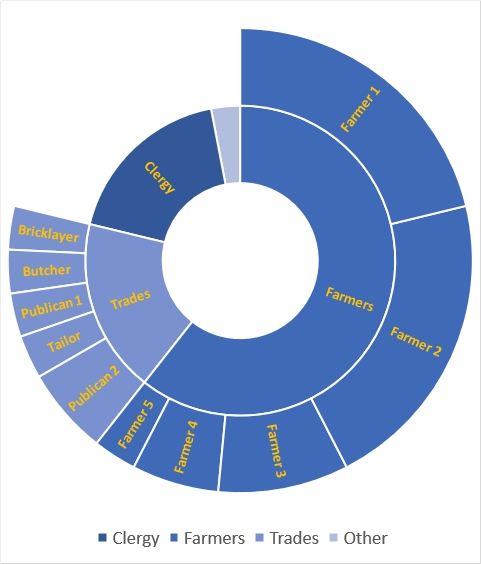
A ring chart, based on data from the 1841 census of Waters Upton, showing the proportion of servants employed by people in four categories of employer (farmers, trades, clergy, and other). Further explanation in article.

Employers of the servants enumerated on the 1841 census of Waters Upton. Each of the smallest segments on the outer ring represents one servant employed by an employer, with the larger segments in proportion.

I said I would return to the servants, and here we see who employed them. The majority worked for the parish’s farmers, those identified as farmers 1 through to 5 being: John Dickin (7 servants), Thomas Whitfield (also 7), Thomas Matthews (3), Charles Allen (2, including the above-mentioned Levi Woolley), and John Brown (1 servant) respectively. Honorary farmer William Corfield, the Rector, employed 6 servants, who were probably divided between domestic and farming services. A further 6 servants were in the employ of 5 of the parishioners who were engaged in trades, including both publicans. Finally, in the inevitable ‘Other’ category, man of (independent) means Thomas Shuker employed 14-year-old Staffordshire-born Mary Pritchard to assist in the household he occupied with his wife Charlotte.

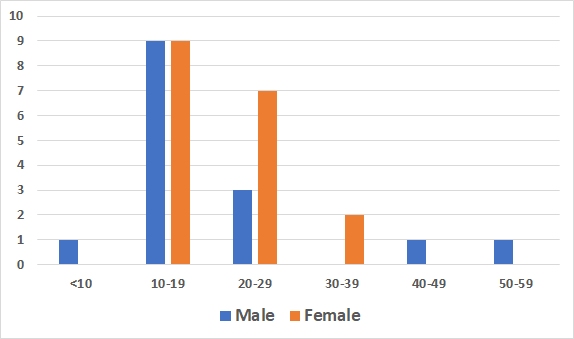
A twin bar chart, based on data from the 1841 census of Waters Upton, showing the number of males and females in 10 year age groups (under 10 to 50 - 59) employed as servants. Further explanation in article.

Numbers of servants on the 1841 census at Waters Upton, broken down by age and sex.

Finally in this section, a closer look at servants which provides information of some relevance to the employment rates (for females in particular) in the age groups of 10-19 and 20-29, and also to migration in those age groups.

All but 5 of Waters Upton’s servants in 1841 fell into the 20 year age range of 10-29. Of the 10 females aged 10-19 who were employed – none of whom were born in the parish – 9 were servants, and all but 1 of the 8 women in the 20-29 age group – only 1 of whom was born in the parish – were also servants.

The situation for males was rather different, with 9 out of 14 working 10-19-year-olds employed as servants (5 of the 14, of whom 2 were servants, were born in the parish), and only 3 of 17 working 20-29-year-olds (6 of the 17, only 1 of whom was a servant, were born in the parish).

All of which leads us quite neatly on to…

1841 to ’51 – who were the ‘remainers’?

(Maybe I should have given this section a more scientific-sounding title like ‘Residential fidelity’?)

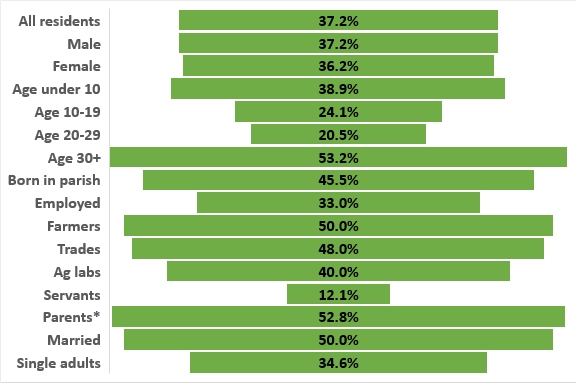
A chart, based on data from the 1841 and 1851 censuses of Waters Upton, showing the percentage of people in each of 16 categories who were enumerated in the parish in both 1841 and 1851. Further explanation in article.

Percentages of various categories of people enumerated on the 1841 census at Waters Upton, who were also enumerated in the parish on the 1851 census. ‘Parents’ I defined as those who, whether married or single, had children aged under 20 at home with them.

As my 1841 census abstract includes links to the 1851 abstract for those who were also present at Waters Upton on the latter census, it was an easy task for me to identify the ‘remainers’ (or in some cases perhaps, to borrow an expression from family historian John Titford ⇗, the ‘bounce-backers’) and add that information to my 1841 census spreadsheet. And then to analyse the data to see if there were any factors which made people enumerated in 1841 more or less likely than on average to remain, or return…

As you can see, the average percentage of all residents of 1841 who were also present in 1851 was 37.2%. Of the 15 categories of people from 1841 which I looked at, there were several for which there was no significant difference from that overall rate of ‘remaining’. These were: sex (male or female), age under 10 in 1841 (only a slightly higher likelihood of remaining), working as an agricultural labourer in 1841 (just slightly more likely to remain), employed (regardless of employment type) in 1841 and single adult in 1841 (both of the latter giving a slightly lower likelihood of remaining).

Natives of Waters Upton who were present in the parish in 1841 were rather more likely to remain (6% more than the average), while those who were married, or parents, were significantly more likely to enumerated there again in 1851 (many people in the former group would also have fallen into the latter). The ‘remain rate’ for these categories (50% and 52.8%) was very similar to that for the 30+ age group (see next) – a category with which there was likely to have been a fair degree of overlap.

Those aged 30+ in 1841 were significantly more likely to stay (53.2% in this category remained), perhaps because many of them had by that age established strong ‘roots’ – such as ties of kinship and/or security of employment – in the community. I have not divided this category further in the chart above because I found very little difference between the various 10-year age groups within it.

Those aged from 10 to 29 in 1841 on the other hand were significantly less likely to remain, with 20-29-year-olds showing even less attachment than the 10-19-year-olds. People in both of these groups were, I suspect, more likely to leave to take up work elsewhere and, particularly in the 20-29 age group, to join marriage partners and raise a family in a location which could accommodate them.

Regarding work, we have already seen that being employed in itself made a person less (but not significantly less) likely to remain, while being an ‘ag lab’ only very slightly raised a person’s chances of staying. Employment in certain other categories did however make a significant difference, with those engaged in trades much more likely to remain. The same goes for farmers, although with only 6 of them in the parish that conclusion can only be accepted with caution (if just one more had left, their remain-rate would have dropped to 33.3%).

Of all the categories I have examined, servants were the least likely to stay in the parish – just 12.1% of those enumerated in 1841 were still in Waters Upton (as servants or otherwise) ten years later!