Coronation celebrations at Waters Upton in 1902

The celebration of the Coronation of the King was observed in several places in Shropshire and the district, but the proceedings were of course shorn of many attractions, and were mostly confined to Intercessory services in the various places of worship, and the treating of old people and children.
Wellington Journal, 28 June 1901, page 11.

Non-Coronation celebrations

The coronation of King Edward VII and Queen Alexandra ⇗ was originally scheduled to take place on 26 June 1902. Elaborate preparations had been made and foreign dignitaries had gathered, but a last-minute medical emergency forced the pomp and pageantry to be postponed. Just two days before the big event, Edward ended up on a table in Buckingham Palace’s Music Room, where surgeon Sir Frederick Treves performed an operation to drain his Majesty’s abdominal cyst.
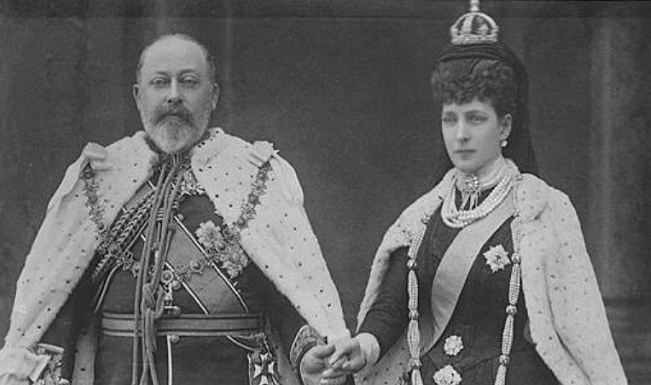
Although the coronation itself could not proceed as planned, Edward insisted that this should not prevent regional celebrations (and the serving of special dinners to 500,000 of London’s poor) from going ahead. It was in these circumstances that somewhat muted celebrations took place in Shropshire. Let’s return to the Wellington Journal of 28 June 1901:

WATERS UPTON. This little village was not behind in its demonstrations of loyalty, as the proceedings on Thursday fully testified, although the jubilation was naturally not so intense in the circumstances of the King’s illness.
The following admirably carried out the arrangements:—The Rev. L. V. Yonge (rector of Rowton, chairman), the Rev. J. B. Davies (rector of Waters Upton), Mrs. Yonge, Messrs. W. Jervis, B. Needham, J. Shakeshaft, R. Allen, H. J. Jones, A. H. James, A. Ridgway, S. T. Bennett, S. Woolley, and W. A. R. Ball (secretary and treasurer).
At 2-15 p.m. a large procession was formed in the School Yard, and, headed by the Waters Upton Brass Band (conducted by Mr. J. Davies), marched to the Parish Church, where Divine service was held. This being concluded, the village, which was gaily decorated, was paraded, the procession eventually moving to the residence the Rev. L. V. Yonge.
During the afternoon every inhabitant of the village was regaled with a plentiful supply of meat, together with three pints of ale for each adult male, whilst ample provision was made for abstainers. For the women an excellent and abundant tea was provided.
All having feasted to their hearts’ content, a capital programme of sports and amusements was carried out and much enjoyed until seven o’clock, when dancing was spiritedly indulged in and kept up till half-past 10, at which time all joined in singing with loyal heartiness “God save the King”, fervent hopes being expressed for his Majesty’s speedy recovery.
The proceedings were brought to a close with ringing cheers for all who had taken part in promoting the festivities of the day. Mrs. Rider of Crescent House, Wellington, with her usual generosity, presented each child in the parish with a Coronation medal, and Mrs. Yonge liberally supplied the men with tobacco and cigars.

Committee members, music, and medals

What a great line-up of local talent on the organising committee for these celebrations! Two clergymen (Lyttleton Vernon Yonge and John Bayley Davies), a clergyman’s wife (Elizabeth Mary Hombersley Yonge, née Groucock), five farmers (William Jervis, Bernard Morrison Needham, John Shakeshaft – who was also a corn and coal merchant, Richard Allen, and Henry James Jones), a butcher (Alfred Henry James), a carpenter and wheelwright (Alfred Ridgway), a shoemaker (Samuel Thomas Bennett), a railway platelayer (Samuel Woolley), and a former tailor who became the local relieving officer and registrar of births and deaths (William Abraham Richard Ball). All were enumerated at Waters Upton on the census of 1901 – I have hyperlinked each of their names to their household’s entry on my abstract of that census.
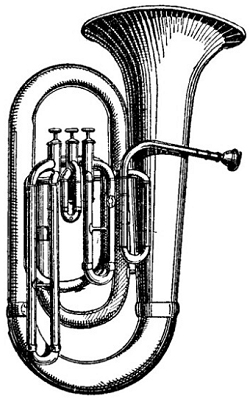
As for the Waters Upton Brass Band, how I wish I could find out more about it. I think it likely that the band’s musicians were drawn not just from Waters Upton but also from neighbouring villages and hamlets too. The band leader, for example, was almost certainly the John Davies who was master of Crudgington School from around 1880. The earliest mention of the band I have found so far was in the Wellington Journal of 8 June 1889. The paper reported that “The Waters Upton Brass Band, under the able leadership of Mr. John Davies,” marched as part of a procession celebrating the anniversary of the Waters Upton lodge of Oddfellows.

Almost certainly this was “the Tibberton and Waters Upton Brass Band” which headed a similar procession four years later (Shrewsbury Chronicle, 16 June 1893) and “the Cold Hatton brass band, which played selections on the ground, Mr. J. Davies conducting” at a parish church bazaar held at Waters Upton in 1901 (Shrewsbury Chronicle, 7 June 1901). After playing at the Coronation celebrations in 1902, and leading another Oddfellows’ procession to Waters Upton church the following year (Shrewsbury Chronicle, 19 June 1903), the last reported ‘gig’ for the Waters Upton Brass Band, conducted by Mr Davies, appears to have been a fund-raising event for parochial work at Crudgington in 1904 (Shrewsbury Chronicle, 24 June 1904). The John Davies whose death at the age of 62 was registered in the first quarter of 1906 in Wellington Registration District, was very likely our band leader.
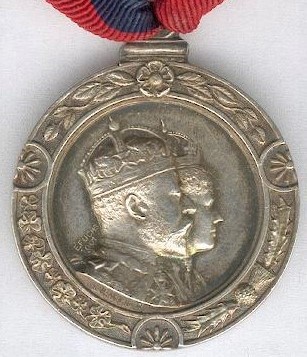
Something else I’d love to know is whether any of the Coronation medals issued to the children of Waters Upton have survived, perhaps in the possession of their descendants? (An example of a Coronation medal – not necessarily representative of those issued at Waters Upton as designs varied – is shown here.) Mrs. Rider of Crescent House, Wellington, who supplied the medals, did not live in the village but through her late husband Dr John Rider – a descendant of the Wase family of Waters Upton Hall, had connections to it. Both Mr and Mrs Rider were buried in Waters Upton churchyard.

A second celebration

This story of Coronation celebrations at Waters Upton in 1902 is not quite over. The King and Queen were finally crowned, following Edward’s recovery, on the ninth of August – and his subjects could mark the occasion with unmuted merriment.

The fact that the reconvened Coronation was scheduled for a Saturday was not entirely welcome. The editor of the Wellington Journal opined in his newspaper on August 2nd, that “It would be difficult, we fancy, to imagine a more awkward time to celebrate the King’s Coronation than on a Saturday, for in nearly every town in England this is a very busy day, and one on which shopkeepers are apt to rely in making up for a probable cash deficiency on the other days of the week, and when the working classes do most of their shopping.”

The parishioners of Waters Upton responded to the potential problems of a Saturday celebration by holding their second Coronation ‘do’ on the following Tuesday. The Reverend Yonge once again chaired the organising committee and made his grounds available, and William Ball reprised his role as “the energetic hon. secretary and treasurer.” The day’s events were similar to those of the original Coronation celebrations, with some elements missing but others added – and with a note of sadness regarding the health of the Rector, as the Wellington Journal of 16 August reported:

The children of the Day and Sunday Schools met in the school yard at three o’clock, and were marshalled in processional order to the grounds, where they partook of an excellent tea. At 4-15 the adults were also entertained to tea. Sports were afterwards provided for the youngsters, and each child received prize, whilst additional prizes were awarded to those making the best attendances in the Sunday School.
Dancing commenced at six, and was kept up till 11 o’clock, to the strains of the Waters Upton Band, conducted by Mr. J. Davies. Subsequently the Rev. Mr. Bardell proposed, and Mr. E. B. [actually, J. B.] Davies seconded, a vote of thanks to Mr. and Mrs. Yonge for their kindness in placing their charming grounds at the disposal of the committee, and also for their hearty and liberal assistance. This was carried with ringing cheers.
Mr. Yonge returned thanks, and made some very touching remarks respecting the illness of the worthy rector of the parish, the Rev. J. B. Davies. At the close all sang lustily the National Anthem. In addition to a donation from the Duke of Sutherland, Mrs. Yonge provided prizes for the whole of the Sunday and Day School children; Mr. Needham and Mr. W. A. R. Ball, sweets and prizes; and Miss M. E. Minor, prizes various kinds.

Picture credits: Edward VII and Alexandra, adapted from a public domain image at Wikimedia Commons ⇗. Tuba from Etienne Mahler at Flickr ⇗, public domain image. Coronation medal from Wikimedia Commons ⇗ contributor Helensq; used under a Creative Commons licence ⇗. Coronation of Edward VII in Westminster Abbey from Library of Congress via getarchives.net ⇗; no known copyright restrictions.
Late Victorian Christmases in Waters Upton – Part 1

The Children’s Christmas

There’s gladness and loud animation
In cottage and palace to-day;
And the children, in warmest elation,
Trill their songs, bright, merry and gay.
The floodgates of joy are now open—
Old Christmas gives out his best store;
For the season of mirth the children
Returns with its hight, hallowed lore.

The star of the far distant ages
Still gleams like a diadem rare;
Still songs of both shepherds and sages
Tell the story of Bethlehem fair.
The children ‘mid innocent pleasure
Re-echo the joyous refrain.
And, swelling the old gladsome measure,
Tell Yuletide’s sweet tale once again.

“J. T.”, Shrewsbury.
Wellington Journal, 20 December 1890.
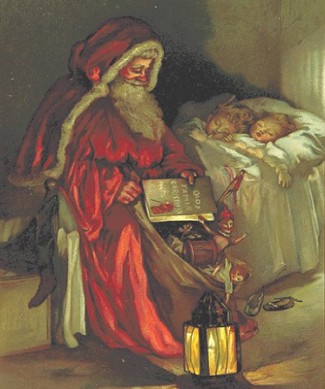
A colour illustration of Father Christmas in his white-trimmed red cloak, with a sack full of gifts, sitting at the end of a small bed in which two young children are sleeping.

During the 1800s, and particularly over the course of Victoria’s reign, the celebration of Christmas in Britain evolved and was enriched by innovations and importations. As a result, towards the end of the century the traditions of the ‘Victorian Christmas ⇗’ were all in place – cards, carols and crackers, decorations and dinners, a red-robed, full-figured Father Christmas / Santa Claus, and a somewhat incongruous combination of commercialism and Christian values.(The image here is from a book published in 1888. Taken from the British Library Flickr photostream ⇗; no known copyright restrictions.)

From the newspapers of the time we can learn what late Victorian Christmases were like in towns and villages across the country, and gain glimpses of the ways in which the season was celebrated in Waters Upton.

Decking the halls (and churches)

The holly berries all aglow
Are wreathed in wonted Christmas brightness
Aloft is hung the mistletoe
In all its pearly whiteness.

“Olive”
Wellington Journal, 22 December 1888.

By longstanding tradition, homes were decorated with Christmas greenery ⇗: holly, mistletoe, garlands of fir, kissing boughs, with wreaths or ‘welcome rings’ hung on front doors. From newspaper reports viewed at the British Newspaper Archive it seems that flowers too were an element of Christmas decorations, at least in public institutions such as infirmaries, workhouses and churches (such reports are easier to come by for those establishments than for private homes). Thus we learn from the Wellington Journal of 26 December 1885 that:

The Parish Church [of Waters Upton] was very tastefully decorated for Christmas, the work being executed as follows:—Pulpit, lectern, and candlesticks, Miss F. Minor; chancel text, “Behold thy King cometh;” Miss F. Minor; banners and wall decorations, Miss E. Taylor and Miss L. Groucock; font, Mrs. Davies and Miss L. Groucock; windows, school children. Mr. J. B. Davies, rector, preached at both morning and evening services.

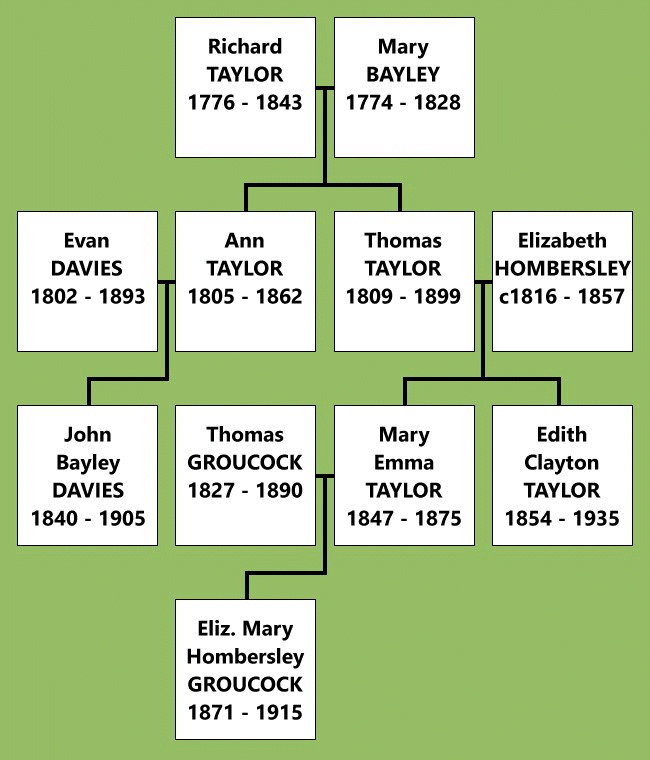
John Bayley Davies was educated at Shrewsbury School ⇗ and became Rector of Waters Upton in 1866. Mrs Davies, formerly Susan Anslow Juckes, was married to the Rev Davies in 1875. If I have correctly worked out who the above-mentioned Misses E Taylor and L Groucock were – Edith Clayton Taylor and Elizabeth (a.k.a. Lizzie?) Mary Hombersley Groucock, the Rev J B Davies was related to both of them (first cousin and first cousin once removed, respectively). The family (Christmas) tree shown here illustrates how the three were related.

A small family tree diagram, showing four generations. First, Richard Taylor (1776 - 1843) and his wife Mary Bayley (1774 - 1828). Next, their children Ann Taylor (1805 - 1862) and Thomas Taylor (1809 - 1899), and the spouses of those children: Ann married Evan Davies (1802 - 1893), and Thomas wed Elizabeth Hombersley (about 1816 - 1857). Evan Davies and Ann begat John Bayley Davies (1840 - 1905). Thomas Taylor and Elizabeth begat Mary Emma Taylor - who married Thomas Groucock (1827 - 1890) - and Edith Clayton Taylor (1854 - 1935). Finally, the fourth generation is Elizabeth Mary Hombersley Groucock (1871 - 1915), daughter of Thomas and Mary Emma.

The Groucock family was originally of Meeson in the neighbouring parish of Bolas Magna, but by 1881 the widowed Thomas Groucock had moved to Waters Upton along with his sister. Mary Emma Groucock née Taylor was born at Burleigh Villa in Bolas Magna, where her father Thomas was still living (see Kelly’s Directory 1891 ⇗).

I have not identified Miss F Minor, but members of family with that surname were resident at Meeson at this time – and we will shortly meet Miss M Minor, almost certainly Margaret Elizabeth Minor of that place. Another demonstration of the links between Meeson and Waters Upton came in 1897.

Christmas at the latter village that year was “observed at the Parish Church in the usual way” according to the New Year’s Day edition of the Wellington Journal in 1898. Celebrations of Holy Communion took place at 8.30am and 11am, with a shortened evening service at 6.30pm at which “the choir sang several carols.” “The church was prettily decorated by the ladies of the congregation, beautiful lilies and camelias being sent from Meeson Hall for the chancel decoration.”

Four years later in 1901, the year of Queen Victoria’s death, the Wellington Journal stated on 28 December that “Christmas in the churches has been kept this year with a heartiness which has probably never been surpassed, notwithstanding those who contend that its celebrations are falling into disuse.” It went on to say that “the decorations have been exceedingly appropriate and ornate, reflecting great credit the busy and untiring efforts of those responsible for the work.” With regard to Waters Upton:

The decorations in this church were, as usual, tastefully arranged. The pulpit and lectern were decorated by Mrs. L. V. Yonge, the east end windows by Miss M. Minor, and the font and nave by the Misses Davies, assisted by Miss Tompkin, Daisy Pritchard, Dolly Austin, Dorothy Tompkin, and S. H. and R. W. Davies. The choir sang carols at the morning and evening services, and the sermons were preached by the rector, the Rev. J. B. Davies.

Mrs L V Yonge was the above-mentioned Elizabeth Mary Hombersley Groucock, now married. Elizabeth had ‘tied the knot’ with the Rev Lyttleton Vernon Yonge, vicar of nearby Rowton in Ercall Magna parish, in 1892 and the couple resided at Waters Upton. I have yet to work out for certain who Dolly Austin was, but she may have been Mary Elizabeth Austin, enumerated (aged 8) with her family at Waters Upton in 1901. On the same census, Daisy Pritchard was recorded ⇗ at nearby Cold Hatton in Ercall Magna parish. Then aged 13, she was the daughter of agricultural labourer Edward Pritchard and his second wife Ellen, née Gough. At first I thought Daisy had no connections with Waters Upton, but her father Edward, although born in Wolverhampton, had Shropshire ancestry and was enumerated at Waters Upton with his parents in the censuses of 1871 and 1881.

The Tompkin girls were most likely Dorothy and Maggie (born 1891 and 1894 respectively), daughters of Robert Tompkin and Mary Margaret Sutton (née Barlow) Tompkin. The Tompkins had not been in Waters Upton for very long at this point, having been enumerated on the census back in April in their native county of Staffordshire. The family was still living in Waters Upton in 1911. That year’s census shows that Robert was a farm bailiff – Kelly’s Directory for 1909 shows that he was working in that capacity for the Rev L V Yonge. Sadly, Robert passed away at the age of 42 on 29 June 1911; he was buried at Waters Upton (see Memorial Inscriptions: Tompkin).

The Misses Davies would have been the Rev John and Mrs Susan Davies’ daughters Annie May (born 1879) and Alice Elizabeth (1880); with the two Davies boys “S. H. and R. W.” being Stephen Harris (1883) and Reginald Wynard (1885) – all of them were recorded on the 1901 census at Waters Upton. I will be devoting several future stories to this family, in which I will explore their lives in and beyond Waters Upton in more depth. But, as you are about to find out, that doesn’t mean they won’t get any further mentions in this one.

A colour illustration showing three bushy sprigs of Holly, with green, spiky leaves and red berries.
Adapted from a Public Domain image at Wikimedia Commons ⇗.

Rev John Bayley Davies saves Christmas

I freely admit to over-egging the (Christmas) pudding a little with that heading. However the Rev Davies, in his capacity as a member of the Wellington Poor Law Union’s Board of Guardians, did help to ‘save Christmas’ for the inmates of the Union Workhouse in Wellington in 1882.

John was present at the fortnightly meeting of the Board which took place on Thursday 14 December that year, at which the subject of “the paupers’ Christmas dinner” arose…

Mr. Lawrence said that as the master’s book was now before them, he was going to ask the Board to allow Mr. Minor to put on the book instructions that the inmates of the House should have their usual Christmas treat. It was done in all the gaols and workhouses in the country, and he did not see why their Board should set aside a custom which had been honoured in the observance ever since the Board was established. He moved that the inmates have the same treat they had last year. (Wellington Journal, 16 December 1882.)

The Clerk of the Board then “read from the minute book the allowance of beef and pudding sanctioned by the Board for the last Christmas dinner”, after which further conversation took place. I imagine, but can’t say for certain, that the Rev John Bayley Davies of Waters Upton contributed to that exchange of views, supporting the principles of Christian charity which had become a part of the Victorian Christmas. I don’t doubt at all that he was heartily pleased when Mr Lawrence’s proposition was, eventually, carried.

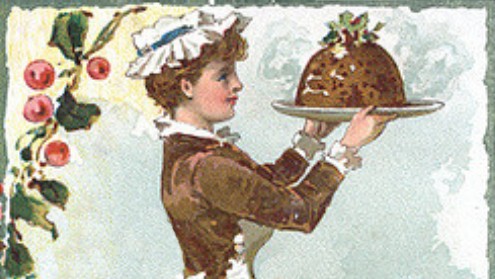
A colour illustration showing a maid carrying a steaming Christmas pudding on a plate, which she is holding so that the pudding is level with her head. The maid is wearing a white hat with frills around the edges, and a white pinafore over a brown top garment.
From a Public Domain image at Picryl ⇗. This is probably not an accurate depiction of the pudding served to the Wellington Union Workhouse inmates at Christmas, nor of the manner in which it was served to them…..

Late Victorian Christmases in Waters Upton – Part 2