Late Victorian Christmases in Waters Upton – Part 2

⇐ Back to Part 1

Christmas carols (and other entertainments)

Pleasant Evenings with the Children.—On Wednesday and Thursday evenings, a miscellaneous entertainment was provided by the children attending Waters Upton School, consisting of duets, dialogues, musical drills, songs, in character, &c. The Rev. J. B. Davies, rector of the parish, presided each evening. The whole of the children acquitted themselves admirably, and gave much credit to Miss Taplin’s careful training. On the proposition of the Rector, hearty votes of thanks were accorded to Miss Taplin (head-teacher), Miss Union [actually Miss M Minor] for presiding at the pianoforte, and to the children for their entertainments, which were heartily applauded. The proceeds are for providing prizes for the children.
Wellington Journal, 23 December 1893.

Miss Taplin was not enumerated at Waters Upton on any of the censuses, but the entry for Waters Upton in the 1895 Kelly’s Directory includes “Miss Sarah Ann Taplin, mistress”. She had embarked on a teaching career early on, the 1881 census ⇗ showing Banbury-born Sarah at the age of 19 as an Assistant Schoolmistress lodging, with two other young women of the same profession, in the Hinckley, Leicestershire household of Schoolmaster and Schoolmistress Alfred and Fanny Webb. Ten years later in 1891 ⇗, Sarah was (along with another School Mistress) a visitor in a household at Wivenhoe in Essex. Her short spell at the National School in Waters Upton followed.

The newspaper report from 1893 quoted above does not explicitly connect the entertainments provided by the schoolchildren with Christmas. The timing of the events makes the association fairly clear however, and this account for the festivities of 1894 (published on 5 Jan 1895) leaves us in no doubt: “The Christmas Season has been kept in this village in the usual way. Before the Christmas holidays began the children of the Parish School gave two evenings’ entertainments of amusing songs and dialogues, in which they were well instructed by their teacher, Miss Taplin.”

I have not yet established exactly when Sarah Taplin left Waters Upton, but by 1901 ⇗ she was living and teaching at Shilton in her native county of Oxfordshire. The following year she was married ⇗, in Nuneaton, Warwickshire, to London & North West Railway worker William Meers. This did of course mean that her 20 year teaching career was over – but it also meant that Sarah was able to have children of her own.
An illustration of Holly leaves and berries.

The Wellington Journal’s summary of the seasonal celebrations of 1894 in Waters Upton continued by noting the beautiful decorations in the church “for the Christmas services by Mrs. L. V. Yonge, Mrs. Percival, and Miss M. Minor.” The offertories from these services were given to the Salop Infirmary, an institution I have written a partial history of (in four parts, so far) on my Atcherley family history website ⇗. The Journal’s report concluded:

At the end of the Christmas week there was also held a most successful entertainment in the Parish School. The room was well filled, and the proceeds, which realised over £5, went to pay for new church gates at the entrance to the churchyard. The programme was as follows:—Piano duet, Misses Annie and Alice Davies; song, Miss M. Minor (encored); song, Mr. Crewe; song (encored), Miss Lucy Rider; song (encored), Mr. Crewe; song (encored), Miss Sutton; piano solo, Miss Crewe; song (encored), Mr. Percival; song (encored), Miss Sutton (in place of Miss Nock, who was unable to be present). During the interval the rector (Rev. J. B. Davies) gave a short reading, and afterwards a very amusing piece was performed by four ladies and three gentlemen, the acting in which was of the highest character and was greatly appreciated. The performers were Rev. W. P. Nock, Dr. White, Mr. Ernest Rider, Mrs. L. V. Yonge, Miss Taylor, Miss Lucy Rider, and Miss Emmeline Heatley. At the conclusion the Rector proposed a hearty vote of thanks to all who had so ably taken part in the entertainment.

A whole cast of characters there, and what festive fun they had! Six of them (the Rev Davies and his daughters Annie and Alice, Mrs Yonge née Groucock, Miss Margaret Minor, and Miss Taylor) we have already met, in Part 1 of this story. Of the others, there are some I cannot identify with certainty: Doctor White, and Mr and Miss Crewe, may reveal themselves with further research. As was the case with some of their fellow celebrants, they may not have been Waters Upton residents. Emmeline Heatley appears from the 1901 census ⇗ to have been from nearby Eaton upon Tern (upstream from Waters Upton), where she was born around 1875, while the 1891 ⇗ and 1901 ⇗ censuses show that the Rev William P Nock (born around 1861) was Rector of Longdon upon Tern (downstream from Waters Upton).

Lucy Catherine Rider was from Wellington, where she was born and baptised in 1872 ⇗. She was a daughter of surgeon John Rider and his wife Mary, née Tennant. The Rider family had connections with Waters Upton parish – both John (born at nearby Crudgington) and Mary were buried at there (in 1887 and 1919 respectively, see Memorial Inscriptions: Rider). Ernest Rider, from Shawbury parish, was Lucy’s first cousin, his father being John Rider’s brother Thomas.
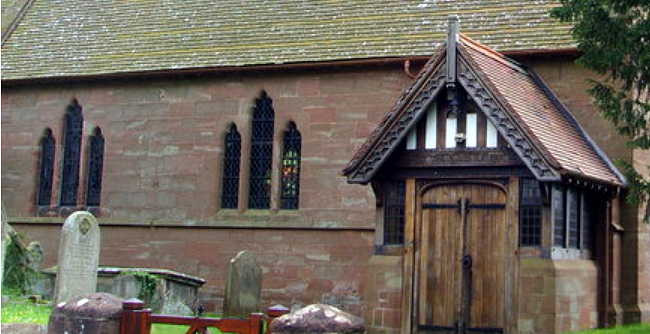
A photo showing part of the North side of St Michael's Church in Waters Upton. On the right is the porch, to the left of which there are two 3-light windows. Part of the roof can be seen, and also part of the churchyard with gravestones and a chest (or table) tomb.
A Holmes / St Michael’s Church / CC BY-SA 2.0 / Modified

That leaves Mr Percival, and also his wife (who helped to decorate the church). Herbert France Percival was born, surprisingly enough, in France (at Pau, now in Pyrénées-Atlantiques, Nouvelle-Aquitaine), on 7 March 1863 according to the Visitation of England and Wales ⇗ (Volume 2) published in 1894. Mary Jane Cornes was born at Longsight in Lancashire on 26 August 1859 and baptised ⇗ at Manchester Cathedral one month later. After a series of moves the Cornes family finally relocated to Crudgington where, on 3 August 1887, Mary Jane was married to Herbert Percival at Waters Upton. The couple settled (and Herbert farmed) in the parish where they wed, were enumerated there on the 1891 census, and their first two children (Geoffrey James France Percival and Sybil Mary France Percival) were born there in 1890 and 1892 respectively.

Herbert France Percival was included in the entry for the Waters Upton in the 1895 Kelly’s Directory, but he and Mary Jane had moved to Crudgington by the time their third and last child, Arthur Stanley France Percival ⇗, was born on 21 November that year. Possibly they had moved in with Mary Jane’s parents (Joseph Cornes, Mary’s father, died on 4 July 1897 and was buried at Waters Upton; see Memorial Inscriptions: Cornes).

Although the Christmas of 1894 was the last one the Percivals spent as residents of Waters Upton, it was not the last time they participated in the parish’s celebrations. The Wellington Journal of 1 January 1898 tells us this about an event which took place at Waters Upton on 29 December 1897:

Entertainment.—A concert was given in the school room, on Wednesday evening, by the church choir, assisted by a few friends. The performances were highly appreciated by a large audience, and credit is due to Miss M. Minor, the organist at the church, who had trained many of the choir to sing in public for the first time. The following took part:—The Choir, Miss A. Minor, Mr. P. Minor, Rev. L. V. Yonge, Mr. George Hall, Mr. Sam Dickin, Mr. Percival, the Misses Davies, Mr. W. A. R. Ball, Mr. Crewe, Willie Bennett, Mr. Tom Madeley, Mr. Tom Bennett.

The Percivals were still living at Crudgington in 1901 ⇗, but by 1911 had moved (with Mary Jane’s widowed mother) to Towyn in Merionethshire. As for the other performers besides Mr Percival, we have already met Margaret Minor, the Rev Yonge and the Misses Davies. How wonderful to see so many other names, of people from within and outwith the parish! In the latter category were A and P Minor (relatives of Margaret of Meeson no doubt, though I have yet to identify them), and Tom (Thomas) Madeley (probably the one born about 1872 at Crudgington, a farmer’s son who was still living there in 1901 ⇗ when he was a butcher).

George Hall was born in the neighbouring parish of Ercall Magna in 1878 but was probably by 1897 a resident of Waters Upton; certainly he was recorded there on the 1901 census when he was working as a sawyer. Samuel Robert Dickin was born a little further away at Little Ness, in 1875; he too must have moved to Waters Upton by 1897, and the 1901 census enumerated him there as a farmer, living with his sister Annie who was his housekeeper.

Brothers Willie (William) and Tom (Thomas) Bennett were both born at Waters Upton, in 1885 and 1880 respectively. They were sons of shoemaker Samuel Thomas Bennett and his wife Alice, née Lucas. Both were with their parents when the 1891 census was taken, and while William had moved on by 1901, Thomas remained (pursuing his father’s – and grandfather’s – profession, and appearing on the censuses of 1901 and 1911, and on the 1939 Register, at Waters Upton). Now there’s a man who saw a lot of Waters Upton Christmases!
An illustration of Holly leaves and berries.

All I want for Christmas is . . . a servant

WANTED, at Christmas, a General Servant, to do plain cooking, and make butter.—Apply, Mrs. J. B. Davies, Waters Upton Rectory, Wellington, Salop.
Wellington Journal, 17 November 1883.

While searching for stories of Christmas at Waters Upton, I came across advertisements for servants wanted “at Christmas” or “for Christmas”. The “most wonderful time of the year ⇗” (as Christmas was christened in the well-known song penned in 1963) was also one of the busiest times, especially for servants. More relevant to the phenomenon of yuletide recruitment however is the fact that Christmas Day was one of the four Quarter Days ⇗ in England and Wales, when rents were due – and servants were hired.

So as we have seen, at the end of 1883 the Rector’s wife Mrs John Bayley Davies (Susan Anslow Davies, née Juckes) was looking for a general servant who would cook, and make butter. The source of the milk for that butter was most likely cows kept on glebe land associated with the rectory.

In the Wellington Journal of 18 December 1886, two more ladies with Waters Upton addresses sought servants for Christmas. I was puzzled at first by Mrs Hoole, who was looking for a “trustworthy Servant” for “milking (two cows), attention to poultry, and plain cooking” for a family of two (“wages about £12”). Further research in the newspapers and then the censuses (e.g. that of 1881 ⇗) showed that Mr and Mrs Hoole were in fact living at Wood Farm, around 2 miles or so North of Waters Upton, in the parish of Stanton on Hine Heath. Presumably their post went through Waters Upton.
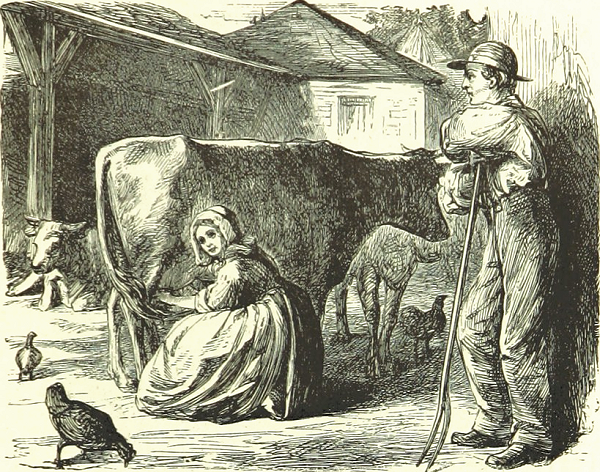
An old drawing of a maid milking a cow in a farmyard. Other cattle, and poultry, can also be seen, and on the right of the picture is a man leaning on a long-handled, two-pronged tool.

Mrs Shepherd, on the other hand, who wanted a “Servant Girl, at Christmas, age 15 to 16, who can milk or willing to learn” was definitely a Waters Upton resident. Jane Shepherd, née Rider, was recorded there on the 1891 census along with her husband Hugh, a farmer. The census shows that Hugh Shepherd was born at Old Deer (Aberdeenshire) in Scotland and that he was 15 years younger than his wife, who was born at Tattenhall in Cheshire. Baptism records for Hugh (in 1823 ⇗) and Jane (at Harthill in 1803 ⇗, the register giving the family’s abode as Broxton and a birth date for Jane of 8 December 1802) show that the age gap between the two was actually more than 20 years. When they married ⇗ on 12 Jan 1857 at Acton in Cheshire (by which time Hugh was already resident in Shropshire), both stated that they were of full age. Hugh was 33 and Jane was 54.

The 1891 census reveals something else about Jane – she was blind. This fact had also been recorded in 1881 ⇗ (when the Shepherds were living at Wrockwardine), but not on censuses from previous years. Presumably she lost her sight through an age-related condition such as macular degeneration or cataracts. Whatever the cause, it is clear that Jane’s inability to see did not prevent her from running household affairs. In these matters she may have been assisted by her niece Mary Lewis, who was enumerated with her at Waters Upton in 1891 as a “Ladies Companion”. Jane Shepherd died, and was buried at Waters Upton, in 1894 (see Death notices etc. and Wills & probate after 1858).

WANTED, Girl, between 14 and 16, as General, either now or at Christmas; character required.—Apply, Miss Walker, Waters Upton.
Wellington Journal, 6 December 1890, page 4.

I originally thought that the word ‘servant’ was accidentally omitted from the above notice, but having since compiled a page of Situations Vacant and Wanted adverts I have found several other examples of Waters Uptionians seeking a ‘general’. Did this ‘small ad’ result in the hiring of Sarah Ann Wilkes, the 16-year-old Lancastrian who appears on the 1891 census as a general servant in the Waters Upton household of Sarah Ann Walker? I have found no other records for Sarah Wilkes, but she may have been Sarah Ann Walker’s niece, enumerated as part of the Walker household in 1881; both aunt and niece shared the same name. The elder Sarah Walker ran a private school in Waters Upton for more than 30 years and so saw many Waters Upton Christmases. I will write about her in more detail another time.


Additional picture credits: Uncredited images all from the British Library Flickr photostream; no known copyright restrictions.
Late Victorian Christmases in Waters Upton – Part 1

The Children’s Christmas

There’s gladness and loud animation
In cottage and palace to-day;
And the children, in warmest elation,
Trill their songs, bright, merry and gay.
The floodgates of joy are now open—
Old Christmas gives out his best store;
For the season of mirth the children
Returns with its hight, hallowed lore.

The star of the far distant ages
Still gleams like a diadem rare;
Still songs of both shepherds and sages
Tell the story of Bethlehem fair.
The children ‘mid innocent pleasure
Re-echo the joyous refrain.
And, swelling the old gladsome measure,
Tell Yuletide’s sweet tale once again.

“J. T.”, Shrewsbury.
Wellington Journal, 20 December 1890.
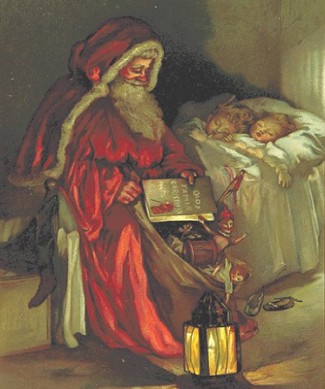
A colour illustration of Father Christmas in his white-trimmed red cloak, with a sack full of gifts, sitting at the end of a small bed in which two young children are sleeping.

During the 1800s, and particularly over the course of Victoria’s reign, the celebration of Christmas in Britain evolved and was enriched by innovations and importations. As a result, towards the end of the century the traditions of the ‘Victorian Christmas ⇗’ were all in place – cards, carols and crackers, decorations and dinners, a red-robed, full-figured Father Christmas / Santa Claus, and a somewhat incongruous combination of commercialism and Christian values.(The image here is from a book published in 1888. Taken from the British Library Flickr photostream ⇗; no known copyright restrictions.)

From the newspapers of the time we can learn what late Victorian Christmases were like in towns and villages across the country, and gain glimpses of the ways in which the season was celebrated in Waters Upton.

Decking the halls (and churches)

The holly berries all aglow
Are wreathed in wonted Christmas brightness
Aloft is hung the mistletoe
In all its pearly whiteness.

“Olive”
Wellington Journal, 22 December 1888.

By longstanding tradition, homes were decorated with Christmas greenery ⇗: holly, mistletoe, garlands of fir, kissing boughs, with wreaths or ‘welcome rings’ hung on front doors. From newspaper reports viewed at the British Newspaper Archive it seems that flowers too were an element of Christmas decorations, at least in public institutions such as infirmaries, workhouses and churches (such reports are easier to come by for those establishments than for private homes). Thus we learn from the Wellington Journal of 26 December 1885 that:

The Parish Church [of Waters Upton] was very tastefully decorated for Christmas, the work being executed as follows:—Pulpit, lectern, and candlesticks, Miss F. Minor; chancel text, “Behold thy King cometh;” Miss F. Minor; banners and wall decorations, Miss E. Taylor and Miss L. Groucock; font, Mrs. Davies and Miss L. Groucock; windows, school children. Mr. J. B. Davies, rector, preached at both morning and evening services.

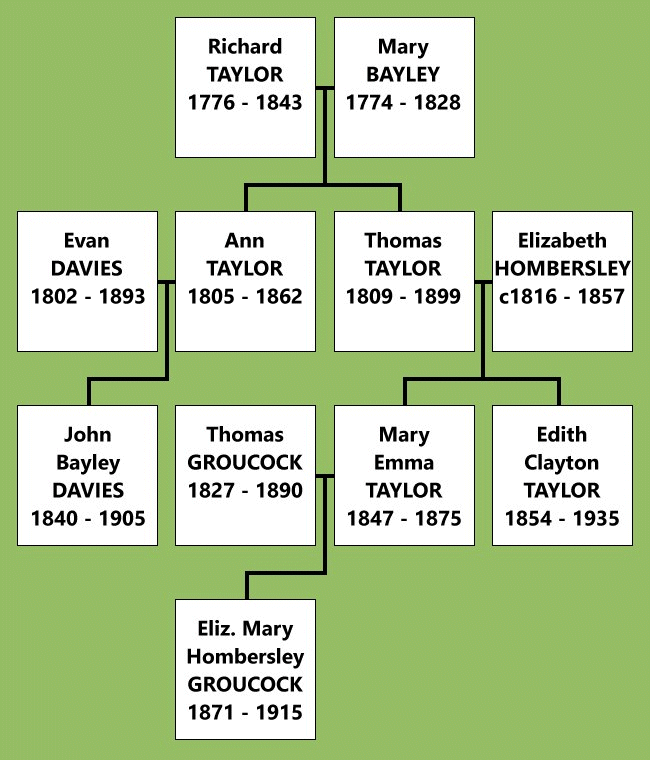
John Bayley Davies was educated at Shrewsbury School ⇗ and became Rector of Waters Upton in 1866. Mrs Davies, formerly Susan Anslow Juckes, was married to the Rev Davies in 1875. If I have correctly worked out who the above-mentioned Misses E Taylor and L Groucock were – Edith Clayton Taylor and Elizabeth (a.k.a. Lizzie?) Mary Hombersley Groucock, the Rev J B Davies was related to both of them (first cousin and first cousin once removed, respectively). The family (Christmas) tree shown here illustrates how the three were related.

A small family tree diagram, showing four generations. First, Richard Taylor (1776 - 1843) and his wife Mary Bayley (1774 - 1828). Next, their children Ann Taylor (1805 - 1862) and Thomas Taylor (1809 - 1899), and the spouses of those children: Ann married Evan Davies (1802 - 1893), and Thomas wed Elizabeth Hombersley (about 1816 - 1857). Evan Davies and Ann begat John Bayley Davies (1840 - 1905). Thomas Taylor and Elizabeth begat Mary Emma Taylor - who married Thomas Groucock (1827 - 1890) - and Edith Clayton Taylor (1854 - 1935). Finally, the fourth generation is Elizabeth Mary Hombersley Groucock (1871 - 1915), daughter of Thomas and Mary Emma.

The Groucock family was originally of Meeson in the neighbouring parish of Bolas Magna, but by 1881 the widowed Thomas Groucock had moved to Waters Upton along with his sister. Mary Emma Groucock née Taylor was born at Burleigh Villa in Bolas Magna, where her father Thomas was still living (see Kelly’s Directory 1891 ⇗).

I have not identified Miss F Minor, but members of family with that surname were resident at Meeson at this time – and we will shortly meet Miss M Minor, almost certainly Margaret Elizabeth Minor of that place. Another demonstration of the links between Meeson and Waters Upton came in 1897.

Christmas at the latter village that year was “observed at the Parish Church in the usual way” according to the New Year’s Day edition of the Wellington Journal in 1898. Celebrations of Holy Communion took place at 8.30am and 11am, with a shortened evening service at 6.30pm at which “the choir sang several carols.” “The church was prettily decorated by the ladies of the congregation, beautiful lilies and camelias being sent from Meeson Hall for the chancel decoration.”

Four years later in 1901, the year of Queen Victoria’s death, the Wellington Journal stated on 28 December that “Christmas in the churches has been kept this year with a heartiness which has probably never been surpassed, notwithstanding those who contend that its celebrations are falling into disuse.” It went on to say that “the decorations have been exceedingly appropriate and ornate, reflecting great credit the busy and untiring efforts of those responsible for the work.” With regard to Waters Upton:

The decorations in this church were, as usual, tastefully arranged. The pulpit and lectern were decorated by Mrs. L. V. Yonge, the east end windows by Miss M. Minor, and the font and nave by the Misses Davies, assisted by Miss Tompkin, Daisy Pritchard, Dolly Austin, Dorothy Tompkin, and S. H. and R. W. Davies. The choir sang carols at the morning and evening services, and the sermons were preached by the rector, the Rev. J. B. Davies.

Mrs L V Yonge was the above-mentioned Elizabeth Mary Hombersley Groucock, now married. Elizabeth had ‘tied the knot’ with the Rev Lyttleton Vernon Yonge, vicar of nearby Rowton in Ercall Magna parish, in 1892 and the couple resided at Waters Upton. I have yet to work out for certain who Dolly Austin was, but she may have been Mary Elizabeth Austin, enumerated (aged 8) with her family at Waters Upton in 1901. On the same census, Daisy Pritchard was recorded ⇗ at nearby Cold Hatton in Ercall Magna parish. Then aged 13, she was the daughter of agricultural labourer Edward Pritchard and his second wife Ellen, née Gough. At first I thought Daisy had no connections with Waters Upton, but her father Edward, although born in Wolverhampton, had Shropshire ancestry and was enumerated at Waters Upton with his parents in the censuses of 1871 and 1881.

The Tompkin girls were most likely Dorothy and Maggie (born 1891 and 1894 respectively), daughters of Robert Tompkin and Mary Margaret Sutton (née Barlow) Tompkin. The Tompkins had not been in Waters Upton for very long at this point, having been enumerated on the census back in April in their native county of Staffordshire. The family was still living in Waters Upton in 1911. That year’s census shows that Robert was a farm bailiff – Kelly’s Directory for 1909 shows that he was working in that capacity for the Rev L V Yonge. Sadly, Robert passed away at the age of 42 on 29 June 1911; he was buried at Waters Upton (see Memorial Inscriptions: Tompkin).

The Misses Davies would have been the Rev John and Mrs Susan Davies’ daughters Annie May (born 1879) and Alice Elizabeth (1880); with the two Davies boys “S. H. and R. W.” being Stephen Harris (1883) and Reginald Wynard (1885) – all of them were recorded on the 1901 census at Waters Upton. I will be devoting several future stories to this family, in which I will explore their lives in and beyond Waters Upton in more depth. But, as you are about to find out, that doesn’t mean they won’t get any further mentions in this one.

A colour illustration showing three bushy sprigs of Holly, with green, spiky leaves and red berries.
Adapted from a Public Domain image at Wikimedia Commons ⇗.

Rev John Bayley Davies saves Christmas

I freely admit to over-egging the (Christmas) pudding a little with that heading. However the Rev Davies, in his capacity as a member of the Wellington Poor Law Union’s Board of Guardians, did help to ‘save Christmas’ for the inmates of the Union Workhouse in Wellington in 1882.

John was present at the fortnightly meeting of the Board which took place on Thursday 14 December that year, at which the subject of “the paupers’ Christmas dinner” arose…

Mr. Lawrence said that as the master’s book was now before them, he was going to ask the Board to allow Mr. Minor to put on the book instructions that the inmates of the House should have their usual Christmas treat. It was done in all the gaols and workhouses in the country, and he did not see why their Board should set aside a custom which had been honoured in the observance ever since the Board was established. He moved that the inmates have the same treat they had last year. (Wellington Journal, 16 December 1882.)

The Clerk of the Board then “read from the minute book the allowance of beef and pudding sanctioned by the Board for the last Christmas dinner”, after which further conversation took place. I imagine, but can’t say for certain, that the Rev John Bayley Davies of Waters Upton contributed to that exchange of views, supporting the principles of Christian charity which had become a part of the Victorian Christmas. I don’t doubt at all that he was heartily pleased when Mr Lawrence’s proposition was, eventually, carried.

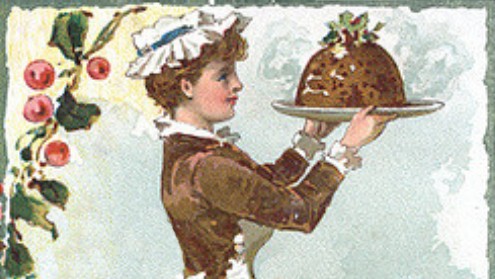
A colour illustration showing a maid carrying a steaming Christmas pudding on a plate, which she is holding so that the pudding is level with her head. The maid is wearing a white hat with frills around the edges, and a white pinafore over a brown top garment.
From a Public Domain image at Picryl ⇗. This is probably not an accurate depiction of the pudding served to the Wellington Union Workhouse inmates at Christmas, nor of the manner in which it was served to them…..

On to Part 2