Waters Upton Tragedies: The Death of William Lloyd

Shocking Discovery at Eyton-On-The-Wild-Moors
On Sunday considerable excitement was created in the town of Wellington and the district of Eyton by a report that the mutilated remains of a man had been found in a haystack at Eyton-on-the-Wild-Moors. The statement proved to be true, but the idea that a brutal murder had been committed was soon dispelled. Deputy Chief-constable Ivins, as soon as the information reached him, took the investigation under his own personal direction.

So began a particularly sad story which appeared in the Shrewsbury Chronicle on 29 June 1883. A slightly sensationalised story too, I think, for not only was the deceased not murdered, his body had not been mutilated. What were the circumstances of the body’s discovery? Who was the unfortunate man? And, since I’m telling his story here, how was he connected to Waters Upton? Let’s return to the Chronicle’s report (to which I have made one small correction).

The stack, under which the body was found, is on the farm of Mr. E. W. Bromley, Eyton House Farm, and situate at some distance from the farm-house or any road, but is easy of access from a footpath and the towing-path of the canal, which runs parallel with the field in which the stack is. When found the body was dressed and partially covered with hay. Owing to the advanced state of decomposition in which the body was the features were unrecognisable, and Mr Ivins, with a view to finding out who the man was, issued a notice which he had extensively circulated in the district. The following is a copy of the same:—
“County Constabulary Office, Wellington, D Division, 24th June, 1883. Found dead on the 24th inst. by a hay stack in a field on the Eyton Moors, parish of Eyton, by two lads, a tramp, about 50 years of age, 5ft. 6 or 7 inches high, dark whiskers and moustache going grey; dressed in old brown hard hat, dark round pilot jacket, blue guernsey, old cord trousers, old lace-up boots, all very much worn and very shabby, had no shirt or stockings on. Supposed to have been dead about a month as he was seen in the same place on the 27th May, and complained of being ill.”
This notice was seen by a man named Joseph Rogers, in the employ of Messrs Barber and Son, Wellington, who recognised it as the description of a man named William Lloyd, about 50 years of age, a native of Waters Upton […]

Poor William! How did he end up living, and dying, in such wretched circumstances?
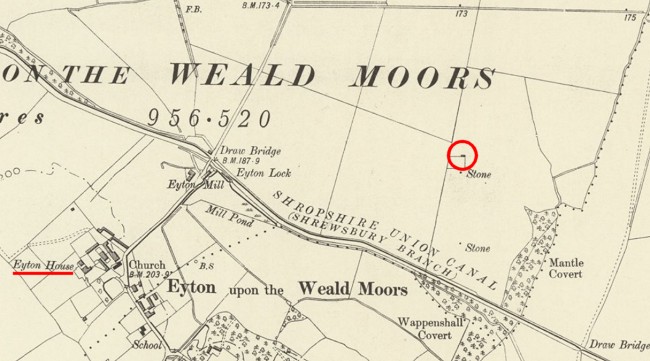
Map of Eyton upon the Weald Moors (or Wild Moors). Circled: The possible location of the shed (and haystack) where William Lloyd was found dead. Underlined: Eyton House, a.k.a. Eyton Farm House, where the inquest took place.

A native of Waters Upton

Piecing together the story of William Lloyd’s origins and early years is not straightforward, so bear with me while I assemble all the evidence – or skip to the next section if you wish! If, as Joseph Rogers stated, William was about 50 at the time of his death, he would have been born around 1833. I believe that Joseph’s estimate of William’s age was a ‘rounding up’ and that William was the 5-year-old William Lloyd who was enumerated on the 1841 census, at Waters Upton, with John and Ann Williams (ages rounded down to 50 and 40 respectively), Joseph Lloyd (12), and Elizabeth Lloyd (7).

Unfortunately the 1841 census did not record the relationships between household members so this record provides fairly limited information about William and those he shared a home with. There’s no baptism record for him that I can find either, nor does there appear to be one for Elizabeth Lloyd. Joseph Lloyd however was baptised at Waters Upton on 22 June 1828, his parents were William Lloyd (a labourer) and Ann, whose abode was in the parish. Were these two also the parents of Elizabeth and of the younger William Lloyd?

The most likely marriage for Joseph’s parents was that which took place at Wellington on 3 February 1827 ⇗. The parish register described the couple as “William Lloyd of this Parish and Anne Taylor of this Parish”. William died in 1835, at the age of 37, and was buried at Waters Upton on 23 Sep that year. (His age at death (37) likely makes him the the son of William and Elizabeth Lloyd who was baptised at Waters Upton on 19 Jun 1798.) Ann then remarried in 1840, to widower William Taylor, their entry in the register naming Ann’s father as James Taylor.

The 1851 census shows John and Ann Williams as husband and wife, but with none of the Lloyd children from 1841 living under their roof. John, aged 63 and an agricultural labourer (as he had been in 1841), was born in Waters Upton; the relevant baptism is likely that of John, son of William and Mary Williams, “in ye Sch: Room” on 1 June 1789. Ann, 51, was born in Cherrington; almost certainly she was “Anne Daur of James & Anne Taylor, Cherrington” baptised at Tibberton ⇗ on 21 April 1799.

William Lloyd too was living in Waters Upton in 1851. Aged 15, he was a hostler residing with and working for publican William Matthews. The pub is not named on the census schedule but there is little doubt that it was the Lion, as the Swan Inn – the only other hostelry in the village – was identified by the enumerator elsewhere.

The census of 1861 adds to the evidence relating to William Lloyd’s family, as well as providing an update on his fortunes. Household schedule 42 recorded agricultural labourer John Williams, 72, with his wife Ann, 61, and two sons (actually, stepsons), Joseph and William Lloyd. Joseph, aged 32 and unmarried, was by this time working as a gardener. William, 25, also unmarried, was an ‘ag lab’ like his stepfather.
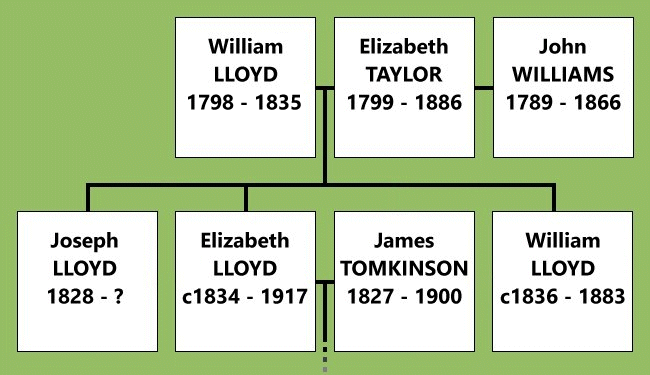
Elizabeth Lloyd had married by this time, and the record of that event ⇗ – naming her father as William Lloyd – adds further evidence to back the theory that she, Joseph, and William Lloyd junior were siblings. She wed James Tomkinson on 6 November 1854, probably at Chetwynd where she had been enumerated as a servant on the 1851 census ⇗ (name transcribed as Mary Hary by FamilySearch!!). She and James spent the rest of their days in nearby Newport, where they had 11 children.

John Williams of Waters Upton died on 26 November 1864, aged 75. The death of Ann Williams, formerly Lloyd, née Taylor, was registered in Wellington Registration District, in the last quarter of 1886; she was 87 but her age was recorded as 86. Joseph Lloyd’s story, which involved duck stealing, I will continue another time. That leaves William Lloyd, whose story I will now conclude.

A vagrant life

William Lloyd’s next appearance on a census, in 1871, seems to have been his last. He had left Waters Upton by this time, and was once more working, this time as a labourer, for an inn keeper: James Brown of the Green Dragon at Hadley. At some point over the next ten years however, something happened which changed William’s way of life – he became homeless. I have not found him on the 1881 census, but I can’t rule out the possibility that was enumerated as a nameless tramp found sheltering under a hedge or in a barn or outbuilding.

The report from the Shrewsbury Chronicle, part of which I quoted at the beginning of this story, was one of several arising from the inquest into William Lloyd’s death; others appeared in the Shrewsbury Journal, 27 June 1883, and the Wellington Journal, 30 June 1883. Together, they provide snippets of information which taken together give us a feel for how William spent his last years, and in particular his final months. It was said that William “had led a vagrant life for some years, sleeping in outbuildings and picking up a living as best he could.” Joseph Rogers, who “had known the deceased from a lad”, also stated that for a long time William “had been going about the country labouring with thrashing machines, and was formerly in the employ of Mr Price, of The Lees, near Walcot.” He was not married, and “had been in the habit of sleeping out.” I can only guess that at some point in the 1870s a spell of unemployment left William without the means to pay for accommodation and led to him taking advantage of whatever shelter and odd jobs he could find, whenever and wherever he was able to. Returning to the Shrewsbury Chronicle:

Rogers states that about a month ago the deceased called at his lodgings, and he had a conversation with him, when Lloyd complained of being ill, and he advised him to go to the Workhouse. He said he would, but Rogers had since ascertained that he did not do so. William Phillips, of the Ercall Hotel, also recognised the body as that of Lloyd, and states that about a month ago he engaged him to do some gardening, but Lloyd never came to do it, and he had not seen him since. A man named Beech, residing at Kynnersley, also saw the deceased about a month ago, and said that he complained of being unwell.

Another witness was John Thomas, described by one paper as a waggoner and by another as a cowman. He worked for Mr Bromley, at whose house the inquest was heldOn Sunday, the 27 May 1883, Mr Thomas saw William Lloyd lying down “on the top of an old stack bottom” with “some hay partially thrown over him.”
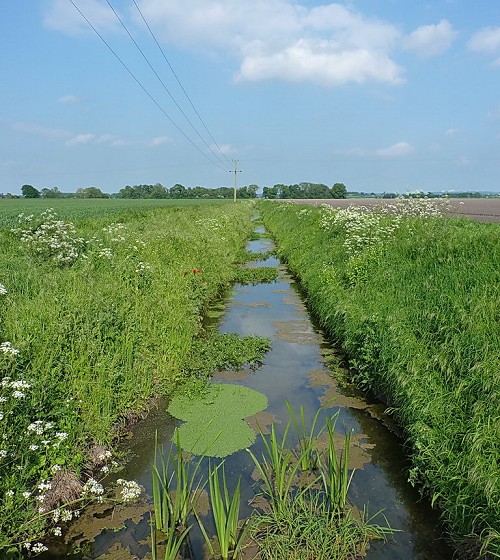
A drain on Eyton Moor

The two men had a conversation, in which William said that he had gone to the place where John found him “on the Saturday night, that he lay in the shed, and that he had come out to sun himself. He said he had been very poorly for some time, suffering from bronchitis”, and as a result of that illness “he had a bad cough”. William also said that “he had been following machines belonging to Mr. Nicholls and Mr. Powell, of Shrewsbury” and that “most of his food had consisted of water.”

A most melancholy case

John Thomas was probably the last person to see William Lloyd alive – and the last person to see him at all for several weeks. There was no public road where William had settled, although the canal and a path leading to Kynnersley were not far away. With the hay in which William slept not being needed at that time, no one went near the stack until Sunday 24 June 1883.

William Lloyd’s body was found that day by two boys. One of them, Walter Ruscoe, lived at Sidney (or Sydney) in the parish of Kynnersley (or Kinnersley) and was, like John Thomas, employed by Mr Bromley. On the day in question he took a bull down to the weald moors, and on his return he found the body by the haystack, half covered with hay. He quickly gave the alarm which led to the police becoming involved, and an inquest taking place the next day.
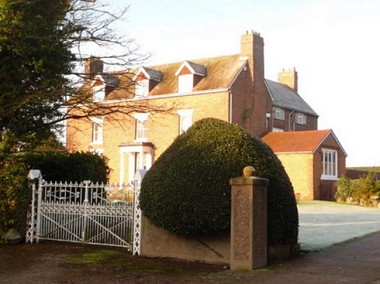
Eyton House, home of farmer Edward William Bromley and location of the inquest into the death of William Lloyd in 1883

At that inquest the jury gave a verdict of “Found dead” or, according to the Wellington Journal, “Death from natural causes.” The Coroner said “that it was a most melancholy case; but there was no ground whatever to suppose that deceased had met with any violence. He had apparently laid down and been overcome. It was a matter of regret that deceased had not taken the advice of one of the witnesses, and gone to the Workhouse.”

Article updated Feb 2026.


Picture credits. Map: Extract from Ordnance Survey Six Inch map Sheet XXXVI.NW ⇗ published 1902; reproduced with the permission of the National Library of Scotland and used under a Creative Commons licence ⇗. Family tree diagram: By the author. Drain on Eyton Moor: Photo © Copyright Richard Law; taken from Geograph ⇗ and modified, used and made available for reuse under a Creative Commons Licence ⇗. Eyton House: Photo © Copyright Chris Downer; taken from Geograph ⇗ and modified, used and made available for reuse under a Creative Commons Licence ⇗.
A fatal tricycle accident at Waters Upton – Part 2

Part 1.

PC Thomas Alexander Lee

Thos. Alexander Lee deposed: I am a police-constable, stationed at Waters Upton. On Tuesday night [11 August 1891], at 10-35, I saw William Matthews and the last witness at Matthews’s wicket [= gate]. There were two tricycles and a man on the ground. I asked “What’s up?” and Matthews said, “Sammy Dodd’s had a drop of beer and fallen off his machine.” I examined the deceased, but did not think he was hurt. The only mark I saw was a scratch on the hand. I saw that the machine was broken.
I went to my rooms, close by, and fetched some matches. Matthews also fetched light. While he was away I lit the lamp of the tricycle, and examined the deceased. I satisfied myself that no bones were broken. I told Matthews that if deceased was hurt it must be about his head, but I could find no marks. Deceased had been vomiting, and smelt strongly of drink. I asked him several times to get up, and he muttered that he should be all right directly if let alone. I was under the impression that he was drunk, and not hurt.
Matthews asked the deceased if he was going home, and he said something about bed. Matthews said, “What have you been doing, Sammy, to get into this state? I’ll not have you in my bed in this form, but I’ve plenty building, and will bed you down.” On that I left them. Owen followed me and said that deceased would be all right—that Matthews would look after him. I did not think deceased capable of going home, but I did think Matthews would take care of him.— [Questioned by] Mr. Superintendent Galliers: I knew deceased to be a friend of Matthews, and believed that Matthews would take him into his house.

Thomas Lee (Police Constable 107) was one of a number of people whose appearance on the 1891 census at Waters Upton was the only time they were enumerated at that place. He was a native of Whitchurch in Shropshire, where he was baptised ⇗ on 24 February 1864; his parents were farmer William Lee and his wife Mary, née Robinson.

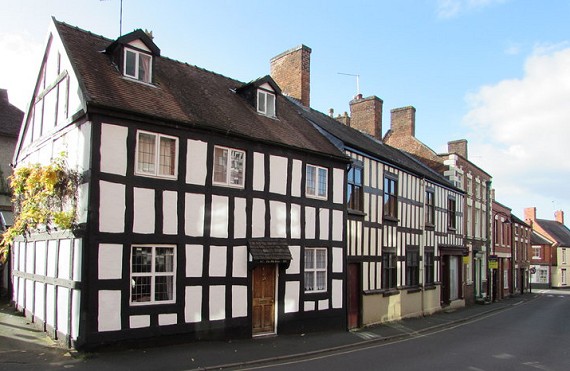
Colour photo of 'The Old House' and neighbouring houses along a street in Whitchurch , Shropshire. Both The Old House and the adjoining house are lovely half-timbered buildings, with white- or lime-washed walls broken by vertical and horizontal black timbers.
The Old House in Whitchurch, Shropshire.

Newspaper reports of the proceedings of the Petty Sessions at Wellington in 1890 and 1891 give the (probably misleading) impression that PC Lee’s duties while stationed in Waters Upton revolved mainly around dealing with drunken patrons of the local hostelries. The earliest such report that I have found so far, in the Wellington Journal of 5 April 1890 (page 6), shows that PC Lee charged two men with drunkenness at Waters Upton on 22 March 1890. Later that year he charged one man with being drunk and disorderly at High Ercall on 11 September and two men for the same offence at Waters Upton on the 20th (Wellington Journal, 4 October 1890, page 3).

A variation on the regular theme was the man summoned by PC Lee to appear at the Petty Sessions on 15 December 1890 “for being drunk and asleep while in charge of a horse and trap on the 8th inst., on the road leading from Crudgington to Waters Upton”. It was ‘business as usual’ on Boxing Day however (two men drunk at Waters Upton, and in May 1891 Thomas charged two men with drunkenness in the village, and another with “being drunk and refusing to quit the Swan Inn, Waters Upton”. (Wellington Journal, 20 December 1891, page 6; 10 January 1891, page 2; 30 May 1891, page 3; and 13 June 1891, page 6.)

PC Lee was clearly used to seeing the effects of alcohol on people, but should he have known better in Samuel Dodd’s case? He did not remain stationed at Waters Upton for long after Dodd’s demise. A round-up of cases heard at the Wellington Petty Sessions on 28 September (Wellington Journal, 3 October 1891, page 2) indicates that he had been transferred to Wellington itself by then. I cannot help wondering whether this move was connected with his conduct on the night of Sam Dodd’s fatal accident, or if the timing was simply a coincidence.

At some point over the next ten years, Thomas and the Shropshire Constabulary parted company. He was enumerated in 1901 ⇗ at Whitchurch, his birthplace, where he was living with his sister (also unmarried) and working as a County Court Bailiff. The only thing that had changed when the 1911 census was taken (apart from Thomas’s age of course) is that he was living with his widowed mother Mary. The death of Thomas Alexander Lee, aged 68, was registered ⇗ in the Atcham Registration District of Shropshire in the last quarter of 1932.

Robert Nicholls, Joseph Jones, Walter Welsh and Jane Jones

Robert Nicholls said: I am a labourer, and live at Waters Upton. Yesterday morning, at five o’clock, I looked out of my bedroom window, and saw some one lying on the footpath. At half-past five I went out to see who it was, and found deceased lying on his side. He was then alive. I thought he was drunk. I spoke to him but he made answer. I called Joseph Jones, and he came and helped me to put him in a pigsty close by. Jones said thought deceased would be better after a lie down. Other people came and saw him, and I then left—[Questioned by] the Foreman: I have heard of deceased being drunk, and I thought he was drunk then. He breathed rather heavily.
Walter Welsh said: I am a blacksmith, and live at Waters Upton. Yesterday morning, shortly before six o’clock, I saw deceased in Matthews’s pigsty. He was breathing very heavily. I knew that Nicholls had put him in the pigsty. I did not know the deceased intimately, but have seen him drunk.
Jane Jones said: Yesterday morning I went into Matthews’s house. Deceased was there on sofa. Directly after I got into the house deceased passed away. I did not lay the body out I put him straight.

The 1891 census shows that Joseph Jones was a farm waggoner, and Jane was his wife. Both were residents of Waters Upton from the mid-1860s – I will return to them in another article. Robert Nicholls and Walter Welsh on the other hand were, like Samuel Owen and Thomas Lee, short-term inhabitants of the parish. I have written very briefly about Walter in Blacksmiths in Waters Upton – Part 2.

Robert Nicholls was born in the small settlement of Sleap, to the south of both Waters Upton and neighbouring Crudgington, and was baptised ⇗ at the parish church of Ercall Magna on 3 June 1855. He was named after his father, and like his dad he worked as an agricultural labourer.

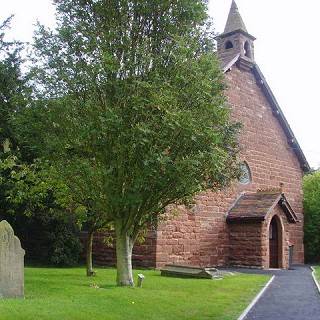
The church of Rowton All Hallows. The stone-built church is partially obscured by a tree in the churchyard, but most of one end of the building, with a porch protecting its entrance and a small bell turret on the roof above, can be seen.
Rowton All Hallows.

Robert married Emma Teece in 1882, the wedding being registered ⇗ in the first quarter of that year in Wellington Registration District. (Emma, who was born and baptised in Waters Upton in 1856, has a story of her own to be told).

The 1891 census shows that the couple’s first two children were born at Rowton while the next two were born in Waters Upton, giving 1887 or thereabouts as an approximate timing for the family’s relocation. In similar fashion the 1901 census ⇗ suggests that the Nicholls family had moved to their next home, at Crudgington Green, in the middle of the 1890s; Robert was a waggoner at this time. They were still there in 1911, by which time Robert was a farm labourer again. The death of an 83-year-old Robert Nicholls, quite possibly this former Waters Uptonian, was registered in Wellington Registration District in the first quarter of 1939.

Medical evidence

Dr. George Hollies deposed: I am a physician and surgeon, practising in Wellington. Yesterday morning I received a telegram asking me to come to Waters Upton to a bicycle accident. I arrived about 11 o’clock. The man was then dead. He was lying on a couch in Matthews’s house. I made an external examination of the body. I found an abrasion on the back of the right hand, with sand and soil in the palm. There was also an abrasion on the left hand, and a slight abrasion on the left elbow. There was a slight scratch on the forehead, above the right eyebrow. I found blood mixed with sand and soil about three inches above the right ear. There was an abrasion of the scalp, larger than shilling. The scalp was swollen and bruised. I consider that such an accident as a fall from a tricycle would cause the injuries described.
From the evidence I have heard, and from the external examination I made, I should judge that the man died from compression of the brain, following concussion, but of course l am unable exactly say from mere external examination. It is difficult to say whether the exposure would have made any great difference in this case. No doubt the danger would be increased the fact of the deceased being moved about. I could not say that death was accelerated in this particular case. It is a common error to mistake the condition in which this man was for a state of drunkenness.

William Matthews’ deposition

William Matthews said: I am a sawyer, and live at Waters Upton. On Tuesday evening I and deceased went for a ride on our tricycles. We called at the Buck’s Head, Long Lane, had some drink there, and remained about an hour. We left about a quarter-past nine, and rode together to Crudgington Road. Deceased then went on in front of me.
I met Mr. Percival [Purcell] by the Post Office, and stopped to talk to him. Samuel Owen came to us by the Rectory, and told us that the deceased had been upset. I asked if he was hurt, and Owen said the machine was worse hurt than the man. I came down to my wicket. Deceased was then under the tree. I stayed with him for some time.
Afterwards Police-constable Lee came, and Owen left. I remained with the deceased until 11-30. I asked him stop with me, and he said he would go home. I did not think he was hurt. He had had some beer, but came as far as I rode with him all right, and I thought he was quite able to get home. I did not think that be wished to stop. I have seen him drunk before. I found him in my pigsty next morning about eight o’clock.
I went to try and get a conveyance to take him home, and sent a telegram to Dr. Hollies. I then got deceased into my house, and did all I could for him. I saw deceased’s father when he came. Dr. Hollies afterwards came, but the man was dead then. I have known and worked with the deceased for some time, and he was an intimate acquaintance of mine.
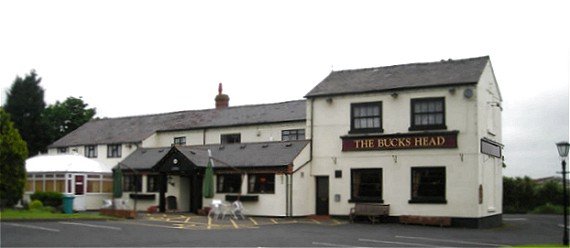
Colour photo of the Bucks Head at Long Lane. It appears that original two-bay, two-storey building was extended twice (to the left side as we look at it), with those extensions then having single storey extensions  of their own (one of them very modern looking) added to to their fronts. The building for the most part has white- or lime-washed walls.
The Buck’s Head at Long Lane as it appears today.

The verdict, and a reprimand

The Coroner then summed up, and the jury, after a short deliberation, returned a verdict to the effect that the deceased died from the result of injuries received by accidentally falling from a tricycle. They added a rider the effect that the witness Matthews was greatly to blame for not taking the deceased into his house, and requested the Coroner to censure him.—Matthews was then called in, and the Coroner severely reprimanded him for his conduct.

Was the censure of Thomas Matthews fair – was he really at fault? What would you have done in his position, and would it have made a difference? Hypothetical questions aside, would you recognise the symptoms of head injury and concussion ⇗ (and know what to do) if you saw them today?

After the inquest

Two letters appeared in the Wellington Journal of 22 August 1891 (page 3). One was sent by Samuel Dodd’s sister, Margaret Wood, of Bolas Magna. She had “worked the tricycle” from which Sam had fallen, back to Bolas Magna – and found it was in good working order. She expressed, in terms which made her distress and bitterness clear, her disbelief that anyone examining the machine could say it was broken, “unless the witnesses kindly mended the machine, whilst leaving my brother to mend himself.”

The other letter was submitted by “one of the jurymen”, who was sympathetic to those who had not been able to tell that Samuel Dodd had been suffering from concussion rather than the effects of drink. Concerned that “Waters Upton is situate five miles from any medical man”, he suggested that “ambulance classes in country districts” should be established. How wonderful that his proposal was, in time, acted upon by the Waters Upton resident whose home was used for Sam Dodd’s inquest (and who may have been the anonymous juryman). The following report appeared on page 8 of the Wellington Journal of 22 October 1892:

WATERS UPTON.
Ambulance Class.—An ambulance class in connection with the Wellington Technical Instruction Committee has been established here by Mr. Wm. A. R. Ball, and the first lecture was delivered at the schoolroom on Monday evening by Dr. Hollies, Wellington. The register contains 25 members, and 22 of these answered to their names. The committee consists of Messrs. Walter Dugdale, H. F. Percival, J. N. Cornes, Humphreys, the Revs. J. B. Davies, L. V. Yonge, and H. T. Tetlow. The secretarial part of the duties are performed by Mr. William A. R. Ball.

Picture credits. The Old House in Whitchurch: Photo by Wikimedia Commons ⇗ contributor Jaggery; modified, used, and made available for reuse under a Creative Commons licence ⇗. All Hallows church at Rowton: Photo © A Holmes; taken from Geograph ⇗ and modified, used and made available for reuse under a Creative Commons licence ⇗. The Buck’s Head at Long Lane: Photo © Row17; taken from Geograph ⇗ and modified, used and made available for reuse under a Creative Commons licence ⇗ licence.

A fatal tricycle accident at Waters Upton – Part 1

FATAL TRICYCLE ACCIDENT AT WATERS UPTON.
DYING, NOT DRUNK.
A fatal tricycle accident, under most painful circumstances, occurred in the village of Waters Upton, on Tuesday night. A carpenter named Samuel Dodd had been out with a companion, William Matthews, both riding tricycles. On their way they called at the Buck’s Head Inn, Long Lane, after which they returned towards home, Matthews and Dodd parting company at Crudgington Road, the latter proceeding on his way to his lodgings. Later on, Dodd was discovered on the side the road at Waters Upton, with his tricycle on the top of him, and in a partially insensible condition. Matthews and others, including a police-officer, subsequently came up, and arrived at the conclusion that Dodd was drunk. The unfortunate man was, under this impression, left where he fell, and it was not until the following morning that it was found he had sustained serious injuries, when he was removed to the house of Matthews, where he died.
Colour photo of two tricycles in a museum; one dates from the late Victorian period and the other a little later, possibly Edwardian.
Frankby Tricycle dating from 1880-1890 (left) and a Victorian/Edwardian Tricycle (right) at Clitheroe Castle Museum.

So began a detailed report in the Wellington Journal of 15 August 1891 (page 6), on the tragic death of Samuel Dodd three days before. Samuel was not a resident of Waters Upton. He was born at Wrockwardine in Shropshire and baptised ⇗ there on 18 December 1859; by 1871 ⇗ his family had moved to his father’s native parish of Bolas Magna. There they remained, with Sam ‘flying the nest’ some time after the census of 1881 ⇗ to move into lodgings. But Samuel was clearly well known in Waters Upton, his untimely demise took place there, and the events surrounding his death involved several of the parish’s inhabitants. We’re going to get to know some of those people in this story, starting with Samuel’s drinking (and tricycling) buddy.

William Matthews.

When the census was taken earlier in 1891, William Matthews was enumerated as an unmarried, 43-year-old sawyer living alone at Waters Upton. I have found no record of his baptism in the relevant register but William’s first appearance on a census schedule, in 1851, shows that he was the son of William Matthews senior, a cordwainer (or shoe maker), and Ann (née Hobson), and born about 1848. His birth was registered in the first quarter of 1848 at Wellington.

By 1861 William junior, age 13, was a shoe maker like his father, but ten years on in 1871 he was enumerated as an agricultural labourer. Over the course of the next decade he adopted another type of employment, one which he seems to have settled on, as the 1881 census (like that of 1891) shows he was working as a sawyer. He seems to have liked a drop of beer too, an aspect of his life that I will explore in more detail another time.

The Inquest begins

The next resident of Waters Upton to appear in the Wellington Journal’s report is someone else to whom I will have to return in another article. For now, I will simply say that William Abraham Richard Ball appeared on the 1891 census as a 42-year-old tailor, living with his Waters Upton-born wife and children.

An inquest on the body was held at the house of Mr. W. A. R. Ball, Waters Upton, on Thursday morning, before J. V. T. Lander, Esq., coroner, and a jury of which Mr. J. Cornes was foreman.—The first witness called was Thomas Dodd, who deposed: l am a gardener, and live at Bolas Heath. The body which the jury have just viewed is that of my son, Samuel Dodd, who was a carpenter, and 31 years of age. He was living in lodgings at Long Waste. I last saw him alive on Monday morning. Yesterday morning I was sent for to see him at Waters Upton. I came, and found him dead.
I saw Matthews, who said he and the deceased had gone out with their tricycles after leaving work, and went to Long Waste. Deceased stayed to get his tea at his lodgings, and then they both rode to the Buck’s Head Inn, Long Lane. After a time they left together on their way to Waters Upton. Matthews said deceased rode in front of him, and that he thought he had gone to my house at Bolas. He further added that he saw no more of him that night.
Matthews also stated that on his getting up next morning he saw the deceased in his pigsty, and that he was very sorry for it; if he had known what was the matter he should have taken him into his house. I asked Matthews what had killed my son, and he said he did not know. Matthews said they had had no beer except at the Buck’s Head, and that the deceased was not drunk.—[Questioned by] the Foreman: Matthews said they had worked the usual time, and afterwards went to the Buck’s Head.
Extract from a large-scale Ordnance Survey map showing Waters Upton at the top, Crudgington and Sleap a little to the South, Sleapford near the bottom right (Southeast) corner, plus 'Longwaste' (Long Waste) and Longdon upon Tern near the bottom left (Southwest) corner.
Map showing locations visited by Samuel Dodd on the evening before he died, including Long Waste, the Buck’s Head at Long Lane (centre of circle, between the fork in the road and the canal), and Waters Upton.

J Cornes, incidentally, was almost certainly Joseph Cornes of nearby Crudgington in the parish of Ercall Magna. Although he never lived within the parish of Waters Upton (as far as I know), he was buried there (in 1897); his gravestone and a little more information about him can be found on his Memorial Inscription page.

Samuel Owen . . .

. . . was the next to give evidence. Although he was recorded (with his wife and three young children) as a resident of Waters Upton on the 1891 census, he had not lived there for long, and would not remain there for much longer either. Born ‘next door’ in the parish of Ercall Magna in 1857, Samuel still had his abode there when he married ⇗ Rosa Fanny Mary Tanswell at nearby Wellington (where the bride lived, at Street Lane) on 9 September 1884. He was a joiner at that time, and a joiner still in 1891; the fact that his and Rosa’s eldest child Ellen was then, according to the census, 5 years old and born in Waters Upton suggests that the couple settled there very soon after they wed. Their other, younger offspring Emily (3) and Frederick (1) were also born in Waters Upton.

By 1901 however the Owens were living at Walton in Samuel’s native parish, with Samuel’s occupation recorded in the census ⇗ as “Joiner (Carpenters)”. The same census shows that the next child born into the family after Frederick (aged 11) was 8 year old Rosa junior, at Waters Upton. The births of younger sons Owen, Harold and Charles however, aged 6, 3 and 1 respectively, all took place at Walton, suggesting that they relocated to that hamlet sometime around 1893. With four of the aforementioned children plus another addition, John, the Owen family was still at Walton in 1911. Samuel’s death was registered ⇗ in Wellington Registration District in the last quarter of 1915; he was 57.

Let’s return to the Wellington Journal and find out what Samuel had to say about the events of the evening of 14 August 1891…

Samuel Owen deposed: l am a joiner, and live Waters Upton. On Tuesday night I left home about nine o’clock and went to the Swan Inn. I was returning home by the Post Office when I saw Matthews talking to the stationmaster, Mr. Perceval. I walked up the road with them. Matthews got off his tricycle and pushed it up the bank. At the top of the bank Matthews and the stationmaster stopped talking. I took Matthews’s tricycle and pushed it down the road, and as I came past Miss Walker’s I saw something on the right-hand side of the road, on the footpath, and I went to see what it was.
I found the deceased on the ground, and a tricycle on top of him. The tricycle was bent, and the wheel would not turn. I picked up the deceased and asked if he was hurt, and he replied, “None of your old tricks.” I told him the machine was broken, and he said, “Bother,” or something of that sort. He could walk with my assistance. I helped him to the wall and left him by it. I went to look for his hat, and when I came back I found he had been vomiting. I did not think he was hurt, but that he was drunk.
I went back to Mr. Perceval and Matthews and told them that “Sammy had had a spill.” They asked if deceased was hurt, and I said I thought the tricycle was smashed up more than Sam. Matthews then came with me to where the deceased had fallen from the wall, and was then in a sitting position against the wall. I asked deceased if he was going home, and he said, “Wait five minutes, and then I’ll come.” Police-constable Lee then arrived, and picked the deceased up, and said he thought he was drunk. I tried again to start him off home, but still he asked to be allowed to stop. Matthews was there, but I heard no mention of deceased’s going to Matthews’s house.
I did not know that deceased had been out with Matthews. Deceased made no complaint. I thought he was simply drunk, and that he had run against the kerbstone and upset the machine. Matthews had had beer, but he was not drunk, and seemed capable of taking care of himself. I left him with the deceased, who was then standing against the wall, and Matthews was talking to him. I heard Matthews tell him he had better go home. I quite thought he was starting home when I left. I have seen him before when he has been in beer, and have started him home several nights.

The stationmaster

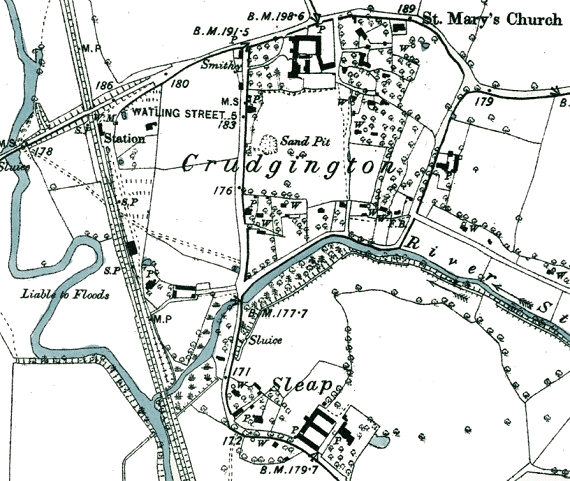
Extract from a large-scale Ordnance Survey map showing the village of Crudgington and, to the South of it, the hamlet of Sleap., as well as the network or roads and lanes within and around those settlements. To the West of both settlements is a railway line, running North-northwest - South-southeast. To the the West of that railway a river (the Tern) follows a similar, though much more winding course. Another river (the Strine) flows from East to West across the map, between Crudgington and Sleap, to join the Tern near the bottom of the map.
Map published 1886 showing Crudgington, Sleap, and Crudgington railway station.

Who was Mr ‘Perceval’, the stationmaster? The only other trace of him I found when I searched the British Newspaper Archive was a report in 1889 in which it was mentioned that he sent flowers to the funeral of John Bertie Davies, who had been employed at the station as a telegraph clerk (Wellington Journal, 7 September 1889, page 8). There was a Mr Herbert F Percival living in Waters Upton in 1891, but he was a farmer. The nearby railway station – with its stationmaster’s house – was at Crudgington, situated south of Waters Upton and in the parish of Ercall Magna (the track and the station are now long gone, but the house and a railway bridge ⇗ remain).

The entry for High Ercall in the 1891 Kelly’s Directory ⇗ provided me with the answer: the name of the Crudgington stationmaster was actually James Purcell (which reinforces the old saying that you shouldn’t believe everything you read in the papers!). The Wellington Journal did at least get his name right in their edition of 31 October 1891 when they included “Mr. Purcell, the popular and obliging stationmaster at Crudgington” among those who attended a concert at Crudgington. The concert had been organised at James Purcell’s request, to raise money for the Widows’ and Orphans’ Fund of the Great Western Railway. Attendees included Waters Upton residents John Bayley Davies (the rector) – and the aforementioned Mr Percival (the farmer).

James Purcell, a Railway Station Master born at Cox Bank in Audlem, Cheshire, was enumerated on the 1891 census ⇗ at Crudgington. He appears to have knocked a few years off his age for that census – although he said he was 34, in 1881 ⇗ when he was a stationmaster at Adderley near Market Drayton, he was 27. We get to the truth by going back another ten years to the 1871 ⇗ census, when James was a railway porter living with his parents and siblings in the place of his birth and his age was given as 19: a son of shoemaker James Purcell and his wife Charlotte, née Worrall, James junior was baptised ⇗ at Audlem on 6 July 1851.

James’s employment took him to Shrewsbury in 1892, a report in the Wellington Journal of 26 November that year noting that: “Mr. Purcell has been stationmaster at Crudgington for upwards of 12 years [10 years at most in reality!], and his leaving seems to be generally regretted throughout the district.” James Purcell, 44, was still living in Shrewsbury when the 1901 census ⇗ was taken, and was employed as a railway clerk (or more specifically, as a “Railway Canvasser”). He remained in Shrewsbury and in that employment until his death on 26 March 1912.

Part 2


Picture credits. Victorian / Edwardian tricycles: Photograph by Mike Peel ⇗; taken from Wikimedia Commons ⇗, modified, used and made available for reuse under a Creative Commons licence ⇗. Map showing Waters Upton, Crudgington, Long Lane, and Long Waste: Composite image made from extracts of Ordnance Survey One-Inch to the mile map sheets 138 and 152 published 1899; reproduced with the permission of the National Library of Scotland ⇗ under a Creative Commons licence ⇗. Map showing Crudgington, Sleap, and Crudgington railway station: Extract from Ordnance Survey Six-inch map sheet XXIX.SE published 1886; reproduced with the permission of the National Library of Scotland under a Creative Commons licence ⇗.