THOMAS PLANT, of the Parish of Waters-Upton, in the County of Salop, Farmer, having left his Family early upon Friday Morning, the 5th of January last, in Order (as he said) to Visit his Friends in Staffordshire for a few Days; and not having been heard since, though diligent Enquiry has been made after him: This is to request the Favor the Public, if they know any Thing of him, to give immediate Notice thereof to the Printer of this Paper, who will take Care to Inform his afflicted Friends. […]
– Shrewsbury Chronicle, 9 Mar 1776, page 3.
Imagine being the “afflicted Friends” – or indeed the family – of Thomas Plant. Off he went one day, saying he was visiting friends in the next county, but two months later he had not returned and no word had been received as to his whereabouts. Concern for Thomas’s wellbeing was heightened by the severe winter weather that followed his departure. The above notice in the Shrewsbury Chronicle continued:
It is feared that, as he went away just before the great fall of Snow, he Perished therein.
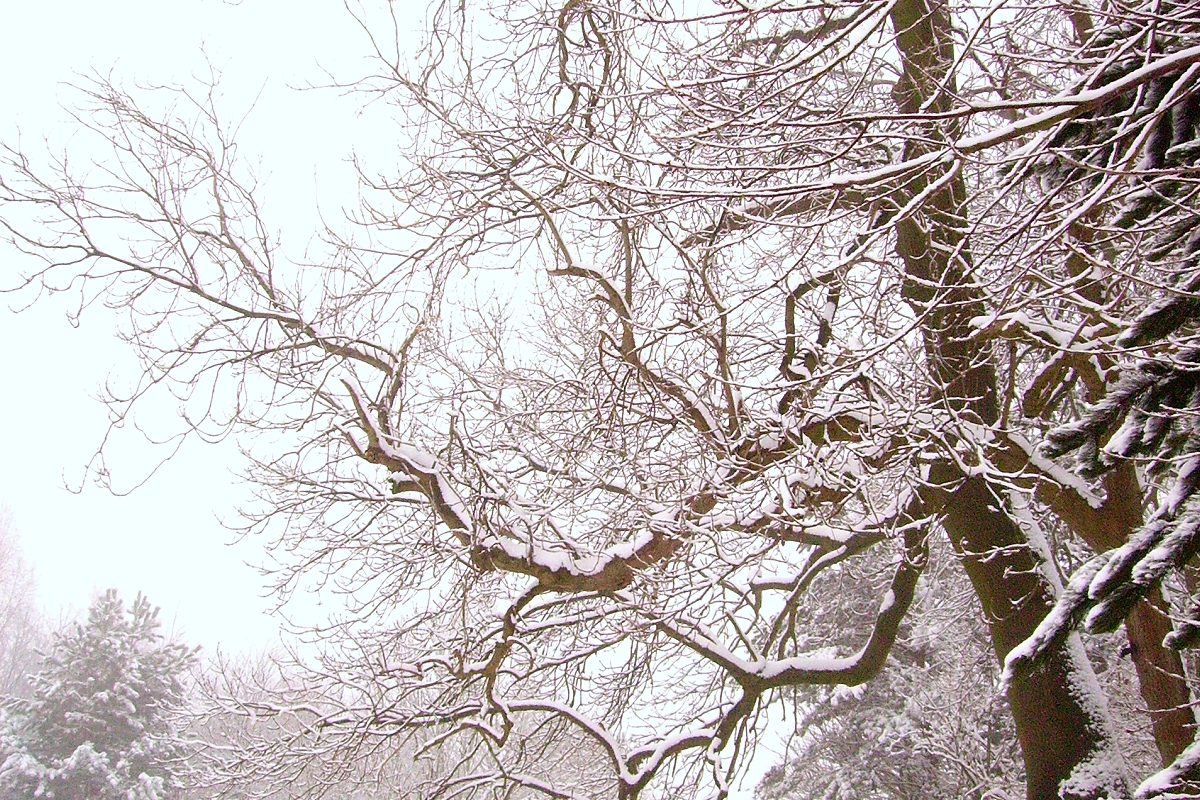
Trees with snowy branches. Photo by the author.
“there never was known in this kingdom so deep a snow”
The description of the snowfall, and the fear expressed that it may have proved to be terminal for Thomas, were not exaggerations. Back on Saturday 13 January, the Shrewsbury Chronicle had reported (on page 3) that “the amazing fall of snow on Saturday night and Sunday last” had rendered the roads from Wolverhampton to Birmingham, and from there through Coventry to London, “intirely impassable.” Furthermore, a woman had been found dead in the snow in Worcestershire.
By the following Saturday, more reports of people lost in the snow had been received, and the Chronicle’s editor stated (again on page 3):
From the best accounts we can collect, there never was known in this kingdom so deep a snow as the present. The communications with London and other places, not only by carriages, but even by horses, were entirely shut for several days. The London mails due on Monday and Thursday last week, did not arrive here till Monday morning last.
Difficulties were still being experienced during the ensuing week. Along with snow-related reports from around the country however, the Shrewsbury Chronicle of 27 January also carried (on page 3 once more) news of local acts of charity. In Shrewsbury itself, William Pulteney and John Corbet, esquires, had paid for nearly 40 wagonloads of coal to be distributed among the poor of the town. A similarly generous helping of coal was also given to the poor of Shrawardine and Montford, by Lord Clive. And thanks to Lord Pigot, “a loaf and cheese were given to every person in Bridgnorth that would accept of them” – that edible offering was accepted by nearly 900 people!
“The Wings of small Birds were so frozen that they fell to the ground”
Another source of information on the severity of the weather in Shropshire at the beginning of 1776 is the parish register of Whittington. In that register the rector, Reverend William Roberts, liked to record far more than just baptisms, weddings and burials. His entries for 1776, which I have transcribed from copies of the original register at Findmypast (another transcript can be found on Mel Lockie’s website ⇗) began:
The New Year is set in with a dreadful fall
of Snow wch began on the 6th at night blown
in drifts by a brisk Easterly Wind, that It lies
in several parts seven feet deep, & has render’d
it impossible for the Mails to pass […]
After a couple of baptisms, Rev Roberts’ weather observations continued at the end of January and into February:
30th
The Snow continues so deep & the Frost so
severe that the London Mails have not yet
come in regularly. The 21st was remarkable for
intense cold, and the 27th nearly as keen.
Feb: 1st
A drizzling Rain wch. fell partly in Icicles, and
froze as it fell, many accidents happen’d from the
slippery surface of the paths wch. were
perfectly glazed. Travellors Cloaths instead of being
wet, were So stiffly congealed about them, that It
was with difficulty They were got off. The Wings
of small Birds were so frozen that they fell to the
ground, many were pick’d up & others
Feb: 2d
died frozen to the ground. The next day a gentle
Thaw began to discover the face of the earth, wch
had been hid for so long a time.
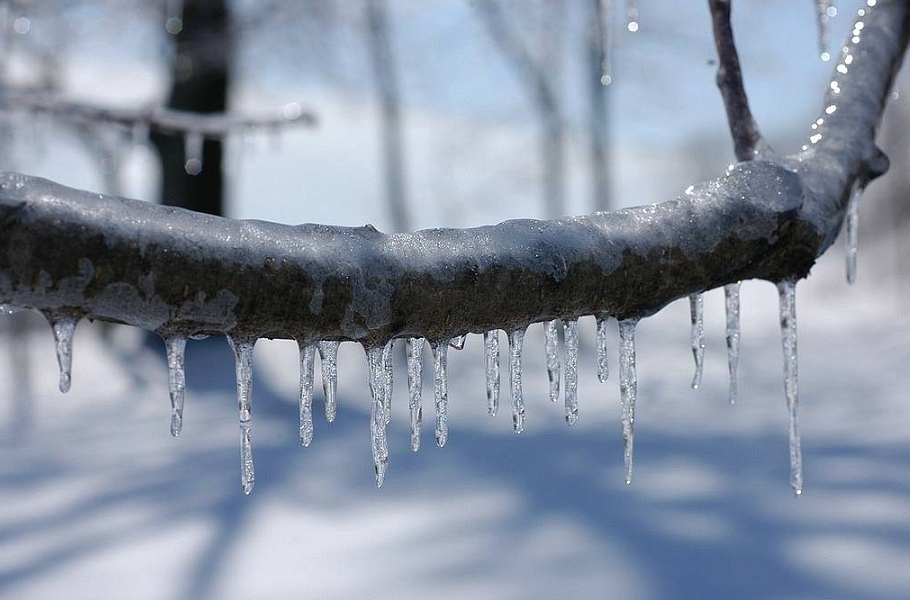
An ice-covered branch. Public domain image from Pixabay via Picryl.
I think you can now fully appreciate the severity of the weather which descended upon Shropshire and many other parts of England, on the evening of the day after Thomas Plant left his home in Waters Upton in January 1776. Was he lost, or can we find the poor man?
To clarify: I’m not suggesting that we invent time travel and go back to look for our missing man. What I am wondering is, can we find Thomas in the records, and can we determine whether or not he survived, and returned to Waters Upton?
“A stout made Man”
Sadly I’ve found nothing about Thomas in the newspapers following the appeal that was made two months after he set off for Staffordshire. However, that appeal (a version of which also appeared on page 3 of Aris’s Birmingham Gazette on 11 Mar 1776) concluded with information about Thomas, to aid in his identification:
The above-named THOMAS PLANT is a stout made Man; upwards of 50 Years of Age; 5 Feet 9 Inches high; of a dark Complexion, with black Hair turning grey; He had on when he left Home, a Suit of blue Cloaths, with Basket Buttons of the same Colour, and wears his Hat turned up on the Sides, but not close cocked; rather Stoops in his Walk, and has an awkward Gait. Waters-Upton, March 9th, 1776.
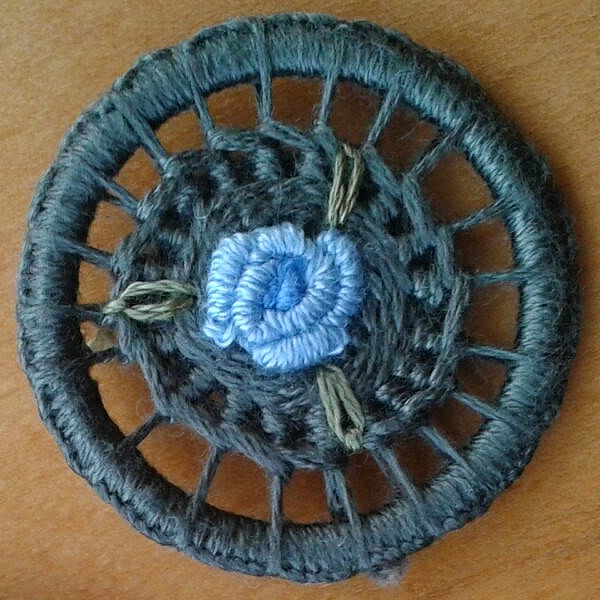
A Dorset crosswheel button. Adapted from a photo by Abigail Seabrook @Moretta Designs and modified, used, and made available for re-use under a Creative Commons licence ⇗.
How fantastic to have this pen-picture of our wanderer from Waters Upton! If, by the way, you are intrigued (as I was) by the ‘Basket Buttons’, they were often known as Dorset buttons ⇗ and were hand-made by “repeatedly binding yarn over a disc or ring former.” Very popular in the 18th century apparently. Not that this helps us in tracking down Thomas!
A more useful piece of information for our purposes is Thomas’s age. It’s a little vague, and might not have been entirely accurate, but it helps to narrow down the field when searching for him in the records. In addition, we know that although he lived in Shropshire, he (supposedly) left home to visit friends in Staffordshire. Might he have had family in that county too?
To the above leads, I can add more from my abstracts of baptisms at Waters Upton. There are four, in the latter half of the 1750s and another in 1761 which are of particular interest. Anne, Thomas, and Margaret, children of Thomas and Ann(e) Plant, were baptised on 18 May 1755, 25 March 1759, and 26 April 1761 respectively. In between the first two of those children, with no parents named but almost certainly another child of Thomas and Ann, there was Martha Plant, baptised on 2 October 1757. I think it is reasonable to conclude that these were children of the man who went walkabout from Waters Upton in 1776.
This information allows a search not only for Thomas Plant’s own baptism, but also for his marriage to Ann. Carrying out such a search, I soon spotted parish register entries which very likely recorded both of these events.
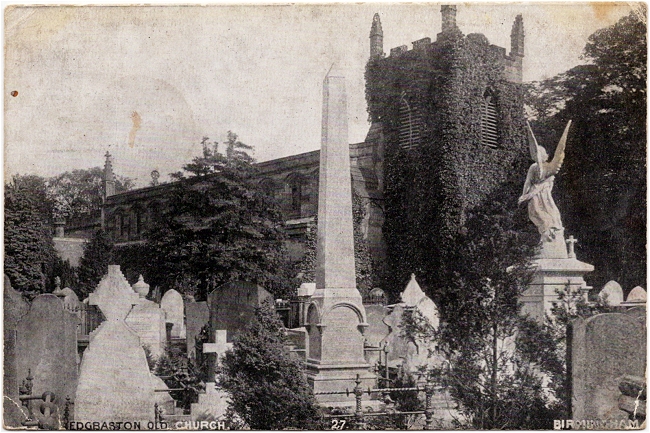
A little while ago I bought a postcard which bears a Waters Upton postmark. It does not add to my limited collection of village views – the scene on the rather grubby front of the card depicts Edgbaston Old Church, Birmingham. But it was probably posted by someone living in Waters Upton, or at least close enough for their mail to be franked there, someone named Elizabeth. Who was she?
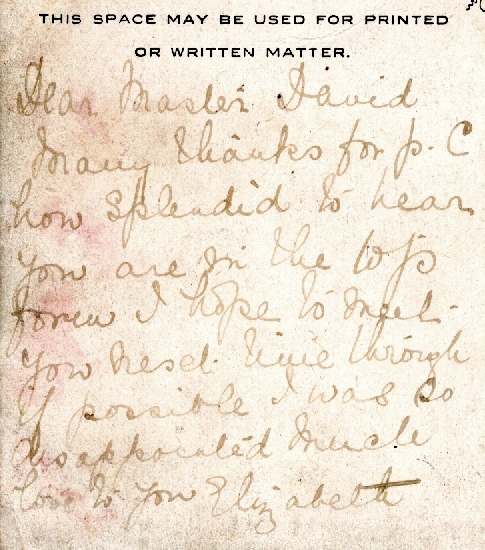
“Dear Master David” wrote Elizabeth, “Many thanks for P.C how splendid to hear you are in the top form I hope to meet you next time through [= though?] if possible I was so disappointed Much love to you”. The postcard was franked on 11 May 1908.
The recipient
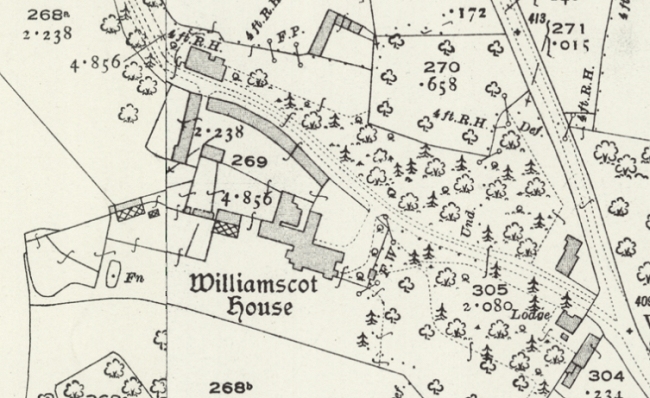
At least the identity of the postcard’s recipient was fairly easy to establish. The card was addressed to Master D. G. Loveday, care of W. Deedes Esq, Mill Mead, Shrewsbury. At the top of the list of results when searching the 1901 census at Findmypast for D* G* Loveday is 4-year-old David G Loveday. He was living at the Manor House in Williamscote, in the Oxfordshire parish in which he was born: Cropredy.
The birth of David Goodwin Loveday, mother’s maiden name Cheape, was registered in the second quarter of 1896 in Banbury registration district ⇗. Googling David’s full name generates results from Wikipedia ⇗ and other websites, showing that he was born on 13 April 1896, was educated at Shrewsbury School, and was an Anglican bishop who died 7 April 1985.
I decided to find out more about David Loveday and his family in the hope that this might help to reveal the identity of Elizabeth. David’s father was John Edward Taylor Loveday. John was born in the first half of 1845 at East Ilsley in Berkshire, where his father (as per the censuses of 1851 ⇗ and 1861 ⇗) was Rector. He seems to be best known for printing, “with an Introduction and an Itinerary”, a manuscript by his great grandfather John Loveday ⇗: Diary of a Tour in 1732 through parts of England, Wales, Ireland, and Scotland. (This tour was probably number 23 in a list of 126 Tours by John Loveday ⇗ compiled by some of his descendants.) He was educated at Exeter College, Oxford ⇗, where he matriculated on 11 June 1862, aged 17.
John Edward Taylor Loveday married ⇗ Edinburgh-born Margaret Cheape on 15 Oct 1874 at Cameron, in Fife, Scotland. The couple made their home at Williamscote House (the above-mentioned ‘Manor House’), where they were enumerated with their first five children in 1881 ⇗. John was described as a “Landed Proprietor & Magistrate for Counties of Oxford & Warwick”. They had five more children over the course of the next 15 years, of whom David Goodwin Loveday was the youngest.
It turns out that David was not the first of the Loveday children to spend time in Shrewsbury. The 1901 census ⇗ records his brother Henry Dodington Loveday, then aged 20 and an articled clerk to a solicitor, lodging with the family of clergyman William Leeke at the Abbey Foregate Vicarage. Another brother, Alexander, was also living in Shrewsbury when the 1901 census ⇗ was taken. Aged 12, he was boarding at the school his brother David would later attend, Mill Mead, a private establishment under the headmastership of Wyndham Deedes.
Elizabeth . . . who?
The Lovedays’ connections with Shrewsbury might explain how the mysterious Elizabeth became a friend of the family. Was there a lady of that name living in Waters Upton in the early 1900s who looks like a suitable candidate? Of the several Elizabeths on the 1901 and 1911 census returns for the parish, one stands out: Elizabeth Yonge.
Elizabeth Mary Hombersley Yonge, née Groucock, was the wife of the Rev Lyttleton Vernon Yonge. Rev Yonge was a son of Vernon George Yonge, also a clergyman, and part of a prominent Staffordshire family which had its seat at Charnes Hall. Lyttleton was born at the Rectory in Great Bolas, received his education at Cambridge, and although he resided at Waters Upton he was vicar of Rowton, in Ercall Magna parish. Elizabeth, who was also from the parish of Bolas Magna, was a daughter of Thomas Groucock (a farmer of 180 acres in 1881), and of Elizabeth Groucock née Dickin, who was descended on her mother’s side from the Wase family of Waters Upton Hall.
The social standing of the Yonges (and perhaps also the subject of the postcard’s picture) makes Elizabeth my top ‘suspect’ in a case which is not so much a ‘whodunnit’ as a ‘whopostedit’. All I am lacking is any direct evidence that the Yonges and the Lovedays actually knew each other!
The front of the postcard sent to Master D G Loveday by Elizabeth.
Maybe one day I will find that David Goodwin Loveday’s early education, before he went to Shrewsbury School, was as a pupil boarding either with Lyttleton Vernon Yonge or with his fellow clergyman and Waters Upton resident, John Bayley Davies? Or perhaps I will find a document written (or least signed) by Elizabeth, so that I can compare it with the writing on the postcard at the centre of this mystery. Her signature should appear in the Waters Upton marriage register, but the register begun in 1837 is still in use and has not been deposited at Shropshire Archives. The probate copy of her will, a digitised version of which I have obtained from HMCTS via the Gov.UK website ⇗, is typewritten and bears no signature.
So is this the end of my investigation? Not quite. Because while looking at the other Elizabeths of Waters Upton, I found a further line of enquiry.
Coincidence or connection?
The Elizabeth who piqued my interest was Elizabeth Emma Ball. She was a daughter of William Abraham Richard Ball and his wife Sarah, née Cureton. This Elizabeth spent the early part of her adult life working as a servant before moving back to Waters Upton between 1901 and 1911. There is nothing to suggest that she met the Lovedays unless perhaps she worked for one or more of them as a servant, but if that was the case the development a postcard-exchanging relationship with David Goodwin Loveday seems unlikely. However, if she didn’t know the Lovedays personally, Elizabeth may have known of them, through her younger sister…
Mary Ann Ball was born at Waters Upton on 13 February 1877. By 1891, when she was 14, she was in service, working as a nurse for the family of John Bayley Davies at Waters Upton Rectory. A decade later she was in Shrewsbury, living and working as a housemaid at a house in Belle Vue Road. Then, in 1909, she married Thomas Henry Kimnell.
Thomas was born at Wardington in Oxfordshire on 25 August 1878 and was enumerated there with his family on the censuses of 1881 ⇗, 1891 ⇗, and 1901 ⇗. When the latter census was taken, Thomas was 22 and, like his father, he was an agricultural labourer. Whether his fortunes changed before or after his marriage is unclear, but change they most certainly did. The 1911 census ⇗ recorded him not as a labourer but as a farmer, working on his own account. With wife Mary Ann and daughter Eva Mary (born 14 March 1910) he was living at Williamscote in Wardington parish.
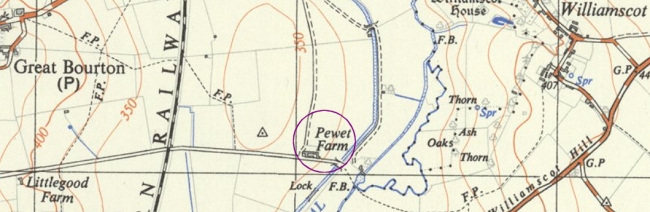
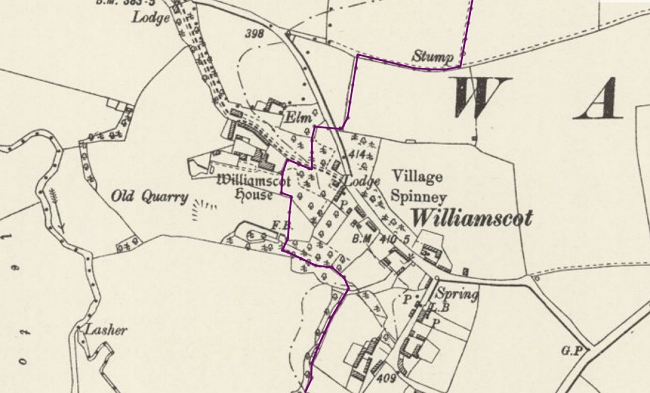
A second daughter, Helen Elizabeth, was born at Williamscote on 22 February 1914, but the Kimnells’ third and last child, Alice, was born at the end of 1917 or in the first quarter of 1918 on the other side of the River Cherwell in the parish of Bourton. Almost certainly the family was living there when the Banbury Guardian of 5 Jul 1917 reported on a military tribunal at which Thomas, a farmer of 107 acres, successful claimed exemption. From the 1921 census and National Identity Register of 1939 it appears that the family remained there for more than 20 years, at Pewet / Peewit Farm (highlighted on the map above).
Thomas Henry Kimnell of Williamscote died on 16 June 1965 at Woodford Halse in Northamptonshire; his estate was valued at £4531. Mary was also of Williamscote at the time of her death on 17 February 1969; given that her death was registered at Daventry she too may have died at Woodford.
Did the references to Williamscote in the preceding paragraphs cause you to think back to the earlier part of this story, relating to the Loveday family? The hamlet of Williamscote, although lying in the parish of Wardington, is a stones-throw from Williamscote House in neighbouring Cropredy parish (the boundary is shown in purple on the map below). The 1911 Kelly’s Directory ⇗ of Oxfordshire lists Thomas H Kimnell right after John Edward Taylor Loveday under Williamscote! Coincidence? Quite possibly, but I think there’s a good chance that it isn’t.
William Ball was well known in Waters Upton so both the Davies family and the Yonges would have been familiar with his daughters, all the more so in the case of Mary Ann given her employment at the Rectory. If, as I have theorised, Elizabeth Yonge was a friend of the Lovedays, this might mean that she was in a position to help bring about the union of Thomas Henry Kimnell (who the Lovedays may have known, perhaps as an employee?) and Mary Ann Ball.
Ultimately, this is speculation and does not prove anything conclusively. The puzzle of the postcard’s sender remains officially unsolved – a one-place study ‘X File’. At least for now. One further possibility for acquiring a sample of Elizabeth Yonge’s handwriting and/or signature remains. Dave Annal recently reported on Twitter that he managed to obtain a copy of an original will from HMCTS – although he did have to wait 16 months!
“Has your #OnePlaceStudy been photographed?” As you might guess from the hashtag, this question was posed on Twitter. Pam Smith’s tweet prompted me to make another online search for old photos of Waters Upton, a search which turned out to be fairly fruitful. Not only did I find an old photo, I also happened upon an intriguing postcard sent to a young lady of Waters Upton, from someone who appears to have been a secret admirer.
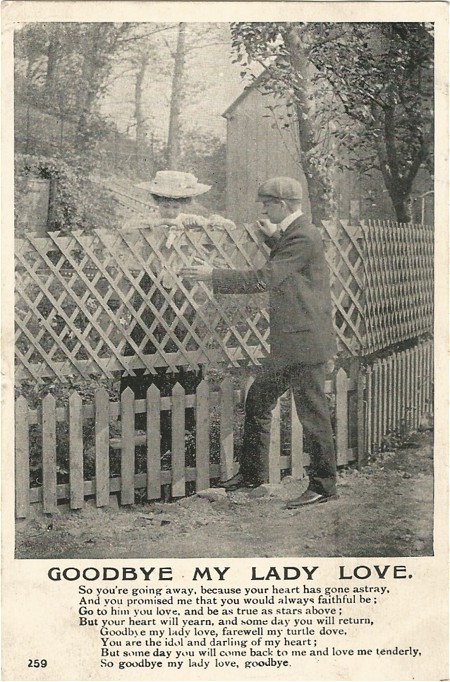
The postcard was one of many being offered for sale on the British Family Tree Research ⇗ website, and naturally I soon snapped it up. As you can see, the front of the card has a black and white photo of a young man standing on one side of a garden fence, looking at a young woman standing on the other side. Below the photo the following verse is printed:
GOODBYE MY LADY LOVE. So you’re going away, because your heart has gone astray, And you promised me that you would always faithful be; Go to him you love, and be as true as stars above; But your heart will yearn, and some day you will return, Goodbye my lady love, farewell my turtle dove, You are my idol and darling of my heart; But some day you will come back to me and love me tenderly, So goodbye my lady love, goodbye.
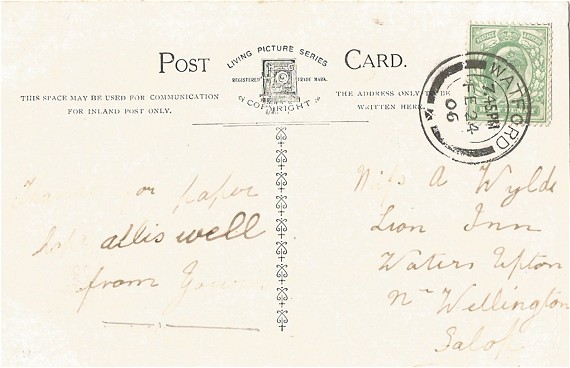
Powerful stuff, so let’s go over to the other side of the postcard for the all-important details of the sender and the recipient. The lamenter of lost love was, as I suspected, anonymous. Not only was no name given, the message is almost illegible in places! That message simply said:
Thanks for paper hope allis [= all is] well from Your’s
OK, what about the postmark – a vital clue or a red herring? Well, it shows that the postcard was posted at Watford, in Hertfordshire, on 24 February 1906. Did the sender live in Watford but visit Waters Upton, or live in the latter and visit the former (through employment, or maybe because of family connections), or did the sender live in Waters Upton but know someone who lived in Watford, who agreed to post the card to make its origins more mysterious? The one person whose identity I knew, from the details provided on the BFTR website, was of course the addressee: Miss A Wylde of the Lion Inn, Waters Upton. Without a doubt Lucy Alice Wylde, who was known as Alice – presumably to avoid confusion as her mother’s name was also Lucy.
The life of Lucy Alice Wylde: part 1
Lucy Alice Wylde was born at Waters Upton in 1889, most likely in the Lion Inn; her birth was registered at Wellington in the second quarter of that year. She was the third child and first daughter of John and Lucy (née Strefford) Wylde, and appears with them at the Lion on the 1891 census, along her elder brothers Frederick and Joseph (twins) and younger sister Sarah Ann (aged 7 months).
Sadly, Lucy Alice and her siblings lost their father on 2 April 1900 (a headstone in Waters Upton churchyard surviving to tell the tale). Their widowed mother took on the running of the Lion, and she was enumerated in that capacity on the 1901 census, with her children Frederick, Joseph, Alice (the forename Lucy dropped by that time), Harry and Albert (but not Sarah who, as we will see, was staying elsewhere).
The Wellington Journal of 27 July 1901 shows that Alice took part in the Bolas and Waters Upton Flower Show, held on the afternoon of Friday 6 July. In the Children’s Division of the show she was awarded fourth place for her collection of grasses; if she entered a wild flower bouquet she was not placed. There were also sporting events held in conjunction with the show (reported on in the following week’s edition of the Journal), including egg and spoon races for married ladies and spinsters; Alice competed in the latter and came second.
The next event in Alice’s life that I know of was the delivery of the postcard from her secret admirer, which quite possibly prompted giggles from Alice’s siblings, and maybe blushes from Alice herself? Alice, who at that time was nearly 17 years old, may well have known who the sender was – but we can only guess. Was it perhaps William James or his younger brother Thomas, sons of Alfred James the butcher and his wife Ann, whose household was enumerated immediately before the Lion on the censuses of 1901 and 1911? Even if I had samples of handwriting to compare (sadly I don’t) it would probably be difficult to prove one way or the other. One reader of the first incarnation of this story suggested “a teasing card from female friends or [an] elder brother.”
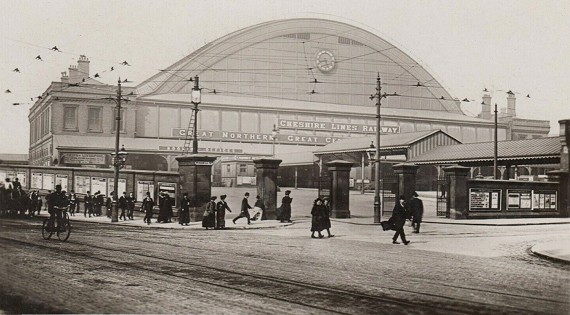
In an attempt to find out more, I endeavoured to piece together what happened to Alice after 1906. The first part of this project was easy. By 1911 Alice had indeed left home and she was not with her family at the Lion Inn on that year’s census. Like her elder twin brothers, Alice had found railway-related work – she was enumerated at Manchester’s Central Station on Lower Mosley Street (pictured below in the 1910s) where she was one of seven single ladies working as bar attendants.
The life of Lucy Alice Wylde: part 2
Alice’s life after 1911 was something which, at first, I was not 100% certain about. With the aid of Ancestry and then also Findmypast, I tentatively pulled together the following sequence of events. As all the records I have found use her full name, I too will from this point refer to Lucy by her original given name.
In the last quarter of 1919, the marriage of Lucy A Wylde and John Crompton was registered ⇗ in Wellington Registration District, Shropshire. Judging by his surname ⇗, John was probably a Lancashire lad whom Lucy met while working in that part of England; I think it very likely that the couple wed at Waters Upton, which was not only the bride’s native parish but also where her mother still lived and worked.
Very soon after their nuptials, the newlyweds emigrated. The passenger list for the Saxon, departing Southampton on 19 December 1919, included a Mr and Mrs J Crompton who were contracted to land at Cape Town. I have to point out that there are a number of things in this record which suggest that it relates to another couple – Mrs Crompton’s age is given as 20 (30 would have been more accurate), and the “country of last permanent residence” was indicated as being “British Possessions” for both parties (I have found no evidence of any previous periods abroad for either of them). However, Mr Crompton’s occupation was given as “Clerk”, and his age as 35, both of which tie in with later records.
On 31 May 1926 Lucy A Crompton, a housewife aged 37, arrived at London from Cape Town aboard the P&O Steamship Balranald from Sydney, Australia. The country of her last permanent residence was recorded as “Africa” – which of course is not a country. (As one of my former geography teachers said many years ago when someone gave “Africa” as an answer to a question, “Damnit man, Africa’s a big place!”) Lucy’s proposed UK address was the Grapes Hotel in Liverpool, but her intended future permanent residence was “Other parts of the British Empire”. Sure enough, on 2 September 1926, 37-year-old housewife Mrs Lucy Alice Crompton, whose last UK address was the Glasgow Arms Hotel in Deansgate, Manchester, departed London for Cape Town aboard the P&O Steamship Borda. Her country of intended future permanent residence was “S. Africa”.
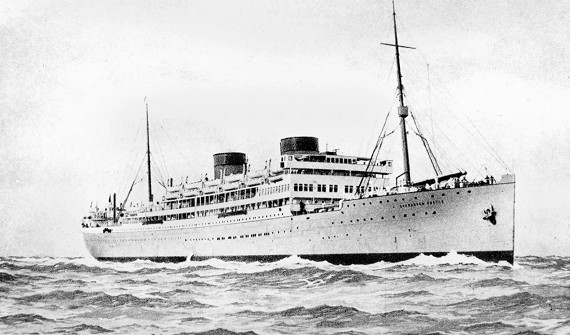
A further brief visit to the UK was made in 1935. This time, 46-year-old Lucy Alice Crompton was accompanied by her husband, John Crompton, a Secretary, aged 50. The couple, whose last and intended future residences were South Africa and “Other parts of the British Empire” respectively, arrived at Southampton on 29 July, aboard the Carnarvon Castle (pictured below). Their proposed UK address – and these details are worth remembering – was “c/o Mr Doughty, 12 Hayes Ave, Bournemouth”. The Cromptons left just over a fortnight later, on the Carnarvon Castle’s return trip to South Africa which began when it departed Southampton on 9 August 1935.
Lucy A Crompton, aged 64, returned to the UK for what appears to have been the last time in 1954. The passenger list for the Edinburgh Castle shows that she arrived at Southampton on 9 April. John Crompton was not with her (I have yet to establish his fate, not to mention who he worked for in South Africa, and whereabouts in that country he and Lucy lived). Lucy was once again heading for 12 Hayes Avenue in Bournemouth – and she intended to remain in England permanently.
According to the National Probate Calendar for 1966, Lucy Alice Crompton of 18 Lansdowne House, Christchurch Road in Bournemouth died on 12 May that year at Christchurch Hospital. Probate was granted to the Westminster Bank, and Lucy left effects valued at an impressive £12,766.
Not a bad life for a publican’s daughter – assuming all the above records actually relate to ‘our’ Lucy Alice Wylde! How to be certain, without purchasing Lucy’s marriage certificate, or her death certificate, or perhaps a copy of the aforementioned will? I decided to follow the fortunes of Sarah Ann Wylde, the younger sister of Lucy, and see what information that turned up.
Wylde at heart: sister Sarah Ann
Sarah, as we have seen, was not with her siblings and her widowed mother at the Lion Inn, Waters Upton, at the time of the 1911 census. Instead, she was staying with her cousin William Lawrence Wylde (a son of Sarah’s late uncle Lewis Wylde) at 52 Stafford Street in Hanley, Staffordshire. William, incidentally, was a Beerhouse Manager, so his (public) house was, aside from being in an urban rather than a rural environment, ‘home from home’ for 10-year-old Sarah.
In my initial searches I failed to find Sarah on the 1911 census, but I managed to catch up with her in 1922 – on her wedding day. The marriage register of Stanmore Church in Middlesex, described by Ancestry as Harrow St John, shows that on 29 June 1922 Sarah Ann Wylde of Stanmore, a spinster aged 31 and a daughter of John Wylde deceased, married Albert Ishmael Doughty of Harrow, son of John Doughty deceased. John, who had retired from business, was a bachelor aged – wait for it – 56 (perhaps there’s hope for me yet!).
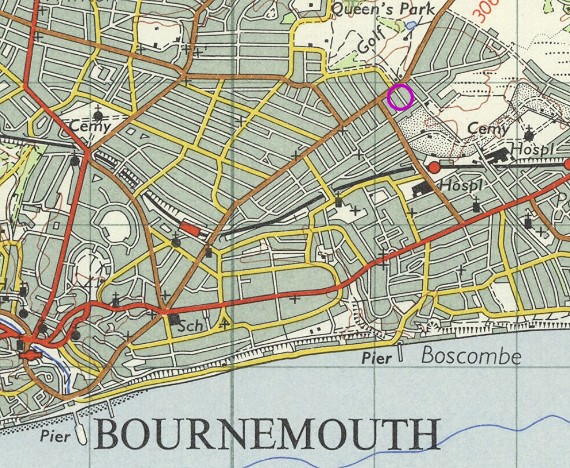
Does the surname Doughty ring any bells? If it doesn’t, how about the address where Sarah and Albert were living when the National Identity Register was compiled in 1939? Albert I Doughty, a retired pawnbroker born 26 August 1865, and Sarah A Doughty, born 19 August 1890, were – along with Albert’s unmarried sister Marion – residing at 12 Hayes Avenue, Bournemouth (Hayes Avenue lies within the purple circle on the map above). Boom! Clear evidence that Sarah’s sister Lucy Alice Wylde had indeed married clerk / secretary John Crompton and emigrated with him to South Africa.
Albert Ishmael Doughty of 12 Hayes Avenue Bournemouth died on 28 November 1942; the National Probate Calendar for 1943 shows that probate was granted to the National Westminster Bank and that Albert effects were valued at a whopping £30,883 4s. 3d. His widow Sarah Ann Doughty, née Wylde, remained at the couple’s home in Bournemouth but died at Strathallan Nursing Home in Owls Road on 12 August 1962. She had evidently been the primary beneficiary of her late husband’s will, as her effects (according the National Probate Calendar of 1962) were valued at £26,901 14s. 5d.
So far away, yet so close
Lucy Alice and Sarah Ann, two sisters from Waters Upton, led very different lives, and for a large part of those lives were half a world away from each other. But despite the distance they were clearly very close to each other. Not only did they keep in touch, they also spent their last years in the same seaside resort on the south coast of England.
What of Lucy Alice’s secret admirer? That postcard wasn’t thrown away, it was kept and it was presumably only after Lucy’s death that it found its way into the old postcard trade, so it must have meant something. Well over a century after it was posted, it came to my notice and has led to a little of Lucy Alice’s life, and that of her sister Sarah, being explored and remembered. But who sent the card?
Thanks to genealogy guru Dave Annal (Lifelines Research ⇗), I think we now have a pretty good idea. Dave did a more thorough job of searching for Sarah in 1911 than I did, and guess where he found her? Living (and working as a general domestic servant) in the household of Ellen Hester Boulter at 2 Loates Lane in Watford, that’s where. Lucy Wylde’s ’secret admirer’ was her sister!
Picture credits. Postcard sent to Miss A Wylde: Posted in 1906 and therefore believed to be out of copyright. Central Train Station, Manchester: From a 1910s postcard and therefore believed to be out of copyright. The Union-Castle Royal Mail Motor Vessel “Carnarvon Castle”: From an out-of-copyright image at State Library of Queensland ⇗ (John Oxley Library), Australia. Map of Bournemouth showing the location of Hayes Avenue: Extract from Ordnance Survey One Inch map Sheet 179 ⇗; reproduced with the permission of the National Library of Scotland and used under a Creative Commons licence ⇗.
 Waters Upton One-Place Study