The Cold Hatton Association for the Prosecution of Felons – Part 2

⇐ Back to Part 1

As we have seen, when the Cold Hatton Association was formed in 1769, drawing members from several small settlements including Waters Upton, it aimed “to prosecute all Felons, especially Horse-stealers”. In the years that followed, while horse thieves remained a priority, the Association (hereinafter referred to as the CHA) developed and diversified its mission, with the deterrence of other forms of felony falling more firmly within its remit.

There was a lot of variation in the notices published by the CHA in its early years, as the young organisation sought to define who, and what, it was for. There was also the matter of how best to present itself to the public, or at least that section of the public who either read the newspapers or had the papers’ news and notices conveyed to them. Within that part of the populace were potential new members, potential partners in crime-fighting, and quite probably some of the felons who might see themselves as potential defendants should they be collared by the CHA.

The CHA was not alone in this experimental phase of its existence, as I have seen the same variation in the notices published by similar Salopian societies around this time. I think there was a lot of ‘borrowing’ of ideas, with the various prosecution associations taking note of (and taking some of the wording from) what the others had published in the papers.
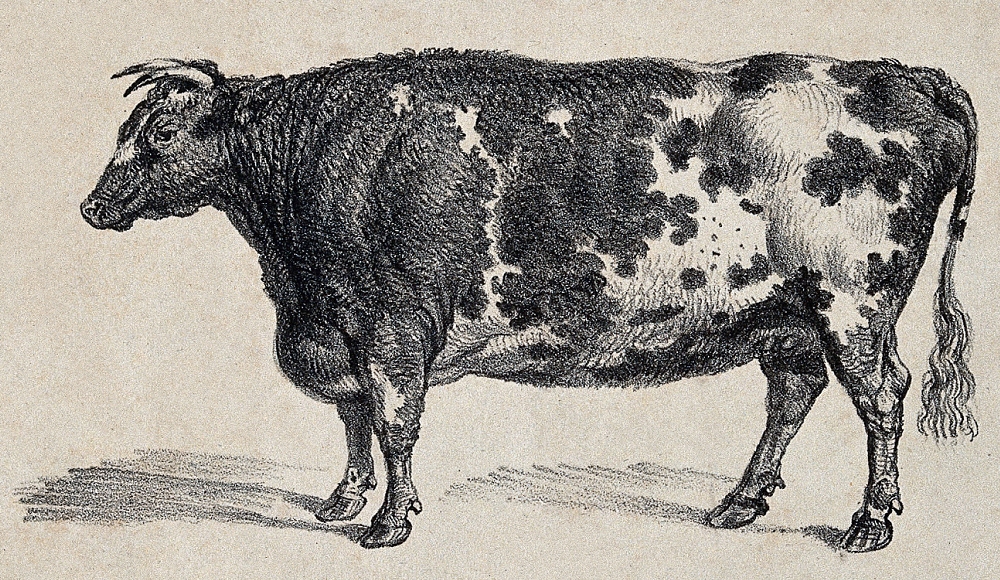
An illustration dating from 1804 of a Shorthorn Cow. The Cow is standing, and facing towards the left side of the image. In black on a buff background.
A Shorthorn Cow, by J Ward, about 1824. Public domain image from the Wellcome Collection ⇗.

In 1771, the CHA advertised that it was “a Society for Prosecuting House-breakers, Horse-stealers, and all other Kinds of Felony whatsoever.” 1773 saw a slightly more detailed agenda published. The CHA would “endeavour to apprehend and prosecute all Persons who shall be guilty of committing Felony or Larceny on the respective Properties” of it members, and it set out the actions to be taken by any member “who shall have his, her, or their House broken open, or Horse, Cattle, or other Property stolen”.

Hedge-tearers, and Springle-getters

The emphasis on equines returned in notices published from 1774 to the beginning of 1777. In September 1777 however, the following statement was added to the CHA’s notice: “They are also determined to prosecute all Hedge-tearers, and Springle-getters to sell, and others that cannot give Account of themselves.”

Hedge-tearers? George Roberts, in his 1856 publication The Social History of the People of the Southern Counties of England in Past Centuries ⇗, categorised hedge-tearers with wood-stealers, spoilers of hedges, “and to crown all, the pollers of trees.” These were poor folk who, in order to obtain fuel for their fires, would plunder the local woods and hedgerows (and presumably, in the case of wood-stealers, their wealthier neighbours’ wood piles). Roberts was writing about the late 1500s in Dorset and Somerset, but evidently hedge-tearers were also a problem two centuries later in Shropshire. Were the Salopian hedge-tearers of that time also looking for fuel, or were they simply vandals?

Springles could also have been a source of firewood, but were being stolen by ‘springle-getters’ so that they could be sold. In an 1894 issue of Notes and Queries ⇗, a correspondent stated that “’Thatching springles’ are willow or hazel rods four feet long, split and with the ends sharpened, and used to bind down the thatch.”

This was in reply to a query in an earlier issue, about the appearance of springles in the churchwardens’ accounts of High Ercall, the parish in which Cold Hatton lay and which Waters Upton was adjacent to. Springles were also mentioned in the eighteenth century accounts of the Overseers of the Poor, in the North Shropshire parish of Moreton Corbet. They were listed along with other items used in connection with “thetching” parishioners’ houses. I have an 1883 edition of the Transactions of the Shropshire Archaeological and Natural History Society ⇗ to thank for that snippet of information.

Clearly, the gentlemen freeholders and farmers of Waters Upton and nearby settlements valued their hedgerows, which helped to keep their cattle and other animals in the fields where they belonged. And it appears that a good number of people in that area had houses with thatched roofs.
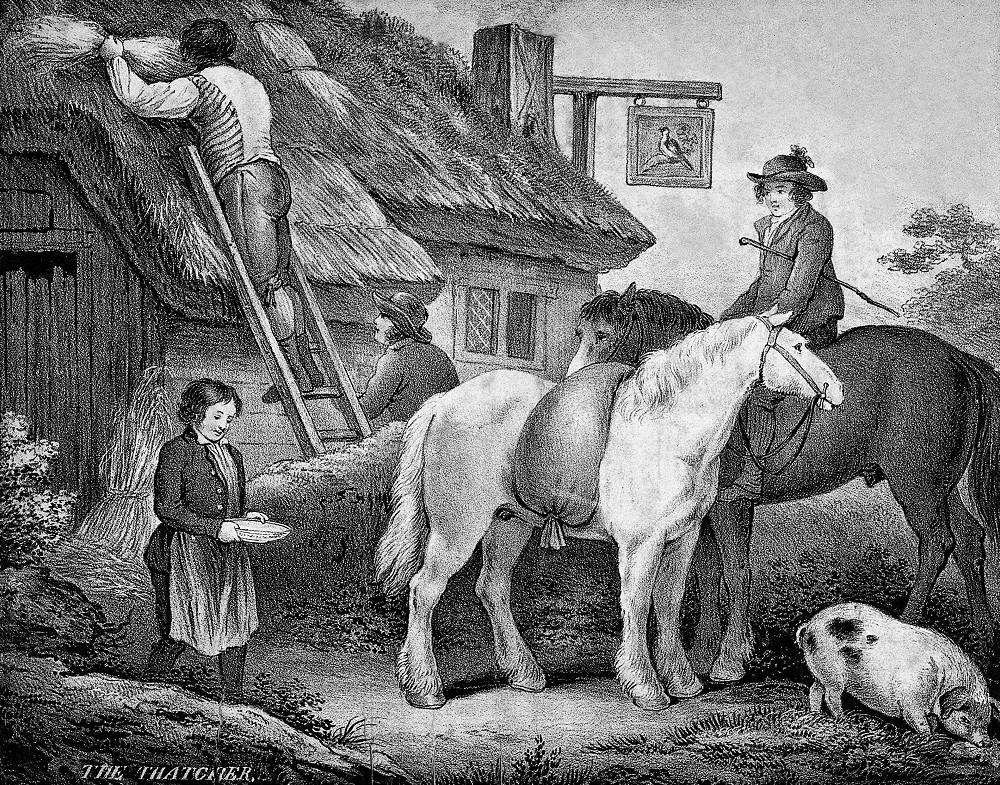
An old, undated illustration of a thatcher at work. The thatcher, standing on a ladder, is adding material to the thatched roof of a small dwelling which has a smoking chimney and a sign, with a picture of bird on it, outside.. Another man stands next to the ladder. Two horses stand close by, a white horse with a bag on its back, and a darker horse behind it, with a rider. A  boy wearing an apron is approaching the horses, holding a bowl. There is also a pig, at the bottom right of the image. A monochrome image, bearing the title "The Thatcher."
The Thatcher, by George Morland, undated. Based on an image from the Wellcome Collection ⇗ (public domain).

All Manner of domestic Fowls; Posts, Rails, Styles, Gates, &c.

The 1777 statement regarding hedge-tearers and springle-getters was retained in a notice published in 1778. That notice was repeated more or less verbatim along with the ever-changing list of CHA members, through to 1781. It specified that members would “pursue and prosecute any Offender or Offenders that shall be guilty of any Felony or Larceny, on any of our respective Persons or Properties; more especially House-breakers, Horse-stealers, and Sheep-stealers”.

The list of offences which the CHA sought to deter through pursuit and prosecution increased in 1783, when the following notice appeared in Aris’s Birmingham Gazette:

MARCH 3, 1783.
ASSOCIATION.
The Inhabitants of Cold Hatton, Rowton, Elerdine, Waters Upton, Crudgington, and Sleap, in the County of Salop, whose names are under-mentioned, have bound themselves by Articles, to prosecute all Felons, and Petit Larceny whatsoever; such as House-breakers, Horse-stealers, or any Kind of Cattle or Beasts, as Cows, Sheep, Pigs, &c. and robbing Orchards, or Gardens, Hedge-tearers, stealing of Springles, Turnips, and all Manner of domestic Fowls; Posts, Rails, Styles, Gates, &c., or any other Kind of Felony whatsoever; and to ride throughout England at the joint Expence of the Society, and prosecute according to Law and Justice.
THOMAS CLARKE, PHILIP WARDLEY, Treasurers.

In the years that followed, the content of the CHA’s notices broadly followed that of 1783, almost without exception (a horse-focused notice appeared in 1785). They typically began with the Association’s name, and an opening statement along the lines of: “WHEREAS several Burglaries, Felonies, Grand and Petit Larcenies, have frequently of late been committed in [the Townships covered by the Association]”.

In 1785 “Hooks and Thimbles” were added to the list of items which, if stolen, would attract the attention of the CHA. These were used in the hanging of gates, a subject I found way more information about than I expected in volume 1 of The Complete Farmer ⇗, published in 1807! According to The Dialect of Leicestershire ⇗, the thimble is the ring which receives the hook in the hinge of a gate.

The wording of the CHA’s notices became fixed from September 1795, with the notice being supplemented from 1799 by a list of rewards. (From 1801 it was clarified that the rewards were offered “on Conviction of Offenders”.)

The felonious burning any house, barn, or other building

The highest reward, of five guineas, was offered in respect of “The felonious breaking and entering any house in the night time” and also “The felonious burning any house, barn, or other building, or any rick, stack, mow, hovel, cock of corn, grain, straw, hay, or wood”. The next highest reward, of three guineas, was offered in respect of “The felonious stealing, killing, maiming, or wounding any horse, mare, or gelding” and in addition, for a new item: “Any servant unlawfully selling, bartering, giving away or embezzling any coal, lime, hay, or other his, her, or their master or mistresses property”.
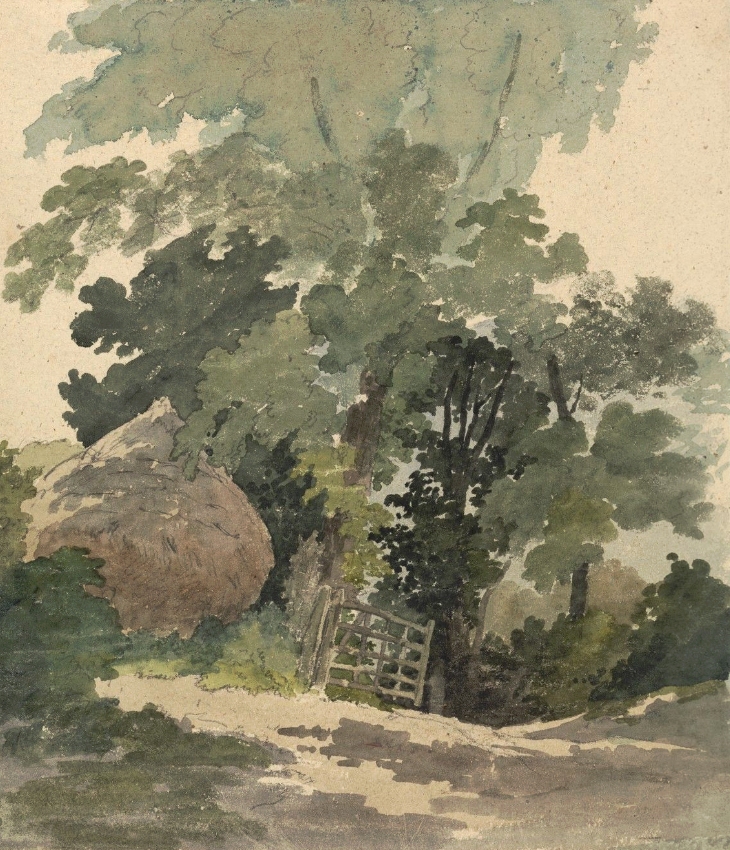
A colour painting (watercolour and graphite) dating from the very late 1700s or early to early-mid 1800s, depicting trees and shrubs by a country lane. Between two of the trees in the middle of the picture there is a 5-bar wooden gate. To the left of the trees is a haystack with a flattened conical top.
A Country Lane with Haystack and Gate by Robert Hills (1769 – 1844), undated. Public domain image from the Yale Center for British Art ⇗.

Smaller rewards, down to a single guinea, were offered in respect of various other offences. Most of these we are familiar with from earlier CHA notices, but the term ‘hedge-tearers’ was abandoned. It was replaced, and combined with several related offences as “The breaking open, throwing down, leveling or destroying any hedges, gates, posts, stiles, pales, rails, or fences”. The range of crimes against crops falling with the CHA’s scope was also expanded, in “The stealing or destroying any fruit tree, root, shrub, plant, turnips, or potatoes, pease, &c. robbing any orchards or gardens”.

These notices, lists of rewards, and lists of members, continued to be published every year – with a few exceptions – up to 1812. The exceptions might be years in which, for whatever reason, the Association did not publish any notices. Or they might be the result of my failure to find search terms which would reveal them in the British Newspaper Archive’s collection!

From the CHA’s notices and lists of rewards, we gain insights regarding the lives of some of the people in Waters Upton and the surrounding area, who were members of the Association in the latter part of the 1700s and first decade or so of the 1800s. We see something of the livestock, crops and other property they owned, what was of value to them, and what was at risk of being stolen or damaged.

Who were the CHA members of Waters Upton though? We have seen their names (in Part 1), but what else is there we can learn about them? Were they all gentlemen and farmers? In Part 3 of this article I will begin my quest for answers to these questions. I will also look at what happened to the Cold Hatton Association for the Prosecution of Felons after 1812.

To be continued.

Top ⇑

The Cold Hatton Association for the Prosecution of Felons

THE Gentlemen, Freeholders, and Farmers as under mentioned, of the Neighbourhood of Cold-Hatton, in the Parish of Ercall Magna, in the County of Salop, have bound themselves in Articles of Agreement to prosecute all Felons, especially Horse-stealers; and by this Agreement any Person or Persons who shall lose a Horse, &c. shall give the earliest Notice possible to the Society, who shall set out different Roads, and ride at their own Expence 100 Miles endways: and if any of the Society shall gain Intelligence of the Horse, &c. that he is in pursuit of, shall ride England through at the Expence of the Society, exclusive of the 100 Miles above-mentioned.
Aris’s Birmingham Gazette, 11 December 1769, page 2.
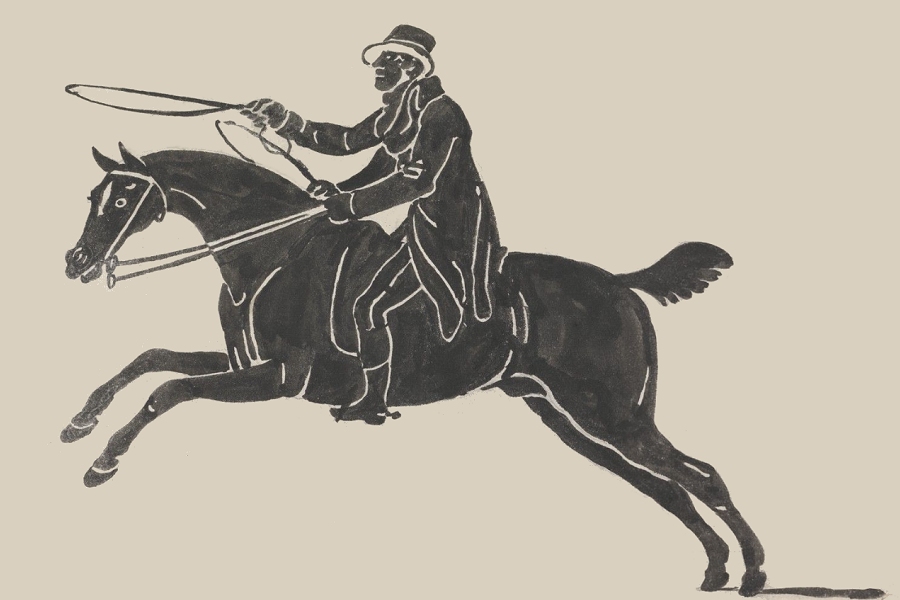
Illustration of a man riding a horse, created in the late 1700s or early 1800s. The man is wearing a hat, a long-tailed coat, and boots with spurs; one arm is outstretched, the had holding a whip. The horse, facing towards the left side of the image, has both forelegs off the ground and both hind legs on the ground.
Julius Caesar Ibbetson, 1759–1817, Rider on a Galloping Horse, undated.
Public domain image from Yale Center for British Art ⇗.

The above notice was followed by a list of 33 names arranged under their places of residence, and a request for gatekeepers (at turnpikes) to provide information in return for a reward. It was the first of many such notices from this society that I have found through searches of the British Newspaper Archive. They span a period of more than 40 years, up to and including 1812 (with another, isolated example in 1834), and my transcriptions of them can be found on a new page in the Crime section of this website: The Cold Hatton Association.

As the title of this article and of that new page suggest, the Society became known as the Cold Hatton Association (for the Prosecution of Felons). Its membership included men – and at least two women – from Waters Upton. In 1769 John Wase (who remained a member until 1803) was the sole representative from the parish. Over the whole of the period from 1769 to 1812 however, at least 21 inhabitants of Waters Upton ‘bound themselves’ in the organisation’s articles of agreement. Some subscribed only for a year or two, while others became long-term members. Joseph James’s association with the, um, Association, lasted for at least 38 years!

The deterrence of felonies

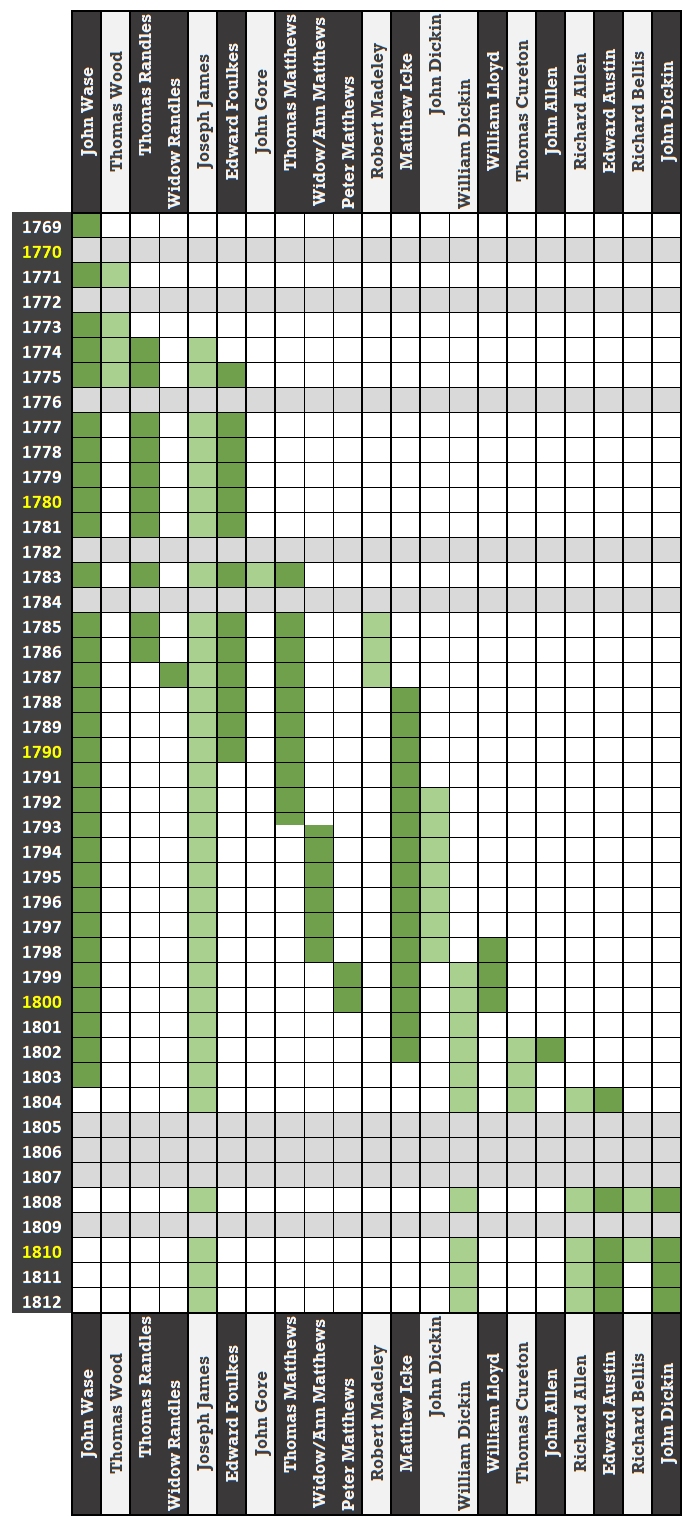
The names of the 21 members of the Association who lived in Waters Upton, and the years in which I have found notices featuring those names, are shown in the chart below. The names are listed from left to right in order of when they first appeared in a published membership list – but where one family member was succeeded by another, I have grouped those family members together. There are two cases where a man was succeeded in membership by his widow. In the second of those cases, the widow remarried and her second husband, who bore the same surname, then took her place in the Association. There was also a son who succeeded his father (and possibly one brother who succeeded another – I’m still looking into that!).

A chart showing Waters Upton residents who were members of the Cold Hatton Association (names across the top of the chart) and the years when they are known to have been members (years, from 1769 to 1812, down the left side of the chart).

The grey lines across the chart indicate years – nine in all – for which I have found no published notices from the Cold Hatton Association in the period from 1769 to 1812. Three of those nine are, unfortunately, successive years: from 1805 to 1807. Otherwise, thankfully, there are one or more years on either side of the various gaps in the record, for which published notices are known. Bringing all of them together provides a useful resource for researching the area and its people, towards the end of a long period lacking the more detailed records created in later decades.

I plan to come back to the Waters Uptonians of the Cold Hatton Association – and hopefully make them more than just names – in future articles. First however, I want to look in more detail at the early history of the Cold Hatton and other Shropshire associations, and shed light on why folk from Waters Upton were joining forces with their neighbours to prosecute felons. I am grateful to past me for carrying out research that has given me a head start on this.

Back in 2017, for my Atcherley one-name study, I wrote about John Atcherley and the deterrence of felonies ⇗. John was a member of another Shropshire society for prosecuting felons in the late 1700s, one centred on Kinnersley (or Kynnersley). The settlements from which its members were drawn included some of those covered by the Cold Hatton Association, including two in the parish of Ercall Magna: Rowton and Moortown. The latter place was where John Atcherley lived and farmed. His sons Samuel and John later joined the Cold Hatton Association.

For want of immediate pursuit

In my article, I noted that when a similar society was announced for Oswestry and nearby parishes in Shropshire in 1775, it was stated that offenders had “too often escaped Justice for want of immediate Pursuit, and effectual Prosecution”. To explain further why these local societies were formed, I also quoted from an online article ⇗ by Matthew White:

18th-century law enforcement was very different from modern-day policing. The prosecution of criminals remained largely in the hands of victims themselves, who were left to organise their own criminal investigations. Every parish was obliged to have one or two constables, who were selected every year from local communities, and were unpaid volunteers. These constables were required to perform policing duties only in their spare time, and many simply paid for substitutes to stand in for them.

I continued as follows (this is copied, with minor modifications, directly from my Atcherley article):

The failure of the parish (or township) constables to adequately protect people’s property was also highlighted by historian Jim Sutton in his well-researched paper of 2004, Protecting Privilege and Property: Associations for the Prosecutions of Felons (in: The Local Historian, volume 34, number 2 ⇗; see page 25 of the PDF download).
Jim traced the history of these associations from their origins in resolutions adopted at parish vestry meetings (which set out terms for using parish funds to prosecute felons), to the ‘mutual subscription societies’ which then arose and came to prominence in the late 1700s and early 1800s […]

Gentlemen, Freeholders, and Farmers

Another author writing on this subject, barrister Gregory J Durston (in Fields, Fens and Felonies, published 2016, page 220 ⇗), has noted that the history of prosecution associations can be traced back to the late seventeenth century. One was formed in Stoke-on-Trent in 1693 – and even that was probably not the first such society. The great majority however were formed after 1760.

1760, coincidentally, may well have been the year when the first association in Shropshire was started. The Chester Courant of 25 March 1760 included a notice naming 24 inhabitants of Hodnet and two adjacent parishes. Sir Rowland Hill of Hawkstone, Baronet, and nearly two dozen of his neighbours, had “come to an agreement to prosecute (at their joint Expence) all Kinds of Felony, Petty Larceny, &c. and more especially Horse-Stealing.”

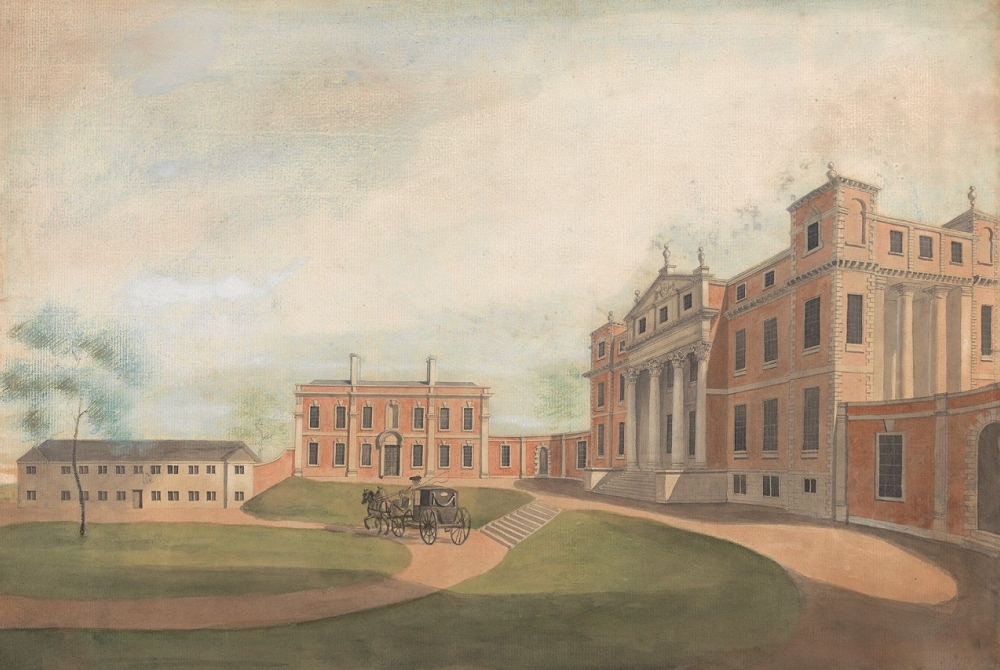
A painting, from around 1790, of Hawkstone Hall in Shropshire. The main hall, a four-storey building constructed largely from reddish-coloured brick or stone, is on slightly higher ground to the right. Other buildings, of one- and two-storeys, extend towards the left from the far end of the main hall. On lower ground to the left is a further building, long and of two storeys. On a wide drive on the lower ground in the centre of the picture, at the foot of a flight of steps, is a coach and horses.
Unknown artist, Hawkstone Hall, Shropshire, ca. 1790.
Public domain image from Yale Center for British Art ⇗.

By 1765 the aforementioned Kinnersley association had also been launched (with members including Richard Belliss and Thomas Wood, who would later live at Waters Upton). The initial focus of this group, according to their notice in Aris’s Birmingham Gazette of 9 December 1765, was solely the prosecution of horse thieves.

In the same newspaper over the following few years, several other Salopian associations began to advertise. In 1768, two dozen “Inhabitants of the Parish of Shiffnall” announced that they had raised a subscription to fund the prosecution of “Horse-stealers, House-breakers, and other Felons”. In addition, 30+ “Gentlemen, Freeholders, and Farmers” in and around Edgmond parish had come together to prosecute people pinching their property. The following year saw the publication of notices on behalf of 38 gents, freeholders and farmers “of the Neighbourhood of Childs-Ercall” and, as we have seen, by the Society formed for the Cold Hatton area.

Through the 1770s and in the decades immediately thereafter, many more associations came into existence, in Shropshire and elsewhere in England and Wales. We will likely never know for sure exactly how many there were. John H Langbein, in The Origins of Adversary Criminal Trial, published 2005 (page 132), cites research ⇗ suggesting that the number was at least a thousand, but might have been four times that figure.

Horse, Mare, or Gelding

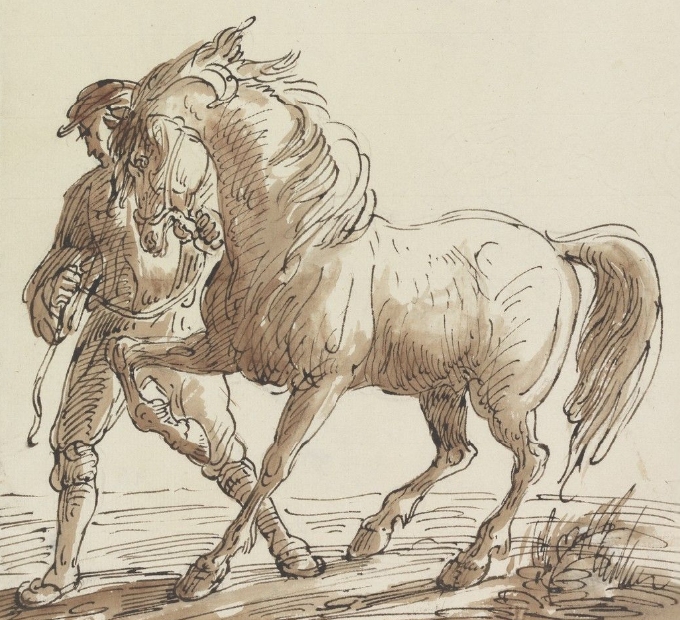
Thomas Barker, 1769–1847, Man Leading a Horse, undated.
Public domain image from Yale Center for British Art ⇗.

“Horse-stealers” were clearly the main target of the prosecution associations set up for the neighbourhoods of Cold Hatton and other Shropshire settlements. Horses were, in the words of Gregory J Durston, “valuable and relatively easy to transport long distances.”

Depending on the breed and the owner, a horse might be used for personal transportation (in the saddle, or in a trap or carriage); for pulling ploughs, drills, harrows, carts or waggons; or for following the chase when hunting with fox or otter hounds. (There were race horses too of course, but probably not many in the stables in and around Cold Hatton and Waters Upton.) The new prosecution societies were clearly a tempting proposition for some of the horse owners living in the areas where those organisations were set up.

As the Cold Hatton and other associations evolved however, there was an increased emphasis on theft, injury or damage to other livestock and property, and a greater range of rewards for information leading to convictions. I will look at these changes and other developments in the second part of this article.

On to Part 2 ⇒


Top ⇑