Towards a house history of… the Lion Inn (Part 1)

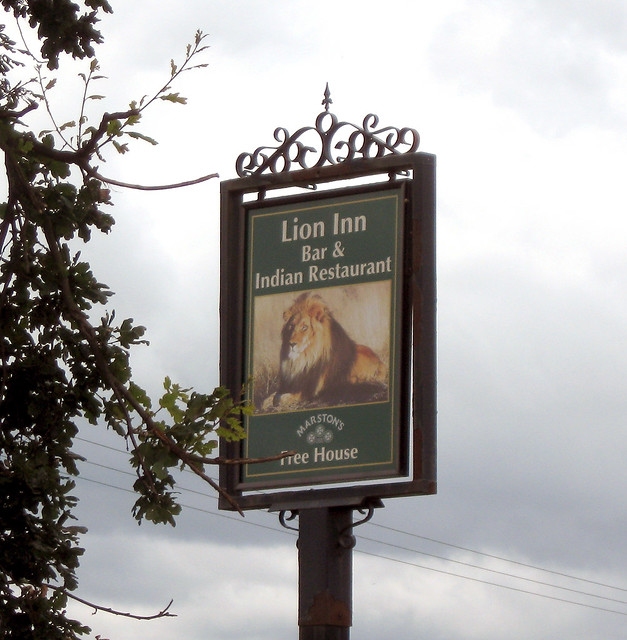
For my first contribution towards a Waters Upton house history I’m going to look at one of the few older properties in the parish which can, throughout its existence, be identified by name in most records relating to it. Today it is the Bharat Indian Restaurant, and for a while in the 1800s it was known as the New Inn, but for most of its near 200 year history this home and business premises was named the Lion Inn.
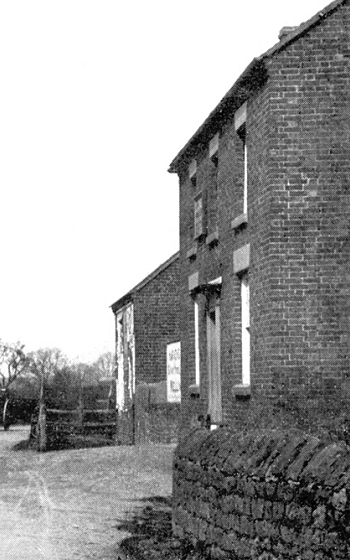
The Lion Inn, as seen in the early 1900s on a Wilding postcard in my collection. Image enhanced and cropped from original.

Before I attempt to give the Lion the House Through Time treatment, I should explain what I mean by ‘towards a house history’. Because of data protection and privacy requirements, and the related issue of more recent records being less accessible, my one-place study of Waters Upton officially ends around the beginning of the Second World War. The same will apply to the accounts of the houses of the parish which I am compiling and will share on this website. In the case of properties which still stand, I will of course include information about them as they are today, but there will be about eight decades of their most recent histories missing. That still leaves a decent period of time for us to look at!

In addition, this post (and others like it, to follow in due course) will provide only an introduction to the people connected with the house. The owners and/or occupants who I have managed to identify will be discussed briefly, with the aim of exploring their stories in more detail later. When those stories are added, I will update this post to include links to them.

Finally, I have yet to consult all of the available records. There are electoral registers and more besides held at Shropshire Archives in Shrewsbury, patiently waiting for me to take a look at them and extract the data they hold. Rather than wait until I have done so before embarking on this house history journey however, I have chosen to share what I have, knowing that I can update things later. I’ll now get on with doing exactly that.

Inn like a Lion…

A notice published on the front page of the Shrewsbury Chronicle of 21 June 1833 provides a beginning for the Lion’s story, nearly two centuries ago:

ELIGIBLE
FREEHOLD PROPERTY,
At Waters Upton and Wellington.
TO BE SOLD BY AUCTION,
By Mr. WYLEY,
At the Lion Inn, Waters Upton, in the County of Salop, on Wednesday, the 26th Day of June, 1833, at Four o’Clock in the Afternoon, subject such Conditions as shall be there and then produced, and in the following or such other Lots as shall be agreed upon at the Time of Sale:
LOT I.
ALL that newly-erected and well-accustomed PUBLIC HOUSE, or Licenced Beer House, called The Lion, situate at Waters Upton aforesaid now in the Occupation of Samuel Nickless, with the Stables, Cowhouses, Walled Garden, and Premises thereunto belonging.
And also all those Four small Pieces of good Meadow and Pasture LAND, lying together and adjoining the House, and containing three Acres or thereabouts, also occupied by Samuel Nickless.
The House consists of excellent Cellaring and spacious and commodious Kitchen, Parlour and Lodging Rooms. It is admirably adapted for Business of any kind, being situate adjoining the Road leading from Wellington to Whitchurch, and at the corner of the Road leading from that Road to Market Drayton, &c. and part of the Premises may at a trifling expense be converted into a Shop. […]

What a wonderfully informative notice! Not only do we find from this that the Lion was “newly-erected”, we also get an impression of the house itself, with its “excellent Cellaring” and those “spacious and commodious” rooms.

The 1911 census recorded that the building had seven rooms (including the kitchen but not including any scullery, landing, lobby, bathroom or closets); the 1921 census says nine. The reason for the apparent increase is not clear. The building might have been extended between the censuses, or a couple of rooms may have been divided. Or the head of the household – the same person in both years – may simply have interpreted the instructions differently on each occasion. Curiously, the room count for the nearby Swan Inn went from nine in 1911 to seven in 1921!

Pride of place

Amongst the other information in the 1833 auction notice is a description of the Lion’s location. The house stands on the East side of what is now the A442, the Wellington to Hodnet and Whitchurch road, on the South side of its junction with the main road through Waters Upton village (from which a far from direct route to Market Drayton can be followed). An ideal location to tempt thirsty travellers or workers (such as waggoners) passing by, while also being well situated for local customers.

The other buildings belonging to the Lion – “Stables, Cowhouses, […] and Premises” – and adjoining parcels of land occupied along with the house (and its walled garden) – “Four small Pieces of good Meadow and Pasture […] containing three Acres or thereabouts” – are also noted in the auction notice.

The tithe map and apportionment records created in 1837 provide details of at least some of these pieces of land. A “House [Buildings] Garden & Croft” (number 121 on the tithe map) corresponds with the Lion’s location. The owner of that property also possessed Middle Marsh (122, pasture, two roods and 20 perches in extent), Lower Marsh (123, meadow, one acres, two roods and 28 perches) and piece of land described as a Garden (147, no description of cultivation given, 25 perches in extent). Below, on an extract from a later (Ordnance Survey) map, I have drawn a line to indicate the boundary of those pieces of land and added the numbers from the tithe map.
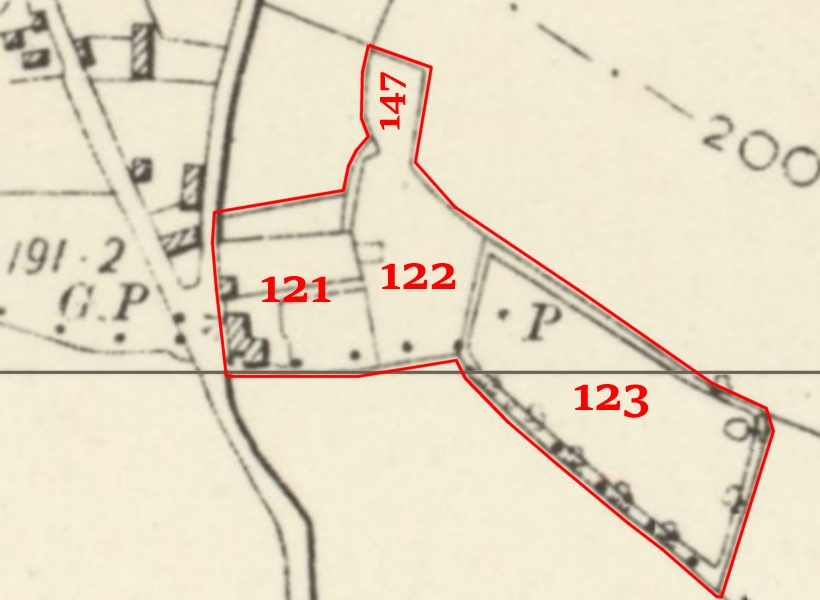
Map adapted from an extract from NLS Maps. Reproduced with the permission of the National Library of Scotland under a Creative Commons licence.

The nature of the beast

Another snippet from the notice of the Lion’s sale in 1833: the property was described as a “PUBLIC HOUSE, or Licenced Beer House”. It seems likely that the Lion was one of the thousands of new public houses which appeared in the wake of the Beerhouse Act 1830. Under this Act any rate payer could apply for a licence (costing two guinea annually) to brew and sell beer on their premises.

No clue as to the original owner of the Lion and its associated land is given in the notice of sale, but the above-mentioned tithe apportionment records of 1837 probably tell us who purchased the property – although there is some confusion over his exact identity. The apportionment agreement referred to a William Felton as “the Owner of a Messuage Garden and several Closes of Land containing by Estimation Three Acres and twenty two perches Statute Measure”. However the accompanying schedule names the landowner as Thomas Felton – perhaps the same Thomas Felton who appeared on the 1841 census at Waters Upton as a publican.

I have my doubts about Thomas being the owner, not least because the register of voters for 1842-43 includes William Felton, with abodes at Rowton and Waters Upton, as the owner of a “Freehold house and land” at Waters Upton – occupied by Thomas Felton. Subsequent registers, up to that of 1850-51, state that William Felton had his abode at Bratton in the parish of Wrockwardine, and referred to his house and land at Waters Upton as the Lion Inn.

William Felton does not appear as a Waters Upton voter in the electoral registers after 1850-51. This corresponds with the death of a 77-year-old William Felton, registered in Wellington Registration District in the first quarter of 1851. I believe he was the William Felton enumerated on the 1841 census at Rowton as a farmer, his age (likely rounded down) given as 65. It appears that his son John Felton then inherited the Lion – and went on to change its name.

Between the Lions

John Felton of Bratton appeared in the lists of voters as the owner of a freehold house and land at Waters Upton before his father’s death. He was likely the John Felton, son of William Sarah, baptised 25 May 1806 at Kinnersley (nowadays Kynnersley). He wed Melona Meredith at High Ercall on 2 October 1837, at which time (according to the allegation made when he applied for his marriage licence) he was a butcher. In 1851 he was recorded on the census as a farmer of 184 acres, living with wife Melona and their children at Long Lane in the parish of Wrockwardine.

John’s property in Waters Upton was not identified by the name of the house or its occupier in the aforementioned lists. Similar entries in those lists continued up to and including that of 1858-59. Then, from 1859-60 until at least 1871, we see John Felton of “Long Lane, near Wellington, Salop” as the owner of a freehold house and land at Waters Upton named as the New Inn.

The establishment formerly known as the Lion appears as the New Inn on the censuses of 1861 and 1871. During the 1870s however the inn’s original name was restored – the earliest reference I have found so far is in a report in the Wellington Journal of 14 October 1876 (page 8). The Lion’s return may well have been a consequence of the death – on 19 July 1875 at Long Lane according his entry in that year’s probate calendar – of John Felton.

I have yet to trace the ownership of the Lion from 1875, although I do know (thanks to the Shrewsbury Chronicle of 1 March 1907, page 8) that on 28 February 1907 “the ‘Lion’ public house, at Waters Upton, with some 3 acres of land, was sold to Mr. W. T. Southam, Shrewsbury, for £850.” There are however other people connected with the history of this house for us to look at – particularly those who lived there and called it home. I will introduce them to you in Part 2.

The Lion Inn, between its days as an inn and its current existence as the Bharat Indian Restaurant. Photo by Harry Pope, taken from Flickr and used under a Creative Commons licence.

By the numbers: How Waters Upton’s doors got their digits (Part 2)

< Back to Part 1.

An important development in the history of house numbering outside London was the enactment of the Towns Improvement Clauses Act of 1847. This legislation “comprised in one Act, sundry provisions for paving, draining, cleansing, lighting and improving towns and populous districts.” Sections 64 and 65 of the Act gave greater control over house numbers and street names to certain commissioners.

The commissioners in question were those of the towns and districts to which this legislation applied, typically those appointed under Town Improvement Acts. They could have other titles, such as trustees. Section 64 allowed them to “cause the houses and buildings in all or any of the streets to be marked up with numbers as they think fit, and […] cause to be put up or painted on a conspicuous part of some house, building, or place at or near each end, corner, or entrance of every such street the name by which such street is to be known”. Section 65 then stated that the “occupiers of houses and other buildings in the streets shall mark their houses with such numbers as the commissioners shall approve of”.

Eleven years later, many of the provisions of the above Act were incorporated into the Local Government Act 1858, which was deemed to form part of the Public Health Act 1848. The powers granted under this combined legislation were adopted by a number of Shropshire’s towns. The county’s newspapers, copies of which I have perused at the British Newspaper Archive, show that eventually, discussions about street naming and house numbering in those towns took place. (In the following paragraphs, ESJ means Eddowes’s Shrewsbury Journal; SC, Shrewsbury Chronicle; and WJ, the Wellington Journal.)

On Monday 18 June 1866 at a meeting of the Local Board for Oswestry, “Mr Bayley called attention to the desirability of putting up the names of the streets and numbering the houses. (Hear, hear.)” Six months later, on Monday 10 December, “The Chairman proposed that all the houses of the town should be numbered.” This was approved, but the work was not carried out. It was not until 1880 that new proposals were put to the Town Council and adopted. In supporting them, councillors referred to the large volumes of mail – including election addresses – that went undelivered because addressees could not be found. (Oswestry Advertiser, 20 Jun 1866, p5, and 12 Dec 1866, p7; WJ, 8 May 1880, p7.)

At the beginning of 1871, Shrewsbury Town Council discussed “the plates of the names of the streets” which were being put up. In addition, “The numbering of the houses, for the purpose of aiding the Registrar General in the taking of the census” was to be considered by a committee. Confirmation that this work was about to begin was given at a meeting of the Shrewsbury Improvement Committee in October that year. (ESJ, 15 Feb 1871, p8, and 18 Oct 1871, p6.)

Also in 1871, at the annual meeting of Wellington’s Improvement Commissioners in June, “An application was considered from Mr. Boyd, postmaster, praying that the Board would consider the question of numbering the houses, on the ground that it would facilitate the delivery of letters.” The matter came up again at later meetings, but each time was deferred. A decade passed before it was agreed that the town’s houses should be numbered; plans were finalised in December 1881. (ESJ, 28 Jun 1871, p6; SC, 20 Oct 1871, p8; ESJ, 26 Oct 1881, p9, and 28 Dec 1881, p6.)

By the time some of Shropshire’s urban representatives had gotten their collective acts together over street naming and house numbering, provisions enabling these improvements in country districts were in place. The Public Health Act of 1875 (according to volume 16 of The Laws of England) conferred the provisions of the Towns Improvement Clauses Act on all urban districts. Crucially for this story, it also allowed Local Government Boards to use the Act’s powers in rural districts. As we have seen however, having those powers granted and having them applied were two very different things.

To say that it took a while for house numbering to become widespread in rural areas would be an understatement. I think that the benefits were accepted, but there was a reluctance on the part of parish officials to make and carry through the necessary plans, or spend the money that was required, or compel local residents to play their part.

In the end it was neither concerns over census-taking nor issues with mail delivery that swayed the smaller settlements of Shropshire. The threat of names being struck off voters’ lists was what finally got numbers and names displayed in reluctant rural parishes.

On 7 July 1905, the Shrewsbury Chronicle reported that Mr J W St Lawrence Leslie had been appointed a revising barrister on the Oxford circuit. Prior to this his name had appeared in the Shropshire papers as Deputy Recorder (from 1899) and then ‘full’ Recorder (from 1904) of Shrewsbury. (WJ, 1 Jul 1899 and 27 Feb 1904.) Much greater prominence in the county’s press lay ahead for John William St Lawrence Leslie.

Mr Leslie’s duty as revising barrister was to hold ‘courts’ for revising and signing off the lists of those entitled to vote in parliamentary and local elections. He had to consider applications made by people who wanted their names added to these lists, and objections made against the inclusion of these names or of any of those already on the list. After weighing up the legal pros and cons he would confirm additions, and strike off those not eligible to vote. (A short guide to Electoral registration and the registers before 1918, in PDF format, is available from the Surrey History Centre; the full legislation – the Parliamentary Registration Act 1843, as it stood, with amendments, in Mr Leslie’s day – can be read in The Statutes of Practical Utility.)

A revising barrister could also bring their judgement to bear on the lists before them without being prompted by objectors. After he had settled into his new role, Mr Leslie did just that. On 25 September 1908, the Shrewsbury Chronicle reported as follows:

THE revision of voting lists in Shropshire has proceeded this week […]. The Revising Barrister has repeatedly commented upon the vital necessity of having houses numbered or identified in some way in the now famous column 4, but has been content for the most part to pass lists imperfect in this particular with the intimation that they must be made perfect next year. The remarks Mr. Leslie made on the subject last year rather led one to expect some drastic measures, but doubtless the fact that in many parishes an earnest effort has been made to carry out his wishes had some influence in inducing him to give a further period of grace in those cases where the task of numbering or naming houses – by no means an easy matter in rural parishes – has not yet been carried out.

The difficulties experienced in one of those rural parishes, Lydbury North, were raised at a revising court held that same month (Ludlow Advertiser, 26 Sep 1908, p7). The assistant overseer said he had done his best, but the scattered nature of the houses across the 9½ mile width of the parish made numbering impractical. Neither the parish council nor the owners could see how to start the work asked of them. Mr Leslie’s solution for this issue was to give the houses distinctive names, adding: “If the owners and residents would not carry out the idea then the Parish Council could apply to the Local Government Board for powers to do it themselves and charge the owners.” If a scheme was not implemented, Mr Leslie said, he would “strike off the people not properly described” from the voters’ list.

On 5 October 1909 it was the turn of the seemingly immovable Waters Upton to meet the unstoppable force of John William St Lawrence Leslie. The Shrewsbury Chronicle of 8 October (page 9) reported:

Mr. Leslie held a court for the revision of the local voters’ lists on Tuesday at Newport. […] Each parish with the exception of Waters Upton had complied with the request that the houses should be numbered or named. Mr. Leslie said the landlords in Shropshire had mostly fallen in line with his suggestion. […] With the exception of Wem and Shifnal, which places he had not yet visited, he could say Shropshire was in perfect order. Only in about half-a-dozen cases was the numbering not done, but it would eventually be carried out as required.
When dealing with the Waters Upton list, the Assistant Overseer stated that at the Parish Meeting they declined to have the houses numbered. Several questions were asked by Mr. Leslie who asked why the Parish meeting was ruled by the Rev L. Vernon Yonge, who had first made himself secure by giving a name to the house he occupied. He then encouraged the parishioners not to number the houses. […].

Numbers, and more house names, came to Waters Upton soon after Mr Leslie’s court concluded. Evidence for this can be seen on the household schedules of the 1911 census (and probably on the electoral rolls of course, but I have not yet viewed the registers for that timeframe). Only a small proportion of the householders gave specific addresses, but it is clear that a house numbering scheme was in place. In addition to 39 Harebutts, 43 Waters Upton, and No 45 Terrill Farm, there was “27 High Street”. This, the address given for the Rectory, is the only time I have seen the village’s main street named (albeit unofficially).

The ‘new’ house names given were The Beeches, The White House, and Clematis Cottage. The first two of these also appeared on household schedules when the 1921 census was taken. Almost every home had a name or a number given on that year’s census, and as Clematis Cottage was described as number 31 it appears some or all of the properties with names, also had numbers assigned to them.

Although this is the end of the story of how house numbers came to Waters Upton, it is just the beginning of my research relating to the properties they identify. For one thing, I need to identify exactly where each of those numbered and named houses stand (or, for those which are no more, where they stood). If my research generates results, there will be lots more stories (perhaps that should be house histories) to come…


Picture credits. 5, © Eva the Weaver (Flickr), adapted and used under a Creative Commons licence. Six, public domain image from HippoPx. 7, © Duncan Cumming (Flickr), used under a Creative Commons licence. Nummer 8 by Liza, public domain image from pixabay. Number 9, a mashup of a public domain image from PeakPX and a photo © Kirsty Hall (Flickr), used under a Creative Commons licence.

By the numbers: How Waters Upton’s doors got their digits (Part 1)

House numbers are something we take for granted these days, but it hasn’t always been that way. They didn’t exist in England before the beginning of the 1700s, and they did not appear in Waters Upton until another two centuries had passed. Here are some edited highlights from the 200-year story of the spread of house numbering, from London to other urban areas, and from Shropshire’s towns to its rural parishes, including Waters Upton.

My interest in house numbering, particularly in the parish of Waters Upton, stems from my desire to research the histories of individual houses there as part of my wider one-place study. For me to be able to do this, I need to be able to distinguish one house from another in records relating to the place and its people. The absence of house numbers before the early 1900s makes this a tricky task.

There were a few houses with names of course (The Hall, the Swan, the Lion Inn), and a couple which can be identified from the occupation of the ‘head of the household’ (the rectory, the smithy). There are also a couple of hamlets in Waters Upton parish (the Terrill, the Harebutts) each consisting of just a few houses (and each with a variety of variant spellings in days gone by!). If house histories are not possible for those places then ‘hamlet histories’ – smaller one-place studies within a larger OPS – might be feasible.

What about street names, which were around long before house numbers (my favourite being Shall-I-go-naked Street in Whitechapel St Mary)? In common with many other small settlements, the road along which most of the village’s houses are situated does not have a name. There is the Market Drayton or Hodnet road of course, on the west side of the village, but few of Waters Upton’s homes faced onto this (two of those that did were the inns, which can be identified from their names). And back in the days before Waters Upton expanded, the one road with a name – River Lane – was not a residential street.

The absence of a named street and of numbered houses would not have been a great problem in a small village like Waters Upton. Those seeking a particular house or its occupants would no doubt have been pointed in the right direction soon enough by one of the villagers. In larger settlements however, and particularly in cities like London, a plethora of properties made things more complicated. How did people find the building they were looking for?

“Before house numbers,” says The Postal Museum, “businesses used illustrated signs to show people where they were”. In times of less than universal literacy, such signs, using images rather than words, were an important part of the ‘visual culture’ of towns and cities. As Kathryn Kane states in her blog post On the Numbering of Houses they would have “served as landmarks by which a person could give directions to their residence.”

Those who could wield a quill had to write out such directions, rather than addresses as we know them today, when sending letters. I suspect the shortcomings of this way of doing things became more and more apparent as the population, and built-up areas, expanded.

The earliest reference to houses in England being numbered appears in the first volume of Edward Hatton’s A New View of London, published in 1708. Describing “Prescot street, a spacious and regular Built str. on the S. side of the Tenter Ground in Goodmans fields,” Hatton said that “Instead of Signs, the Houses here are distinguished by Numbers”.

It does not appear that this early experiment sparked immediate imitation elsewhere. The notion of numbers being used to identify properties did eventually catch on though, and in the latter part of the 18th century received ‘official’ approval. This came about as part of much broader efforts to tackle the state of the streets in and around the city of London.

Writing about these times in his Modern History of the City of London (1896), Philip Norman stated: “The condition of the paving in the roads and foot-paths of the City [had] long given rise to complaints”. He also observed that “The want of proper tablets to distinguish the names of streets and courts, and of regularity in numbering the houses, occasioned great difficulty, especially to strangers.”

These issues led to laws designed to bring cleanliness, safety and order to the capital’s thoroughfares, through the appointment of commissioners with powers to put improvements in place. The city of Westminster was the first to secure such legislation, in 1762 (2 Geo III c21), although further statutes were needed to make this workable. The first of those updates (3 Geo III c23) to the original “act for paving, cleansing, and lighting, the squares, streets, and lanes” in Westminster (and other parishes and liberties in Middlesex) is of particular interest. It gave commissioners the power to order “the names of the streets or squares to be affixed on the corner houses”.

By 1766, according to John Noorthouck (in A New History of London, published 1773), “The paving of Westminster under the new regulations was […] far advanced, and the great disparity in elegance and convenience between the Westminster side of Temple bar, and the London side, was […] observable to every one who passed through”.

Westminster’s example was quickly copied. Acts for Southwark (6 Geo III c24) and the city of London (6 Geo III c26) were soon secured. Southwark’s act empowered commissioners to order the names of streets, lanes, courts etc to be displayed, and to “order and direct the houses within the said streets and lanes, and within the said courts, yards, alleys, passages, and places, or any of them, to be numbered with figures placed or painted on the doors thereof, or in such other part of the said houses respectively as [the commissioners] shall think proper”.

London’s legislation included very similar provisions. Other districts followed. Evidence for claims made elsewhere online that house numbering resulted from provisions in the Postage Act of 1765 has been sought but not found.

“Across London,” wrote Jerry White in London In The Eighteenth Century: A Great and Monstrous Thing (2012), “these were momentous changes. They were not comprehensive, because some place like the ancient Liberty of Norton Folgate in Shoreditch, for instance, opted out of parish statutes through the poverty of their residents. And doubtless the commissioners were not always and everywhere as vigilant as they should have been. But the reorganisation of paving and lighting, the naming of streets and numbering of houses, all made London tangibly more manageable. And more modern too.”

London’s streets certainly saw improvements, but there were still problems with regard to the house numbers and street names on display. The names to be used were those by which streets were usually or ‘properly’ known, and the commissioners had no say in exactly which numbers were used.

The consequences, as described by the Postal Museum, were that “numbering systems varied even in the same street”. As for street names: “There were irregularities everywhere, and the naming of streets and parts of streets was left to the idiosyncrasy or whim of the owner.” The Illustrated London News of 16 May 1846 complained:

Scores of streets in different and widely-separated parts of this vast City bear the same name, and the numbering of houses is sometimes past all comprehension. The slightest imperfection in the address of a letter sends it on a voyage of discovery to all the squares and terraces of the same name, till it finds the right one. This must add much to the labour of the [Post Office], while the defect is out of its power to remove.

The same concerns were expressed in 1854 by the Inspector of Letter Carriers in a report to Rowland Hill, which gave several examples of horrendous house numbering and street naming nightmares. The very next year however, the enactment of the Metropolis Local Management Act (18 & 19 Vict c120) offered hope of a solution. It created a Metropolitan Board of Works with wide-ranging powers including the regulation of the numbering of houses and the naming of streets.

The slow progress in the early years of this body were noted in the annual reports of the Postmaster General in 1856 (“No improvement has yet been made in the street nomenclature of London”), 1857 (“some little has been done”), and 1858 (“further progress has been made in improving the nomenclature of the streets in London and the numbering of the houses; but the main work has still to be accomplished”).

Despite this slow start, and some resistance from the public to altered addresses, by 1871 4,800 street names had been changed and 100,000 houses renumbered in London (Postal Museum figures). The work of letter carriers was made a little easier. The work of future house historians, not so much!

In the meantime, while this progress was being made in London, legislation allowing similar improvements to be made beyond the capital had been introduced. It’s time for this story to move away from the Metropolis.

On to Part 2 >


Picture credits. Number 1, © Leo Reynolds (Flickr), used under a Creative Commons licence. Colorful house number, 2, © Martin LaBar (Flickr), used under a Creative Commons licence. Door Number 3 by George Hodan, public domain image from PublicDomainPictures.net. “34”, © Brian (Flickr), adapted, used, and made available for reuse under a Creative Commons licence.