Blacksmiths in Waters Upton – Part 2

⇐ Back to Part 1

James Ridgway, husband and father

He goes on Sunday to the church,
And sits among his boys;
He hears the parson pray and preach,
He hears his daughter’s voice,
Singing in the village choir,
And it makes his heart rejoice.

It sounds to him like her mother’s voice,
Singing in Paradise!
He needs must think of her once more,
How in the grave she lies;
And with his hard, rough hand he wipes
A tear out of his eyes.

— The Village Blacksmith, by Henry Wadsworth Longfellow, published 1840.

Illustration from 1885, showing an external view of the entrance to a smithy. The door is open and the blacksmith stands inside, behind a barrel and, next to that, a tall block on which stands and anvil. There are several horseshoes at the foot of the block. Outside, there is a tree, under which, and next to the smithy door, stands a horse.

James fathered six children in all. His first wife Ann née Jones bore him two daughters and three sons before her death, when aged just 39, on 6 March 1846. Those children were Harriet Ridgway (baptised 30 September 1838), Ellen (baptised 16 February 1840), William (baptised 17 October 1841), George (born in 1843, but no baptism record found), and James junior (baptised 26 January 1845).

None of these five children remained in Waters Upton. William did not stray far: like his father he became a blacksmith, but in a move which was the complete opposite of that made by James, after a spell of smithing at Ollerton (1861 census ⇗) he settled in Ercall Magna parish (1871 ⇗, 1881 ⇗, 1891 ⇗ and 1901 ⇗ censuses). William married ⇗ Emma Lawley, a daughter of fellow blacksmith Henry Lawley and his wife Jane, who I mentioned in Part 1 of this article. I did promise that I would return to them!

Ellen’s various jobs in service are took her to Staffordshire (1861 census ⇗), Yorkshire (1871 census ⇗), and quite possibly other parts of the country too (I have yet to find her on the 1881 census), before she returned to Shropshire and, like her brother William, settled in Ercall Magna (1891 ⇗, 1901 ⇗ and 1911 ⇗ censuses). Ellen did not marry. Her sister Harriet on the other hand wed ⇗ coach builder Richard Denchfield at Edgbaston, Warwickshire, on 24 May 1868, and lived with him at Balsall Heath (1871 ⇗, 1881 ⇗, 1891 ⇗, 1901 ⇗ and 1911 ⇗ censuses).

The Ridgway siblings who moved the furthest however were without doubt George and James junior, who emigrated to New Zealand and became farmers (a story for another time perhaps).

Some five and half years after the loss of his first wife, James Ridgway married ⇗ Harriet Mayne Knot, daughter of cooper Richard Knott, at Birmingham St Phillips on 3 November 1851. James stated that he was living in Bull Street at the time, but that was likely only a short term residence purely for the purposes of the nuptials.

Ridgway and Knott: Keeping it in the family

Harriet, incidentally, was James’s sister-in-law, his younger brother George Ridgway having wed ⇗ Harriet’s younger sister Elizabeth Mayne Knott on 29 December 1846, also at Birmingham St Phillips. George, whose baptism at Waters Upton on 30 May 1824 I have already mentioned, followed James’s example and became a blacksmith like their father, but he remained in Cold Hatton (1851 ⇗, 1861 ⇗, 1871 ⇗, 1881 ⇗ and 1891 ⇗ censuses).

I wonder how much of a surprise it was when Harriet discovered that she was pregnant and due to give birth to her first child at the age of 42. Charles John Ridgway was baptised at Waters Upton on 15 Apr 1855, and as we have seen he remained with his parents and entered the family business. He was enumerated as John Ridgway, a 16-year-old blacksmith’s assistant, when the 1871 census was taken, and as a fully-fledged blacksmith (26 and still known as John) ten years later in 1881.
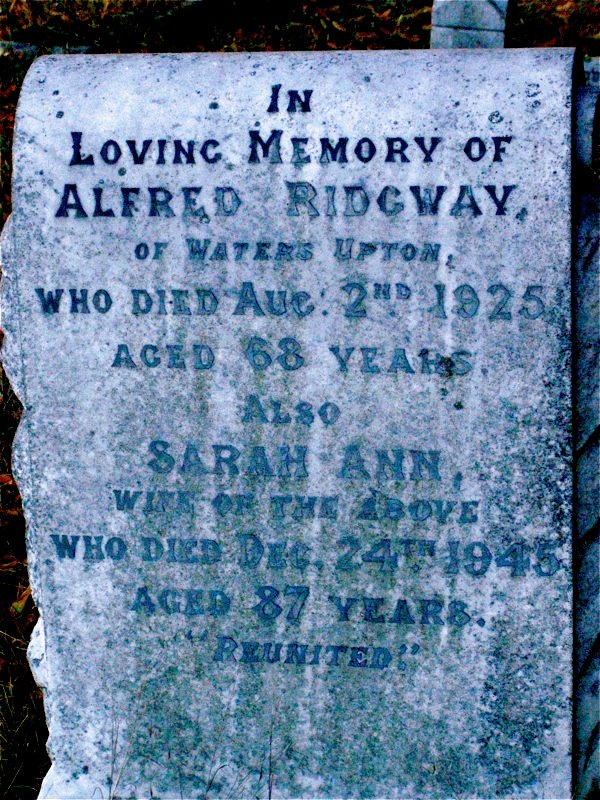
Photo of the gravestone of Alfred Ridgway of Waters Upton (died 1925 aged 68) and his wife Sarah Ann (died 1945, aged 87).

Another Ridgway family was also living in Waters Upton in 1881, headed by 26-year-old Alfred Ridgway. Alfred was James and Harriet’s nephew and (Charles) John’s double first cousin, a son of George Ridgway and Elizabeth, née Knott. He was a wheelwright, so it is entirely possible that he worked in conjunction with his uncle James and cousin Charles John at the Waters Upton Smithy. Like his uncle, after settling in Waters Upton he stayed there until he died. He appeared on the 1891 census as a wheelwright once more, but the censuses of 1901, 1911 and 1921 show that he had broadened his business and became a carpenter and wheelwright.

The 1921 census showed that Alfred was then living at 8 Waters Upton. An entry in the National Probate Calendar for 1925 ⇗ shows that he continued to reside at the same address up to his death (on 2 August that year). His wife Sarah Ann, née Woolley, survived him and was still living at Number 8 when the 1939 Register was taken on 29 September 1939. She lived right through the Second World War before following her late husband to grave on Christmas Eve 1945.

Carry On Smithing: Charles John Ridgway takes over

James Ridgway, blacksmith to the people of Waters Upton from at least 1837,  died on 24 February 1890 aged 78. Did he carry on smithing right to the end? In 1887 he was named as the occupier of “A FREEHOLD HOUSE and BLACKSMITH’S SHOP, with Garden and Appurtenances, situate in the Sandholes, in the village of Waters Upton” when these properties were once again put up for sale by auction. So it is entirely possible that he was still toiling at the forge in his mid-70s. On the other hand, it is perhaps also possible that as the senior Ridgway the occupancy of these properties would still have been under his name even if he had retired.

On James’s death, if not a little before, Charles John Ridgway took over the ‘family business’ and supported his widowed mother Harriet, who lived with him until her own passing on 21 March 1903 at the grand old age of 90.
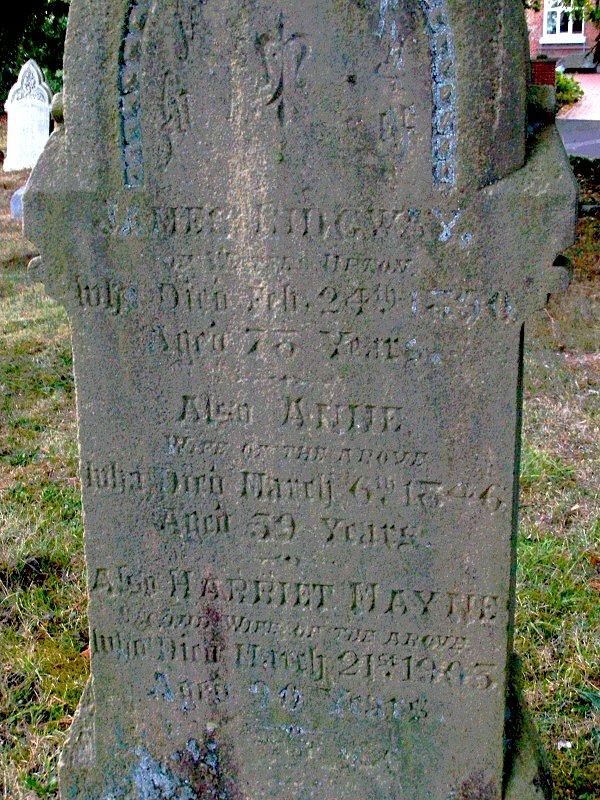
Photo of the gravestone of James Ridgway of Waters Upton (died 1890, aged 73), his wife Anne (died 1846, aged 39), and his second wife Harriet (died 1903, aged 90).

Under the name John Ridgway, he appeared in the 1891 census and in trade directories for 1891 and 1895 as the blacksmith of Waters Upton. He was not always the only blacksmith in the village during that period. An inquest held at Waters Upton in 1890 (about which I will shortly post an article) received evidence from, amongst others, Walter Welsh who began his short statement by saying “I am a blacksmith, and live at Waters Upton.” I suspect he was working at the Ridgway smithy, but had not been doing so for very long as he was not enumerated in the parish on the 1891 census. (He may have been the 22-year-old Walter G Welch living with his parents and a sister at Marbury in Cheshire when that census was taken; both he and his father were blacksmiths.)

By census time in 1901 Charles had reclaimed his original forename, being enumerated as Charles J Ridgway. And having reclaimed his birth name, for the most part he kept it. He was plain John in Kelly’s Directory of 1905, but appeared as Charles John Ridgway, blacksmith, in the directories of 1909, 1913, 1917 and 1922, and on the 1911 and 1921 censuses. Did he actually retire, or did he keep working to the end? He died, unmarried, at the age of 68, on 11 February 1924, leaving effects valued at £1803 19s 10d. I think it is fair to conclude that the Ridgway ‘Vulcans’ of Waters Upton lived long and prospered.

Toiling,–rejoicing,–sorrowing,
Onward through life he goes;
Each morning sees some task begin,
Each evening sees it close
Something attempted, something done,
Has earned a night’s repose.

Thanks, thanks to thee, my worthy friend,
For the lesson thou hast taught!
Thus at the flaming forge of life
Our fortunes must be wrought;
Thus on its sounding anvil shaped
Each burning deed and thought.

— The Village Blacksmith, by Henry Wadsworth Longfellow, published 1840.

Tools of the trade

At the time when I published this article in 2020, my searches of the British Newspaper Archive ⇗ have not produced any newspaper reports relating to the Ridgway blacksmithing business in Waters Upton. I had however found items relating to blacksmiths in Shropshire more generally, including the fact that when established rural smiths advertised for men to work for them, they tended to look for those who were “steady”, “used to country work”, and a “good shoer” or a “good nailer on”.

Since 2020, additions to the BNA have enabled me to find advertisements placed by the Ridgways of Waters Upton. James, in 1882, wanted “a steady Man, for the country; must be a good shoer, and one used to the implement trade preferred.” (Charles) John, when advertising for a young man to work for him in 1889, did not include any requirements regarding experience. In 1891 however, he stated that he wanted a young man who was “a good shoer. and used to country work.” He had identical requirements in 1899, 1903, and in 1919 (when he sought a “steady Man” rather than a young one).

I have still not found any references to the tools used by of Waters Upton Vulcans, so the notice I found relating to a sale by auction elsewhere in Shropshire, in 1884, is still the next best thing. The sale consisted of “a Capital Lot of BLACKSMITHS’ TOOLS (in good condition), excellent anvil (nearly new), 4cwt. 1qr. 15lbs; Pair of 36in. Bellows (with frame and piping), 4 Blacksmiths’ Vices, &c., 75 dozen new Horse Shoes (various), a 3ft, 6in. Grindstone and frame, Drilling Machines, and other useful lots.” (Wellington Journal, 12 April 1884, page 1.)

Postscript: After the Ridgways

Kelly’s Directories for 1926, 1929, 1934, 1937 and 1941 show that the successor to Charles John Ridgway as blacksmith of Waters Upton was John Leech. The 1939 Register provides more details: John H Leech, born 6 August 1897, occupation “Shoeing & General Smith” was living with his wife and children at 4 Hanford Terrace in Waters Upton. A native of Shrewsbury, by 1911 John Henry Leech was living with his parents and siblings in the parish of Stanton on Hine Heath. Aged 13, he was an apprentice wheelwright. Maybe he switched masters after that and became an apprentice to a blacksmith, or perhaps as a wheelwright he picked up metal working skills which stood him in good stead when he later turned his hand to shoeing and smithing. He died on 3 January 1982, his death being registered in Shrewsbury Registration District, and was buried at Waters Upton.

I ended the original version of this article with questions regarding John Leech and the final decades of the blacksmith trade in Waters Upton, and concluded by saying there was: “still more to find out before I can close the book on the blacksmiths of Waters Upton.” With information that has come to light since then I have answers to some of my questions, and possibly enough material for “Blacksmiths in Waters Upton – Part 3!”

Updated Feb 2026.


Picture credits. Blacksmith in his smithy: From an 1885 edition of Longfellow’s The Village Blacksmith; taken from the British Library Flickr photostream ⇗, no known copyright restrictions. Gravestones of Ridgway family members at Waters Upton: Both photos by the author.

Blacksmiths in Waters Upton – Part 1

V is for Vulcan

This article is an extended version of a post ⇗ I wrote as a contribution to the Society for One-Place Studies ⇗’ employment-themed A to Z Blogging Challenge in April 2020. One of the two letters I volunteered to cover was ‘V’. According to an online Dictionary of Old Occupations ⇗, “Vulcan [is] a term for a Blacksmith, possibly derived from the name of the Roman god”. So naturally I starting out by explaining: “I know what you’re thinking. I’m a big Star Trek fan, and it would be just my style to work out some way of shoehorning a green-blooded, pointy-eared alien into a one-place studies blog post! But as my Place is earth-bound Waters Upton, that would be illogical …”

A colour illustration of the interior of a blacksmith's shop in the late 1800s. The blacksmith is standing with his back to us, his right hand (holding a hammer) held high, while his left hand hold, probably with a pair of tongs, an item on top of an anvil (which itself stands on top of a square block). To the left is the blacksmith's forge, topped with flames.

Under a spreading chestnut-tree
The village smithy stands;
The smith, a mighty man is he,
With large and sinewy hands;
And the muscles of his brawny arms
Are strong as iron bands.

His hair is crisp, and black, and long,
His face is like the tan;
His brow is wet with honest sweat,
He earns whate’er he can,
And looks the whole world in the face,
For he owes not any man.

— The Village Blacksmith, by Henry Wadsworth Longfellow, published 1840.

The blacksmith, with his forge, hammer and anvil, is probably one of the first people we think of when considering village occupations – even a village as small as Waters Upton had one. The earliest evidence I know of confirming the presence of a blacksmith in the parish is a baptism recorded in the parish register covering the early 1600s, when one child’s father was described as a “blakesmith.”

Blacksmiths worked with iron to make everything from nails to horseshoes, and they repaired tools and farm implements, so their importance to the communities they served can easily be imagined. Many also worked closely with wheelwrights, as the wooden components of wheels for carts, wagons and carriages were held together by an outer rim of metal. Originally the metal took the form of strakes, lengths of iron which were nailed to the outside of wheels. In the mid-1800s however strakes were replaced by tyres, each one a single ring of iron made to fit the wheel tightly once it was cooled, with tire-bolts added to ensure it remained in place.

Death of a blacksmith

With the fires in their forges burning all day, blacksmiths were used to working in hot conditions. Not all blacksmiths received a warm welcome at Waters Upton however. According to newspaper reports, on the night of Sunday the 2nd of October 1785 “a very rash and fatal Affair” occurred when a blacksmith from Ruyton with the amazing appellation of Octavius Caesar Augustus Hithcot visited the Waters Upton watering hole of innkeeper John Gower (the surnames of these two were actually Hitchcock and Gore). Unfortunately “an Affray arose about some trifling Matters, when the Landlord took his Gun and shot the Blacksmith dead on the Spot.” Gower (Gore) then absconded, with a 10 guinea reward on offer for his apprehension. This is definitely a story which deserves its own post!

The Ridgway family of Cold Hatton

Thankfully Waters Upton’s own blacksmiths, at least in the 19th and 20th centuries, seem to have fared rather better. Prior to the census we can use the parish’s baptism register to trace some of those smiths – but only from 1815 when the new-style printed register (which recorded the occupations of all the fathers named therein) was adopted by the newly-installed incumbent Richard Hill. The first blacksmiths recorded in that register lived in the nearby hamlets of Cold Hatton and Rowton, situated in the adjacent parish of Ercall Magna.

Among the blacksmiths of that parish who had their children baptised at Waters Upton was John Ridgway of Cold Hatton, whose wife was named in the register as Ann. Their daughters Sarah and Charlotte were baptised on 27 February 1820, and that joint ceremony was followed by the baptisms of sons George on 30 May 1824 and Robert on 20 March 1827. I will return to the Ridgways later.

Extract from an Ordnance Survey map showing Waters Upton near the centre, with other nearby villages and hamlets around it (clockwise from top): Cold Hatton Heath, Great Bolas, Meeson, Crudgington, Sleap, Moortown, Rowton, and Cold Hatton. Plus roads and rivers. The map dates from the early 1800s.
Map showing Waters Upton and nearby settlements, including Cold Hatton, Rowton and Crudginton.

Humphreys, Fox and Robinson in Waters Upton

The first blacksmith who I can say for sure was a resident of Waters Upton in the 1800s was John Humphreys. He and his wife Elizabeth were living in nearby Crudgington (again in Ercall Magna parish) when their son Henry was baptised at Waters Upton on 22 April 1821. By 25 May 1823 however, when the couple’s next son, Ambrose, was baptised there, the family’s abode was Waters Upton. They were still there when daughter Rachael was baptised on 9 October 1825 – and when Elizabeth, wife of John, died in 1828; she was buried at Waters Upton on 4 January that year. At some point after his bereavement John returned to Crudgington with his children, where he was enumerated on the censuses of 1841 and 1851. His burial at Waters Upton, presumably in the same grave as his late wife, took place on 25 Oct 1857.

It appears that another blacksmith was working in Waters Upton for at least part of the period when John Humphreys was there (whether the two were competitors, or worked alongside each other, is unclear). Marianne, the daughter of blacksmith Richard Fox and his wife Elizabeth (née Jones), of Waters Upton, was baptised at St Michael’s on 11 September 1826. Two years later, on 8 September 1828, the same ceremony was performed for another Fox ‘cub’, Martha.

Richard Fox was from neighbouring Great Bolas (he was baptised there on 31 Aug 1806 ⇗), to which place he returned and where he continued working as a blacksmith. He is recorded there on the censuses of 1841 ⇗, 1851 ⇗ and 1861 ⇗. The schedule for the first of those three censuses also records ⇗ Richard’s widowed mother, Justina Fox, living close by – her age given as 70, and her occupation as Blacksmith. Was she wielding a hammer, or operating her late husband’s business with others (primarily her son Richard) doing the actual smithing?

After Humphreys and Fox, no more Waters Upton blacksmiths appear in the baptism register until 2 March 1833, at which point it seems the village forge was being tended by a Thomas Robinson.

Vickers and Buttery of Rowton and Lawley of Cold Hatton

Another gap follows, during which time it is not clear who the village blacksmith was. Three baptisms for children of two more blacksmiths living beyond the parish boundary are worthy of mention here. On 17 April 1835 Wright Willett, the Curate, seethed as he recorded the baptism of Elizabeth the illegitimate daughter of George Vickers and Ann Buttery of Rowton. He described George as a “Blacksmith & Married Man!!!” and Ann as a “Widow & Sister in law to Vickers!!!” (It looks like the wayward Ann’s late husband had followed the same trade, as Mary, daughter of Joseph Buttery, blacksmith, and Ann, of Rowton, had been baptised at Waters Upton on 12 Sep 1830.)

The other two baptisms of a blacksmith’s babies that I want to mention are those of Andrew and Ann, children of Henry and Jane Lawley of Cold Hatton, which took place on 8 June 1834 and 27 Mar 1836 respectively. The Lawleys will feature in this article again, in connection with the Ridgway family – to which I will now return.

James Ridgway, blacksmith of Waters Upton

Week in, week out, from morn till night,
You can hear his bellows blow;
You can hear him swing his heavy sledge,
With measured beat and slow,
Like a sexton ringing the village bell,
When the evening sun is low.

And children coming home from school
Look in at the open door;
They love to see the flaming forge,
And hear the bellows roar,
And catch the burning sparks that fly
Like chaff from a threshing-floor.

— The Village Blacksmith, by Henry Wadsworth Longfellow, published 1840.

James Ridgway was an elder son of the above-mentioned John and Ann Ridgway of Cold Hatton, and was baptised at Waters Upton on 10 March 1811. He followed in his father’s footsteps by becoming a blacksmith, and he took his trade with him when he moved to Waters Upton. I don’t know exactly when he ‘set up shop’ there, but he was a resident of the village by 1837 when he married Ann Jones at Cound in Shropshire on 20 June.

The Tithe Commutation records and map for Waters Upton produced in 1837 show that James Ridgway occupied a “House Buildings & Garden” on the North / West side of the village’s main thoroughfare which was owned by George Jones. The “Smith’s Shop” occupied by James, more or less directly opposite on the South / East side of the road, was owned by John Dickin Esq (one of the larger landowners in the parish, with quite a few tenants). Both of these properties are shown (numbered 101 and 150s respectively) on Tithe Apportionments – Houses etc.

Extract from a large-scale Ordnance Survey map showing part of the village of Waters Upton. The Church, Rectory, Smithy, Swan Inn, and other, unnamed houses and buildings can be seen.
Map showing the Smithy in Waters Upton, and the house across the road which was occupied by James Ridgway and his family.

In May 1848 the properties occupied by James were put up for sale by auction, and were described as “Lot 2.—All that BRICK and TILE DWELLING HOUSE, erected within a short period, together with the Blacksmith’s Shop, Pent-house, Piggeries, Gardens, Pond, and Croft of Land thereto adjoining, pleasantly situate, and adjoining the Turnpike Road in Waters Upton aforesaid, containing by admeasurement 2R. 11P., now in the several possessions of Samuel Tudor and James Ridgway. This lot is exceedingly well situated for a Blacksmith […]”. The sale did not mean that James’s occupancy of the house and blacksmith’s shop came to end, in all probability the only impact was that he paid rent to someone else afterwards. One question I have, given that the dwelling house was said to be “erected within a short period”, is how long had the blacksmith’s shop been in that location?

Census records (for 1841, ’51, ’61, ’71 and ‘81) and trade directories (for 1851, ’63, ’71 and ‘80) show that James Ridgway remained in Waters Upton, working as a blacksmith, for the rest of his life. The only other blacksmiths I have discovered pursuing the same trade in the village during that time were Henry Cheshire (wife Elizabeth), who probably worked briefly for James and whose son Charles was baptised on 14 November 1848, and James’s son Charles John Ridgway.

Updated Feb 2026.

On to Part 2


Picture credits. Blacksmith’s shop, late 1800s: Painting by Albert Brument; public domain image taken from Wikimedia Commons ⇗. Map showing Waters Upton and nearby settlements: This work is based on data provided through www.VisionofBritain.org.uk ⇗ and uses historical material which is copyright of the Great Britain Historical GIS Project and the University of Portsmouth; it is used under a Creative Commons ⇗ licence. Map of Waters Upton showing the location of the smithy: From Ordnance Survey 25 Inch map XXIX.8 published 1901; reproduced with the permission of the National Library of Scotland ⇗ under a Creative Commons licence ⇗

Analysis: Kinship in the parish of Waters Upton in 1841 (Part 2)

⇐ Back to Part 1

On now to the second of the two extended groups of Waters Uptonians with kinship connections.

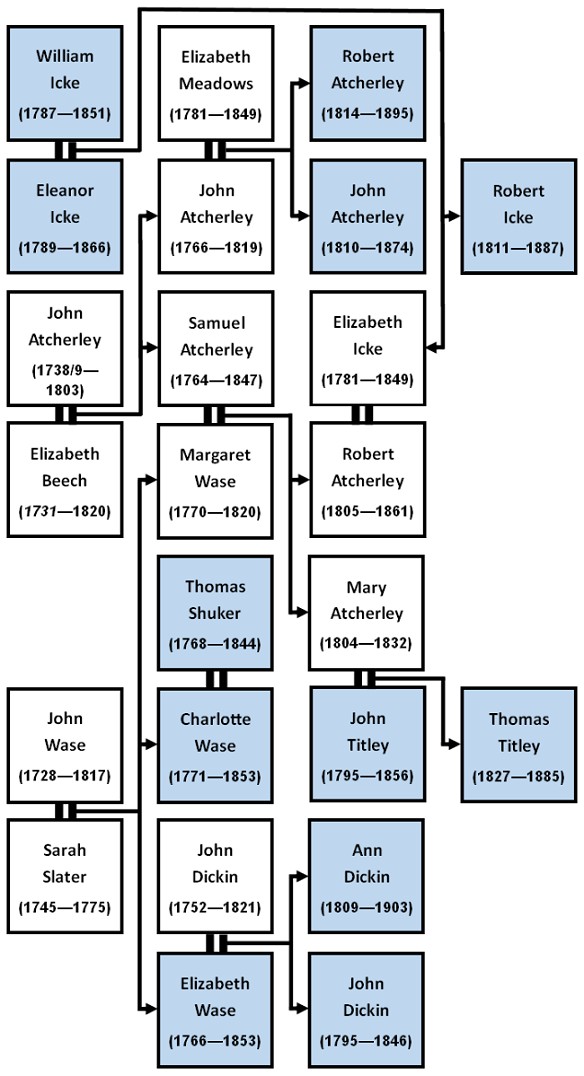
Titley, Atcherley, Wase, Dickin, Icke, Griffiths, Harper, Shakeshaft, and Gregory connections

These are the relatives and others who were linked in one way or another to 14 year old Thomas Titley, living in household 27 in 1841 with his father John Titley (and a servant, Mary Griffiths, regarding whom I will say more shortly). The first sub-group of these people are those to whom Thomas was related (however remotely) through his late mother Mary Titley née Atcherley (who was also my 2x great grandmother).

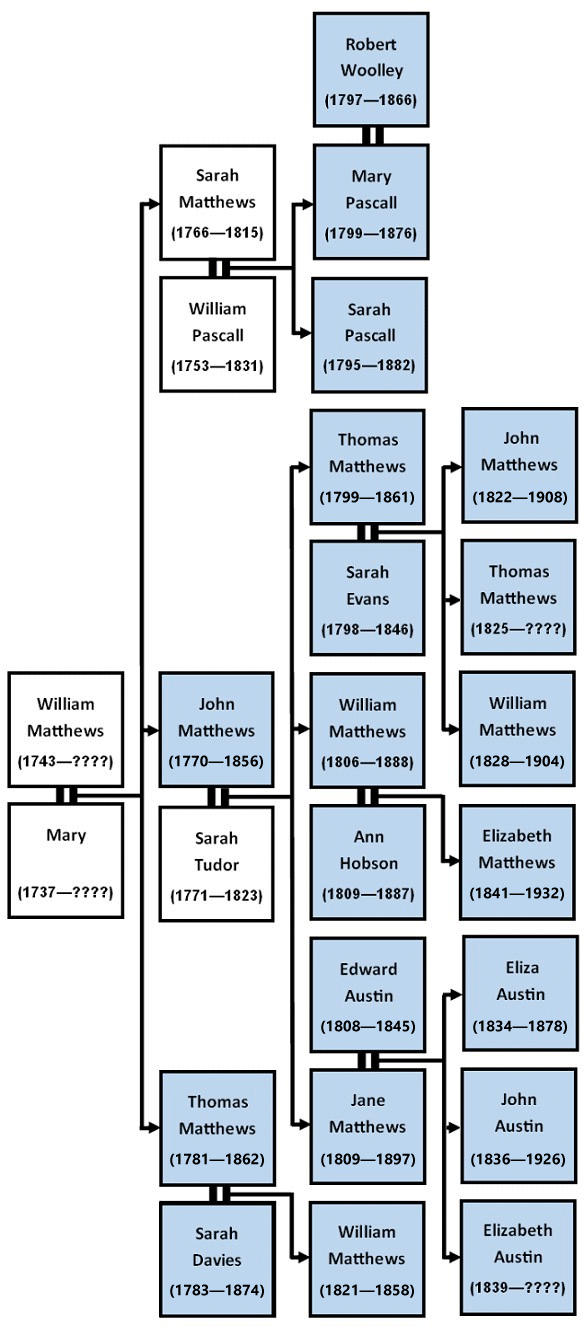
A family tree diagram showing 24 people, all connected by blood and/or marriage, 12 of whom were living in Waters Upton when the 1841 census was taken. Further details are provided in the article.

Here we see these Waters Upton residents:

  • Mary Atcherley’s maternal aunt Charlotte Shuker (née Wase) in household 25 with her husband Thomas Shuker (who was of independent means) and a servant. Whether these Shukers were related to William, Alice and Thomas of household 26 I do not know, but what a coincidence if they weren’t!
  • Mary’s maternal aunt Elizabeth Dickin (née Wase), widow of John Dickin, in household 2 with her son and daughter John Dickin (a landowner and farmer with 7 servants, one of whom – John Pidgeon – appears later in this article) and Ann Dickin, neither of whom were married.
  • Mary’s first cousin John Atcherley, a tailor, the sole occupant of household 7.
  • Mary’s first cousin Robert Atcherley, an agricultural labourer, the only denizen of household 37.
  • The parents-in-law of Mary’s brother Robert Atcherley, William Icke and Eleanor (née Icke, almost certainly a relative of her husband) in household 41, a public house, with their son, Mary’s brother-in-law, Robert Icke, and three servants.

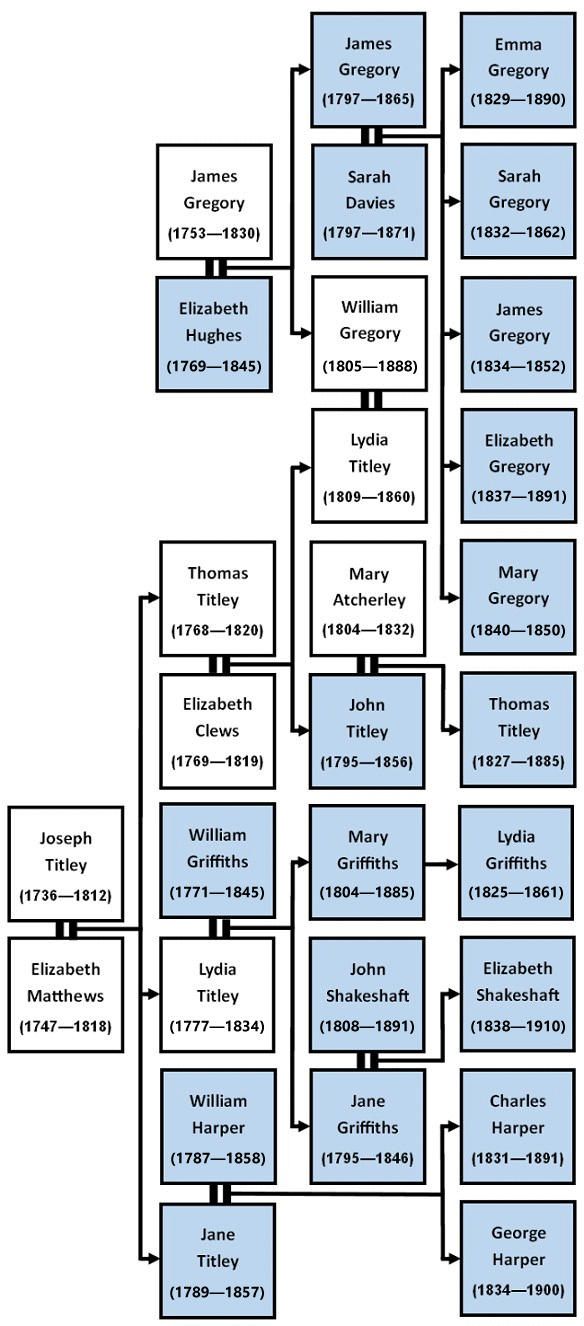
The second sub-group of Thomas Titley’s kin are those related to him through his father John.

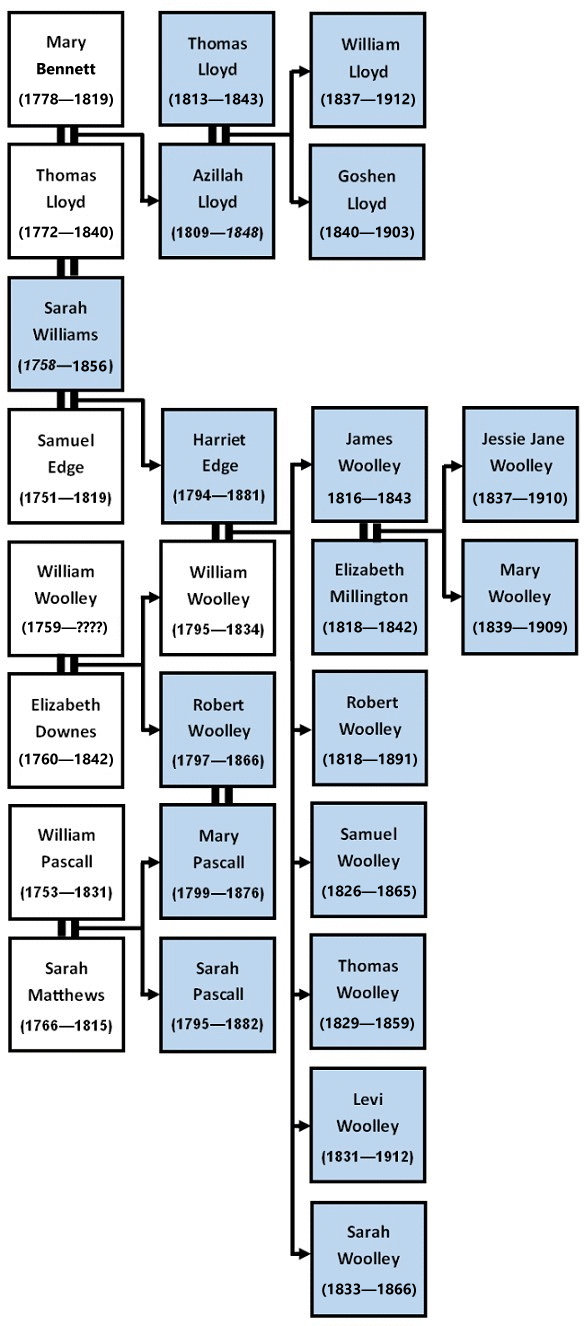
A family tree diagram showing 29 people, all connected by blood and/or marriage, 20 of whom were living in Waters Upton when the 1841 census was taken. Further details are provided in the article.

In this, our final chart, the following are shown:

  • John Titley’s brother-in-law James Gregory in household 34, with his widowed mother Elizabeth Gregory née Hughes, wife Sarah (née Davies), and children Emma, Sarah, James, Elizabeth and Mary (plus servant Samuel Allen, who we will see again soon).
  • John’s paternal aunt Jane Harper née Titley in household 3, with husband William Harper and children Charles and George. I am not aware of any connection between these Harpers and those of household 8 (William, wife Martha, and children Elizabeth and Sarah).
  • John’s uncle William Griffiths, widower of John’s paternal aunt Lydia, in household 35 with granddaughter Lydia Titley (age 15), married daughter Jane Shakeshaft, son-in-law John Shakeshaft, and their daughter Elizabeth (plus a guest, Samuel Harrison, who does not appear to have been a relative). There was also one other person in this household, who was definitely a relative – I will return to her later!
  • In the Titley’s own home the aforementioned servant was John’s first cousin Mary Griffiths; a daughter of William Griffiths and (unmarried) mother of Lydia Griffiths.

That’s a group of 30 people spread across 9 households (2, 3, 7, 25, 27, 34, 35, 37 and 41) with varying degrees of kinship between them. And if the Elizabeth Matthews (1747–1818) who married Joseph Titley was related to the Sarah Matthews (1766–1815) who wed William Pascall (see Part 1 of this article), this group would link up with the first one. That’s an intriguing possibility as it would give us a single group of 65 people (out of a total of 226) across 19 household (out of 41)!

Update (Feb 2026): Further research has shown that Elizabeth Titley née Matthews (1747–1818) was related to Sarah Pascall née Matthews (1766–1815) – Sarah was Elizabeth’s niece. Her father William Matthews (baptised 1743 at Waters Upton) was one of Elizabeth’s brothers.

Less complex connections

Having looked at the more tangled trees, let’s move on to the less complicated cases of kinship within and across households. Mary Worrall for instance, a resident of household 24 with Joseph and Martha Wilks (or Wilkes), was that couple’s granddaughter through their daughter Elizabeth Wilkes (wife of James Worrall), who was not resident in the parish.

Elizabeth Pickin, wife of John Pickin in household 36, was the daughter of Thomas and Ann Felton, who lived close by in household 33.

As we have seen, some of the young servants of Waters Upton were children of families living in other households in the parish; two more examples follow. First, residing with farmer John Dickin in household 2, was teenager John Pidgeon whose family was living in household 19. The young Pidgeon had evidently flown the nest but settled not far away. Incidentally, William Cowley, part of the Pidgeon household in 1841, was the pre-marital son of William Pidgeon’s wife Martha, née Cowley.

Another servant of interest is 11-year-old Samuel Allen, who in 1841 was ensconced with tailor James Gregory and family in household 34. Despite his seemingly low status, Samuel appears to have been a member of the agricultural Allens who farmed in the neighbouring parish of Ercall Magna. Specifically, it looks like his parents were Samuel (a farmer at Cotwall in 1841 and a retailer of wines and spirits in 1851) and Emma. If this was the case, farmer Charles Allen in household 11 was, I believe, Samuel’s paternal uncle.

William Pritchard was, along with the Morris family, an occupant of household 38. He was a son of Ann Morris, formerly Pritchard, née Jackson, born between her marriages to Messrs Pritchard and Morris.

Another child born out of wedlock was two-year-old James Andrews, enumerated in household 31 with the Cureton family, was, not surprisingly, the son of Deborah Andrews, aged 25 or more, who was also a member of that household. Like his mum, James was born in Suffolk – but who was his father? Ladies and gentlemen of the jury, I call William Howard, living in household 41 with the Icke family. I’m going beyond the 1841 census with my evidence here, but what the heck: William Howard went on to marry Deborah Andrews, and by 1851 James Andrews had become James Howard. I put it you that on the balance of probabilities, William was the father of James.

Colour photo of a 'Connect 4' game. It has a vertical 'game board' with 7 columns, into each of which up to 6 plastic discs can be dropped so that stack one above the other, each visible through a circular hole in the 'game board'. This board has discs, some red, and some yellow, occupying all but three of the available spaces. Neither the player using red discs, nor the player using yellow discs, has managed to win the game by getting four of their discs lined up in a horizontal, vertical or diagonal row.

Connected, or not?

There were several people enumerated on the 1841 census at Waters Upton whose surnames suggest the possibility of connections with others, which I have not yet been able to verify (or dismiss). The Harpers, the Lloyds and the Shukers I have already mentioned, but there were also the Williamses, some of whom coincidentally had a connection with the Lloyds who appeared at the end of Part 1 of this article. Was John Williams of household 23 related to Sarah Lloyd, formerly Edge, née Williams in household 12 or servants Charles Williams (in household 41) or Emma Williams (in household 28), or any of the latter to each other? The frequency with which the surname occurs makes the question less than straightforward to resolve, but in time I may have an answer.

Update (Feb 2026): Further research has connected some of those named above to The Waters Upton ‘Big Tree’. This is the case with the Harpers, and also John Williams and his family. In the case of the Harpers, their connection to the Big Tree came after 1841. In the case of John Williams and family however, all the links in the long chain of marriages and blood relationships were prior to 1841, so they were linked to many of their fellow parishioners at the time of that year’s census.

In conclusion

More than half of the households in Waters Upton at the time of the 1841 census had at least one occupant related in some way to one or more occupants of another household. This leaves the following households inhabited by people with no confirmed links to others in the parish: 1 (Corfield family and servants), 5 (Anslow family), 6 (Edwards family & guests), 8 (Browns and servant), 9 (Evans), 10 (Dodd family), 14 (Woodhouse family and guests), 15 (Davies family), 23 (Williams / Lloyd family), 24 (Wilkes family), 26 (Shuker family), 28 (Tudor family and guest), 30 (Moore family), 32 (Ridgway family), 38 (Morris family), 39 (Bennett family).

Update (Feb 2026): Further research has connected many of those named above to The Waters Upton ‘Big Tree’. This is the case with the Evans family (household schedule 9), the Dodd family (10), the Davies family (15), the Williams / Lloyd family (23), the Wilkes family (24), the Tudor family (28), the Ridgway family (32), the Morris family (38) and the Bennett family (39). Some of those links however may only have been established after the 1841 census was taken – I need to look into those connections in more detail.

Just one more thing …

… as TV detective Columbo ⇗ used to say. I said I would return to another person in the household of William Griffiths. She features in this genealogical version of Only Connect ⇗, but I left her off the relevant family tree chart. Her name was Elizabeth Griffiths and she was the daughter of teenager Lydia Griffiths, the granddaughter of Mary Griffiths (John Titley’s servant), and the great granddaughter of William. This made her a first cousin twice removed from John Titley and a second cousin once removed from John’s son Thomas Titley. But she also had another, closer relationship to the two Titleys – and therein lies a story which requires a separate article.

Second family tree chart updated (corrections, plus birth/death dates found by further research) Feb 2026.


Picture credits: Family tree charts by the author. Photo of Connect 4 game by Wikimedia Commons ⇗ contributor Popperipopp; modified, used and made available for re-use under a Creative Commons licence ⇗.

Analysis: Kinship in the parish of Waters Upton in 1841 (Part 1)

One element of the research I carried out for my two-part article Analysis: The 1841 census of Waters Upton was further work on my Waters Upton family tree at Ancestry. ‘Forest’ might actually be a better word than ‘tree’ in this situation however, given that what I have established is in fact a collection of numerous separate trees growing in one place. As I traced the roots of those trees more deeply however, some of them began to merge. Quite a few of those trees were not ‘separate’ after all.

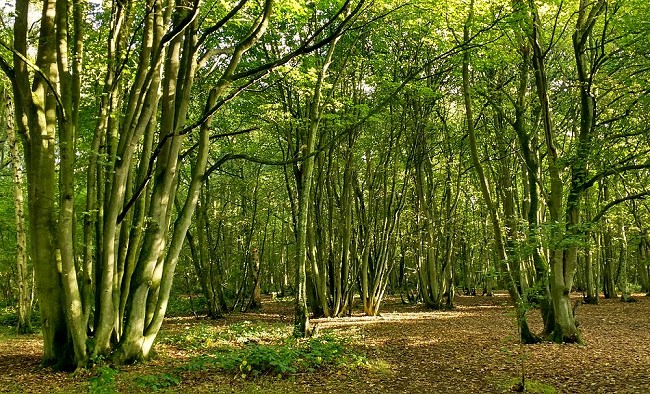
Colour photo of part of a woodland. Almost all of the trees here were coppiced (cut down to the roots) a good few years ago, so that each one has multiple slim trunks rising from their bases.

In adding people to the Waters Upton ‘forest’ my primary goal was to link other records to them besides the census and so find information vital to establishing who they were – their identities. For example, where and when were they born? This is not always easy to establish even for those enumerated on the more detailed censuses of England and Wales taken from 1851 onwards, due in part to inaccuracies in the information supplied, recorded, and transcribed. In the case of the 1841 census we have different levels of vagueness to contend with too, particularly with regard to places of birth. In most cases however, I have overcome these problems in respect of the Waters Uptonians of 1841. As a result, my analysis of that year’s census includes the geographic origins of the parishioners.

Another key component of each individual’s identity is how they are related – through blood and/or marriage – to others. So for each person in my Waters Upton ‘forest’ an important task was to find and link them with their parents, any siblings and, where applicable, spouses and children. Again the limitations of the 1841 census adds to the workload here, as relationships between the ‘head’ of each household and other residents were not recorded, and neither was marital status. Thankfully in the course of my research other records have cleared up any doubts, in most cases but certainly not in all.

There remains a sizeable minority of people on the 1841 census of Waters Upton whose full identities are still unknown to me (because I have not so far managed to track them down in other records), some of whom might yet turn out to be related to one or more of their fellow parishioners. These include many of the young servants and also boarders / lodgers (particularly those with high-frequency surnames) who were living away from their immediate families.

In one case even the ‘head’ of a household (household 8) has eluded me: I have yet to discover who 40 (or so) year old farmer John Brown was, and I don’t know whether the younger Elizabeth Brown enumerated with him was his wife or his sister.

Confirmed – and complex – connections

Returning to the people whose identities and families I have established, as my work on them progressed a number of families became larger in size and/or multi-generational and/or connected to other families. Consequently some of those families were split between two or more households, and more and more distant and complex relationships between some of the people present in the parish in 1841 became apparent.

I’ll begin my exploration of all these links with the largest of two extensive groups of connected people, for whom I have prepared family tree charts to make their kinships clearer. In both cases I have picked one person as the centre of the ‘web’, and I have also split the groups down into two further sub-groups to make things a little easier.

Pascall, Matthews, Austin, Woolley and Lloyd connections

Mary Woolley, née Pascall, was enumerated in household 21 on the 1841 census of Waters Upton along with her husband Robert Woolley, her unmarried sister Sarah Pascall, and a servant (Emma Juckes, unrelated as far as I know).

It appears that Robert and Mary had no children, but there were lots of people in the parish to whom they were linked – by blood, marriage, and more tenuous connections. Here is the first sub-group of those people.

A family tree diagram showing 25 people, all connected by blood and/or marriage, 20 of whom were living in Waters Upton when the 1841 census was taken. Further details are provided in the article.

This family tree chart (like the others illustrating this article) does not include every member of the families shown, just those who were connected to Mary Woolley née Pascall (and to each other) who were residing in Waters Upton parish in 1841 (names in boxes with a blue background) plus the immediate ancestors from whom those relatives were descended. In addition to Mary, her husband and her sister we can see:

  • Mary Woolley’s maternal uncle John Matthews, sharing household 22 with his daughter (Mary’s first cousin) Jane Austin née Matthews, Jane’s husband Edward Austin, and that couple’s children Eliza, John and Elizabeth Austin.
  • John Matthew’s son Thomas Matthews in household 20 with his wife Sarah (née Evans) and their children John, Thomas and William.
  • John Matthew’s son William Matthews in household 16 with his wife Ann (née Hobson) and their infant daughter Elizabeth.
  • Mary Woolley’s maternal uncle Thomas Matthews in household 17 with his wife Sarah (née Davies) and their son William.

The second sub-group of people are connected to Mary Woolley – some quite loosely! – through her husband Robert.

A family tree diagram showing 26 people, all connected by blood and/or marriage, 18 of whom were living in Waters Upton when the 1841 census was taken. Further details are provided in the article.

In this tree we have the following:

  • Mary Woolley’s sister-in-law Harriet Woolley (née Edge), widow of William Woolley, in household 40 with her children Robert, Thomas and Sarah.
  • Harriet Woolley’s 9 year old son Levi in household 11, where he was working for farmer Samuel Allen as a servant.
  • Harriet Woolley’s son Samuel (age 14) in household 13, another farmer’s servant who was employed by Thomas Whitfield.
  • Harriet Woolley’s son James in household 29, with his wife Elizabeth (née Millington) and their children Jessie Jane and Mary.
  • Harriet Woolley’s twice-widowed mother Sarah Lloyd, formerly Edge, née Williams in household 12 with her step-daughter Azillah Lloyd, Zillah’s husband Thomas Lloyd (who may or may not have been related), their children William and Goshen, plus two other Lloyds (Thomas and William, both in their 20s) whose relationship to the others I have yet to determine. Similarly, at this point I don’t know whether, or how, any of these Lloyds were connected to those with that surname in households 4 (Elizabeth, Joseph and Harriet), 23 (Joseph, Elizabeth and William, children of Ann Williams, formerly Lloyd, née Taylor) and 41 (Mary).

In total, that’s 35 people spread across 10 households (11, 12, 13, 16, 17, 20, 21, 22, 29 and 40) who had links to each other.

Family tree charts updated (with birth/death dates found by further research) Feb 2026.


Picture credits: Family tree charts by the author.

On to Part 2

John Thomas Halke and the Church of Waters Upton

The Rev John Thomas Halke was Curate of the parish of Waters Upton from 1859 until 1867. When he departed the village, John took with him a gift of silverware from the parishioners, along with their best wishes. He left behind him a long-lasting monument to his endeavours: a newly-built church which, with a few modifications, still stands today.

The ministry was in the blood of the Halke family. Richard Halke of Kent was educated at Corpus Christi, Cambridge, and ordained as Deacon in 1766 then as Priest in 1768. He served thereafter as Curate and Vicar, mainly in Kent, until his death at the age of 70 in 1813. Richard’s sons Charles (born abt. 1784) and James (born 1787 at Faversham, Kent) were also educated at Cambridge. Charles passed away aged about 20 in 1804, but James went on to follow in his father’s footsteps. After holding several curacies in Kent, in 1831 he became the Vicar of Weston-by-Welland in Northamptonshire. It was there that Richard’s son John Thomas Halke was born on 7 May 1832.

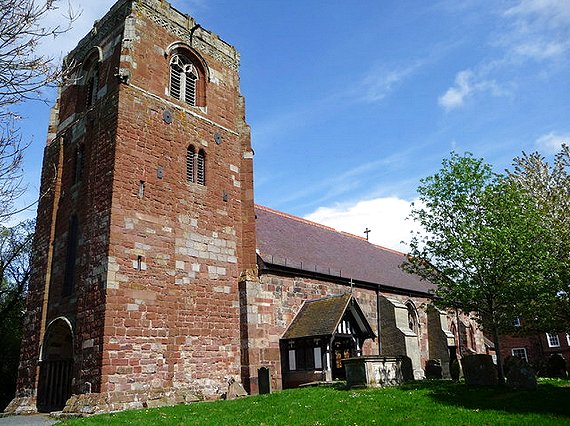
Commencing his education at Uppingham School, John was then admitted to St John’s College, Cambridge, in 1851. He obtained his LL.B. in 1858, by which time he had lost his father (in 1853) and been ordained as Deacon (in 1856), appointed Curate of Atcham in Shropshire (also in 1856; the church of Atcham St Aeta is pictured below) and ordained as Priest (in 1857).

Colour photo of the church of Atcham St Eata. There is a sturdy-looking tower of redish-brown stone on the left, with the rest of the building, of a paler stone, extending to the right. A porch, and two buttresses, can be seen.

“the kindness of the Rev. J. T. Halke, curate of Atcham

John set up home in Shropshire with his widowed mother Mary (the marriage of James Halke and Mary Starr had taken place at Canterbury, Kent, in 1817). Something of John’s character, and of the esteem in which he and his mother were held, can be gauged from the following report published in the Shrewsbury Chronicle of 7 August 1857:

On Wednesday week last, an evening of great pleasure was spent at Chilton, through the kindness of the Rev. J. T. Halke, curate of Atcham, he having invited the wives of the labourers, and other working classes of the parish, to a tea-drinking; also the children from the Union, in all numbering about 230. They began to assemble at about half-past three o’clock, and after having enjoyed a most excellent tea, dancing was commenced by the elder party, and bag races and other games for the children. The amusements drew to a close at 9 o’clock, and after having sung God Save the Queen, and given three cheers for the Rev. J. T. Halke, and the mother of the rev. gentleman, they all separated with many good wishes, and hearts full of gratitude to their kind benefactor.

John’s time at Atcham was short but sweet. His “general kindness the poor and needy, attention the sick and dying, and his friendly visits to the infant school, rendered him a general favourite in the parish”, but in the summer of 1859 he was appointed to the curacy of Waters Upton. The first baptism John performed at his new church took place on 19 June that year. He did however return to Atcham later in 1859 for a final farewell from his faithful flock. The Wellington Journal of 8 October 1859 carried the following notice:

Presentation.—The Rev. J. T. Halke having resigned the curacy Atcham for that of Waters Upton, the parishioners determined to present him with a testimonial on his leaving them, he having gained great respect by the zealous and untiring manner in which he performed the office of minister amongst them; they accordingly assembled on Friday week, at the Berwick Arms Hotel, and read a very feeling address. Mr. Halke replied suitably. The testimonial consisted of a tea service which was very chaste and beautiful (furnished by Mr. Nightingale, of Shrewsbury), and bore the following very appropriate inscription:—“Presented to the Rev. John Thomas Halke by the parishioners of Atcham, as a reward of their sincere respect and affectionate regard. September, 1859.” The obverse side bore the family arms and motto.

“an admirable sermon, […] by the Rev. J. T. Halke, of Waters Upton”

At Waters Upton, John Halke and his mother continued in the same spirit which had endeared them to the inhabitants of Atcham. In 1860 their names headed a subscription list set up to pay for the children of the Industrial School near Waters Upton to have a day out on the Wrekin. John also accompanied the party, and with others he “contributed not a little to heighten the enjoyment of the children by participating with them in their amusements”.

Preaching, of course, also formed part of John’s duties, and it was not confined to the church in Waters Upton. In the Autumn of 1861, for example, at the Harvest Festival held at Uffington in Shropshire, “an admirable sermon, both in matter and delivery, was preached by the Rev. J. T. Halke, of Waters Upton, from Jeremiah v. part of the 24th verse: ‘He reserveth unto us the appointed weeks of the harvest.’”

A full picture of John Halke’s duties at Waters Upton is difficult to paint, as the burial and marriage registers covering his curacy are still in use and not available to peruse. However, as with his sermons, his performance of the rites and ceremonies of the church was also carried out in other parishes from time to time. To give just one example, in 1862 Edward Ryley of Little Drayton and Mary Ellen Atcherley of Ercall Magna were married at High Ercall by “John T Halke, Curate”.

The only marriage that I know of which was conducted at Waters Upton during John’s curacy was quite possibly the last one to be held there before the existing church was demolished. John Higgins Esquire of Lubstree Park and Elizabeth Groucock of Meeson in the parish of Great Bolas were wed on 9 June 1864. By that time it had already been announced that the money for rebuilding Waters Upton church “on an enlarged plan” was ready.

“rebuilding the church of Waters Upton”

In July and August 1864, notices appeared in Shropshire and Staffordshire newspapers calling first for “about eight or ten good masons” and later, “six or eight good stonemasons” to work on Waters Upton Church. One of the stonemasons who responded to these advertisements was a man by the name of Thomas Parry, who had an unfortunate experience when he looked for lodgings in Wellington (see 1864: A charge of felony in Crime, elsewhere on this website).

A letter from John Halke appealing for contributions towards the cost of the project, no doubt written in 1864, was published in The Herts Guardian in May 1865 (by which time, although funds were still needed, work was almost complete). It sets out the reasons why the rebuilding of Waters Upton church was considered necessary:

Application has been made for aid towards rebuilding the church of Waters Upton, Salop. The curate writes in behalf of what he styles a work of necessity, and states:—“The living has been sequestered for many years, and I have consequently, sole charge of the parish. The population is not very large, but, as some of the poor inhabitants, of the two adjoining hamlets, are in the habit of attending this church, (all of them being from two to four miles distant from their own), it is quite too small for the congregations, and is much out of repair, and being besides, a most unsightly structure, it is thought advisable to take it down, and rebuild it on a larger scale, at a cost of about £1500. This most desirable object can only be obtained by subscriptions. I shall receive therefore, with much gratitude, the smallest contribution, even a shilling in stamps.—Yours very respectfully, John T. Halke.—Any remittance by post order may be made payable on the Wellington office to Rev. John T. Halke, Waters Upton, Salop.”—The list of subscriptions enclosed amounts to about £800, so that above half the required sum is promised. The Bishop of Lichfield gives £10; probably some of our opulent readers may be disposed to aid.
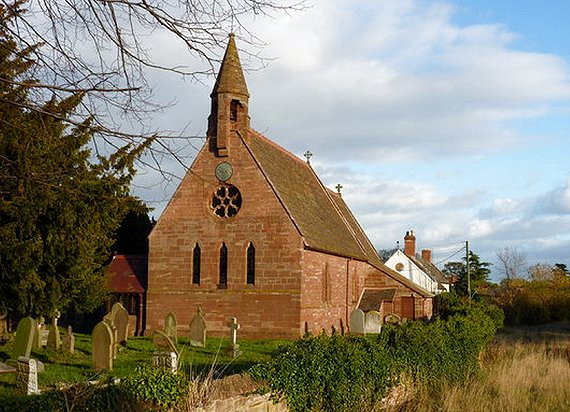
Colour photo of the church of Waters Upton St Michael. A small building of reddish-brown sandstone, with a bell turret at the end closest to us. Part of the churchyard, with its gravestones, can also be seen.

On 23 May 1865, John Halke’s dream of a new church for Waters Upton became reality (see above for a modern-day photo of the building). The Staffordshire Advertiser of 27 May reported as follows:

The parish church St. Michael’s, Waters Upton, Salop, was re-opened on Tuesday, and consecrated by the Right Rev. the Lord Bishop of the Diocese. The old building had long been in a state of complete dilapidation and was quite unfit for the purposes of public worship. When the Rev. J. T. Halke came to Waters Upton, six years ago, he wished to remedy this state and received such promise of support that the tottering ruin was levelled to the ground, and a very handsome and commodious new building erected by Mr. Cobb, of Newport, at a cost of about £1,800. At the conclusion of divine service in the morning, the burial ground was consecrated, after which the company sat down in an adjoining field to a cold collation. Collections took place after each service, and a handsome sum was realised towards paying off the portion of debt which still remains on the building.

The Mr Cobb who erected the church was most likely John Francis Cobb, son of the late John Cobb, architect and builder, of Chetwynd End near Newport, Shropshire. The design of the new place of worship however was Essex-born architect George Edmund Street, who already had a number of ecclesiastical buildings large and small to his credit. Described in modern times as a “small, cheap but carefully detailed church”, St Michael’s was constructed in Early English style from red sandstone ashlar, with a tiled roof, and an octagonal bellcote (or bell-turret), corbelled over the West gable. It is now a Grade II listed building.

“we leave [Waters Upton] with deep regret”

John Thomas Halke was not destined to enjoy the fruits of his labours at Waters Upton for very long. He had been undertaking the role of Curate for the Rector of the parish. But in August 1865 it was announced that “The Lord Chancellor’s rectory of Waters Upton, near Wellington, in this county, has become vacant by the death of the Rev. Richard Corfield, M.A. formerly of Clare College, Cambridge, who was presented by Lord Chancellor Eldon in 1822.” At the end of the following year, this report appeared in the Shrewsbury Chronicle:

Testimonial to Mrs. Halke and the Rev. J. T Halke.—The living of this parish has recently been purchased (under Lord Westbury’s Act) by John Taylor, Esq., and presented to his nephew, the Rev. John Bayley Davies. The Rev. J. T. Halke has had the sole charge of the parish for the last eight years, and during that time he has performed his duties most faithfully and zealously, administering in every way to the temporal and spiritual wants of the poor, and being at all times profuse in his charities to them. When he entered the parish the church was an old, ugly structure, and through his exertions a new church, of very beautiful design, has been erected by public subscription. When it was made known that he was about leaving this parish to remove to [Withington], a subscription was at once commenced, by general consent, and to which every parishioner, without exception, most willingly contributed—even the poorest gave their mite. A sufficient sum was soon collected to purchase a handsome and useful present of the following articles, all in silver:—Two handsome sugar vases, 12 fish knives and forks, asparagus tongs, and large fish fork. These were presented to Mr. Halke and his mother, Mrs. Halke, who had given such valuable and kindly aid in his efforts for the good of the people. It may not be out of place to give the pleasing reply which was received by each contributor:—
“Waters Upton Rectory, Dec. 12th, 1866.
“My dear Parishioners and Friends,—I beg to offer you my own and my mother’s heartfelt thanks for the beautiful and costly token of regard and esteem which we have just received from you. We shall value it as long as we live, as a testimony of your liberality, and still more for the kindly feeling with which it is given. The eight years of our abode at Waters Upton have been among the happiest of our lives; we leave it with deep regret and shall ever remember it with the warmest affection. For a time, at least, we shall have the satisfaction of regular intercourse, and wherever our future lot may be cast, we shall ever look back with pleasure to the period of our residence here. Dear Parishioners and Friends, I once more thank you from my heart for your beautiful present, and for all your kindness towards me.—Believe me, to be your very sincere Friend and Pastor,
“John T. Halke”

John began performing baptisms at Withington on 28 October 1866, but continued his curacy at Waters Upton into 1867, conducting his last baptism there on 24 February that year. Wednesday 7 March 1867 was “appointed by the Lord Bishop of this Diocese to be held as a day of prayer and humiliation on account of the cattle plague” and on the morning of that day John “preached from Jeremiah vii. 3.” at Waters Upton. If this was not his final sermon at Waters Upton, it was certainly one of the last that he preached there.

On 30 January 1873, at St Cross in Winchester, “the Rev. John T. Halke, Vicar of Withington, Salop” was married to “Lucy, eldest daughter of the late Richard Meredith, Esq., of Bishop’s Castle.” The couple had four children at Withington, and John passed away there on 8 September 1915 at the age of 83. A stained glass window, in memory of the Rev. John Thomas Halke LL.B. curate in charge (1859 to 1867), was added to the church of Waters Upton St Michael that same year.


Picture credits. Atcham St Aeta: © Copyright Anji Carrier, taken from Geograph ⇗, modified, used, and made available for re-use under a Creative Commons licence ⇗. Waters Upton St Michael:© Copyright Richard Law, taken from Geograph ⇗, modified, used, and made available for re-use under a Creative Commons licence ⇗.


References

[1] John Venn, J. A. Venn (eds.) (1947), Alumni Cantabrigienses. Volume II. Part 3. Page 196. Copy previewed at Google Books ⇗.
[2] The Rev. Richard HALKE, M.A. ⇗ At: Teresa’s Tree – Goatham Genealogy (website, accessed 1 Nov 2015).
[3] Monthly Magazine. No. 119, September 1804. Page 180. Copy viewed at Google Books ⇗.
[4] Weston-by-Welland, Northamptonshire, baptism register. Entry dated 28 Jun 1832 for John Thomas Halke. Copy viewed at Ancestry – Northamptonshire, England, Baptisms, 1813-1912. Indexed at FamilySearch ⇗, Batch I04386-4, Film 2000022, Ref ID item 4.
[5] Christ Church Cathedral, Canterbury, Kent, marriage register. Entry dated 23 Oct 1817 for The Revd. James Halke of Selling, Widower, and Mary Starr, Spinster. Copy viewed at Findmypast – Kent, Canterbury Archdeaconry Marriages 1538-1928. Indexed at FamilySearch ⇗, Batch I00751-7, Film 1786080, Ref ID it 2 p 8.
[6] Shrewsbury Chronicle, 7 Aug 1857, page 4.
[7] Shrewsbury Chronicle, 7 Oct 1859, page 6.
[8] Morning Post, 4 Jul 1859, page 3. Ecclesiastical Intelligence.
[9] Waters Upton, Shropshire, baptism register for 1815 to 1870. Copy viewed at Findmypast – Shropshire, parish registers browse, 1538-1900.
[10] Wellington Journal, 8 Oct 1859, page 3. District News. Atcham.
[11] Shrewsbury Chronicle, 7 Sep 1860, page 7. Waters Upton.
[12] Shrewsbury Chronicle, 4 Oct 1861, page 6. Uffington Harvest Festival.
[13] High Ercall, Shropshire, marriage register. Entry dated 14 May 1862 for Edward Ryley and Mary Ellen Atcherley.
[14] Staffordshire Advertiser, 18 Jun 1864, page 5. See Marriages at Waters Upton.
[15] Eddowes’s Shrewsbury Journal, 6 Apr 1864, page 6. Archidiaconal Visitation.
[16] Staffordshire Advertiser, 9 Jul 1864, page 4; 16 July 1864, page 4; 6 Aug 1864, page 4; 13 Aug 1864, page 4.
[17] Shrewsbury Chronicle, 12 Aug 1864, page 4.
[18] The Herts Guardian, 9 May 1865, page 4. A Church to be Rebuilt.
[19] Staffordshire Advertiser, 27 May 1865, page 3. Religious, Educational, &c.
[20] Staffordshire Advertiser, 5 Dec 1863, page 1. THE TRUSTEES of the late Mr. JOHN COBB respectfully announce that the Business of ARCHITECT, SURVEYOR, and BUILDER, carried on by him at Chetwynd-End, Newport, Shropshire, will be conducted heretofore, in all its branches, for the Benefit of his Family, by his Son, MR. J. F. COBB, For whom they earnestly solicit a continuance of the kind patronage so long and liberally extended to his late Father. Chetwynd-End, December 3rd, 1863.
[21] 1861 census of England and Wales. Piece 1901, Folio 79, Page 5. Chetwynd End, Chetwynd, Shropshire. Head: John Cobb, 48, architect & builder, born Newport. Wife Ann Cobb, 49, born Newport. Dau: Jane Cobb, 23, born Chetwynd. Dau: Mercy Cobb, 21, born Chetwynd. Son: John Cobb, 16, architect & builder’s clerk, born Chetwynd. Son: Willie [Walter] Cobb, 5, scholar, born Chetwynd. Plus 2 servants (housemaid, cook).
[22] George Edmund Street ⇗. At: Wikipedia (website, accessed 1 Nov 2015).
[23] List of new churches by G. E. Street ⇗. At: Wikipedia (website, accessed 1 Nov 2015).
[24] John Newman (2006), Shropshire. Page 672. Copy previewed at Google Books ⇗.
[25] Church of St Michael ⇗. At: Historic England website (accessed 1 Nov 2015).
[26] Eddowes’s Shrewsbury Journal, 16 Aug 1865, page 5. The Church.
[27] Shrewsbury Chronicle, 28 Dec 1866, page 7. Waters Upton.
[28] Withington, Shropshire, baptism register for 1813 to 1948. Copy (of portion from 1815 to 1900) viewed at Findmypast – Shropshire, parish registers browse, 1538-1900.
[29] Canterbury Journal, 8 Feb 1873, page 4.
[30] Kelly’s Directory of Shropshire, 1917.
[31] The Church ⇗. At: St. Michael’s Church Waters Upton (website, accessed 1 Nov 2015).