“The history of no people can be said to have been written so long as its superstitions and beliefs in past times have not been studied.” These words were written by Professor John Rhys, M.A., back in 1881 ⇗, and quoted on the title pages of a publication I have been perusing in search of folklore connected with Waters Upton and its neighbouring parishes.
Shropshire Folk-lore: A Sheaf of Gleanings was published in three volumes from 1883 to 1886. The book was based on the collections of Georgina Frederica Jackson, and edited by Charlotte Sophia Burne. Collected within its pages were legends and traditions (concerning giants, devils, fairies, meres and more), followed by a shedload of superstitions, customs and beliefs including ghosts, witchcraft, cures, well worship, wakes and games, and concerning animals, plants, days of the week, and seasons from the new year to Christmastide.
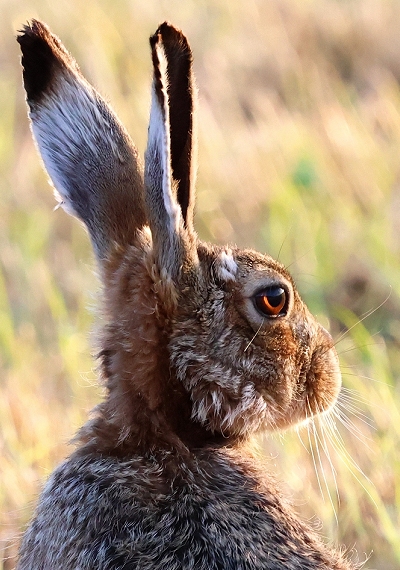
It is lucky to meet a hare…
From Waters Upton itself just one superstition is recorded in this Sheaf of Gleanings, but it concerns one of my favourite animals:
The Hare, like the cat, is associated with witchcraft, and therefore ominous. It is lucky to meet a hare (Waters’ Upton and Cold Hatton, in North Shropshire), but unlucky to see it run across the path.
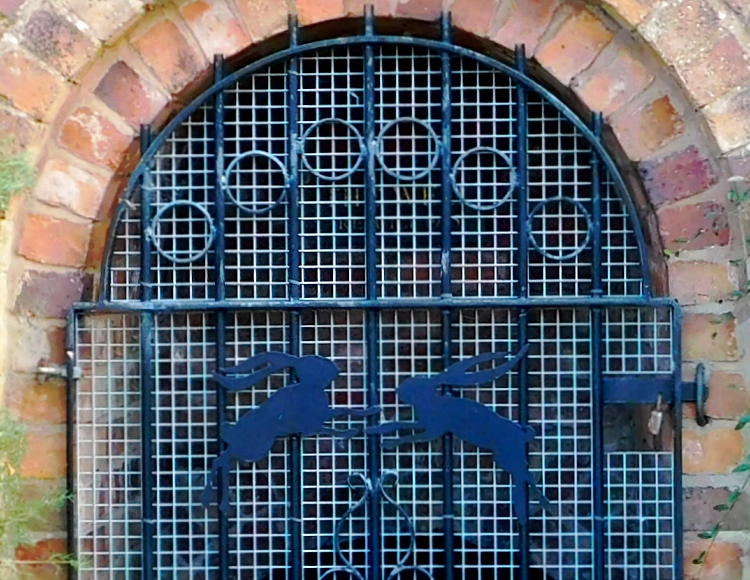
The silhouettes of two Hares on the gate to the well at the Western end of Catsbritch Lane, Waters Upton
What then of the area around Waters Upton – parishes which some Waters Uptonians would have come from, and which many will have visited or had other connections with? Some of the customs, superstitions and beliefs documented in relation to those parishes may well have been practiced or held by – or at least known to – people over a wider area. And the fame (or infamy) attached to any individual believed to possess ‘special powers’ would certainly not have been confined to that person’s own parish. In this article, I’m going to look at a custom, and an individual, both very likely to have been familiar to Waters Upton residents in the 1800s.
The custom is one related to harvest-time, an important season in any rural parish. Before examining that custom however, I want to share a snippet from Shropshire Folk-lore which shows how the practice of harvesting underwent a revolution in the mid-19th century as a result of mechanisation.
PERHAPS nothing in all the range of country life has undergone a more complete and more recent change than has the ingathering of the harvest since the introduction of reaping-machines some twenty years ago. Even before that time, dissatisfaction with the old slow methods of reaping and ‘badging,’ or ‘swiving,’ was widely felt; and the sickle was already giving place to the ‘broad hook,’ and that to the scythe, when all alike made way for the machine. And the agricultural labourers of the present generation often do not even know the correct names, much less the uses, of the time-honoured tools with which their fathers toiled so patiently day after day from dawn to dark.
Crying the mare
On then to “Crying, calling, or shouting the mare, […] a ceremony performed by the men of that farm which is the first in any parish or district to finish the harvest.” Miss Burne goes on to tell us (having noted in the preface to her book that “no true Salopian ever sounds the letter h”) that:
The object of it is to make known their own prowess, and to taunt the laggards by a pretended offer of the ‘owd mar’ to help out their ‘chem’ [team]. All the men assemble in the stackyard, or—better—on the highest ground on the farm, and there shout the following dialogue, preceding it by a grand “Hip, hip, hip, hurrah!”
“I ‘ave ‘er, I ‘ave ‘er, I ‘ave ‘er!”
“Whad ‘ast thee, whad ‘ast thee, whad ‘ast thee?”
“A mar’! a mar’! a mar’!”
“Whose is ‘er, whose is ‘er, whose is ‘er?”
“Maister A.’s, Maister A.’s, Maister A.’s!” (naming the farmer whose harvest is finished).
“To Maister B.’s, to Maister B.’s, to Maister B.’s” (naming one whose harvest is not finished).
“’Uth a hip, hip, hip, hurrah!” (in chorus). […]
[S]ometimes the mocking offer of the mare was responded to by a mocking acceptance of her help, as when an old man told Mr. Hartshorne, “while we wun at supper, a mon cumm’d wi’ a autar [halter] to fatch her away.” There were of course variations in the details of the braggadocio in different places, but it was universally practised, and though dying out, is by no means extinct. Mr. Gill dates its disuse at Hodnet about 1850-60 […].
In 1868 the unusually early harvest of that hot summer incited a party of men at Edgmond, whose employer had finished on the 31st of July, to celebrate the event by crying the mare. “Wheer shan we send ‘er?” asked one party.” T’owd Johnny Bleakmur,” came the reply. Any unusual excitement or rivalry would naturally revive the old custom in this way, even when it had been disused as a general thing. […]
Tommy the conjuror
From Crying the Mare and ‘owd Johnny Bleakmur (John Blakemore of Edgmond, I believe), to ‘owd (old) Thomas Light of Walton in Ercall Magna parish. He would certainly have been a character familiar to people living in nearby Waters Upton – and was very likely related to some of them. The following, contributed to Shropshire Notes and Queries of 13 February 1885 by a correspondent identified only as ‘A’, was included in Shropshire Folk-lore under Conjurors:
Between sixty and seventy years ago a man named Thomas Light had a high local reputation as a conjuror, fortune-teller, and “wise man.” He lived in the half-timbered cottage nearly opposite Mr. Webster’s house in the village of Walton (near High Ercall), and I have heard an old inhabitant of Walton say that he had seen as many as six vehicles driven up to the cottage in a morning. This conjurer carried on a roaring trade for many years, and people sought his advice and assistance from places as remote as the Cheshire and Staffordshire borders, and even out of Wales.
Cock-fighters brought him their birds to charm, and paid him for putting spells upon their opponents’ feathered representatives; farmers sought his power to remove cattle disease; wives and maidens came to him for their fortunes to be told, and the losers of stolen goods made him their detective. There were two “reception” rooms in the cottage, into one of which Light always retired to consult the stars or hold intercourse with his familiar spirits. Sometimes he could be heard by his customers wrestling with some supernatural presence, and the rattling of chains of course suggested that the conjurer was wrestling with the Evil One himself. […]
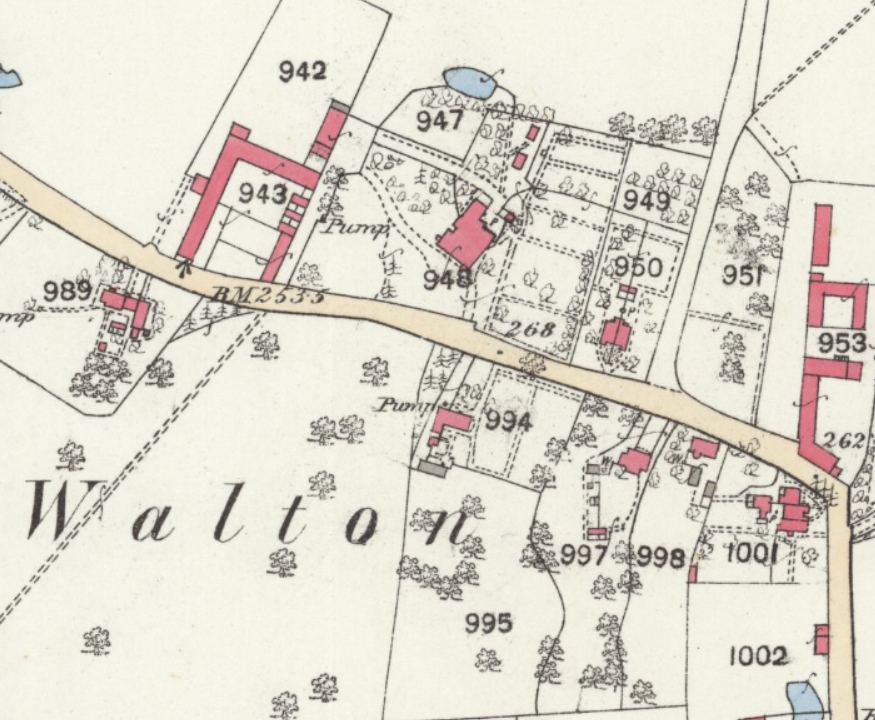
Extract from an Ordnance Survey map (25 inches to the mile, Shropshire XXIX.10) published 1881, reproduced with the permission of the National Library of Scotland ⇗ under a Creative Commons licence ⇗. This does not show things exactly as they were when the tithe apportionment map for Ercall Magna parish was drawn up in 1838, but that earlier map tells us that John Webster lived at the property in parcel number 943 here, while Thomas Light (who “lived in the half-timbered cottage nearly opposite”) occupied the house in parcel 994.
Thomas’ obituary, published in the Shrewsbury Chronicle of Friday September 10th, 1841 (page 3), very much suggests that he put the ‘con’ into ‘conjuror’! It makes for an entertaining read, and I reproduce it here as published, save for splitting the text into more than the original two paragraphs:
Death of an Eccentric Character.—On Sunday last, at Walton, near High Ercall, at the age of 94, Thomas Light, better known by the sobriquet of “Tommy Light the Conjuror.” This eccentric individual had from an early period of his life been a professor of the “Mysterious Art of Conjuring,” which he continued to practice with considerable pecuniary advantage to the close of his days.
His personal appearance was of no common order, as he always strictly adhered to the peculiar character of dress in fashion about the middle of the last century: a stranger on meeting “Old Tommy” was instantly struck with the excessive originality of his manner and costume; clad in a light sky blue “coat of other days” with an extravagantly lengthened linsey vest with large flaps descending over scanty “continuations.”
This antiquated oracle usually attended the markets to render his prophetic advice and assistance to all whom he could find possessed of the two great requisites for the successful development of his mystic craft, viz. Faith and Money; and it speaks but little for the intellectuality of the age, when it is considered what numbers of persons were sufficiently ignorant and superstitious to consult him, in all the various matters which have generally been subjects for the divinations and prophecies of this now (thanks be to the schoolmaster) almost extinct race of conjurers and fortune-tellers. His professional career was not merely confined to his own locality, but he was frequently applied to by the credulous rustics of the neighbouring counties.
His conjuring propensities were at one time the means of giving him rather an awkward introduction to the magisterial bench at Wellington; a lad at Ketley having robbed his employer both parties secretly applied to the sage, the one for the means of safety from detection, the other to have the property returned and the offender punished. Having instructed the lad to replace part of the stolen treasure, he informed the other that part of the missing property would be by his powers replaced.
The trick however having been detected by the parties, and it being suspected that he had received a large fee out of the missing cash, “Tommy” was pulled up before the magistrates and was committed to take his trial at the sessions, but was afterwards bailed out by a relative, to whom it is said he took a hundred sovereigns as security; he was however finally acquitted, but this had evidently the effect of making him more cautious in his future proceedings.
Among the many eccentric incidents of his life was that of purchasing a wife, who afterwards resided with him until death dissolved the unhallowed bargain. From this time her daughter by a legitimate husband superintended his domestic affairs, until at an advanced age she was accidentally burned to death.
Some time before his death, he gave several considerable sums of money, and has since willed further sums to different parties; a few days ago, several sovereigns and guineas were found among some old iron in a chest, in his dwelling, and many are of the conjectures that a horde yet remains to be discovered on the premises he occupied, which consisted of a cottage, orchard and garden, the property of the Duke of Cleveland.
“Old Tommy” was the oldest tenant on his Grace’s Ercall Estates. This extraordinary character possessed considerable originality of mind, and an exceedingly retentive memory, and remained in full possession of his mental faculties until the period of his death.
Searching the records for ‘Young Tommy’ (as I find myself thinking of the boy who grew up to become Tommy the Conjuror) I found that “Tho Son of Tho Light of Walton was baptized September ye twenty third” in 1748 at High Ercall. Depending on how soon after his birth he was baptised, Thomas would have been 92 or 93 years old when he died, not 94 as reported in the press. 92 was the age entered in the High Ercall burial register when Thomas was buried on 8 September 1841.
Just three months before his demise, Thomas was enumerated at Walton on the 1841 census. His age was recorded as 90 (rounded down to the nearest five years as was generally the case for adults on that year’s census) and he was of independent means (a status recorded as “Ind”). Living with him was a female servant, Jane Dabbs, age 55. His near neighbour Mr John Webster, mentioned above, was a 70-tear-old farmer. All were said to be natives of Shropshire.
Did any residents of Waters Upton avail themselves of Old Tommy’s mystical (or more likely, mythical) ‘services’ during his long life? I don’t think we will ever know for certain. At the very least, I’m sure he was the subject of many a conversation in the village’s hostelries, during his lifetime and for many years after!
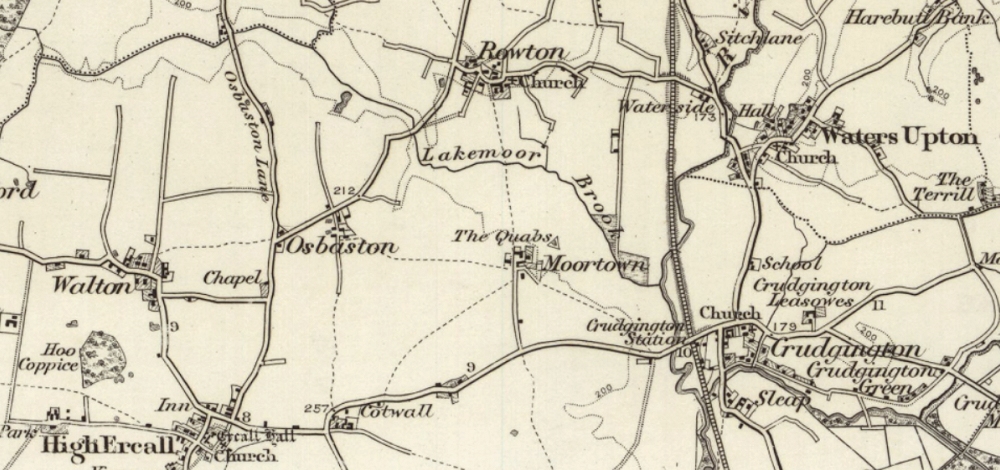
Extract from an Ordnance Survey map (1 inch to the mile, Sheet 138 – Wem) published 1889, showing Walton to the West and Waters Upton to the East. Reproduced with the permission of the National Library of Scotland ⇗ under a Creative Commons licence ⇗.
 Waters Upton One-Place Study