Kinship, continued: The Waters Upton ‘Big Tree’

Back in 2020, in Kinship in the parish of Waters Upton in 1841, I wrote about the ‘family tree’ of my Waters Upton one-place study at Ancestry. “‘Forest’ might actually be a better word than ‘tree’,” I said, “given that what I have established is in fact a collection of numerous separate trees growing in one place.” Even then I recognised that, as more connections by blood and/or marriage became apparent, “[quite] a few of those trees were not ‘separate’ after all.” Following some recent work on the ‘forest’ I think it’s time for me to update you on the subject of kinship in the parish of Waters Upton – and introduce you to the ‘Big Tree.’

Normally when a family tree is constructed, its starting point is the person who is building it (or the person for whom the tree is being built by someone else). From that person a branching network of ancestors and relatives grows. If you build your tree on the Ancestry platform, and set yourself as the ‘home person’ of that tree, the profile page for every person in it will tell you how they are related to you. What I am creating for my Waters Upton one-place study is clearly not a normal family tree! I have however set a home person for the ‘forest.’ Let me explain why.

A well-connected couple

As I have described on this site’s home page, the woman who drew me to Waters Upton back in 2011, and sparked the interest that became my one-place study (or OPS), was my 3x great grandmother Mary Titley, née Atcherley. Mary, who died in 1832 and is buried in the churchyard of Waters Upton St Michael, was part of a farming family based at Moortown, not far from Waters Upton in the neighbouring parish of Ercall Magna.
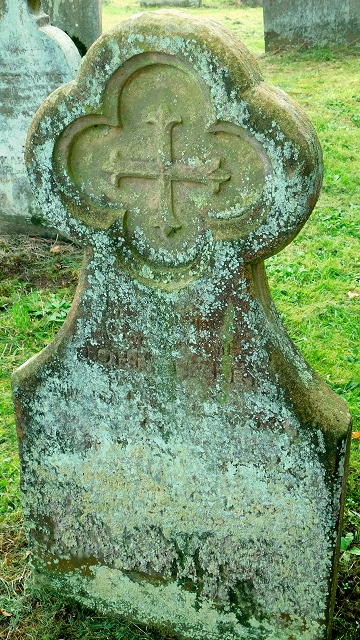
Colour photo of a gravestone in a grassy churchyard. It has a lot of grey-green lichen growth on it, and some green algae, leaving some of the inscription illegible.
The gravestone of John and Mary Titley at Waters Upton.

Mary’s maternal ancestors were the Wase family, established at Waters Upton Hall from the beginning of the 1700s. Amongst her other ancestors in the parish, Mary’s 4x great grandfather Richard Hitchins, baptised on 30 June 1616, was born there.

Mary’s husband John Titley (not my ancestor, but that’s another story) is buried with her at Waters Upton. John was a butcher, but his ancestors were agricultural labourers. His relatives, prior to his marriage to Mary Atcherley, were mostly labourers, or engaged in trades or crafts. The Titleys did not have deep roots in Waters Upton. Nevertheless, John had a 2x great grandmother, Elizabeth Matthews, née Christian, who was a native of the parish and was baptised at St Michael’s on 19 February 1720/21.

Between them, Mary and John had familial connections with a great many people, across the social spectrum, in Waters Upton parish. So I decided a while ago to set Mary as the home person of the growing Waters Upton forest at Ancestry. After that, if anyone in the forest had family ties to Mary, no matter how convoluted or remote, the nature of their relationship was shown on their profile page. This gave me my first feel for the extent of the complex network of connections between the people of the parish. It also made me rethink the ‘rules’ I had set regarding who I should include in the growing forest…

Welcome to the jungle?

I set the rules of admission quite early on, when I was nurturing the saplings. The core people were those who were either born in Waters Upton parish, or came to live in it at some point later in their lives. To explore the stories of those people in more detail, I decided I would also include their spouses, all of their children, plus their children’s spouses, whether or not they were born in or lived in the parish.

Later, to research the extent of kinship in the parish more fully, I adapted my rules and started to add parents, or siblings, sometimes grandparents (even if those relatives weren’t born in, or never lived in, Waters Upton), where this would bring out the relationships between the core people of the OPS forest.

Those connections to my 3x great grandmother, incidentally, could range from a first or second cousin, to something like “1st cousin 1x removed of wife of brother-in-law of 1st cousin 2x removed of husband”! The degree to which an individual is connected to Mary Atcherley Titley isn’t the important thing, it’s the fact they are part of a group of people who are all connected to each other by blood and/or marriage.

A colour photo in which can be seen, above a hedge, the upper parts of a small church with bell turret, and some neighbouring houses. Beyond, the tops of several trees can be seen, including one tree much taller than the others, and considerably taller than the top of the bell turret on the church.
A big tree in Waters Upton. But not the Big Tree.

Gradually, the ‘Big Tree’ within the forest grew ever larger. But how large? Exactly how many – or what percentage – of my forest dwellers were part of this increasingly complicated web of connected people?

The suffix fix

Most family tree programmes will tell you how one person in a tree is related to another. But they aren’t designed to tell you how many people in the tree are related to one particular person. After all, in a typical family tree everyone is related to everybody else, in one way or another. Not so with my atypical tree, the OPS forest! With no quick technological fix available to me, I had to come up with a different solution.

If I had done this after Ancestry introduced MyTreeTags ⇗ I might have created a custom tag called The Big Tree and made a start on adding that tag to everyone I saw who was connected to my 3x great grandmother. Conducting a search for people within the forest, using that tag as the criteria, would then give me the names of all the people so tagged, and display a total. The recent addition by Ancestry of Networks ⇗, part of a suite of Pro Tools ⇗ requiring an additional subscription, provides another possible method.

With neither Tree Tags nor Networks available to me, I came up with something else. I had already started using Ancestry’s name suffix field to identify people who were born in or who lived in Waters Upton, with “[OPS]” as a ‘marker’. So I started adding a new marker for people who were related to Mary Atcherley Titley: [🌳]. As it is a string of three characters (even if one of them is an emoji, and even though this string is in the name suffix field) I can conduct name searches to pick up all the people with the marker.

More recently I started adding a second marker. I wanted to be able to see at a glance whether a given individual without a ‘Big Tree’ marker was not part of the tree, or was someone to whom I had yet to add the marker. For those in the forest who are not (or at least, not yet) in the Big Tree I am adding this marker: [🍃] – a falling leaf, not attached to a tree.

This is a time-consuming solution, and one which is ongoing due to the size of the Waters Upton forest. At the time of writing, there are 7,688 people in that forest, of whom a fraction under 26%, incidentally, have the [OPS] marker.

Treemendous totals
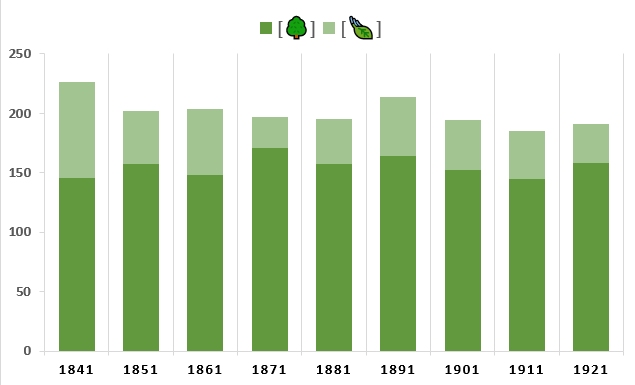
A bar chart showing the total number of people enumerated at Waters Upton in each census from 1841 to 1921 inclusive. The shading of each bar shows the number of people in each year who are, or are not, part of the Waters Upton 'Big Tree'. Further explanation in the article.

The “recent work on the ‘forest’” that I mentioned in my introduction to this article is an attempt to generate some meaningful data from the Big Tree markers. Using census Tree Tags that I had already created, I filtered the list of people in the OPS forest to view those enumerated at Waters Upton in each of the censuses from 1841 to 1921. Then I made sure all of those people had [🌳] or [🍃] markers. This has provided numbers, at fixed points in time over a period of 80 years, for Waters Upton residents who were (or were not) in the Big Tree.

As you can see, in every census year a sizeable majority of Waters Upton’s residents were part of the Big Tree – even in 1841 (64.6%). (See the aforementioned Kinship article for more on the challenges presented by that particular census). The average percentage across the censuses from 1851 to 1921 is just under 80%. Wow. Everyone on the planet is related of course, but I wasn’t expecting the level of provable (if often complex!) connections in my OPS to be quite that high.

I’ll conclude with a few points to be borne in mind (and with a version of the bar chart showing percentages for each census year):

  • The ‘forest’ does not, and never will contain everyone who was ever born in or lived in Waters Upton, nor does it contain all the people who might link a particular ‘forest dweller’ to the Big Tree
  • Further research, examining the ancestry of individuals in the forest more deeply, would (and probably will!) connect more people to the Big Tree
  • Proving connections between people, particularly as we go further back in time, can be difficult, so an unknown number of people in the forest who should be in the Big Tree, are not
  • Depending on the timing of the marriage that (directly or indirectly) connected a previously unrelated forest dweller to the Big Tree, that person might not have been part of the tree when a particular census was taken, or indeed during their lifetime!

(The last of the above points is a cue for more work, perhaps looking at a particular post-1841 census to see the extent of the connections that existed at the time in question. 1871 – with nearly 87% in the Big Tree – looks like it would be a great choice!)
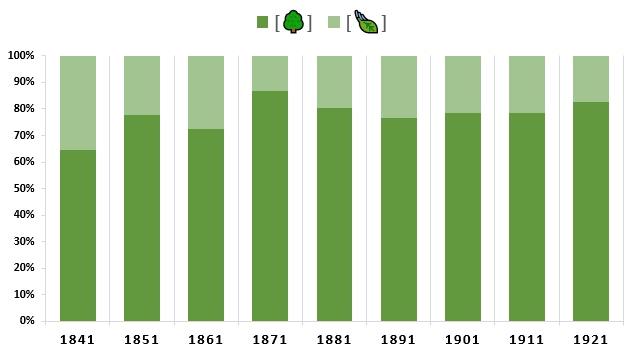
A bar chart showing the percentage of the people enumerated at Waters Upton in each census from 1841 to 1921 inclusive, who are, or are not, part of the Waters Upton 'Big Tree'. Further explanation in the article.

Analysis: Kinship in the parish of Waters Upton in 1841 (Part 2)

⇐ Back to Part 1

On now to the second of the two extended groups of Waters Uptonians with kinship connections.

Titley, Atcherley, Wase, Dickin, Icke, Griffiths, Harper, Shakeshaft, and Gregory connections

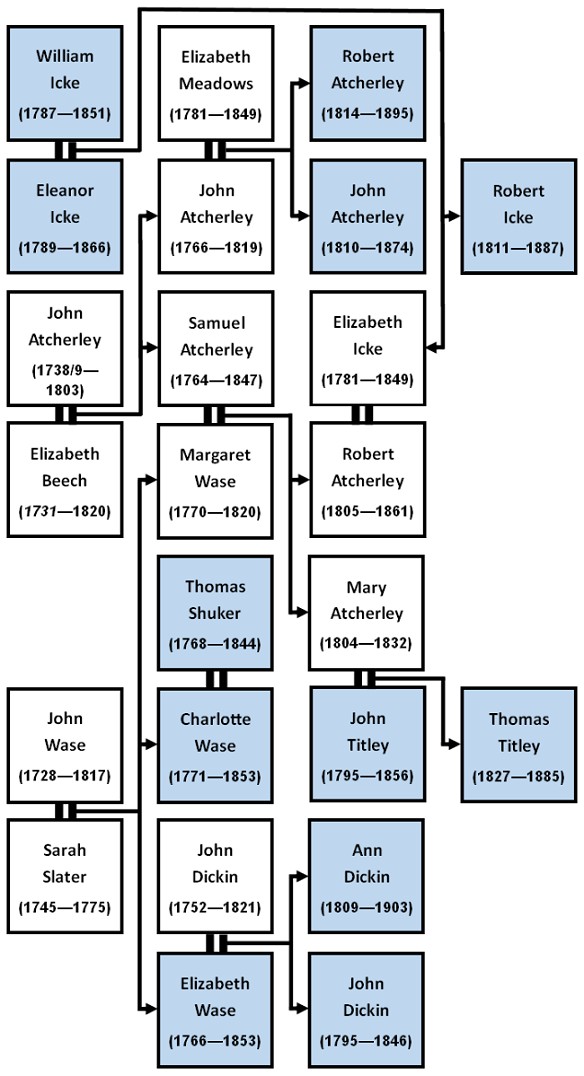
These are the relatives and others who were linked in one way or another to 14 year old Thomas Titley, living in household 27 in 1841 with his father John Titley (and a servant, Mary Griffiths, regarding whom I will say more shortly). The first sub-group of these people are those to whom Thomas was related (however remotely) through his late mother Mary Titley née Atcherley (who was also my 2x great grandmother).

A family tree diagram showing 24 people, all connected by blood and/or marriage, 12 of whom were living in Waters Upton when the 1841 census was taken. Further details are provided in the article.

Here we see these Waters Upton residents:

  • Mary Atcherley’s maternal aunt Charlotte Shuker (née Wase) in household 25 with her husband Thomas Shuker (who was of independent means) and a servant. Whether these Shukers were related to William, Alice and Thomas of household 26 I do not know, but what a coincidence if they weren’t!
  • Mary’s maternal aunt Elizabeth Dickin (née Wase), widow of John Dickin, in household 2 with her son and daughter John Dickin (a landowner and farmer with 7 servants, one of whom – John Pidgeon – appears later in this article) and Ann Dickin, neither of whom were married.
  • Mary’s first cousin John Atcherley, a tailor, the sole occupant of household 7.
  • Mary’s first cousin Robert Atcherley, an agricultural labourer, the only denizen of household 37.
  • The parents-in-law of Mary’s brother Robert Atcherley, William Icke and Eleanor (née Icke, almost certainly a relative of her husband) in household 41, a public house, with their son, Mary’s brother-in-law, Robert Icke, and three servants.

The second sub-group of Thomas Titley’s kin are those related to him through his father John.

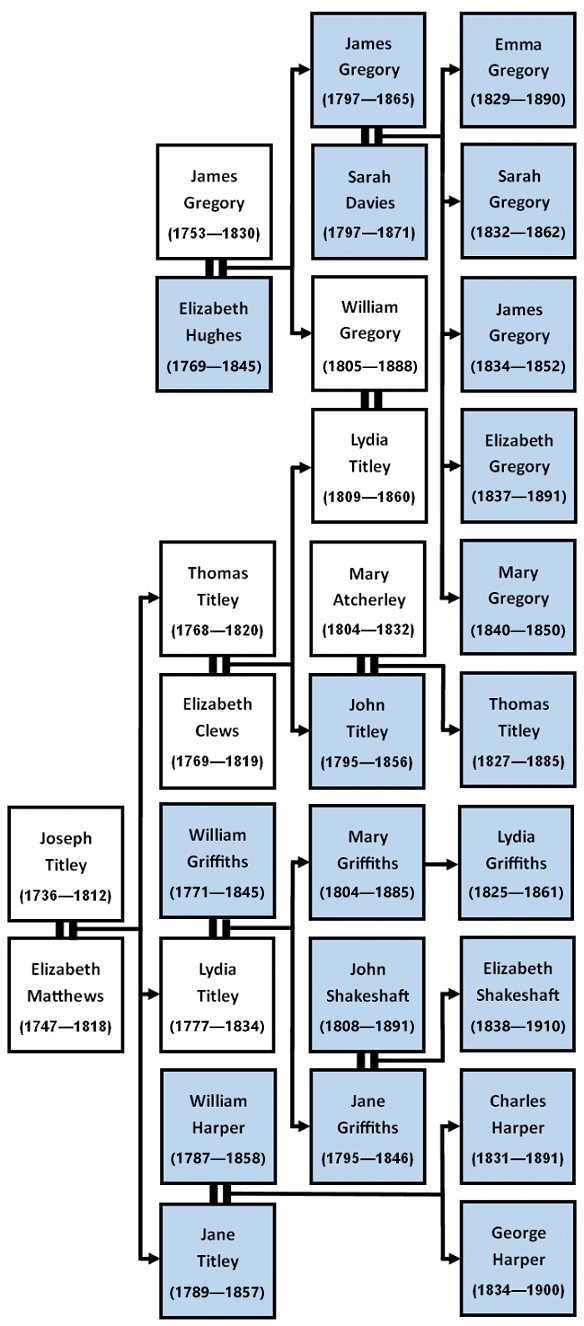
A family tree diagram showing 29 people, all connected by blood and/or marriage, 20 of whom were living in Waters Upton when the 1841 census was taken. Further details are provided in the article.

In this, our final chart, the following are shown:

  • John Titley’s brother-in-law James Gregory in household 34, with his widowed mother Elizabeth Gregory née Hughes, wife Sarah (née Davies), and children Emma, Sarah, James, Elizabeth and Mary (plus servant Samuel Allen, who we will see again soon).
  • John’s paternal aunt Jane Harper née Titley in household 3, with husband William Harper and children Charles and George. I am not aware of any connection between these Harpers and those of household 8 (William, wife Martha, and children Elizabeth and Sarah).
  • John’s uncle William Griffiths, widower of John’s paternal aunt Lydia, in household 35 with granddaughter Lydia Titley (age 15), married daughter Jane Shakeshaft, son-in-law John Shakeshaft, and their daughter Elizabeth (plus a guest, Samuel Harrison, who does not appear to have been a relative). There was also one other person in this household, who was definitely a relative – I will return to her later!
  • In the Titley’s own home the aforementioned servant was John’s first cousin Mary Griffiths; a daughter of William Griffiths and (unmarried) mother of Lydia Griffiths.

That’s a group of 30 people spread across 9 households (2, 3, 7, 25, 27, 34, 35, 37 and 41) with varying degrees of kinship between them. And if the Elizabeth Matthews (1747–1818) who married Joseph Titley was related to the Sarah Matthews (1766–1815) who wed William Pascall (see Part 1 of this article), this group would link up with the first one. That’s an intriguing possibility as it would give us a single group of 65 people (out of a total of 226) across 19 household (out of 41)!

Update (Feb 2026): Further research has shown that Elizabeth Titley née Matthews (1747–1818) was related to Sarah Pascall née Matthews (1766–1815) – Sarah was Elizabeth’s niece. Her father William Matthews (baptised 1743 at Waters Upton) was one of Elizabeth’s brothers.

Less complex connections

Having looked at the more tangled trees, let’s move on to the less complicated cases of kinship within and across households. Mary Worrall for instance, a resident of household 24 with Joseph and Martha Wilks (or Wilkes), was that couple’s granddaughter through their daughter Elizabeth Wilkes (wife of James Worrall), who was not resident in the parish.

Elizabeth Pickin, wife of John Pickin in household 36, was the daughter of Thomas and Ann Felton, who lived close by in household 33.

As we have seen, some of the young servants of Waters Upton were children of families living in other households in the parish; two more examples follow. First, residing with farmer John Dickin in household 2, was teenager John Pidgeon whose family was living in household 19. The young Pidgeon had evidently flown the nest but settled not far away. Incidentally, William Cowley, part of the Pidgeon household in 1841, was the pre-marital son of William Pidgeon’s wife Martha, née Cowley.

Another servant of interest is 11-year-old Samuel Allen, who in 1841 was ensconced with tailor James Gregory and family in household 34. Despite his seemingly low status, Samuel appears to have been a member of the agricultural Allens who farmed in the neighbouring parish of Ercall Magna. Specifically, it looks like his parents were Samuel (a farmer at Cotwall in 1841 and a retailer of wines and spirits in 1851) and Emma. If this was the case, farmer Charles Allen in household 11 was, I believe, Samuel’s paternal uncle.

William Pritchard was, along with the Morris family, an occupant of household 38. He was a son of Ann Morris, formerly Pritchard, née Jackson, born between her marriages to Messrs Pritchard and Morris.

Another child born out of wedlock was two-year-old James Andrews, enumerated in household 31 with the Cureton family, was, not surprisingly, the son of Deborah Andrews, aged 25 or more, who was also a member of that household. Like his mum, James was born in Suffolk – but who was his father? Ladies and gentlemen of the jury, I call William Howard, living in household 41 with the Icke family. I’m going beyond the 1841 census with my evidence here, but what the heck: William Howard went on to marry Deborah Andrews, and by 1851 James Andrews had become James Howard. I put it you that on the balance of probabilities, William was the father of James.

Colour photo of a 'Connect 4' game. It has a vertical 'game board' with 7 columns, into each of which up to 6 plastic discs can be dropped so that stack one above the other, each visible through a circular hole in the 'game board'. This board has discs, some red, and some yellow, occupying all but three of the available spaces. Neither the player using red discs, nor the player using yellow discs, has managed to win the game by getting four of their discs lined up in a horizontal, vertical or diagonal row.

Connected, or not?

There were several people enumerated on the 1841 census at Waters Upton whose surnames suggest the possibility of connections with others, which I have not yet been able to verify (or dismiss). The Harpers, the Lloyds and the Shukers I have already mentioned, but there were also the Williamses, some of whom coincidentally had a connection with the Lloyds who appeared at the end of Part 1 of this article. Was John Williams of household 23 related to Sarah Lloyd, formerly Edge, née Williams in household 12 or servants Charles Williams (in household 41) or Emma Williams (in household 28), or any of the latter to each other? The frequency with which the surname occurs makes the question less than straightforward to resolve, but in time I may have an answer.

Update (Feb 2026): Further research has connected some of those named above to The Waters Upton ‘Big Tree’. This is the case with the Harpers, and also John Williams and his family. In the case of the Harpers, their connection to the Big Tree came after 1841. In the case of John Williams and family however, all the links in the long chain of marriages and blood relationships were prior to 1841, so they were linked to many of their fellow parishioners at the time of that year’s census.

In conclusion

More than half of the households in Waters Upton at the time of the 1841 census had at least one occupant related in some way to one or more occupants of another household. This leaves the following households inhabited by people with no confirmed links to others in the parish: 1 (Corfield family and servants), 5 (Anslow family), 6 (Edwards family & guests), 8 (Browns and servant), 9 (Evans), 10 (Dodd family), 14 (Woodhouse family and guests), 15 (Davies family), 23 (Williams / Lloyd family), 24 (Wilkes family), 26 (Shuker family), 28 (Tudor family and guest), 30 (Moore family), 32 (Ridgway family), 38 (Morris family), 39 (Bennett family).

Update (Feb 2026): Further research has connected many of those named above to The Waters Upton ‘Big Tree’. This is the case with the Evans family (household schedule 9), the Dodd family (10), the Davies family (15), the Williams / Lloyd family (23), the Wilkes family (24), the Tudor family (28), the Ridgway family (32), the Morris family (38) and the Bennett family (39). Some of those links however may only have been established after the 1841 census was taken – I need to look into those connections in more detail.

Just one more thing …

… as TV detective Columbo ⇗ used to say. I said I would return to another person in the household of William Griffiths. She features in this genealogical version of Only Connect ⇗, but I left her off the relevant family tree chart. Her name was Elizabeth Griffiths and she was the daughter of teenager Lydia Griffiths, the granddaughter of Mary Griffiths (John Titley’s servant), and the great granddaughter of William. This made her a first cousin twice removed from John Titley and a second cousin once removed from John’s son Thomas Titley. But she also had another, closer relationship to the two Titleys – and therein lies a story which requires a separate article.

Second family tree chart updated (corrections, plus birth/death dates found by further research) Feb 2026.


Picture credits: Family tree charts by the author. Photo of Connect 4 game by Wikimedia Commons ⇗ contributor Popperipopp; modified, used and made available for re-use under a Creative Commons licence ⇗.

Analysis: Kinship in the parish of Waters Upton in 1841 (Part 1)

One element of the research I carried out for my two-part article Analysis: The 1841 census of Waters Upton was further work on my Waters Upton family tree at Ancestry. ‘Forest’ might actually be a better word than ‘tree’ in this situation however, given that what I have established is in fact a collection of numerous separate trees growing in one place. As I traced the roots of those trees more deeply however, some of them began to merge. Quite a few of those trees were not ‘separate’ after all.

Colour photo of part of a woodland. Almost all of the trees here were coppiced (cut down to the roots) a good few years ago, so that each one has multiple slim trunks rising from their bases.

In adding people to the Waters Upton ‘forest’ my primary goal was to link other records to them besides the census and so find information vital to establishing who they were – their identities. For example, where and when were they born? This is not always easy to establish even for those enumerated on the more detailed censuses of England and Wales taken from 1851 onwards, due in part to inaccuracies in the information supplied, recorded, and transcribed. In the case of the 1841 census we have different levels of vagueness to contend with too, particularly with regard to places of birth. In most cases however, I have overcome these problems in respect of the Waters Uptonians of 1841. As a result, my analysis of that year’s census includes the geographic origins of the parishioners.

Another key component of each individual’s identity is how they are related – through blood and/or marriage – to others. So for each person in my Waters Upton ‘forest’ an important task was to find and link them with their parents, any siblings and, where applicable, spouses and children. Again the limitations of the 1841 census adds to the workload here, as relationships between the ‘head’ of each household and other residents were not recorded, and neither was marital status. Thankfully in the course of my research other records have cleared up any doubts, in most cases but certainly not in all.

There remains a sizeable minority of people on the 1841 census of Waters Upton whose full identities are still unknown to me (because I have not so far managed to track them down in other records), some of whom might yet turn out to be related to one or more of their fellow parishioners. These include many of the young servants and also boarders / lodgers (particularly those with high-frequency surnames) who were living away from their immediate families.

In one case even the ‘head’ of a household (household 8) has eluded me: I have yet to discover who 40 (or so) year old farmer John Brown was, and I don’t know whether the younger Elizabeth Brown enumerated with him was his wife or his sister.

Confirmed – and complex – connections

Returning to the people whose identities and families I have established, as my work on them progressed a number of families became larger in size and/or multi-generational and/or connected to other families. Consequently some of those families were split between two or more households, and more and more distant and complex relationships between some of the people present in the parish in 1841 became apparent.

I’ll begin my exploration of all these links with the largest of two extensive groups of connected people, for whom I have prepared family tree charts to make their kinships clearer. In both cases I have picked one person as the centre of the ‘web’, and I have also split the groups down into two further sub-groups to make things a little easier.

Pascall, Matthews, Austin, Woolley and Lloyd connections

Mary Woolley, née Pascall, was enumerated in household 21 on the 1841 census of Waters Upton along with her husband Robert Woolley, her unmarried sister Sarah Pascall, and a servant (Emma Juckes, unrelated as far as I know).

It appears that Robert and Mary had no children, but there were lots of people in the parish to whom they were linked – by blood, marriage, and more tenuous connections. Here is the first sub-group of those people.

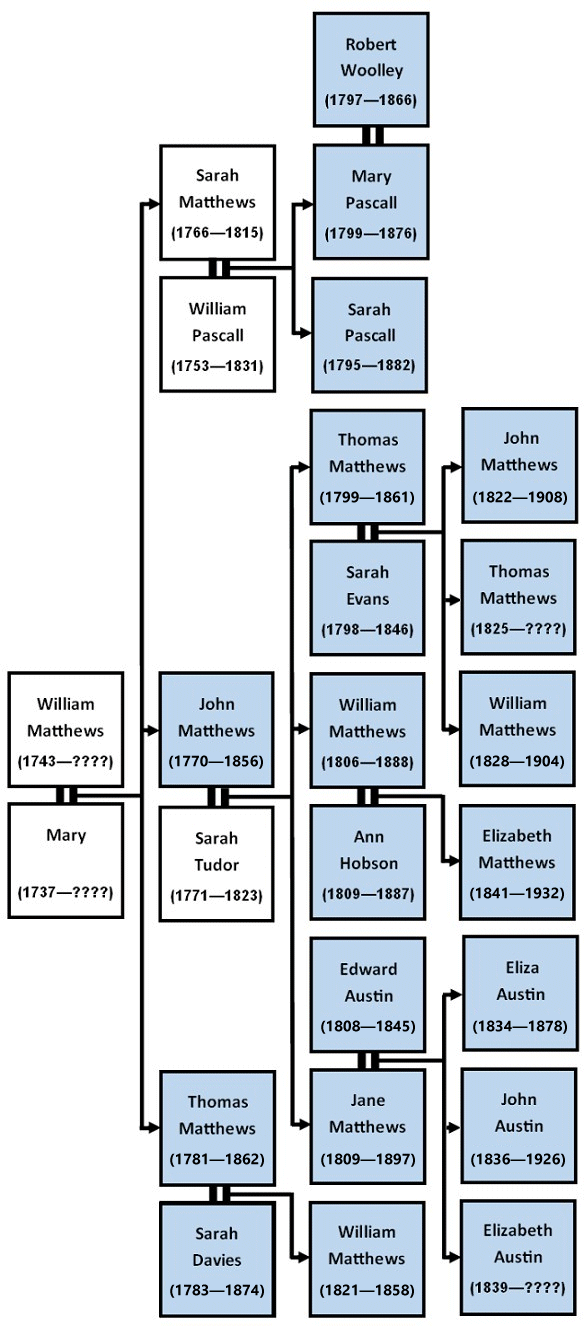
A family tree diagram showing 25 people, all connected by blood and/or marriage, 20 of whom were living in Waters Upton when the 1841 census was taken. Further details are provided in the article.

This family tree chart (like the others illustrating this article) does not include every member of the families shown, just those who were connected to Mary Woolley née Pascall (and to each other) who were residing in Waters Upton parish in 1841 (names in boxes with a blue background) plus the immediate ancestors from whom those relatives were descended. In addition to Mary, her husband and her sister we can see:

  • Mary Woolley’s maternal uncle John Matthews, sharing household 22 with his daughter (Mary’s first cousin) Jane Austin née Matthews, Jane’s husband Edward Austin, and that couple’s children Eliza, John and Elizabeth Austin.
  • John Matthew’s son Thomas Matthews in household 20 with his wife Sarah (née Evans) and their children John, Thomas and William.
  • John Matthew’s son William Matthews in household 16 with his wife Ann (née Hobson) and their infant daughter Elizabeth.
  • Mary Woolley’s maternal uncle Thomas Matthews in household 17 with his wife Sarah (née Davies) and their son William.

The second sub-group of people are connected to Mary Woolley – some quite loosely! – through her husband Robert.

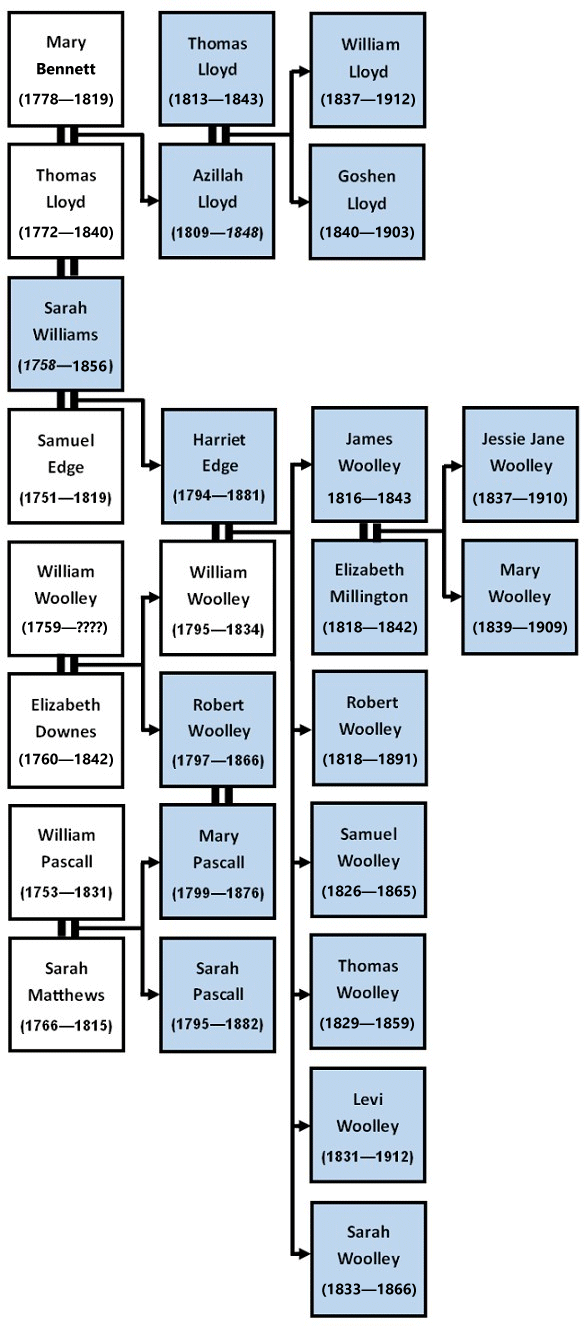
A family tree diagram showing 26 people, all connected by blood and/or marriage, 18 of whom were living in Waters Upton when the 1841 census was taken. Further details are provided in the article.

In this tree we have the following:

  • Mary Woolley’s sister-in-law Harriet Woolley (née Edge), widow of William Woolley, in household 40 with her children Robert, Thomas and Sarah.
  • Harriet Woolley’s 9 year old son Levi in household 11, where he was working for farmer Samuel Allen as a servant.
  • Harriet Woolley’s son Samuel (age 14) in household 13, another farmer’s servant who was employed by Thomas Whitfield.
  • Harriet Woolley’s son James in household 29, with his wife Elizabeth (née Millington) and their children Jessie Jane and Mary.
  • Harriet Woolley’s twice-widowed mother Sarah Lloyd, formerly Edge, née Williams in household 12 with her step-daughter Azillah Lloyd, Zillah’s husband Thomas Lloyd (who may or may not have been related), their children William and Goshen, plus two other Lloyds (Thomas and William, both in their 20s) whose relationship to the others I have yet to determine. Similarly, at this point I don’t know whether, or how, any of these Lloyds were connected to those with that surname in households 4 (Elizabeth, Joseph and Harriet), 23 (Joseph, Elizabeth and William, children of Ann Williams, formerly Lloyd, née Taylor) and 41 (Mary).

In total, that’s 35 people spread across 10 households (11, 12, 13, 16, 17, 20, 21, 22, 29 and 40) who had links to each other.

Family tree charts updated (with birth/death dates found by further research) Feb 2026.


Picture credits: Family tree charts by the author.

On to Part 2