Unknown's avatar

About AtcherleyOrgUK

My primary area of interest is the Atcherley family (my maternal ancestors and cousins). I conduct a One-Name Study of the surname, research the family's genealogy and study the family history of the Atcherleys and their descendants. I also carry out a One-Place Study of the parish of Waters Upton in Shropshire. My One Place Study of Waters Upton in Shropshire came about as a result of a trip to the parish churchyard to photograph the grave of my 3x great grandmother, who was born Mary Atcherley.

A Man Found: Thomas Plant, of the Parish of Waters Upton

⇐ Back to Part 1 (A Man Missing)

It appears that Thomas Plant of Waters Upton originated from Mucklestone, a parish which back then included parts of both Shropshire and Staffordshire. The baptism of “Tho: Plant Son of John Plant & Eliz: his wife” took place on 18 September 1726 ⇗ (making Thomas just under 50 rather than “upwards of” that age at the beginning of 1776). Then, on 4 September 1750 ⇗ and also in Mucklestone, the wedding of “Thomas Plant & Ann Thomas both of this Parish by Banns” took place.
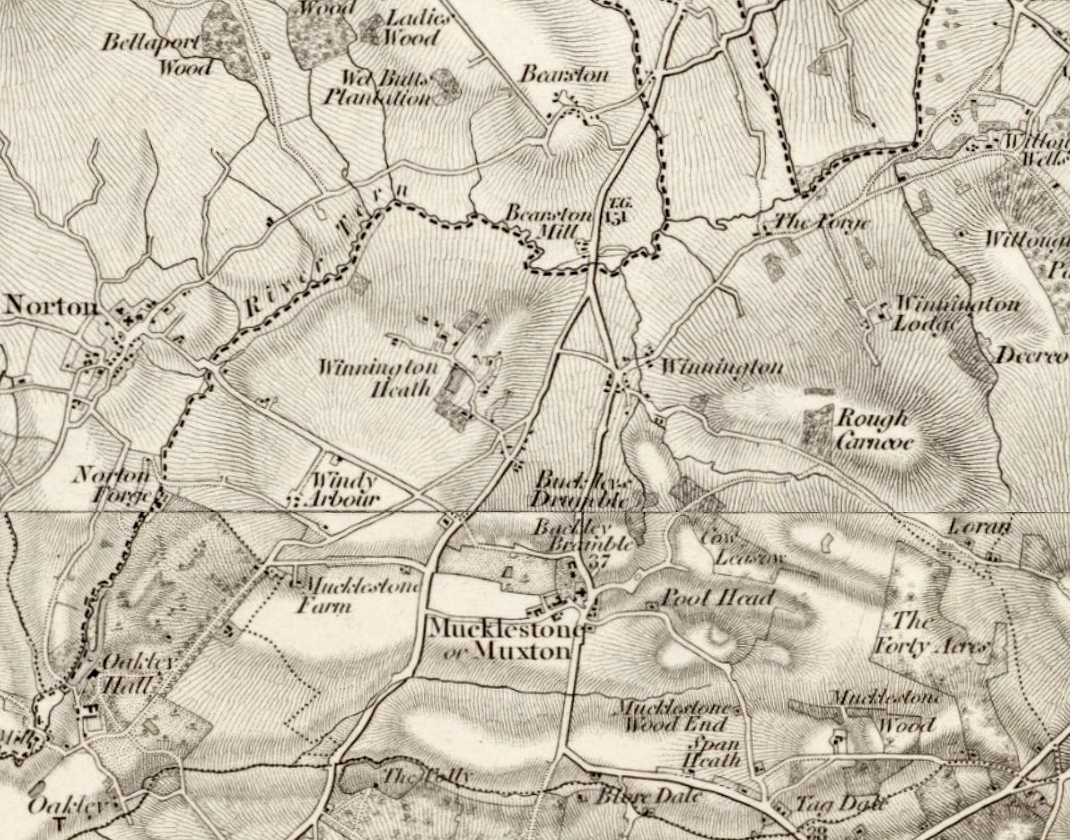
Image created from two map extracts, showing "Mucklestone or Muxton" and nearby settlements and features including Oakley Hall, Winnington, Norton, the River Tern, Bellaport Wood, and Mucklestone Wood.
Mucklestone and nearby settlements, as mapped in the 1800s. Image created from two maps, reproduced with the permission of the National Library of Scotland ⇗ under a Creative Commons licence ⇗.Click on the image to view a larger version.

The Thomas Plant who was baptised in 1726 would have been 23 or maybe 24 years old when the above marriage took place, so I think the chances are good that he was the groom. What, though, are the odds that he was also the Thomas Plant who, with wife Ann, had children at Waters Upton a few years later and, later still, went a-wandering just before the snowfall of the century?

Another question: there was a gap of about five years between the marriage of Thomas Plant and Ann Thomas in 1750, and the first baptism of a child of Thomas and Ann Plant at Waters Upton in 1755 – were there any children born in that gap who might belong to this family?

In my attempt to answer the second question, I turned to Findmypast. This website has excellent collections of digitised and indexed parish registers from both Shropshire and Staffordshire (although oddly, while there are images of the register containing Thomas Plant’s baptism, that register has not been indexed). In addition, they have a very useful way for subscribers to search for vital events from across their record sets. This allows us to look for events falling within a range of distances from a particular place.

“Daughter[s] of Thomas & Ann Plant of Chetwyn Parish”

After using this search functionality I found myself focussing on two of the baptisms it revealed, both falling in the period from 1750 to 1755, and both at Hinstock (about seven miles away from Mucklestone, as the crow flies). First, on 6 Aug 1751 ⇗, there was Mary. Then, on 20 May 1753 ⇗, there was Elizabeth. Each of these girls was described in the parish register as being a “Daughter of Thomas & Ann Plant of Chetwyn Parish”.

For ‘Chetwyn,’ by the way, read Chetwynd: the Plant family had probably, erm, planted themselves somewhere in the north of that parish, such as Sambrook. At that time Hinstock’s church would have been closer than the one in Chetwynd village (Sambrook St Luke ⇗, shown on the map below, was not built until 1856).

Depending on exactly where in the northern part of Chetwynd parish the Plants were living, the distance by road from their abode to Waters Upton might have been somewhere between six and eight miles, or thereabouts. Did the Plant family of Chetwynd travel those roads and become the Plant family of Waters Upton? After researching their children, I believe they did.

Extract from an Ordnance Survey map showing the villages of Hinstock, Sambrook and Pickstock, along with other smaller settlements, roads, the River Meese, and areas of heathland including Ercall Heath and Chetwynd Heath.
Hinstock and parts of the neighbouring parishes of Childs Ercall and Chetwynd, as mapped in the late 1800s. Map reproduced with the permission of the National Library of Scotland ⇗ under a Creative Commons licence ⇗. Click on the image to view a larger version.

My attempts to find out what happened to the Plant children have met with mixed results. The fate of Thomas Plant junior was all too easy to determine. Turn over a leaf of the Waters Upton parish register, from the pages showing his baptism in 1759, and you find the burial of the same “Thomas Plant the Son of Thomas and Ann Plant”. He was laid to rest on 11 August 1761, his second birthday having been his last. As for the sisters of this unfortunate boy, I’ll look at them in order, from the youngest to the eldest.

Margaret Plant was baptised in the month following her brother Thomas’s burial. It appears that she may have married in her home parish – at the age of 42. Banns of marriage between “Thomas Groom of the Parish of Bolas, Bachelor, & Margaret Plant of this Parish, Spinster” were published on three successive Sundays, May 1, 8 and 15, prior to the nuptials at Waters Upton on Monday 16 May 1803.

I have looked for baptism records for any children who may have been born of this union, in case the bride was another, younger Margaret Plant, but have found none.  Neither, sadly, have I found death or burial records that I can link with any certainty to Thomas or Margaret, confirming their ages.

Even more speculative are my conclusions regarding Martha Plant. She may have married Edward Podmore at Chetwynd on 29 December 1781 ⇗. If she did, she might have ended her days in that parish: Martha Podmore of Chetwynd End, age 70, was buried at Chetwynd on 6 December 1824 ⇗.

“Elisabeth, the base-born Daughter of Ann Plant”

For Ann, there is another entry in the Waters Upton parish register besides her baptism which almost certainly relates to her – and to her daughter. On 7 March 1776 “Elisabeth, the base-born Daughter of Ann Plant by Edward Jones of Kidderminster” was baptised.

I am not at all certain what happened to baby Elizabeth, although I hope she survived, thrived, and was supported financially by the man who fathered her out of wedlock. I don’t think Ann married Edward Jones. She may have been the Ann Plant who wed a man whose name has been transcribed as John Esbury, at Stoke Upon Tern on 23 June 1778 ⇗.

Further guesswork is all that I can offer in the case of Ann’s sister Elizabeth Plant. She was possibly the bride of Thomas Talbot, in a marriage solemnised at Church Aston on 28 December 1776 ⇗. She might then have been the widowed Elizabeth Talbot of Chetwynd Heath who was buried 6 April 1783 ⇗ at Chetwynd.

For the firstborn child of Thomas and Ann Plant I believe I can offer greater certainty. Following the publication on 20 and 27 November and 4 December 1774 of Banns between “Thomas Cartledge and Mary Plant both of this Parish”, that couple were married at Waters Upton shortly afterwards on 15 December. Both parties made their marks rather than signing the register. One of the witnesses who likewise made her mark was Ann Plant, who was likely to have been either the mother or the younger sister of the bride.

Mary, you might remember, was one of the two Plant girls baptised at Hinstock. This marriage, I think, confirms her (and her sister Elizabeth) as part of the Plant family of Waters Upton. In which parish Thomas and Mary Cartledge remained after their wedding. Five children, Sarah, Mary, John, Elizabeth and Thomas, were born to this couple, all baptised in the church of St Michael in the latter half of the 1770s and the early 1780s, the surname in each case written as Cartlidge.

“Thos. Plant a Pauper”
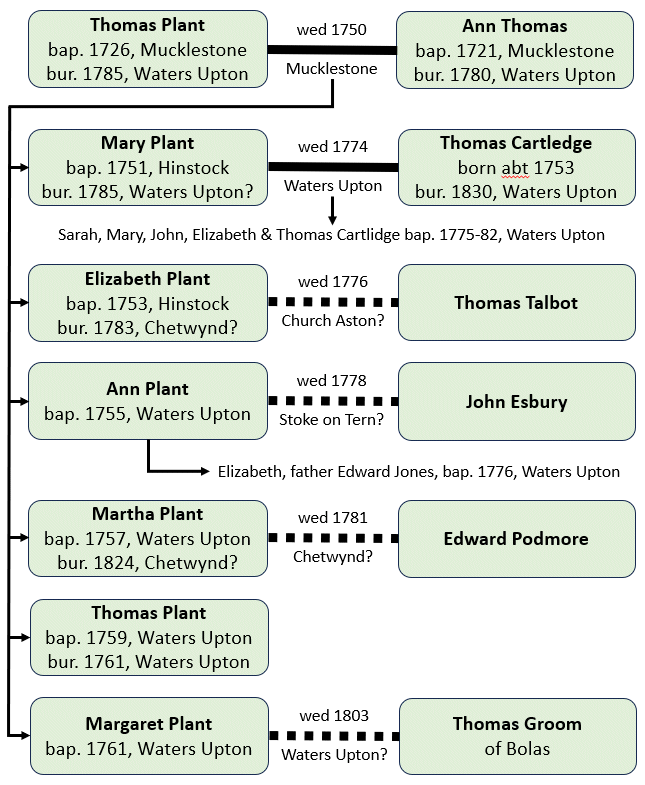
A diagram showing the family of Thomas Plant (1726 - 1785) and Ann Thomas (1721 - 1780), with the marriages and spouses (many speculative) of their children, as described in the text of this blog post.

Let’s return to the parents of these children, Thomas and Ann. There are burials for both of them in the Waters Upton register. “Ann, the Wife of Thomas Plant, aged 62” was interred on 9 May 1780. Despite the slight age discrepancy, I think that makes her “Ann ye daughter of John Thomas of [probably Napley – part of the page is missing] Laborour”, baptised 30 January 1720/21 ⇗ at Muckleton.

Notice that the register entry for Ann’s burial refers to her as the wife, not the widow, of Thomas Plant. Thomas did survive the spectacular snowfall of January 1766, and at some point he did return to Waters Upton. His burial, on 27 December 1785, was entered in the parish register as “Thos. Plant a Pauper, aged”. Possibly the clerk meant that Thomas was aged as in old, but more likely I think is that Thomas’s age was never ascertained and the register entry was left incomplete.

Wait though – Thomas, a farmer in 1776, was a pauper at the time of his death? This is entirely possible. He may have been what we would now call a smallholder, renting and cultivating (and/or grazing livestock on) a  relatively small acreage. And he may have suffered a setback, in the form of crop failure, diseased livestock, or personal ill-health for example, which left him unable to keep the farm and support himself in his later years.

Perhaps Thomas’s trip to Staffordshire (or wherever he actually went!), followed by his failure to return home for a couple of months or more, was the first sign that things were not well with him, with his farm, or with his finances. In which case, a cynic might take the view that Thomas’s ‘afflicted friends’ were actually creditors trying to track down the man who owed them money.

I prefer to believe that Thomas had friends who genuinely cared about him. Friends within his local community who were so concerned by his disappearance in the dreadful winter weather of January 1776, that they were prepared to pay for notices in newspapers in the hope of finding him alive and reuniting him with his family. Thomas Plant, the blue-suited ‘stout made man’ of Waters Upton, may have ended his days financially impoverished, but well off in that priceless commodity known as friendship.
A Man Missing: Thomas Plant, of the Parish of Waters Upton

A Man Missing:
THOMAS PLANT, of the Parish of Waters-Upton, in the County of Salop, Farmer, having left his Family early upon Friday Morning, the 5th of January last, in Order (as he said) to Visit his Friends in Staffordshire for a few Days; and not having been heard since, though diligent Enquiry has been made after him: This is to request the Favor the Public, if they know any Thing of him, to give immediate Notice thereof to the Printer of this Paper, who will take Care to Inform his afflicted Friends. […]
– Shrewsbury Chronicle, 9 Mar 1776, page 3.

Imagine being the “afflicted Friends” – or indeed the family – of Thomas Plant. Off he went one day, saying he was visiting friends in the next county, but two months later he had not returned and no word had been received as to his whereabouts. Concern for Thomas’s wellbeing was heightened by the severe winter weather that followed his departure. The above notice in the Shrewsbury Chronicle continued:

It is feared that, as he went away just before the great fall of Snow, he Perished therein.
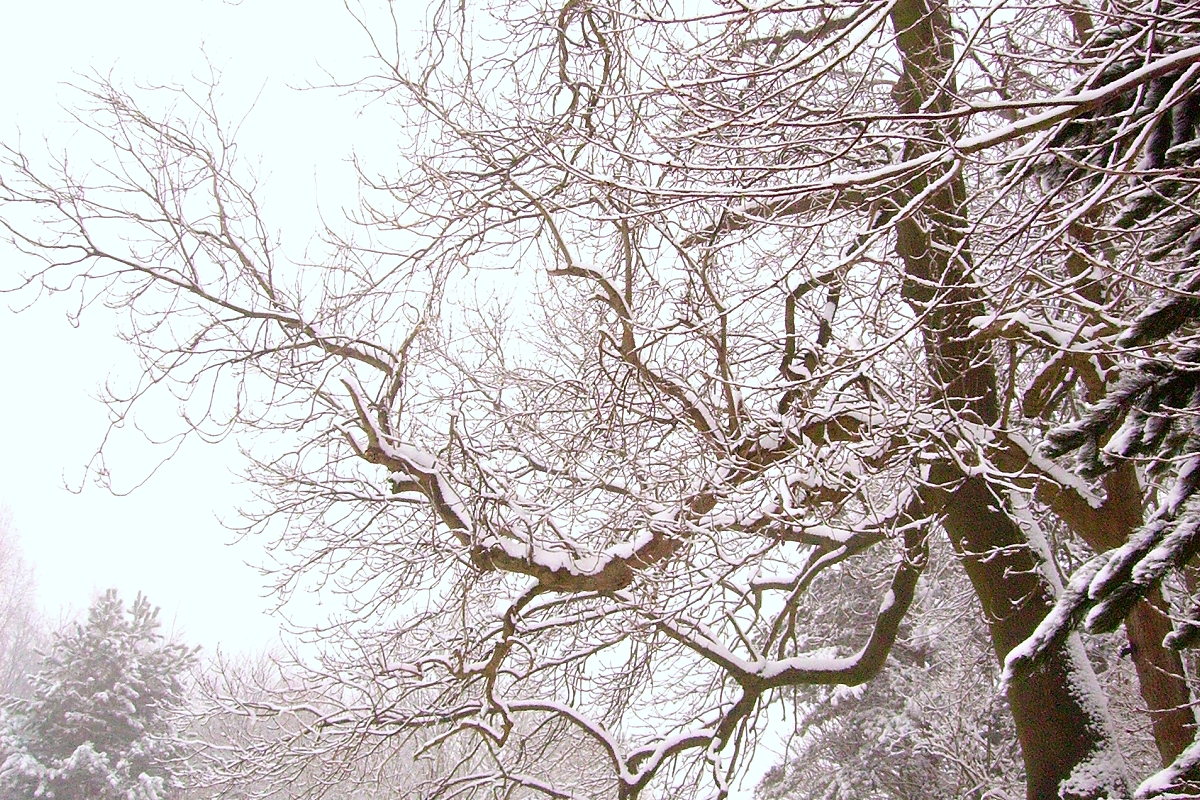
Photo of two Ash trees, with their trunks on the right side of the image and gnarled, twisting branches extending across to the left side. The upper sides of the branches, and the right sides of the trunks, are snow-covered.
Trees with snowy branches. Photo by the author.

“there never was known in this kingdom so deep a snow”

The description of the snowfall, and the fear expressed that it may have proved to be terminal for Thomas, were not exaggerations. Back on Saturday 13 January, the Shrewsbury Chronicle had reported (on page 3) that “the amazing fall of snow on Saturday night and Sunday last” had rendered the roads from Wolverhampton to Birmingham, and from there through Coventry to London, “intirely impassable.” Furthermore, a woman had been found dead in the snow in Worcestershire.

By the following Saturday, more reports of people lost in the snow had been received, and the Chronicle’s editor stated (again on page 3):

From the best accounts we can collect, there never was known in this kingdom so deep a snow as the present. The communications with London and other places, not only by carriages, but even by horses, were entirely shut for several days. The London mails due on Monday and Thursday last week, did not arrive here till Monday morning last.

Difficulties were still being experienced during the ensuing week. Along with snow-related reports from around the country however, the Shrewsbury Chronicle of 27 January also carried (on page 3 once more) news of local acts of charity. In Shrewsbury itself, William Pulteney and John Corbet, esquires, had paid for nearly 40 wagonloads of coal to be distributed among the poor of the town. A similarly generous helping of coal was also given to the poor of Shrawardine and Montford, by Lord Clive. And thanks to Lord Pigot, “a loaf and cheese were given to every person in Bridgnorth that would accept of them”  – that edible offering was accepted by nearly 900 people!

“The Wings of small Birds were so frozen that they fell to the ground”

Another source of information on the severity of the weather in Shropshire at the beginning of 1776 is the parish register of Whittington. In that register the rector, Reverend William Roberts, liked to record far more than just baptisms, weddings and burials. His entries for 1776, which I have transcribed from copies of the original register at Findmypast (another transcript can be found on Mel Lockie’s website ⇗) began:

The New Year is set in with a dreadful fall
of Snow wch began on the 6th at night blown
in drifts by a brisk Easterly Wind, that It lies
in several parts seven feet deep, & has render’d        
it impossible for the Mails to pass […]

After a couple of baptisms, Rev Roberts’ weather observations continued at the end of January and into February:

30th
The Snow continues so deep & the Frost so
severe that the London Mails have not yet
come in regularly. The 21st was remarkable for
intense cold, and the 27th nearly as keen.
Feb: 1st
A drizzling Rain wch. fell partly in Icicles, and
froze as it fell, many accidents happen’d from the
slippery surface of the paths wch. were
perfectly glazed. Travellors Cloaths instead of being
wet, were So stiffly congealed about them, that It
was with difficulty They were got off. The Wings
of small Birds were so frozen that they fell to the
ground, many were pick’d up & others
Feb: 2d
died frozen to the ground. The next day a gentle
Thaw began to discover the face of the earth, wch
had been hid for so long a time.

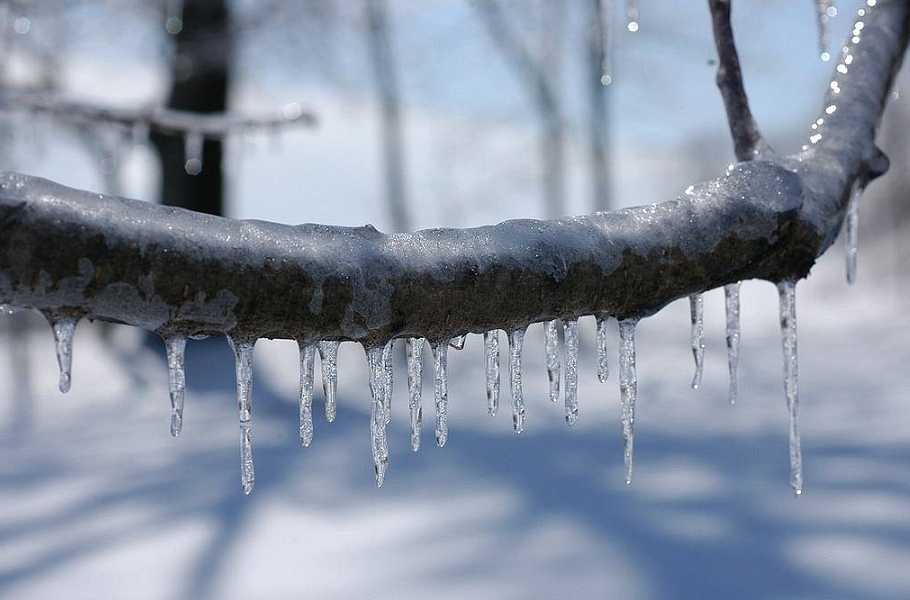
Photo of a tree branch, stretching horizontally from left to right. The top of the branch is covered with ice, and icicles hang along the length of the bottom of the branch. Behind, and out of focus, snow-covered ground can be seen, along with further small trees or shrubs and their shadows.
An ice-covered branch. Public domain image from Pixabay via Picryl.

I think you can now fully appreciate the severity of the weather which descended upon Shropshire and many other parts of England, on the evening of the day after Thomas Plant left his home in Waters Upton in January 1776. Was he lost, or can we find the poor man?

To clarify: I’m not suggesting that we invent time travel and go back to look for our missing man. What I am wondering is, can we find Thomas in the records, and can we determine whether or not he survived, and returned to Waters Upton?

“A stout made Man”

Sadly I’ve found nothing about Thomas in the newspapers following the appeal that was made two months after he set off for Staffordshire. However, that appeal (a version of which also appeared on page 3 of Aris’s Birmingham Gazette on 11 Mar 1776) concluded with information about Thomas, to aid in his identification:

The above-named THOMAS PLANT is a stout made Man; upwards of 50 Years of Age; 5 Feet 9 Inches high; of a dark Complexion, with black Hair turning grey; He had on when he left Home, a Suit of blue Cloaths, with Basket Buttons of the same Colour, and wears his Hat turned up on the Sides, but not close cocked; rather Stoops in his Walk, and has an awkward Gait. Waters-Upton, March 9th, 1776.
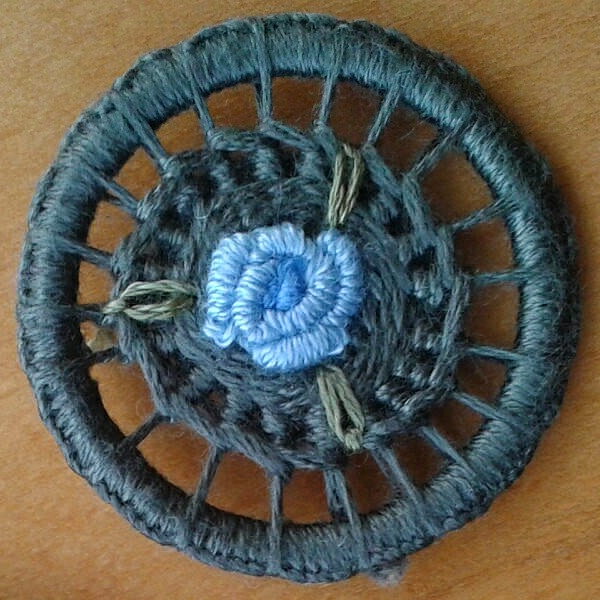
Photo of a Dorset crosswheel button. Created by wrapping dark blue yarn around a ring so that the ring is covered; yarn is also extended from one side of the ring to the other so that there are 20 'spokes'. Yet more yarn is then wrapped around the central area where the spokes met, creating a wide hub of sorts. Within that hub a sky blue-coloured yarn has been used to create what appears to be a rose.
A Dorset crosswheel button. Adapted from a photo by Abigail Seabrook @Moretta Designs and modified, used, and made available for re-use under a Creative Commons licence ⇗.

How fantastic to have this pen-picture of our wanderer from Waters Upton! If, by the way, you are intrigued (as I was) by the ‘Basket Buttons’, they were often known as Dorset buttons ⇗ and were hand-made by “repeatedly binding yarn over a disc or ring former.” Very popular in the 18th century apparently. Not that this helps us in tracking down Thomas!

A more useful piece of information for our purposes is Thomas’s age. It’s a little vague, and might not have been entirely accurate, but it helps to narrow down the field when searching for him in the records. In addition, we know that although he lived in Shropshire, he (supposedly) left home to visit friends in Staffordshire. Might he have had family in that county too?

To the above leads, I can add more from my abstracts of baptisms at Waters Upton. There are four, in the latter half of the 1750s and another in 1761 which are of particular interest. Anne, Thomas, and Margaret, children of Thomas and Ann(e) Plant, were baptised on 18 May 1755, 25 March 1759, and 26 April 1761 respectively. In between the first two of those children, with no parents named but almost certainly another child of Thomas and Ann, there was Martha Plant, baptised on 2 October 1757. I think it is reasonable to conclude that these were children of the man who went walkabout from Waters Upton in 1776.

This information allows a search not only for Thomas Plant’s own baptism, but also for his marriage to Ann. Carrying out such a search, I soon spotted parish register entries which very likely recorded both of these events.

On to Part 2 (A Man Found) ⇒

Finding Folklore in and around Waters Upton

“The history of no people can be said to have been written so long as its superstitions and beliefs in past times have not been studied.” These words were written by Professor John Rhys, M.A., back in 1881 ⇗, and quoted on the title pages of a publication I have been perusing in search of folklore connected with Waters Upton and its neighbouring parishes.

Shropshire Folk-lore: A Sheaf of Gleanings was published in three volumes from 1883 to 1886. The book was based on the collections of Georgina Frederica Jackson, and edited by Charlotte Sophia Burne. Collected within its pages were legends and traditions (concerning giants, devils, fairies, meres and more), followed by a shedload of superstitions, customs and beliefs including ghosts, witchcraft, cures, well worship, wakes and games, and concerning animals, plants, days of the week, and seasons from the new year to Christmastide.

It is lucky to meet a hare…

From Waters Upton itself just one superstition is recorded in this Sheaf of Gleanings, but it concerns one of my favourite animals:

The Hare, like the cat, is associated with witchcraft, and therefore ominous. It is lucky to meet a hare (Waters’ Upton and Cold Hatton, in North Shropshire), but unlucky to see it run across the path.
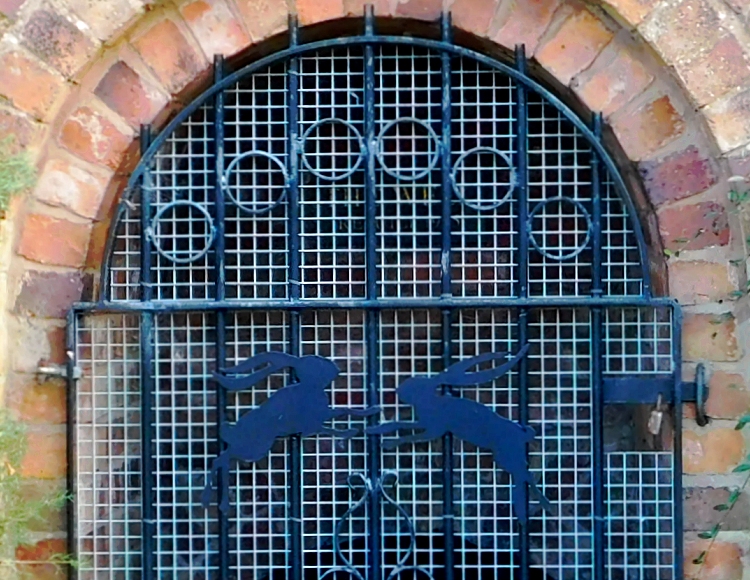
Photo showing part of a brick structure   in which there is an old well. An iron gate, with wire mesh, gives access (but it is padlocked shut). Added to the gate are two black silhouettes of boxing Brown Hares.
The silhouettes of two Hares on the gate to the well at the Western end of Catsbritch Lane, Waters Upton
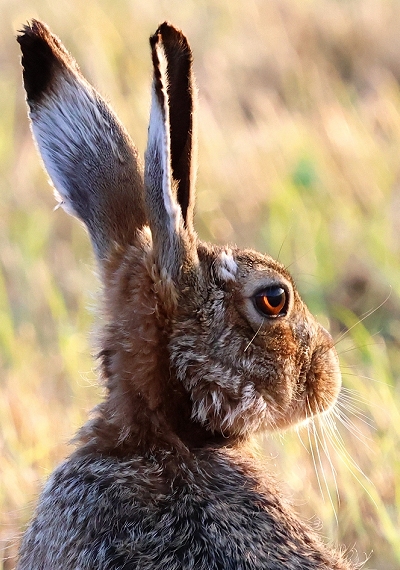
Photo showing the head and shoulders of a Brown Hare, with his or her long ears held erect. The Hare's body is facing away from us, but the head is turned to the right. The fur is mostly a white-grizzled brown, with more white on the ears, which have black tips. The eye is a golden brown colour, with a large black pupil and a thick black rim.

What then of the area around Waters Upton – parishes which some Waters Uptonians would have come from, and which many will have visited or had other connections with? Some of the customs, superstitions and beliefs documented in relation to those parishes may well have been practiced or held by – or at least known to – people over a wider area. And the fame (or infamy) attached to any individual believed to possess ‘special powers’ would certainly not have been confined to that person’s own parish. In this article, I’m going to look at a custom, and an individual, both very likely to have been familiar to Waters Upton residents in the 1800s.

The custom is one related to harvest-time, an important season in any rural parish. Before examining that custom however, I want to share a snippet from Shropshire Folk-lore which shows how the practice of harvesting underwent a revolution in the mid-19th century as a result of mechanisation.

PERHAPS nothing in all the range of country life has undergone a more complete and more recent change than has the ingathering of the harvest since the introduction of reaping-machines some twenty years ago. Even before that time, dissatisfaction with the old slow methods of reaping and ‘badging,’ or ‘swiving,’ was widely felt; and the sickle was already giving place to the ‘broad hook,’ and that to the scythe, when all alike made way for the machine. And the agricultural labourers of the present generation often do not even know the correct names, much less the uses, of the time-honoured tools with which their fathers toiled so patiently day after day from dawn to dark.

Crying the mare

On then to “Crying, calling, or shouting the mare, […] a ceremony performed by the men of that farm which is the first in any parish or district to finish the harvest.” Miss Burne goes on to tell us (having noted in the preface to her book that “no true Salopian ever sounds the letter h”) that:

The object of it is to make known their own prowess, and to taunt the laggards by a pretended offer of the ‘owd mar’ to help out their ‘chem’ [team]. All the men assemble in the stackyard, or—better—on the highest ground on the farm, and there shout the following dialogue, preceding it by a grand “Hip, hip, hip, hurrah!”
“I ‘ave ‘er, I ‘ave ‘er, I ‘ave ‘er!”
“Whad ‘ast thee, whad ‘ast thee, whad ‘ast thee?”
“A mar’! a mar’! a mar’!”
“Whose is ‘er, whose is ‘er, whose is ‘er?”
“Maister A.’s, Maister A.’s, Maister A.’s!” (naming the farmer whose harvest is finished).
“W’eer sha’t the’ send ‘er? w’eer sha’t the’ send ‘er? w’eer sha’t the’ send ‘er?”
“To Maister B.’s, to Maister B.’s, to Maister B.’s” (naming one whose harvest is not finished).
“’Uth a hip, hip, hip, hurrah!” (in chorus). […]
[S]ometimes the mocking offer of the mare was responded to by a mocking acceptance of her help, as when an old man told Mr. Hartshorne, “while we wun at supper, a mon cumm’d wi’ a autar [halter] to fatch her away.” There were of course variations in the details of the braggadocio in different places, but it was universally practised, and though dying out, is by no means extinct. Mr. Gill dates its disuse at Hodnet about 1850-60 […].
In 1868 the unusually early harvest of that hot summer incited a party of men at Edgmond, whose employer had finished on the 31st of July, to celebrate the event by crying the mare. “Wheer shan we send ‘er?” asked one party.” T’owd Johnny Bleakmur,” came the reply. Any unusual excitement or rivalry would naturally revive the old custom in this way, even when it had been disused as a general thing. […]

Tommy the conjuror

From Crying the Mare and ‘owd Johnny Bleakmur (John Blakemore of Edgmond, I believe), to ‘owd (old) Thomas Light of Walton in Ercall Magna parish. He would certainly have been a character familiar to people living in nearby Waters Upton – and was very likely related to some of them. The following, contributed to Shropshire Notes and Queries of 13 February 1885 by a correspondent identified only as ‘A’, was included in Shropshire Folk-lore under Conjurors:

Between sixty and seventy years ago a man named Thomas Light had a high local reputation as a conjuror, fortune-teller, and “wise man.” He lived in the half-timbered cottage nearly opposite Mr. Webster’s house in the village of Walton (near High Ercall), and I have heard an old inhabitant of Walton say that he had seen as many as six vehicles driven up to the cottage in a morning. This conjurer carried on a roaring trade for many years, and people sought his advice and assistance from places as remote as the Cheshire and Staffordshire borders, and even out of Wales.
Cock-fighters brought him their birds to charm, and paid him for putting spells upon their opponents’ feathered representatives; farmers sought his power to remove cattle disease; wives and maidens came to him for their fortunes to be told, and the losers of stolen goods made him their detective. There were two “reception” rooms in the cottage, into one of which Light always retired to consult the stars or hold intercourse with his familiar spirits. Sometimes he could be heard by his customers wrestling with some supernatural presence, and the rattling of chains of course suggested that the conjurer was wrestling with the Evil One himself. […]
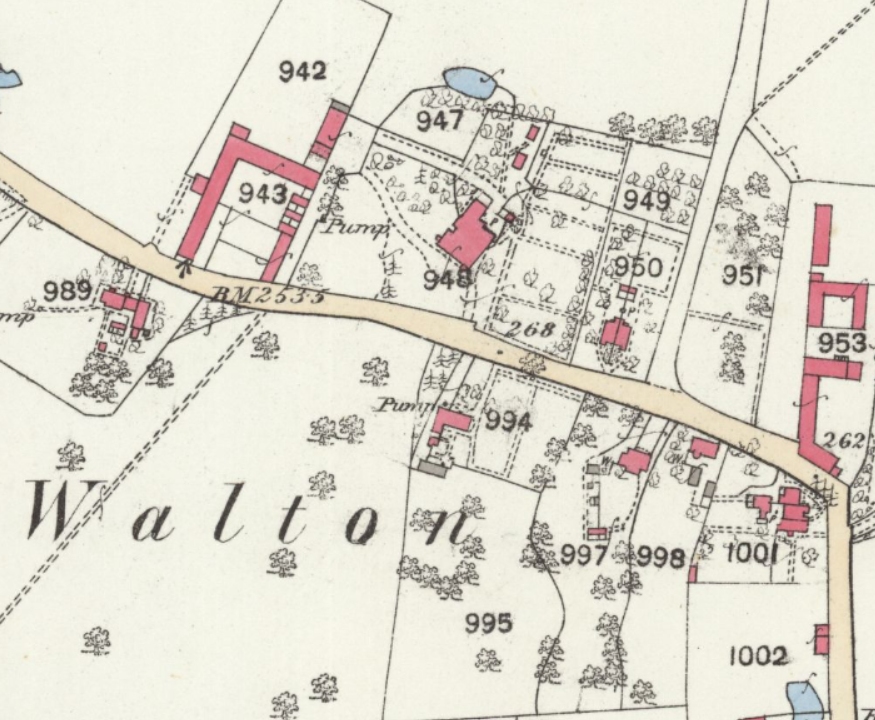
Extract from a large-scale Ordnance Survey map showing some of the houses and other buildings (all shaded in pink) of Walton village. The road running through the village is also shown, along with field and garden boundaries, three ponds, and many trees along field boundaries, in some of the gardens, and in some of the fields.
Extract from an Ordnance Survey map (25 inches to the mile, Shropshire XXIX.10) published 1881, reproduced with the permission of the National Library of Scotland ⇗ under a Creative Commons licence ⇗. This does not show things exactly as they were when the tithe apportionment map for Ercall Magna parish was drawn up in 1838, but that earlier map tells us that John Webster lived at the property in parcel number 943 here, while Thomas Light (who “lived in the half-timbered cottage nearly opposite”) occupied the house in parcel 994.

Thomas’ obituary, published in the Shrewsbury Chronicle of Friday September 10th, 1841 (page 3), very much suggests that he put the ‘con’ into ‘conjuror’! It makes for an entertaining read, and I reproduce it here as published, save for splitting the text into more than the original two paragraphs:

Death of an Eccentric Character.—On Sunday last, at Walton, near High Ercall, at the age of 94, Thomas Light, better known by the sobriquet of “Tommy Light the Conjuror.” This eccentric individual had from an early period of his life been a professor of the “Mysterious Art of Conjuring,” which he continued to practice with considerable pecuniary advantage to the close of his days.
His personal appearance was of no common order, as he always strictly adhered to the peculiar character of dress in fashion about the middle of the last century: a stranger on meeting “Old Tommy” was instantly struck with the excessive originality of his manner and costume; clad in a light sky blue “coat of other days” with an extravagantly lengthened linsey vest with large flaps descending over scanty “continuations.”
This antiquated oracle usually attended the markets to render his prophetic advice and assistance to all whom he could find possessed of the two great requisites for the successful development of his mystic craft, viz. Faith and Money; and it speaks but little for the intellectuality of the age, when it is considered what numbers of persons were sufficiently ignorant and superstitious to consult him, in all the various matters which have generally been subjects for the divinations and prophecies of this now (thanks be to the schoolmaster) almost extinct race of conjurers and fortune-tellers. His professional career was not merely confined to his own locality, but he was frequently applied to by the credulous rustics of the neighbouring counties.
His conjuring propensities were at one time the means of giving him rather an awkward introduction to the magisterial bench at Wellington; a lad at Ketley having robbed his employer both parties secretly applied to the sage, the one for the means of safety from detection, the other to have the property returned and the offender punished. Having instructed the lad to replace part of the stolen treasure, he informed the other that part of the missing property would be by his powers replaced.
The trick however having been detected by the parties, and it being suspected that he had received a large fee out of the missing cash, “Tommy” was pulled up before the magistrates and was committed to take his trial at the sessions, but was afterwards bailed out by a relative, to whom it is said he took a hundred sovereigns as security; he was however finally acquitted, but this had evidently the effect of making him more cautious in his future proceedings.
Among the many eccentric incidents of his life was that of purchasing a wife, who afterwards resided with him until death dissolved the unhallowed bargain. From this time her daughter by a legitimate husband superintended his domestic affairs, until at an advanced age she was accidentally burned to death.
Some time before his death, he gave several considerable sums of money, and has since willed further sums to different parties; a few days ago, several sovereigns and guineas were found among some old iron in a chest, in his dwelling, and many are of the conjectures that a horde yet remains to be discovered on the premises he occupied, which consisted of a cottage, orchard and garden, the property of the Duke of Cleveland.
“Old Tommy” was the oldest tenant on his Grace’s Ercall Estates. This extraordinary character possessed considerable originality of mind, and an exceedingly retentive memory, and remained in full possession of his mental faculties until the period of his death.

Searching the records for ‘Young Tommy’ (as I find myself thinking of the boy who grew up to become Tommy the Conjuror) I found that “Tho Son of Tho Light of Walton was baptized September ye twenty third” in 1748 at High Ercall. Depending on how soon after his birth he was baptised, Thomas would have been 92 or 93 years old when he died, not 94 as reported in the press. 92 was the age entered in the High Ercall burial register when Thomas was buried on 8 September 1841.

Just three months before his demise, Thomas was enumerated at Walton on the 1841 census. His age was recorded as 90 (rounded down to the nearest five years as was generally the case for adults on that year’s census) and he was of independent means (a status recorded as “Ind”). Living with him was a female servant, Jane Dabbs, age 55. His near neighbour Mr John Webster, mentioned above, was a 70-tear-old farmer. All were said to be natives of Shropshire.

Did any residents of Waters Upton avail themselves of Old Tommy’s mystical (or more likely, mythical) ‘services’ during his long life? I don’t think we will ever know for certain. At the very least, I’m sure he was the subject of many a conversation in the village’s hostelries, during his lifetime and for many years after!

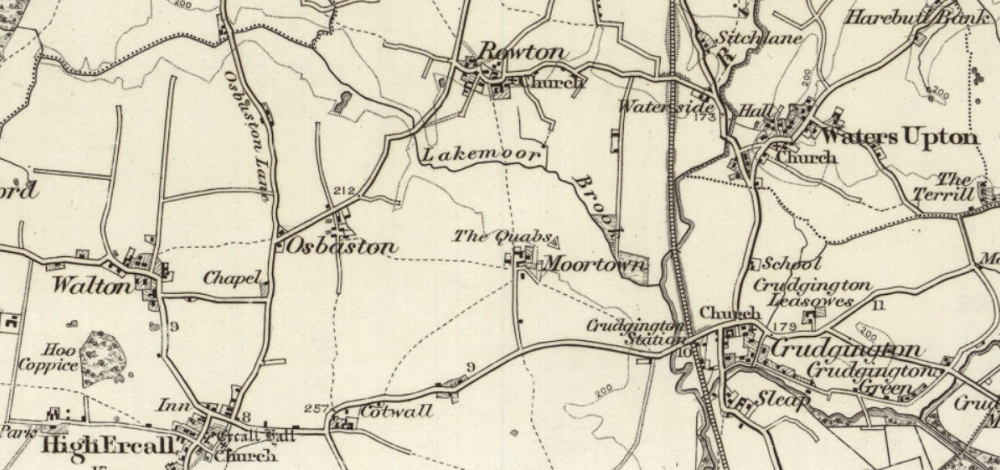
Extract from an old Ordnance Survey map showing the settlements of (from West to East) Walton, High Ercall, Osbaston, Rowton, Moortown, Sleap, Crudgington, and Waters Upton.
Extract from an Ordnance Survey map (1 inch to the mile, Sheet 138 – Wem) published 1889, showing Walton to the West and Waters Upton to the East. Reproduced with the permission of the National Library of Scotland ⇗ under a Creative Commons licence ⇗.

Waters Upton 1921: a post-war parish (part 2)

⇐ Back to Part 1

Edgar Percy Davies now retraced his steps back along the village road, heading towards and then beyond the church. Soon he was passing the White House, his destination being the next house along.


Number 11 was occupied by newcomers to the village, the Rowberry family. Thomas Henry Rowberry may well have served during the war – there are two sets of medal award records (one from the Machine Gun Corps and one from King’s Royal Rifle Corps), either of which might be his, but no pension index/ledger cards or surviving service record to confirm this.


Beyond number 11 lay the semi-detached residences numbers 10 and 9, headed respectively by (post-war incomers?) Joseph Ralphs and his son Frank Ralphs. I am not aware of any wartime military service being undertaken by members of this family, but it would not surprise me if Frank or one (or more) of his brothers had served.


Why did the enumerator cross the road? To collect the household schedules on the other side. Number 31 (Clematis Cottage) was the home of Arthur Ball and his sister Elizabeth Emma, neither of whom had connections with military service that I know of. The same cannot be said of the next house however.


Photo showing two names on a brass memorial plaque listing men of Waters Upton parish who died while serving in the Great War: Private W. James, K. Liverpool Regt., Private J. H. Jones, Royal Welsh Fusiliers.

At number 32 lived widower Charles George, along with two of his daughters, both war widows, and their children. Jane’s husband William James, a native of Waters Upton, I have already mentioned (his mother lived at number 23 Waters Upton). Kate’s husband John Herbert Jones was a Liverpudlian, who was killed in action while fighting with the Royal Welsh Fusiliers in France. A few years after this census was taken Jane and Kate would both emigrate, with their children, to start new lives New Zealand.


On went enumerator Davies to numbers 33 (William and Matthews) and 34 (William Edward Morgan and family), and then, after crossing road, to number 8. The occupant of this house, Alfred Ridgway, I have already mentioned (his first cousin Charles, the blacksmith, lived at number 15). Alfred, a carpenter and wheelwright, had two sons who, despite having no medals to show for it, had ‘done their bit’ during the war: William George Ridgway (Devonshire Regiment and Labour Corps) and Alfred John Ridgway (Royal Garrison Artillery).


Back across the road to Malt House Farm and, just to the North of that, Lower House Farm, both occupied by (unrelated, as far as I know) Powell families. These farming families had no wartime military connections that I know of, but one of the servants at Lower House Farm did: Thomas Hall (who would marry his employer’s sister in 1922) served with the Royal Army Veterinary Corps. His brother, Pryce Hall, also played his part in the Great War. Having emigrated to Australia in 1912, Pryce served with the Australian Imperial Force from 1915.


On leaving Lower House Edgar Davies continued along the road, which now left the village of Waters Upton, and headed towards Harebutt Bank. He called next on number 39, which was occupied by the Cartwright family. John, the head of the household, had no military record but his younger brother James did. James Cartwright enlisted with the Monmouth Regiment, then transferred to the South Wales Borderers after entering France with the British Expeditionary Force. He was discharged after receiving a gunshot wound to the left thigh in 1917, and died in 1919.

Photo of a Poppy flower, with large, scarlet petals and dark centre.
Poppy. Public domain (CC0) image by Travel Photographer, from negativespace.co

Edgar had already visited one home where relatives of John Evans lived (number 25), and now he called on another, number 40, where John’s uncle and aunt Samuel and Martha Evans lived. After that, he went to Harebutts Farm (number 38), home of the Casewell family. The Casewells’ servant, agricultural worker Alan Furnivall, had joined the Royal Flying Corps in 1917 and transferred to the RAF on its formation in 1918. Alan worked on aircraft rather than flying them, and he was discharged in 1920 with a record featuring a long list of civil convictions and prison sentences.


As he began to head back towards the Waters Upton village, Edgar the enumerator collected a final schedule from a Harebutt Bank household (The Harebutts, number 37, home of John Stanley Morgan and family). Then he continued along the road, past Lower House Farm, and turned left onto Catsbritch Lane.


On the right as he entered the lane was a dwelling divided into three, numbers 7, 6 and 5. These households were occupied by Elizabeth Matthews (at number 7), Frank and Annie Battman (at number 6), and William Beech with his wife Elizabeth and son Thomas (at number 5). Thomas Beech had been a Private with the Shropshire Yeomanry and then a Driver with Royal Field Artillery during the Great War, while his brother Henry Eddowes Beech (now living elsewhere) had emulated the latter part of his service.


Just a little further along Catsbritch Lane and on the same side of the road was a terrace of four houses where Waters Upton’s street numbers began: number 4 (Charles James and family), number 3 (Ernest Edward Austin and family), number 2 (Joshua Cartwright and family), and number 1 (Thomas Bennett and family). All but one of these (number 3) houses had connections with military service in the Great War. Of those three, two have already been mentioned: Charles James at number 4 (a brother of Thomas James at number 23, of John James and the late Williams James, and a brother-in-law of William’s widow Jane James at number 32), and Thomas Bennett at number 1 (a brother of Alfred, George and Charles Edward Bennett at number 17).

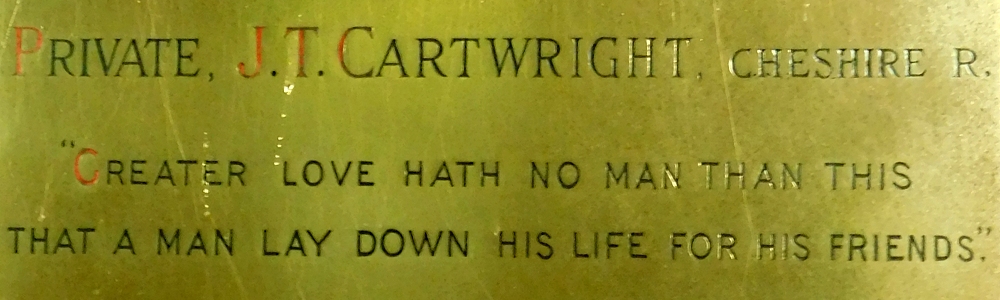
That leaves number 2 Waters Upton, the last household Edgar Davies would visit in which a family member had been lost during the war: Joshua and Priscilla Cartwright’s son John Thomas Cartwright was killed in action while fighting with the Cheshire Regiment during the Second Battle of the Somme on 27 March 1918.

Photo showing the last name on a brass memorial plaque listing men of Waters Upton parish who died while serving in the Great War: Private J. T. Cartwright, Cheshire R. Beneath that name is inscribed: "Greater love hath no man than this, that a man lay down his life for his friends."

A little further along Catsbritch Lane, and set back from it on the other side, was The Grange Farm (number 41?). The head of this household was Ferdinand Heyne, a naturalised British Subject born in Germany. Ferdinand was a pork butcher in Shrewsbury from at least 1901 until 1913 (when he listed in that year’s Kelly’s Directory) and possibly a little later, but not in 1917. Had anti-German sentiment during the war pushed him out of the town and into the countryside?


The next house at which Edgar Davies stopped to collect a census schedule was number 48. I must admit that I’m not entirely clear about the numbering along Catsbritch Lane, but I suspect that number 48 was the cottage now known as Manor Lodge, which sits beside one of the entrances to Waters Upton Manor (which might be number 49). It was occupied by James Evans, his wife, and their children, one of whom was John Evans. John had enlisted with the RAF in July 1918, just 11 days after his 18th birthday and a little over three months before the war ended.


At the Manor itself – not that it was named (or numbered) on the schedule – was Arthur Lea Juckes. Arthur had a little military service to his name, in the form of a brief spell as a Lieutenant with the Surma Valley Light Horse in India, but that was in 1898. During the Great War he took on another role, chairing military tribunals at Wellington – and ruthlessly enforcing the rules under which men could be conscripted.


As he got closer to The Terrill, the end of our enumerator’s tour of Waters Upton was nearly over. He visited number 42 (farmer Richard Allen and his housekeeper – was this Melverley House or Linden Lea?) and then number 44 (Thomas Edward Harris and family; I’m guessing that number 43 – Grange Cottage? – was unoccupied).


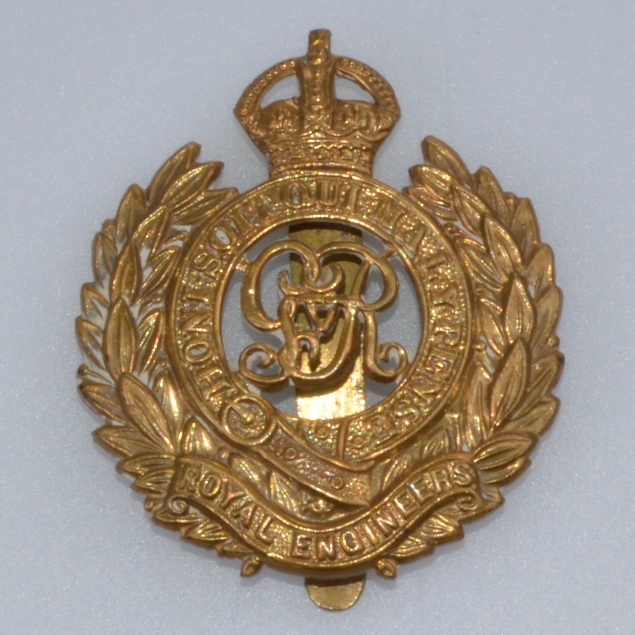
Photo of a Royal Engineers cap badge. It is bronze in colour. In the centre are the ornate initials G. R. (the King), surrounded by a belt with a barely legible inscription. Above that is a crown. A wreath extends from the bottom (where a banner bears the words Royal Engineers) and up both sides.
Royal Engineers cap badge. Public domain image from getarchive.net

Edgar Davies’ penultimate house call was to number 45, The Terrill Farm, occupied by septuagenarian farmer William Woolley, his wife Emma, two of their daughters, and three visiting relatives. Four of William’s sons had participated in the Great War: George Woolley (Yorkshire Regiment and Labour Corps), Robert Woolley (Canadian Royal Engineers), Frederick Woolley (Royal Engineers), and William Woolley (Royal Field Artillery).


Finally came number 46, a cottage just North of the Terrill Farm (number 47, a little further to the North, was most likely unoccupied). This was the home of widow Sarah Cartwright and two of her grandsons, one of whom was Geoffrey Henry Cartwright. It appears that Geoffrey first enlisted with the Black Watch (possibly before the war), then fought with the Worcester Regiment (when he was wounded at Gallipoli), and went on to serve with the Oxfordshire and Buckinghamshire Regiment and finally, post-war, with the King’s Shropshire Light Infantry (Territorial Army). He was the third resident of Waters Upton parish to declare himself as being out of work – all three were former servicemen.


Life went on in Waters Upton after the First World War, as it did elsewhere, but without those who paid the ultimate price to help deliver victory over the Central Powers, and with many who came home bearing physical injuries, mental scars, memories of battle which would never fade. Directly and indirectly, the lives of many of Waters Upton’s inhabitants were forever changed. More than a century later, we remember those who died, those who returned, and the families and communities they belonged to.


Picture credits: All photos by the author except where otherwise credited.

Waters Upton 1921: a post-war parish (part 1)

Taken two and a half years after the end of the Great War, the census of 1921 provides a picture of what life was like in that conflict’s aftermath. In this look at the parish of Waters Upton at the point when that census was taken, my main focus is on the households which were impacted by military service.

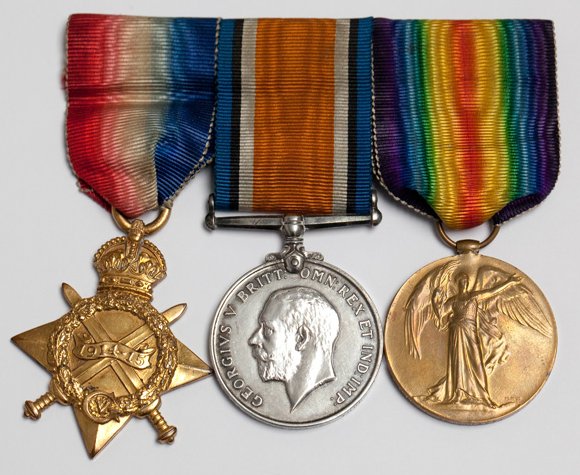
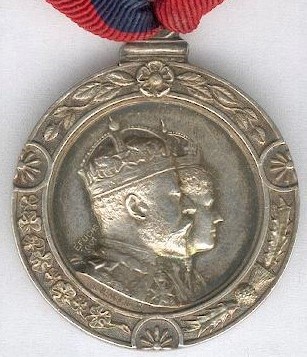
Photo of the three most commonly awarded medals of the First World War. From left to right: A 1914-15 Star (a four-pointed star of bright bronze, with crossed swords, surmounted with a crown; the ribbon has bands of red, white, and finally blue)); a British War Medal (a silver disc bearing an effigy of the head of King George V; the ribbon has a wide central orange band, on each side of which are narrow bands of white, then black, and finally blue); a UK Victory medal (a bronze disc, with the winged, full-length, full-front, figure of 'Victory,' or 'Victoria'; the ribbon has a central stripe of red, on each side of which are further stripes of yellow, then green, then blue, and finally purple).
Pip, Squeak and Wilfred. Photo credit: Europeana 1914-1918 project photo, taken from Wikimedia Commons ⇗ and adapted, used, and made available for reuse under a Creative Commons licence ⇗.

47 households in the parish of Waters Upton returned census schedules to the enumerator on the morning of Monday, 20 June 1921. In 15 of those households (a fraction under 32%) there were one or more occupants who had served with the armed forces during the Great War. Three of those households also had one or more occupants with immediate family members, by then dead or living elsewhere, who had served.

In another 13 (or 27.7%) of Waters Upton’s households which did not fall into the above category, there were one or more occupants with immediate family members (husband / son / father), by then dead or living elsewhere, who had served.

Taking these two categories together, at least 59.6% of Waters Upton’s households (28 out of 47) had occupants with direct or close connections to wartime military service – including five with immediate family members (seven men in total) who were killed during the war or died shortly afterwards. “At least”? Well, there was one more household which included someone who I suspect was an ex-serviceman. There may also have been others amongst those who came to village after the war. And it is quite possible that other households included occupants with immediate family members whose service I am not aware of. Further information boosting the total (and percentage) above may yet come my way.

Of the remaining 19 Waters Upton households, three had one or more occupants with more distant family members who served: a nephew, a first cousin, and a first cousin once removed. Another had an occupant who contributed to the war through involvement in military recruitment.

Enough of the numbers. Let’s meet the people and the families of Waters Upton whose lives were never quite the same after the first world war – and let’s do that by following the enumerator for the parish, Edgar Percy Davies, as he visited the homes of Waters Upton and collected the householders’ census schedules. This will provide us with brief introductions to the families of the parish in 1921, and to most of those individuals from the parish who served during the war. I hope to expand upon these introductions in future posts.


Edgar first called on the pubs and houses situated alongside the Wellington to Market Drayton road, starting with the southernmost, the Lion Inn (number 16 Waters Upton). Here, Lucy Price is our person of interest. She had two sons by her first husband, both born at Waters Upton, who had served during the war: Henry Wylde (King’s Liverpool Regiment and Labour Corps) and Albert Wylde (Royal Navy).


Next was number 23, home of widow Anne James and her adult children Thomas and Lizzie. Three of Anne’s sons had enlisted: John James (Royal Field Artillery), William James (The King’s Liverpool Regiment), and the aforementioned Thomas James (Shropshire Yeomanry). Sadly, William died on 17 November 1917 from wounds received while serving in France. Edgar Davies would later call at William’s former home, number 32, where his widow and sister-in-law were living; he would also visit the home of another James brother, Charles, at number 4.


Heading briefly up the main road running through the village took Edgar to number 22, another household with an ex-serviceman: John Picken was a Sapper with the Royal Engineers during the Great War.


Returning to the Wellington to Market Drayton road and crossing it took our enumerator to number 17, a house occupied by three former soldiers. Alfred Bennett had served with the King’s Shropshire Light Infantry, while his brothers George Bennett and Charles Edward Bennett had both been members of the Royal Army Service Corps. Edgar would later visit their brother Thomas Bennett (who had not served) at number 1 Waters Upton.

Photo showing three names on a brass plaque commemorating men from Waters Upton who served in and survived the Great War: Private Charles E. Bennett, R.A.S.C. M.T; Private William Bennett, R.A.S.C. M.T; Private Alfred Bennett, 8th K.S.L.I.

Back across the road to the Austin family at number 21 and then to number 24 next door, the abode of former Private (with the Oxfordshire and Buckinghamshire Light Infantry) Thomas Cartwright.


Next was number 20, also known as Sutherland Cottage. This was the home of Samuel and Mary Anne Woolley, two of their sons, and their only surviving daughter. Three sons were no longer at home, two of whom had been military men during the war: Robert Ernest Woolley was demobbed at a Sergeant in the Middlesex Regiment; Hubert Victor Woolley was still with Military Foot Police (and was enumerated at Cologne in Germany with the British Army of the Rhine).


After one final trip across the Wellington to Market Drayton road (to the Beeches, number 18) and back, Edgar Davies visited the last house in this part of Waters Upton village, the Swan Inn (number 19). Minnie Harper Owen was the innkeeper here, with her sister Emma Louisa Pierce providing domestic help. Emma was a widow, but not (as far as I can tell) a war widow. The sisters did have a connection to military service in the recent war however: their brother Charles Gordon Owen had been a Sergeant in the Royal Horse Artillery.

After he left the Swan, enumerator Davies headed up River Lane to the main road through the village, where he turned left and arrived at the Rectory (number 27). William Astbury Meakin, the rector, had not taken part in the war but his son, the Rev George Astbury Meakin, had briefly served with the Royal Army Medical Corps.


The next port of call was The Hall (number 28), home of Ernest James Fisk, who had ended the Great War as a Major in the Royal Field Artillery.


Photo showing two names on a brass plaque commemorating men from Waters Upton who died while serving in the Great War: Lieut. G. H. Davies, 3rd K. Shropshire L. I; 2nd Lieut. W. L. Davies, 7th K. Shrops. L. I.

Crossing the road and walking past the parish church took Edgar Davies to the White House (number 12). Of all the households in Waters Upton, I think it is fair to say that this one had contributed most to the war. This was the home of Susan Anslow Davies, widow of rector John Bayley Davies. Five of this couple’s sons had gone to war: Arthur John Davies (Royal Navy), Walter Llewelyn Davies (King’s Shropshire Light Infantry), Reginald Wynyard Davies (Royal Army Medical Corps), George Herbert Davies (King’s Shropshire Light Infantry), and Andrew Taylor Davies (Gurkha Rifles).

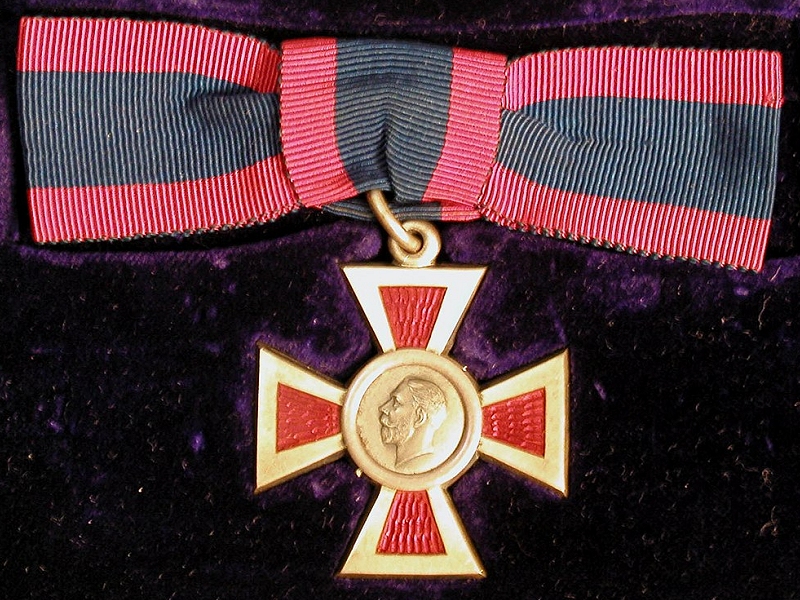
Two of the Davies brothers did not come home. George Herbert Davies was killed in action at Hooge on 9 (some sources say 10) August 1915; Walter Llewelyn Davies died of his wounds at the Somme on 15 July 1916. Annie May Davies, living at home with her mother, had served during the war too – she was awarded the Royal Red Cross Second Class in 1918 “in recognition of [her] valuable services with the British Forces in Mesopotamia” with Queen Alexandra’s Imperial Military Nursing Service Reserve.

Photo of a badge of the Royal Red Cross, Second Class. The badge is in the shape of a golden cross, with a circular medallion at its centre, bearing an effigy of the King's head. The ribbon, in the form of a bow, is dark blue (that colour appears black in this image) with crimson edge stripes.
Royal Red Cross Second Class. Image credit Auckland Museum, licence CC BY.

Crossing the road again took our enumerator to an abode which was not numbered on the schedule; it appears to have been in the vicinity of The Hall and might have been what is now either 29a or Groom’s Cottage. Another Woolley family lived here: John, Fanny, and their son George Woolley, a “Discharged Soldier” who had been working for Lady Mary Herbert but was now out of work. During the war George had been a Gunner with the Royal Field Artillery. His brother Thomas Woolley had served too, with the Army Service Corps; in 1915 he gave his father John’s address as “Oldhall Cottages” in Waters Upton.


The next residence visited was number 29, where Joseph Shakeshaft had one of the more distant connections with wartime military service: his first cousin Joseph Baxter Shakeshaft, born at Waters Upton in 1885, had toiled with the Labour Corps.


The Crescent (Crescent House, number 30) was Edgar’s next stop. Frederick Walter Godfrey Starling was probably a post-war resident of Waters Upton; he brought with him memories of being a Private with the Army Service Corps.


After he left The Crescent, enumerator Davies doubled back to visit the houses in the vicinity of the smithy – he could have saved himself some legwork by turning right when he entered the main street from River Lane. The village blacksmith was the first person called upon on this little detour: Charles John Ridgway lived at number 15, next to his workplace. Charles was another resident whose connections with those who had served during the war was more distant. That connection was with two of his first cousins once removed. They were sons of Charles’ first cousin Alfred Ridgway at number 8 Waters Upton, so I will mention them later.


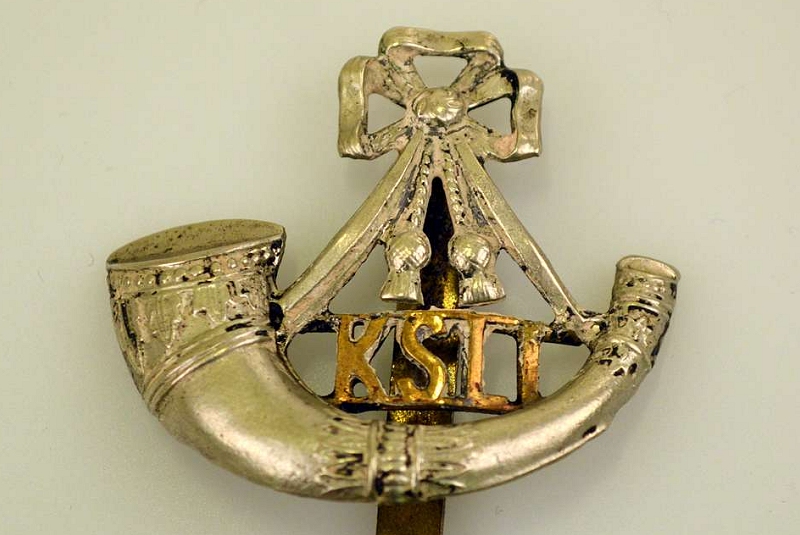
Photo of a King’s Shropshire Light Infantry cap badge (or, as my caption for the image original said, cap badger. The Imperial war Museum describes this as a "Bi-metal badge in the form of a stringed bugle-horn (in white metal) within the cords of which are, the brass letters 'KSLI' on bars."
King’s Shropshire Light Infantry cap badge. Public domain image from getarchive.net

Across the road to number 25, home of James Buckley and his family. James had enlisted with the King’s Shropshire Light Infantry in 1910 so he was already in the Army when the Great War began. His brother-in-law John Evans had also served – Edgar Davies would call at John’s home, and meet another of John’s relatives, later.


Continuing back along the village road and crossing it once more to our enumerator to numbers 14 and 13, both inhabited by former soldiers. At the first house was John Halford Ferrington, formerly of the Royal Engineers, and his family; next door at number 13 lived Hannah Cartwright with her niece Gertrude Tudor and nephew Ernest Samuel Tudor. Ernest was another ex-military man (Cheshire Regiment and Labour Corps) who was now unemployed.

The last of this group of houses near the smithy, on the other side of the road, was number 26, the home of war widow Edith Mabel Parry and her three children. Edith’s late husband Edward Lewis Parry, formerly Waters Upton’s grocer and sub-postmaster, was killed in action in Northern France on 30 September 1918 while fighting with the Lancashire Fusiliers.

Photo showing two names on a brass plaque commemorating men from Waters Upton who died while serving in the Great War: Private E. Parry, Lancashire Fus.

Picture credits: All photos by the author except where otherwise credited.

On to Part 2 ⇒

Towards a house history of… the Lion Inn (Part 1)

For my first contribution towards a Waters Upton house history I’m going to look at one of the few older properties in the parish which can, throughout its existence, be identified by name in most records relating to it. Today it is the Bharat Indian Restaurant ⇗, and for a while in the 1800s it was known as the New Inn, but for most of its near 200 year history this home and business premises was named the Lion Inn.

A black and white image, cropped from a scan of a postcard photo. It shows the front and part of one side of the Lion Inn, a two-storey, three-bay, brick-built house, and an adjacent, single-storey buildings. set to the right side of a road. The Lion faces onto that road, se we see its front at an oblique angle.
The Lion Inn, as seen in the early 1900s on a Wilding postcard in my collection. Image enhanced and cropped from original.

Before I attempt to give the Lion the House Through Time ⇗ treatment, I should explain what I mean by ‘towards a house history’. Because of data protection and privacy requirements, and the related issue of more recent records being less accessible, my one-place study of Waters Upton officially ends around the beginning of the Second World War. The same will apply to the accounts of the houses of the parish which I am compiling and will share on this website. In the case of properties which still stand, I will of course include information about them as they are today, but there will be about eight decades of their most recent histories missing. That still leaves a decent period of time for us to look at!

In addition, this post (and others like it, to follow in due course) will provide only an introduction to the people connected with the house. The owners and/or occupants who I have managed to identify will be discussed briefly, with the aim of exploring their stories in more detail later. When those stories are added, I will update this post to include links to them.

Finally, I have yet to consult all of the available records. There are electoral registers and more besides held at Shropshire Archives in Shrewsbury, patiently waiting for me to take a look at them and extract the data they hold. Rather than wait until I have done so before embarking on this house history journey however, I have chosen to share what I have, knowing that I can update things later. I’ll now get on with doing exactly that.

Inn like a Lion…

A notice published on the front page of the Shrewsbury Chronicle of 21 June 1833 provides a beginning for the Lion’s story, nearly two centuries ago:

ELIGIBLE
FREEHOLD PROPERTY,
At Waters Upton and Wellington.
TO BE SOLD BY AUCTION,
By Mr. WYLEY,
At the Lion Inn, Waters Upton, in the County of Salop, on Wednesday, the 26th Day of June, 1833, at Four o’Clock in the Afternoon, subject such Conditions as shall be there and then produced, and in the following or such other Lots as shall be agreed upon at the Time of Sale:
LOT I.
ALL that newly-erected and well-accustomed PUBLIC HOUSE, or Licenced Beer House, called The Lion, situate at Waters Upton aforesaid now in the Occupation of Samuel Nickless, with the Stables, Cowhouses, Walled Garden, and Premises thereunto belonging.
And also all those Four small Pieces of good Meadow and Pasture LAND, lying together and adjoining the House, and containing three Acres or thereabouts, also occupied by Samuel Nickless.
The House consists of excellent Cellaring and spacious and commodious Kitchen, Parlour and Lodging Rooms. It is admirably adapted for Business of any kind, being situate adjoining the Road leading from Wellington to Whitchurch, and at the corner of the Road leading from that Road to Market Drayton, &c. and part of the Premises may at a trifling expense be converted into a Shop. […]

What a wonderfully informative notice! Not only do we find from this that the Lion was “newly-erected”, we also get an impression of the house itself, with its “excellent Cellaring” and those “spacious and commodious” rooms.

The 1911 census recorded that the building had seven rooms (including the kitchen but not including any scullery, landing, lobby, bathroom or closets); the 1921 census says nine. The reason for the apparent increase is not clear. The building might have been extended between the censuses, or a couple of rooms may have been divided. Or the head of the household – the same person in both years – may simply have interpreted the instructions differently on each occasion. Curiously, the room count for the nearby Swan Inn went from nine in 1911 to seven in 1921!

Pride of place

Amongst the other information in the 1833 auction notice is a description of the Lion’s location. The house stands on the East side of what is now the A442, the Wellington to Hodnet and Whitchurch road, on the South side of its junction with the main road through Waters Upton village (from which a far from direct route to Market Drayton can be followed). An ideal location to tempt thirsty travellers or workers (such as waggoners) passing by, while also being well situated for local customers.

The other buildings belonging to the Lion – “Stables, Cowhouses, […] and Premises” – and adjoining parcels of land occupied along with the house (and its walled garden) – “Four small Pieces of good Meadow and Pasture […] containing three Acres or thereabouts” – are also noted in the auction notice.

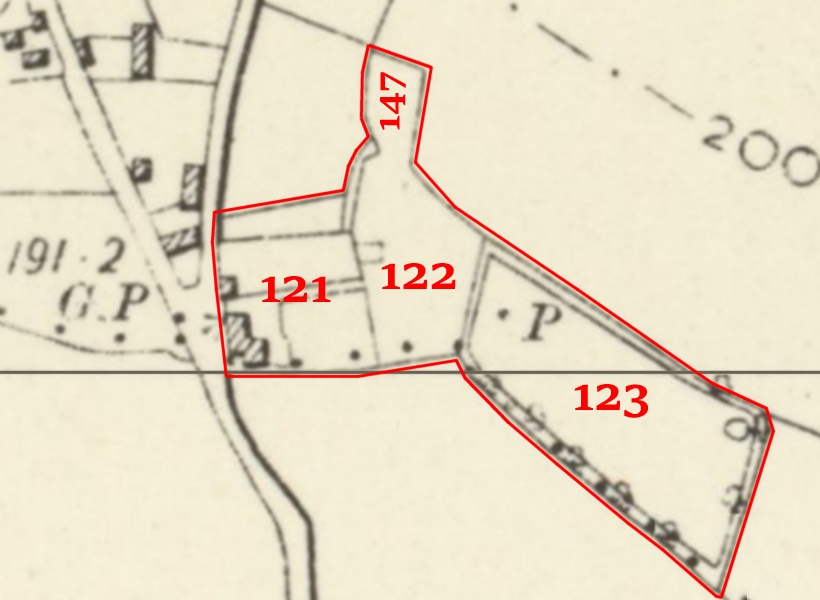
The tithe map and apportionment records created in 1837 provide details of at least some of these pieces of land. A “House [Buildings] Garden & Croft” (number 121 on the tithe map) corresponds with the Lion’s location. The owner of that property also possessed Middle Marsh (122, pasture, two roods and 20 perches in extent), Lower Marsh (123, meadow, one acres, two roods and 28 perches) and piece of land described as a Garden (147, no description of cultivation given, 25 perches in extent). Below, on an extract from a later (Ordnance Survey) map, I have drawn a line to indicate the boundary of those pieces of land and added the numbers from the tithe map.

Extract from a large-scale Ordnance Survey map showing a small part of Waters Upton village. A road runs North-northwest from the bottom of the map, a little to the left of centre. About half way up, another road branches off, heading more directly North but also curving slightly to the East. A few houses are shown alongside these roads, from the junction Northwards. A red line has been added to indicate the boundary of the four parcels of lane (containing the Lion Inn and adjacent enclosures and fields), with numbers added matching those used in the tithe apportionments and map: 121, 122, 123, and 147.
Map adapted from an extract from NLS Maps ⇗. Reproduced with the permission of the National Library of Scotland under a Creative Commons licence ⇗.

The nature of the beast

Another snippet from the notice of the Lion’s sale in 1833: the property was described as a “PUBLIC HOUSE, or Licenced Beer House”. It seems likely that the Lion was one of the thousands of new public houses which appeared in the wake of the Beerhouse Act 1830 ⇗. Under this Act any rate payer could apply for a licence (costing two guinea annually) to brew and sell beer on their premises.

No clue as to the original owner of the Lion and its associated land is given in the notice of sale, but the above-mentioned tithe apportionment records of 1837 probably tell us who purchased the property – although there is some confusion over his exact identity. The apportionment agreement referred to a William Felton as “the Owner of a Messuage Garden and several Closes of Land containing by Estimation Three Acres and twenty two perches Statute Measure”. However the accompanying schedule names the landowner as Thomas Felton – perhaps the same Thomas Felton who appeared on the 1841 census at Waters Upton as a publican.

I have my doubts about Thomas being the owner, not least because the register of voters for 1842-43 includes William Felton, with abodes at Rowton and Waters Upton, as the owner of a “Freehold house and land” at Waters Upton – occupied by Thomas Felton. Subsequent registers, up to that of 1850-51, state that William Felton had his abode at Bratton in the parish of Wrockwardine, and referred to his house and land at Waters Upton as the Lion Inn.

William Felton does not appear as a Waters Upton voter in the electoral registers after 1850-51. This corresponds with the death ⇗ of a 77-year-old William Felton, registered in Wellington Registration District in the first quarter of 1851. I believe he was the William Felton enumerated on the 1841 census ⇗ at Rowton as a farmer, his age (likely rounded down) given as 65. It appears that his son John Felton then inherited the Lion – and went on to change its name.

Between the Lions

John Felton of Bratton appeared in the lists of voters as the owner of a freehold house and land at Waters Upton before his father’s death. He was likely the John Felton, son of William and Sarah, baptised ⇗ 25 May 1806 at Kinnersley (nowadays Kynnersley). He wed Melona Meredith ⇗ at High Ercall on 2 October 1837, at which time (according to the allegation made when he applied for his marriage licence ⇗) he was a butcher. In 1851 he was recorded on the census ⇗ as a farmer of 184 acres, living with wife Melona and their children at Long Lane in the parish of Wrockwardine.

John’s property in Waters Upton was not identified by the name of the house or its occupier in the aforementioned lists. Similar entries in those lists continued up to and including that of 1858-59. Then, from 1859-60 until at least 1871, we see John Felton of “Long Lane, near Wellington, Salop” as the owner of a freehold house and land at Waters Upton named as the New Inn.

The establishment formerly known as the Lion appears as the New Inn on the censuses of 1861 and 1871. During the 1870s however the inn’s original name was restored – the earliest reference I have found so far is in a report in the Wellington Journal of 14 October 1876 (page 8). The Lion’s return may well have been a consequence of the death – on 19 July 1875 at Long Lane according his entry in that year’s probate calendar – of John Felton.

I have yet to trace the ownership of the Lion from 1875, although I do know (thanks to the Shrewsbury Chronicle of 1 March 1907, page 8) that on 28 February 1907 “the ‘Lion’ public house, at Waters Upton, with some 3 acres of land, was sold to Mr. W. T. Southam, Shrewsbury, for £850.” There are however other people connected with the history of this house for us to look at – particularly those who lived there and called it home. I will introduce them to you in Part 2.

To be continued.

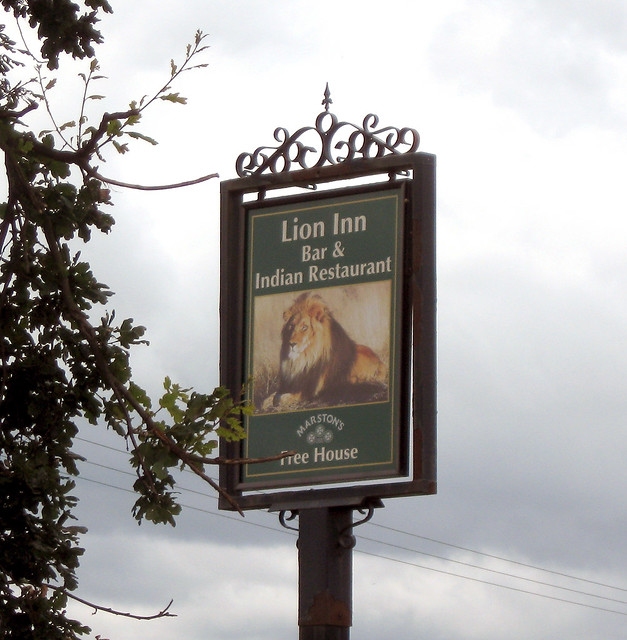
Colour photo of a free-standing pub sign on top of a pole. The sign, hanging within a metal frame, is dark green with white lettering and, in the centre, a colour illustration of a male Lion at rest. The lettering above the Lion says "Lion Inn Bar & Indian Restaurant." The lettering below the Lion says "Marston's Free House."

The Lion Inn, between its days as an inn and its current existence as the Bharat Indian Restaurant. Photo by Harry Pope, taken from Flickr ⇗ and used under a Creative Commons licence ⇗.

By the numbers: How Waters Upton’s doors got their digits (Part 2)

⇐ Back to Part 1

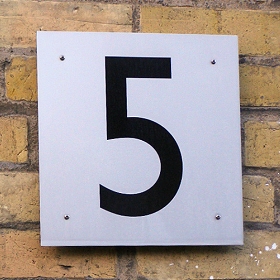
Colour photo of a house number, in this case number 5. The figure, in black, is on a square, white plaque, affixed to brickwork with a nail or screw near each corner.

An important development in the history of house numbering outside London was the enactment of the Towns Improvement Clauses Act of 1847 ⇗. This legislation “comprised in one Act, sundry provisions for paving, draining, cleansing, lighting and improving towns and populous districts.” Sections 64 and 65 ⇗ of the Act gave greater control over house numbers and street names to certain commissioners.

The commissioners in question were those of the towns and districts to which this legislation applied, typically those appointed under Town Improvement Acts. They could have other titles, such as trustees. Section 64 allowed them to “cause the houses and buildings in all or any of the streets to be marked up with numbers as they think fit, and […] cause to be put up or painted on a conspicuous part of some house, building, or place at or near each end, corner, or entrance of every such street the name by which such street is to be known”. Section 65 then stated that the “occupiers of houses and other buildings in the streets shall mark their houses with such numbers as the commissioners shall approve of”.

Eleven years later, many of the provisions of the above Act were incorporated into the Local Government Act 1858 ⇗, which was deemed to form part of the Public Health Act 1848 ⇗. The powers granted under this combined legislation were adopted by a number of Shropshire’s towns. The county’s newspapers, copies of which I have perused at the British Newspaper Archive, show that eventually, discussions about street naming and house numbering in those towns took place. (In the following paragraphs, ESJ means Eddowes’s Shrewsbury Journal; SC, Shrewsbury Chronicle; and WJ, the Wellington Journal.)

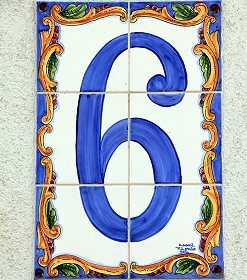
Colour photo of a house number, in this case number 6. The figure, in blue, is painted across six tiles (three rows of two). The tiles are white, a decorative border design around  the edges.

On Monday 18 June 1866 at a meeting of the Local Board for Oswestry, “Mr Bayley called attention to the desirability of putting up the names of the streets and numbering the houses. (Hear, hear.)” Six months later, on Monday 10 December, “The Chairman proposed that all the houses of the town should be numbered.” This was approved, but the work was not carried out. It was not until 1880 that new proposals were put to the Town Council and adopted. In supporting them, councillors referred to the large volumes of mail – including election addresses – that went undelivered because addressees could not be found. (Oswestry Advertiser, 20 Jun 1866, p5, and 12 Dec 1866, p7; WJ, 8 May 1880, p7.)

At the beginning of 1871, Shrewsbury Town Council discussed “the plates of the names of the streets” which were being put up. In addition, “The numbering of the houses, for the purpose of aiding the Registrar General in the taking of the census” was to be considered by a committee. Confirmation that this work was about to begin was given at a meeting of the Shrewsbury Improvement Committee in October that year. (ESJ, 15 Feb 1871, p8, and 18 Oct 1871, p6.)

Also in 1871, at the annual meeting of Wellington’s Improvement Commissioners in June, “An application was considered from Mr. Boyd, postmaster, praying that the Board would consider the question of numbering the houses, on the ground that it would facilitate the delivery of letters.” The matter came up again at later meetings, but each time was deferred. A decade passed before it was agreed that the town’s houses should be numbered; plans were finalised in December 1881. (ESJ, 28 Jun 1871, p6; SC, 20 Oct 1871, p8; ESJ, 26 Oct 1881, p9, and 28 Dec 1881, p6.)

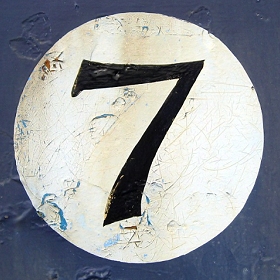
Colour photo of a house number, in this case number 7. The figure, in black, is painted on a white disc, on blue wood. Both disc and number appear to have been painted on the blood wood; the white paint is discoloured in places, and here and there, blue from underneath is showing.

By the time some of Shropshire’s urban representatives had gotten their collective acts together over street naming and house numbering, provisions enabling these improvements in country districts were in place. The Public Health Act of 1875 (according to volume 16 of The Laws of England ⇗) conferred the provisions of the Towns Improvement Clauses Act on all urban districts. Crucially for this story, it also allowed Local Government Boards to use the Act’s powers in rural districts. As we have seen however, having those powers granted and having them applied were two very different things.

To say that it took a while for house numbering to become widespread in rural areas would be an understatement. I think that the benefits were accepted, but there was a reluctance on the part of parish officials to make and carry through the necessary plans, or spend the money that was required, or compel local residents to play their part.

In the end it was neither concerns over census-taking nor issues with mail delivery that swayed the smaller settlements of Shropshire. The threat of names being struck off voters’ lists was what finally got numbers and names displayed in reluctant rural parishes.

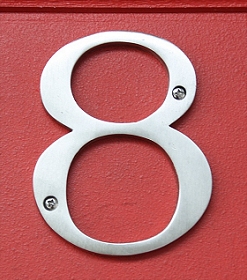
Colour photo of a house number, in this case number 8. The figure is made of metal, and is affixed with two screws on vermillion-painted wood.

On 7 July 1905, the Shrewsbury Chronicle reported that Mr J W St Lawrence Leslie had been appointed a revising barrister on the Oxford circuit. Prior to this his name had appeared in the Shropshire papers as Deputy Recorder (from 1899) and then ‘full’ Recorder (from 1904) of Shrewsbury. (WJ, 1 Jul 1899 and 27 Feb 1904.) Much greater prominence in the county’s press lay ahead for John William St Lawrence Leslie.

Mr Leslie’s duty as revising barrister was to hold ‘courts’ for revising and signing off the lists of those entitled to vote in parliamentary and local elections. He had to consider applications made by people who wanted their names added to these lists, and objections made against the inclusion of these names or of any of those already on the list. After weighing up the legal pros and cons he would confirm additions, and strike off those not eligible to vote. (A short guide to Electoral registration and the registers before 1918 ⇗, in PDF format, is available from the Surrey History Centre; the full legislation – the Parliamentary Registration Act 1843, as it stood, with amendments, in Mr Leslie’s day – can be read in The Statutes of Practical Utility ⇗.)

A revising barrister could also bring their judgement to bear on the lists before them without being prompted by objectors. After he had settled into his new role, Mr Leslie did just that. On 25 September 1908, the Shrewsbury Chronicle reported as follows:

THE revision of voting lists in Shropshire has proceeded this week […]. The Revising Barrister has repeatedly commented upon the vital necessity of having houses numbered or identified in some way in the now famous column 4, but has been content for the most part to pass lists imperfect in this particular with the intimation that they must be made perfect next year. The remarks Mr. Leslie made on the subject last year rather led one to expect some drastic measures, but doubtless the fact that in many parishes an earnest effort has been made to carry out his wishes had some influence in inducing him to give a further period of grace in those cases where the task of numbering or naming houses – by no means an easy matter in rural parishes – has not yet been carried out.

The difficulties experienced in one of those rural parishes, Lydbury North, were raised at a revising court held that same month (Ludlow Advertiser, 26 Sep 1908, p7). The assistant overseer said he had done his best, but the scattered nature of the houses across the 9½ mile width of the parish made numbering impractical. Neither the parish council nor the owners could see how to start the work asked of them. Mr Leslie’s solution for this issue was to give the houses distinctive names, adding: “If the owners and residents would not carry out the idea then the Parish Council could apply to the Local Government Board for powers to do it themselves and charge the owners.” If a scheme was not implemented, Mr Leslie said, he would “strike off the people not properly described” from the voters’ list.

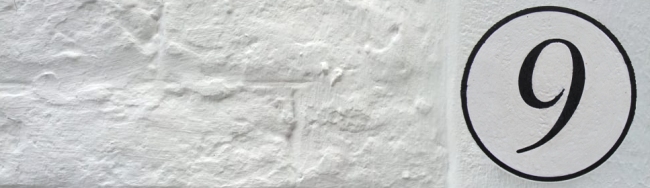
An image I have created by combing elements of two photos. On the left, taking up most of this long rectangular image, is white- or lime-washed brickwork. On the right is a house number, in this case number 9. The figure, in black and surrounded by a black circular border , is painted on a grey background.

On 5 October 1909 it was the turn of the seemingly immovable Waters Upton to meet the unstoppable force of John William St Lawrence Leslie. The Shrewsbury Chronicle of 8 October (page 9) reported:

Mr. Leslie held a court for the revision of the local voters’ lists on Tuesday at Newport. […] Each parish with the exception of Waters Upton had complied with the request that the houses should be numbered or named. Mr. Leslie said the landlords in Shropshire had mostly fallen in line with his suggestion. […] With the exception of Wem and Shifnal, which places he had not yet visited, he could say Shropshire was in perfect order. Only in about half-a-dozen cases was the numbering not done, but it would eventually be carried out as required.
When dealing with the Waters Upton list, the Assistant Overseer stated that at the Parish Meeting they declined to have the houses numbered. Several questions were asked by Mr. Leslie who asked why the Parish meeting was ruled by the Rev L. Vernon Yonge, who had first made himself secure by giving a name to the house he occupied. He then encouraged the parishioners not to number the houses. […].

Numbers, and more house names, came to Waters Upton soon after Mr Leslie’s court concluded. Evidence for this can be seen on the household schedules of the 1911 census (and probably on the electoral rolls of course, but I have not yet viewed the registers for that timeframe). Only a small proportion of the householders gave specific addresses, but it is clear that a house numbering scheme was in place. In addition to 39 Harebutts, 43 Waters Upton, and No 45 Terrill Farm, there was “27 High Street”. This, the address given for the Rectory, is the only time I have seen the village’s main street named (albeit unofficially).

The ‘new’ house names given were The Beeches, The White House, and Clematis Cottage. The first two of these also appeared on household schedules when the 1921 census was taken. Almost every home had a name or a number given on that year’s census, and as Clematis Cottage was described as number 31 it appears some or all of the properties with names, also had numbers assigned to them.

Although this is the end of the story of how house numbers came to Waters Upton, it is just the beginning of my research relating to the properties they identify. For one thing, I need to identify exactly where each of those numbered and named houses stand (or, for those which are no more, where they stood). If my research generates results, there will be lots more stories (perhaps that should be house histories) to come…


Picture credits.5, © Eva the Weaver (Flickr ⇗), adapted and used under a Creative Commons licence ⇗. Six, public domain image from HippoPx ⇗. 7, © Duncan Cumming (Flickr ⇗), used under a Creative Commons licence ⇗. Number 8 by Liza, public domain image from pixabay ⇗. Number 9, a mashup of a public domain image from PeakPX ⇗ and a photo © Kirsty Hall (Flickr ⇗), used under a Creative Commons licence ⇗.

By the numbers: How Waters Upton’s doors got their digits (Part 1)

House numbers are something we take for granted these days, but it hasn’t always been that way. They didn’t exist in England before the beginning of the 1700s, and they did not appear in Waters Upton until another two centuries had passed. Here are some edited highlights from the 200-year story of the spread of house numbering, from London to other urban areas, and from Shropshire’s towns to its rural parishes, including Waters Upton.

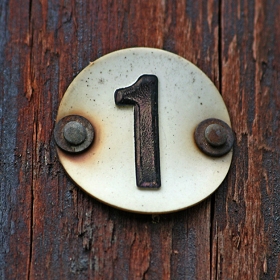
Colour photo of a house number, in this case number 1. The figure, in black, is on a white disc, affixed with two nails or tacks to the wood of the door.

My interest in house numbering, particularly in the parish of Waters Upton, stems from my desire to research the histories of individual houses there as part of my wider one-place study. For me to be able to do this, I need to be able to distinguish one house from another in records relating to the place and its people. The absence of house numbers before the early 1900s makes this a tricky task.

There were a few houses with names of course (The Hall, the Swan, the Lion Inn), and a couple which can be identified from the occupation of the ‘head of the household’ (the rectory, the smithy). There are also a couple of hamlets in Waters Upton parish (the Terrill, the Harebutts) each consisting of just a few houses (and each with a variety of variant spellings in days gone by!). If house histories are not possible for those places then ‘hamlet histories’ – smaller one-place studies within a larger OPS – might be feasible.

What about street names, which were around long before house numbers (my favourite being Shall-I-go-naked Street ⇗ in Whitechapel St Mary)? In common with many other small settlements, the road along which most of the village’s houses are situated does not have a name. There is the Market Drayton or Hodnet road of course, on the west side of the village, but few of Waters Upton’s homes faced onto this (two of those that did were the inns, which can be identified from their names). And back in the days before Waters Upton expanded, the one road with a name – River Lane – was not a residential street.

The absence of a named street and of numbered houses would not have been a great problem in a small village like Waters Upton. Those seeking a particular house or its occupants would no doubt have been pointed in the right direction soon enough by one of the villagers. In larger settlements however, and particularly in cities like London, a plethora of properties made things more complicated. How did people find the building they were looking for?

Colour photo of a house number, in this case number 2. The figure, in black, is on a white tile with colourful floral decoration around the edges. The tile is enclosed in a rusting metal frame.

“Before house numbers,” says The Postal Museum ⇗, “businesses used illustrated signs to show people where they were”. In times of less than universal literacy, such signs, using images rather than words, were an important part of the ‘visual culture ⇗’ of towns and cities. As Kathryn Kane states in her blog post On the Numbering of Houses ⇗ they would have “served as landmarks by which a person could give directions to their residence.”

Those who could wield a quill had to write out such directions, rather than addresses as we know them today, when sending letters. I suspect the shortcomings of this way of doing things became more and more apparent as the population, and built-up areas, expanded.

The earliest reference to houses in England being numbered appears in the first volume of Edward Hatton’s A New View of London ⇗, published in 1708. Describing “Prescot street, a spacious and regular Built str. on the S. side of the Tenter Ground in Goodmans fields,” Hatton said that “Instead of Signs, the Houses here are distinguished by Numbers”.

It does not appear that this early experiment sparked immediate imitation elsewhere. The notion of numbers being used to identify properties did eventually catch on though, and in the latter part of the 18th century received ‘official’ approval. This came about as part of much broader efforts to tackle the state of the streets in and around the city of London.

Writing about these times in his Modern History of the City of London ⇗ (1896), Philip Norman stated: “The condition of the paving in the roads and foot-paths of the City [had] long given rise to complaints”. He also observed that “The want of proper tablets to distinguish the names of streets and courts, and of regularity in numbering the houses, occasioned great difficulty, especially to strangers.”

Colour photo of a door number, in this case number 3. The figure is made of metal, and is affixed to the dark blue wood of a door.

These issues led to laws designed to bring cleanliness, safety and order to the capital’s thoroughfares, through the appointment of commissioners with powers to put improvements in place. The city of Westminster was the first to secure such legislation, in 1762 (2 Geo III c21 ⇗), although further statutes were needed to make this workable. The first of those updates (3 Geo III c23 ⇗) to the original “act for paving, cleansing, and lighting, the squares, streets, and lanes” in Westminster (and other parishes and liberties in Middlesex) is of particular interest. It gave commissioners the power to order “the names of the streets or squares to be affixed on the corner houses”.

By 1766, according to John Noorthouck (in A New History of London ⇗, published 1773), “The paving of Westminster under the new regulations was […] far advanced, and the great disparity in elegance and convenience between the Westminster side of Temple bar, and the London side, was […] observable to every one who passed through”.

Westminster’s example was quickly copied. Acts for Southwark (6 Geo III c24 ⇗) and the city of London (6 Geo III c26 ⇗) were soon secured. Southwark’s Act empowered commissioners ⇗ to order the names of streets, lanes, courts etc to be displayed, and to “order and direct the houses within the said streets and lanes, and within the said courts, yards, alleys, passages, and places, or any of them, to be numbered with figures placed or painted on the doors thereof, or in such other part of the said houses respectively as [the commissioners] shall think proper”.

London’s legislation included very similar provisions ⇗. Other districts followed. Evidence for claims made elsewhere online that house numbering resulted from provisions in the Postage Act of 1765 has been sought but not found ⇗.

“Across London,” wrote Jerry White in London In The Eighteenth Century: A Great and Monstrous Thing (2012), “these were momentous changes. They were not comprehensive, because some place like the ancient Liberty of Norton Folgate in Shoreditch, for instance, opted out of parish statutes through the poverty of their residents. And doubtless the commissioners were not always and everywhere as vigilant as they should have been. But the reorganisation of paving and lighting, the naming of streets and numbering of houses, all made London tangibly more manageable. And more modern too.”

Colour photo of a house number, in this case number 4. The figure, in white, is on a large black circular plaque, possibly ceramic, which is decorated with representations of green Ivy leaves, six at the top and two at the bottom. The plaque is affixed to brickwork with two screws.

London’s streets certainly saw improvements, but there were still problems with regard to the house numbers and street names on display. The names to be used were those by which streets were usually or ‘properly’ known, and the commissioners had no say in exactly which numbers were used.

The consequences, as described by the Postal Museum, were that “numbering systems varied even in the same street”. As for street names: “There were irregularities everywhere, and the naming of streets and parts of streets was left to the idiosyncrasy or whim of the owner.” The Illustrated London News ⇗ of 16 May 1846 complained:

Scores of streets in different and widely-separated parts of this vast City bear the same name, and the numbering of houses is sometimes past all comprehension. The slightest imperfection in the address of a letter sends it on a voyage of discovery to all the squares and terraces of the same name, till it finds the right one. This must add much to the labour of the [Post Office], while the defect is out of its power to remove.

The same concerns were expressed in 1854 by the Inspector of Letter Carriers in a report to Rowland Hill ⇗, which gave several examples of horrendous house numbering and street naming nightmares. The very next year however, the enactment of the Metropolis Local Management Act (18 & 19 Vict c120) offered hope of a solution. It created a Metropolitan Board of Works with wide-ranging powers including the regulation of the numbering of houses and the naming of streets ⇗.

The slow progress in the early years of this body were noted in the annual reports of the Postmaster General in 1856 ⇗ (“No improvement has yet been made in the street nomenclature of London”), 1857 ⇗ (“some little has been done”), and 1858 ⇗ (“further progress has been made in improving the nomenclature of the streets in London and the numbering of the houses; but the main work has still to be accomplished”).

Despite this slow start, and some resistance from the public to altered addresses, by 1871 4,800 street names had been changed and 100,000 houses renumbered in London (Postal Museum figures). The work of letter carriers was made a little easier. The work of future house historians, not so much!

In the meantime, while this progress was being made in London, legislation allowing similar improvements to be made beyond the capital had been introduced. It’s time for this story to move away from the Metropolis.

On to Part 2 ⇒


Picture credits. Number 1, © Leo Reynolds (Flickr ⇗), used under a Creative Commons licence ⇗. Colorful house number, 2, © Martin LaBar (Flickr ⇗), used under a Creative Commons licence ⇗. Door Number 3by George Hodan, public domain image from PublicDomainPictures.net ⇗. “34”, © Brian (Flickr ⇗), adapted, used, and made available for reuse under a Creative Commons licence ⇗.

A puzzling postcard from Waters Upton

A little while ago I bought a postcard which bears a Waters Upton postmark. It does not add to my limited collection of village views – the scene on the rather grubby front of the card depicts Edgbaston Old Church, Birmingham. But it was probably posted by someone living in Waters Upton, or at least close enough for their mail to be franked there, someone named Elizabeth. Who was she?

“Dear Master David” wrote Elizabeth, “Many thanks for P.C how splendid to hear you are in the top form I hope to meet you next time through [= though?] if possible I was so disappointed Much love to you”. The postcard was franked on 11 May 1908.

Scanned image of the reverse of the postcard that is the subject of this article, cropped to show only the message. That message is transcribed in the article.

The recipient

At least the identity of the postcard’s recipient was fairly easy to establish. The card was addressed to Master D. G. Loveday, care of W. Deedes Esq, Mill Mead, Shrewsbury. At the top of the list of results when searching the 1901 census at Findmypast for D* G* Loveday is 4-year-old David G Loveday. He was living at the Manor House in Williamscote, in the Oxfordshire parish in which he was born: Cropredy.

The birth of David Goodwin Loveday, mother’s maiden name Cheape, was registered in the second quarter of 1896 in Banbury registration district ⇗. Googling David’s full name generates results from Wikipedia ⇗ and other websites, showing that he was born on 13 April 1896, was educated at Shrewsbury School, and was an Anglican bishop who died 7 April 1985.

I decided to find out more about David Loveday and his family in the hope that this might help to reveal the identity of Elizabeth. David’s father was John Edward Taylor Loveday. John was born in the first half of 1845 at East Ilsley in Berkshire, where his father (as per the censuses of 1851 ⇗ and 1861 ⇗) was Rector. He seems to be best known for printing, “with an Introduction and an Itinerary”, a manuscript by his great grandfather John Loveday ⇗: Diary of a Tour in 1732 through parts of England, Wales, Ireland, and Scotland. (This tour was probably number 23 in a list of 126 Tours by John Loveday ⇗ compiled by some of his descendants.) He was educated at Exeter College, Oxford ⇗, where he matriculated on 11 June 1862, aged 17.

John Edward Taylor Loveday married ⇗ Edinburgh-born Margaret Cheape on 15 Oct 1874 at Cameron, in Fife, Scotland. The couple made their home at Williamscote House (the above-mentioned ‘Manor House’), where they were enumerated with their first five children in 1881 ⇗. John was described as a “Landed Proprietor & Magistrate for Counties of Oxford & Warwick”. They had five more children over the course of the next 15 years, of whom David Goodwin Loveday was the youngest.

Extract from a large-scale Ordnance Survey map showing Williamscot House, its surrounding buildings, and its wooded grounds, with open fields to the West, and a road running from the top of the map to its South-east corner, to the East.

It turns out that David was not the first of the Loveday children to spend time in Shrewsbury. The 1901 census ⇗ records his brother Henry Dodington Loveday, then aged 20 and an articled clerk to a solicitor, lodging with the family of clergyman William Leeke at the Abbey Foregate Vicarage. Another brother, Alexander, was also living in Shrewsbury when the 1901 census ⇗ was taken. Aged 12, he was boarding at the school his brother David would later attend, Mill Mead, a private establishment under the headmastership of Wyndham Deedes.

Elizabeth . . . who?

The Lovedays’ connections with Shrewsbury might explain how the mysterious Elizabeth became a friend of the family. Was there a lady of that name living in Waters Upton in the early 1900s who looks like a suitable candidate? Of the several Elizabeths on the 1901 and 1911 census returns for the parish, one stands out: Elizabeth Yonge.

Elizabeth Mary Hombersley Yonge, née Groucock, was the wife of the Rev Lyttleton Vernon Yonge. Rev Yonge was a son of Vernon George Yonge, also a clergyman, and part of a prominent Staffordshire family which had its seat at Charnes Hall. Lyttleton was born at the Rectory in Great Bolas, received his education at Cambridge, and although he resided at Waters Upton he was vicar of Rowton, in Ercall Magna parish. Elizabeth, who was also from the parish of Bolas Magna, was a daughter of Thomas Groucock (a farmer of 180 acres in 1881), and of Elizabeth Groucock née Dickin, who was descended on her mother’s side from the Wase family of Waters Upton Hall.

The social standing of the Yonges (and perhaps also the subject of the postcard’s picture) makes Elizabeth my top ‘suspect’ in a case which is not so much a ‘whodunnit’ as a ‘whopostedit’. All I am lacking is any direct evidence that the Yonges and the Lovedays actually knew each other!

A scanned image showing the photo on the front of the postcard that is the subject of this article.  It depicts Old Edgbaston Church, with its tower on the right, behind a churchyard packed with gravestones and monuments along with several trees and shrubs.
The front of the postcard sent to Master D G Loveday by Elizabeth.

Maybe one day I will find that David Goodwin Loveday’s early education, before he went to Shrewsbury School, was as a pupil boarding either with Lyttleton Vernon Yonge or with his fellow clergyman and Waters Upton resident, John Bayley Davies? Or perhaps I will find a document written (or least signed) by Elizabeth, so that I can compare it with the writing on the postcard at the centre of this mystery. Her signature should appear in the Waters Upton marriage register, but the register begun in 1837 is still in use and has not been deposited at Shropshire Archives. The probate copy of her will, a digitised version of which I have obtained from HMCTS via the Gov.UK website ⇗, is typewritten and bears no signature.

So is this the end of my investigation? Not quite. Because while looking at the other Elizabeths of Waters Upton, I found a further line of enquiry.

Coincidence or connection?

The Elizabeth who piqued my interest was Elizabeth Emma Ball. She was a daughter of William Abraham Richard Ball and his wife Sarah, née Cureton. This Elizabeth spent the early part of her adult life working as a servant before moving back to Waters Upton between 1901 and 1911. There is nothing to suggest that she met the Lovedays unless perhaps she worked for one or more of them as a servant, but if that was the case the development a postcard-exchanging relationship with David Goodwin Loveday seems unlikely. However, if she didn’t know the Lovedays personally, Elizabeth may have known of them, through her younger sister…

Mary Ann Ball was born at Waters Upton on 13 February 1877. By 1891, when she was 14, she was in service, working as a nurse for the family of John Bayley Davies at Waters Upton Rectory. A decade later she was in Shrewsbury, living and working as a housemaid at a house in Belle Vue Road. Then, in 1909, she married Thomas Henry Kimnell.

Thomas was born at Wardington in Oxfordshire on 25 August 1878 and was enumerated there with his family on the censuses of 1881 ⇗, 1891 ⇗, and 1901 ⇗. When the latter census was taken, Thomas was 22 and, like his father, he was an agricultural labourer. Whether his fortunes changed before or after his marriage is unclear, but change they most certainly did. The 1911 census ⇗ recorded him not as a labourer but as a farmer, working on his own account. With wife Mary Ann and daughter Eva Mary (born 14 March 1910) he was living at Williamscote in Wardington parish.

Extract from a colour Ordnance Survey map dating from the mid-1900s, showing part of Great Bourton on the left and Williamscot on the right. Between those settlements is open countryside, a few roads and farm tracks, a railway running North-South near Great Bourton, and a canal and a river running roughly North-South just right of centre. Just West of the canal, in the centre of the map, is Pewet Farm.

A second daughter, Helen Elizabeth, was born at Williamscote on 22 February 1914, but the Kimnells’ third and last child, Alice, was born at the end of 1917 or in the first quarter of 1918 on the other side of the River Cherwell in the parish of Bourton. Almost certainly the family was living there when the Banbury Guardian of 5 Jul 1917 reported on a military tribunal at which Thomas, a farmer of 107 acres, successful claimed exemption. From the 1921 census and National Identity Register of 1939 it appears that the family remained there for more than 20 years, at Pewet / Peewit Farm (highlighted on the map above).

Thomas Henry Kimnell of Williamscote died on 16 June 1965 at Woodford Halse in Northamptonshire; his estate was valued at £4531. Mary was also of Williamscote at the time of her death on 17 February 1969; given that her death was registered at Daventry she too may have died at Woodford.

Did the references to Williamscote in the preceding paragraphs cause you to think back to the earlier part of this story, relating to the Loveday family? The hamlet of Williamscote, although lying in the parish of Wardington, is a stones-throw from Williamscote House in neighbouring Cropredy parish (the boundary is shown in purple on the map below). The 1911 Kelly’s Directory ⇗ of Oxfordshire lists Thomas H Kimnell right after John Edward Taylor Loveday under Williamscote! Coincidence? Quite possibly, but I think there’s a good chance that it isn’t.

A large-scale Ordnance Survey map showing the village of Williamscot, with Williamscot House immediately to the North-west of it, surrounded by fields, with roads, a few spinneys, and (to the West) part of a river. The parish boundary between Wardington parish on the right (in which Williamscot lies) and Cropredy parish (in which Williamscot House is situated) on the left, is highlighted in purple.

William Ball was well known in Waters Upton so both the Davies family and the Yonges would have been familiar with his daughters, all the more so in the case of Mary Ann given her employment at the Rectory. If, as I have theorised, Elizabeth Yonge was a friend of the Lovedays, this might mean that she was in a position to help bring about the union of Thomas Henry Kimnell (who the Lovedays may have known, perhaps as an employee?) and Mary Ann Ball.

Ultimately, this is speculation and does not prove anything conclusively. The puzzle of the postcard’s sender remains officially unsolved – a one-place study ‘X File’. At least for now. One further possibility for acquiring a sample of Elizabeth Yonge’s handwriting and/or signature remains. Dave Annal recently reported on Twitter that he managed to obtain a copy of an original will from HMCTS – although he did have to wait 16 months!


Picture credits: Front and back of postcard, author’s own images. Extract from Ordnance Survey 25 Inch mapping (1892-1914) showing Williamscot House ⇗ reproduced with the permission of the National Library of Scotland ⇗ under a Creative Commons licence ⇗. Extract from Ordnance Survey 1:25,000 mapping (1937-61) showing Great Bourton, Pewet Farm and Williamscot ⇗ reproduced with the permission of the National Library of Scotland ⇗ under a Creative Commons licence ⇗. Extract from Ordnance Survey 6 Inch mapping (1888-1913) showing Williamscot House and Williamscot ⇗ reproduced with the permission of the National Library of Scotland ⇗ under a Creative Commons licence ⇗.

Coronation celebrations at Waters Upton in 1902

The celebration of the Coronation of the King was observed in several places in Shropshire and the district, but the proceedings were of course shorn of many attractions, and were mostly confined to Intercessory services in the various places of worship, and the treating of old people and children.
—Wellington Journal, 28 June 1901, page 11.

Non-Coronation celebrations

The coronation of King Edward VII and Queen Alexandra ⇗ was originally scheduled to take place on 26 June 1902. Elaborate preparations had been made and foreign dignitaries had gathered, but a last-minute medical emergency forced the pomp and pageantry to be postponed. Just two days before the big event, Edward ended up on a table in Buckingham Palace’s Music Room, where surgeon Sir Frederick Treves performed an operation to drain his Majesty’s abdominal cyst.

A black and white photo of Edward VII (left, bearded, uncrowned) and Alexandra (right). Both wear ermine cloaks, sashes, and decorations.

Although the coronation itself could not proceed as planned, Edward insisted that this should not prevent regional celebrations (and the serving of special dinners to 500,000 of London’s poor) from going ahead. It was in these circumstances that somewhat muted celebrations took place in Shropshire. Let’s return to the Wellington Journal of 28 June 1901:

WATERS UPTON. This little village was not behind in its demonstrations of loyalty, as the proceedings on Thursday fully testified, although the jubilation was naturally not so intense in the circumstances of the King’s illness.
The following admirably carried out the arrangements:—The Rev. L. V. Yonge (rector of Rowton, chairman), the Rev. J. B. Davies (rector of Waters Upton), Mrs. Yonge, Messrs. W. Jervis, B. Needham, J. Shakeshaft, R. Allen, H. J. Jones, A. H. James, A. Ridgway, S. T. Bennett, S. Woolley, and W. A. R. Ball (secretary and treasurer).
At 2-15 p.m. a large procession was formed in the School Yard, and, headed by the Waters Upton Brass Band (conducted by Mr. J. Davies), marched to the Parish Church, where Divine service was held. This being concluded, the village, which was gaily decorated, was paraded, the procession eventually moving to the residence the Rev. L. V. Yonge.
During the afternoon every inhabitant of the village was regaled with a plentiful supply of meat, together with three pints of ale for each adult male, whilst ample provision was made for abstainers. For the women an excellent and abundant tea was provided.
All having feasted to their hearts’ content, a capital programme of sports and amusements was carried out and much enjoyed until seven o’clock, when dancing was spiritedly indulged in and kept up till half-past 10, at which time all joined in singing with loyal heartiness “God save the King”, fervent hopes being expressed for his Majesty’s speedy recovery.
The proceedings were brought to a close with ringing cheers for all who had taken part in promoting the festivities of the day. Mrs. Rider of Crescent House, Wellington, with her usual generosity, presented each child in the parish with a Coronation medal, and Mrs. Yonge liberally supplied the men with tobacco and cigars.

Committee members, music, and medals

What a great line-up of local talent on the organising committee for these celebrations! Two clergymen (Lyttleton Vernon Yonge and John Bayley Davies), a clergyman’s wife (Elizabeth Mary Hombersley Yonge, née Groucock), five farmers (William Jervis, Bernard Morrison Needham, John Shakeshaft – who was also a corn and coal merchant, Richard Allen, and Henry James Jones), a butcher (Alfred Henry James), a carpenter and wheelwright (Alfred Ridgway), a shoemaker (Samuel Thomas Bennett), a railway platelayer (Samuel Woolley), and a former tailor who became the local relieving officer and registrar of births and deaths (William Abraham Richard Ball). All were enumerated at Waters Upton on the census of 1901 – I have hyperlinked each of their names to their household’s entry on my abstract of that census.

A black and white line drawing of a tuba.

As for the Waters Upton Brass Band, how I wish I could find out more about it. I think it likely that the band’s musicians were drawn not just from Waters Upton but also from neighbouring villages and hamlets too. The band leader, for example, was almost certainly the John Davies who was master of Crudgington School from around 1880. The earliest mention of the band I have found so far was in the Wellington Journal of 8 June 1889. The paper reported that “The Waters Upton Brass Band, under the able leadership of Mr. John Davies,” marched as part of a procession celebrating the anniversary of the Waters Upton lodge of Oddfellows.

Almost certainly this was “the Tibberton and Waters Upton Brass Band” which headed a similar procession four years later (Shrewsbury Chronicle, 16 June 1893) and “the Cold Hatton brass band, which played selections on the ground, Mr. J. Davies conducting” at a parish church bazaar held at Waters Upton in 1901 (Shrewsbury Chronicle, 7 June 1901). After playing at the Coronation celebrations in 1902, and leading another Oddfellows’ procession to Waters Upton church the following year (Shrewsbury Chronicle, 19 June 1903), the last reported ‘gig’ for the Waters Upton Brass Band, conducted by Mr Davies, appears to have been a fund-raising event for parochial work at Crudgington in 1904 (Shrewsbury Chronicle, 24 June 1904). The John Davies whose death at the age of 62 was registered in the first quarter of 1906 in Wellington Registration District, was very likely our band leader.

Colour photo of a Coronation medal. It is a metal disc bearing effigies of the heads of Edward and Alexandra, facing to the right, Edward wearing his crown, within a decorative border in which national floral emblems (rose, thistle, shamrock leaves) feature.

Something else I’d love to know is whether any of the Coronation medals issued to the children of Waters Upton have survived, perhaps in the possession of their descendants? (An example of a Coronation medal – not necessarily representative of those issued at Waters Upton as designs varied – is shown here.) Mrs. Rider of Crescent House, Wellington, who supplied the medals, did not live in the village but through her late husband Dr John Rider – a descendant of the Wase family of Waters Upton Hall, had connections to it. Both Mr and Mrs Rider were buried in Waters Upton churchyard.

A second celebration

This story of Coronation celebrations at Waters Upton in 1902 is not quite over. The King and Queen were finally crowned, following Edward’s recovery, on the ninth of August – and his subjects could mark the occasion with unmuted merriment.

The fact that the reconvened Coronation was scheduled for a Saturday was not entirely welcome. The editor of the Wellington Journal opined in his newspaper on August 2nd, that “It would be difficult, we fancy, to imagine a more awkward time to celebrate the King’s Coronation than on a Saturday, for in nearly every town in England this is a very busy day, and one on which shopkeepers are apt to rely in making up for a probable cash deficiency on the other days of the week, and when the working classes do most of their shopping.”

The parishioners of Waters Upton responded to the potential problems of a Saturday celebration by holding their second Coronation ‘do’ on the following Tuesday. The Reverend Yonge once again chaired the organising committee and made his grounds available, and William Ball reprised his role as “the energetic hon. secretary and treasurer.” The day’s events were similar to those of the original Coronation celebrations, with some elements missing but others added – and with a note of sadness regarding the health of the Rector, as the Wellington Journal of 16 August reported:

The children of the Day and Sunday Schools met in the school yard at three o’clock, and were marshalled in processional order to the grounds, where they partook of an excellent tea. At 4-15 the adults were also entertained to tea. Sports were afterwards provided for the youngsters, and each child received prize, whilst additional prizes were awarded to those making the best attendances in the Sunday School.
Dancing commenced at six, and was kept up till 11 o’clock, to the strains of the Waters Upton Band, conducted by Mr. J. Davies. Subsequently the Rev. Mr. Bardell proposed, and Mr. E. B. [actually, J. B.] Davies seconded, a vote of thanks to Mr. and Mrs. Yonge for their kindness in placing their charming grounds at the disposal of the committee, and also for their hearty and liberal assistance. This was carried with ringing cheers.
Mr. Yonge returned thanks, and made some very touching remarks respecting the illness of the worthy rector of the parish, the Rev. J. B. Davies. At the close all sang lustily the National Anthem. In addition to a donation from the Duke of Sutherland, Mrs. Yonge provided prizes for the whole of the Sunday and Day School children; Mr. Needham and Mr. W. A. R. Ball, sweets and prizes; and Miss M. E. Minor, prizes various kinds.
An illustration of the Coronation of Edward VII in Westminster Abbey. Edward sits uncrowned, while a man holding the crown aloft above his head approached, as crowds, standing and seated, look on.

Picture credits: Edward VII and Alexandra, adapted from a public domain image at Wikimedia Commons ⇗. Tuba from Etienne Mahler at Flickr ⇗, public domain image. Coronation medal from Wikimedia Commons ⇗ contributor Helensq; used under a Creative Commons licence ⇗. Coronation of Edward VII in Westminster Abbey from Library of Congress via getarchives.net ⇗; no known copyright restrictions.