Recently I looked again at one of the people recorded at Waters Upton when the National Identity Register was compiled at the end of September 1939. Dorothy M Judge, born 15 January 1907 – why could I find no other records for her? Looking again at an image of the register page, the answer dawned on me: I had misread Dorothy’s surname, the ‘J’ was in fact a ‘T’. Oops. (The transcribers working for Ancestry and Findmypast made the same mistake; I have submitted corrections to both.)
With Dorothy’s true name established I could finally find and link together records relating to her, and piece together what remains of her story. Where better to start than at . . . the end? Well, it struck me that Dorothy’s obituary, the ‘potted history’ of her life shared by way of remembrance just after her death, provides a framework upon which a more detailed account could be constructed – and can now be shared.
Stepaside
As we have seen, Dorothy Mary Tudge was born in January 1907, in Shropshire. I think the exact location was most likely the place where she and her family were enumerated on the 1911 census: Stepaside. This lies on the edge of the parish of Stokesay, then part of the Ludlow Registration District ⇗ in which Dorothy’s birth was duly registered ⇗. It also lies right next to the village and parish of Onibury.
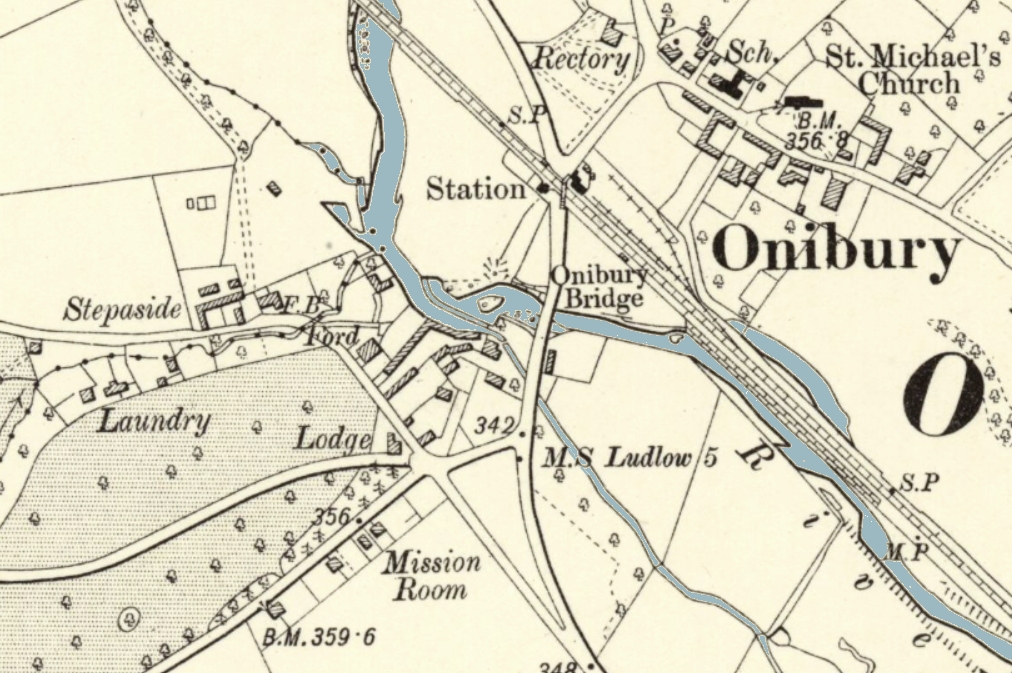
The household at Stepaside recorded on the 1911 census was headed by Dorothy’s father William Bradford Tudge, aged 29, a farmer born at Leominster in the neighbouring county of Herefordshire. William’s wife was Mary Eleanor, 26, a native of nearby Wistanstow. She had been married to William for five years (their wedding took place at Stokesay on 14 March 1906 ⇗) and two children had been born of their union. Dorothy, then 4, we know about of course. The other child was a very new addition to the family: Herbert John Charles Tudge, age “under one month.” Enumerated with the Tudges were a maternity nurse, a ‘lady help,’ a general domestic servant, and a cowman.
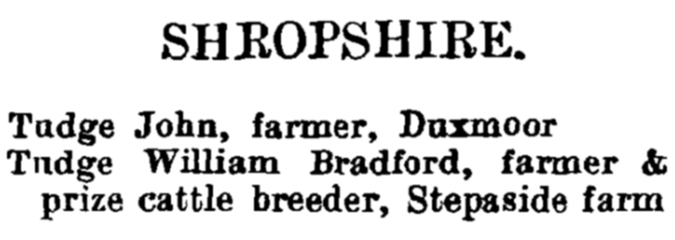
Stepaside Farm was still this family’s home in 1913, when William Bradford Tudge, “farmer & prize cattle breeder,” was listed in that year’s Kelly’s Directory of Shropshire ⇗ as part of the entry for Onibury (the snippet from the directory, on the University of Leicester website ⇗, is used under a Creative Commons licence ⇗). His details appeared just below those of his father John, who farmed at Duxmoor. These listings were repeated in the 1917 directory (viewed at Ancestry: Herefordshire and Shropshire Directories, 1917).
By 1921, William Bradford Tudge had taken his family to live with his parents John (71) and Helen (68) at ‘Duxmore’. William’s occupation was given as “Assisting Father.” Dorothy, then aged 14, was not with her family however. She was instead boarding elsewhere in the county.
Wellington
Hiatt Ladies’ College in Wellington was Dorothy Tudge’s home away from home, presumably for several years. This institution was established in 1847 ⇗ by Mrs Elizabeth Hiatt, née Keay (whose Crudgington-born father John, incidentally, was baptised in November 1801 at Waters Upton). Allan Frost, author of a book on the history the college, is quoted by the Shropshire Star in 2019 ⇗ as saying that it was “the first college intended purely for the education of young ladies in the country.”
It appears that the college did an excellent job too. A list of students with top educational attainments published in The Educational Times of 1 February 1906 (pages 91 ⇗ and 92) includes five names from Elizabeth Hiatt’s establishment, and there are other examples to be found.
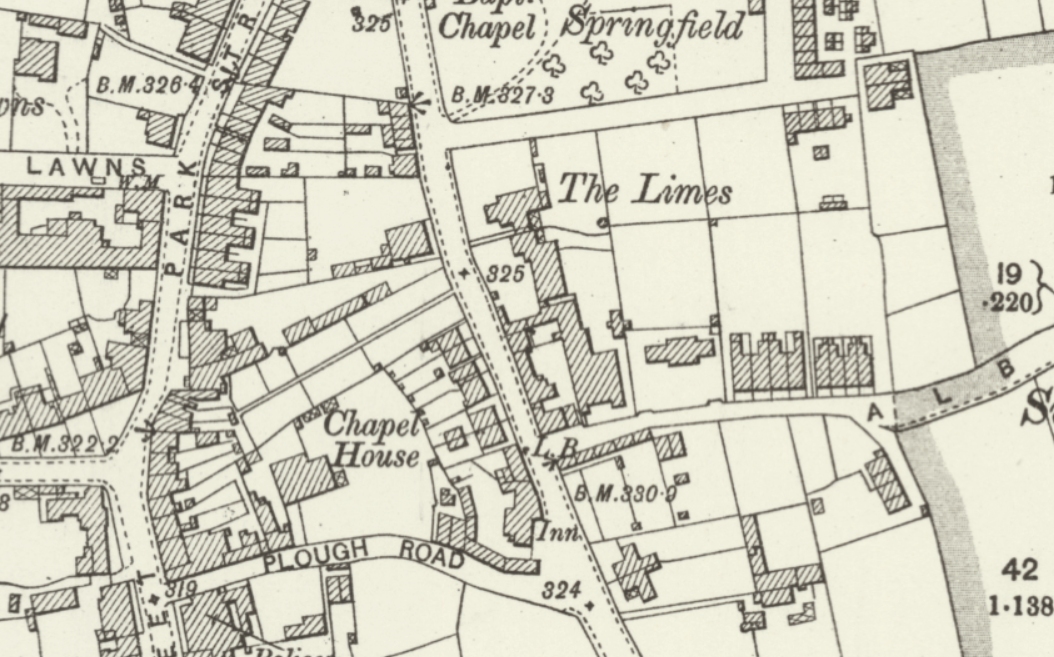
The census of 1921 shows that in addition to the head, May Margaret Daniels, there were 11 other mistresses, teaching English, French, science, history, music, art, and gymnastics. In addition the college had a matron, an assistant matron, and a nurse. Dorothy Tudge was one of 55 pupils, aged from 10 to 17, most of whom came from Shropshire and the neighbouring counties of Cheshire, Staffordshire and Warwickshire.
I would love to know what Dorothy’s educational accomplishments were during her time at the college, not to mention her other experiences and how she adjusted to a very different way of life after her childhood on a farm. Who were her friends? What did they get up to when not in class? Did they break the rules, and if so, were they caught?
Cwm Head, Radbrook, and Whittingslow
As for the length of time Dorothy attended Hiatt Ladies’ College, my guess is that she was there from around 1917 to about 1923. A report in the Wellington Journal of 19 January 1924 (page 5) then places her back in the South of Shropshire, and pursuing an interest in dairy work. The report, covering a meeting of the Salop Agricultural Committee, noted that:
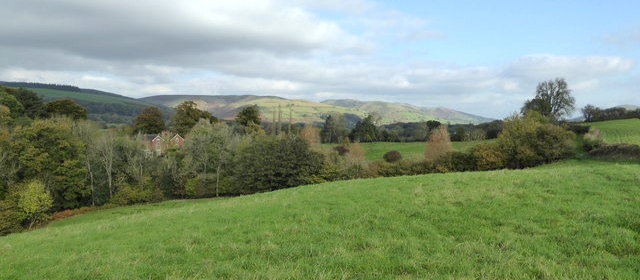
Did Dorothy delay taking up her ten week scholarship? Or did she stay at Radbrook for a lot longer than ten weeks? Some 18 months after the above report, the same newspaper carried (on 25 July 1925, page 5) details of the distribution of prizes at Radbrook Technical School. Amongst those presented with certificates and prizes by Lady Harlech was Miss D Tudge, who received a school certificate for dairy work – first class.
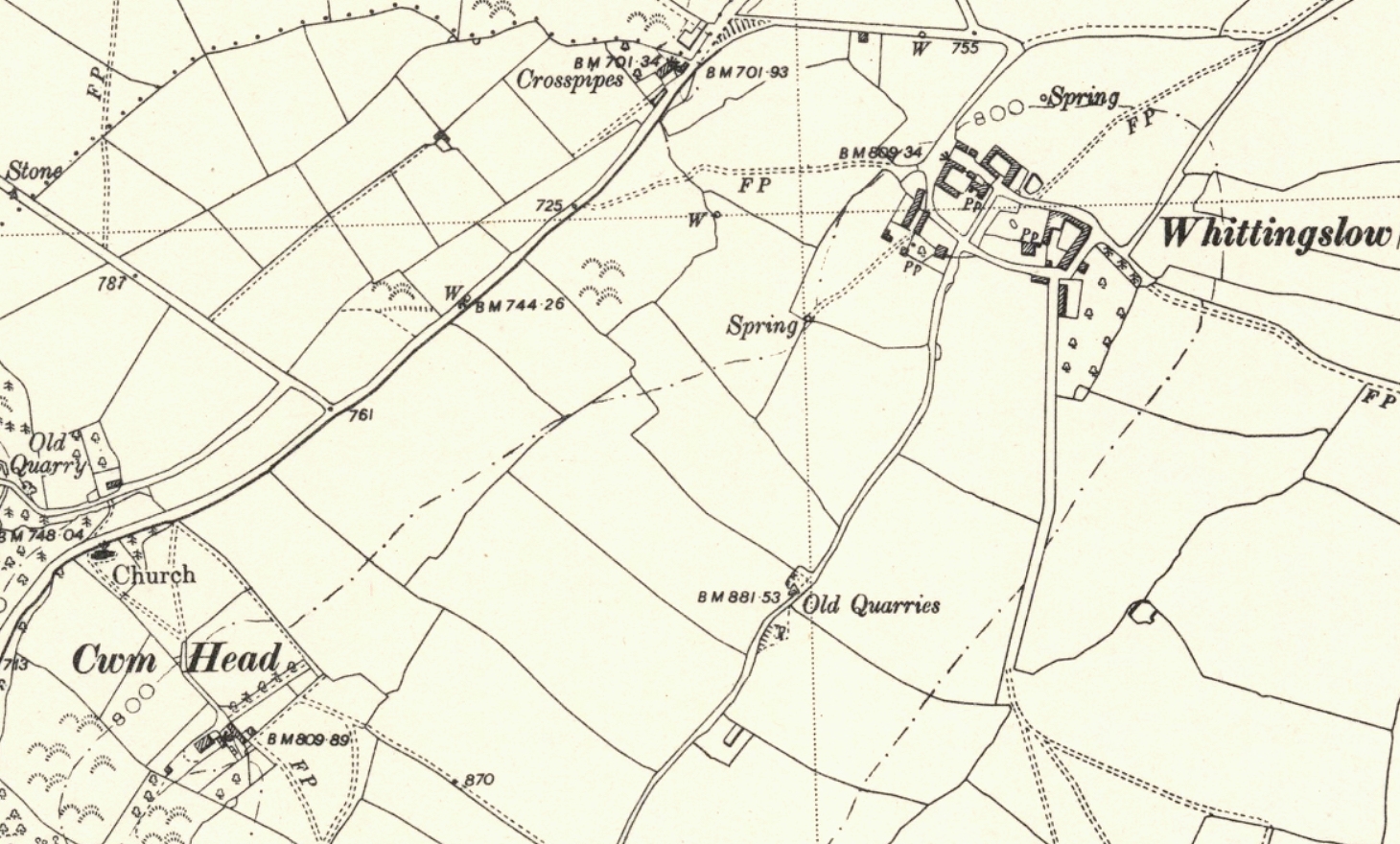
Over nearly all of the following 15 years, Dorothy seems to have ‘flown under the radar’ as far as the press was concerned. In complete contrast, her father and her maternal aunt, Mrs (Katie) Maybery, were regularly in the local newspapers thanks to their prize-winning herd of dairy Shorthorn cattle. From earlier examples of this media coverage (including the Shrewsbury Chronicle, 8 Apr 1932, page 8) it appears that the herd was established at Cwm Head around 1926, before the operation moved (in about 1929 I believe) to nearby Whittingslow Farm, Marshbrook. Though she spent time away from her family, these farms – especially Whittingslow – were home.
Surrey, and back to Shropshire
Dorothy spent at least part of this time living – and presumably working – in Surrey. Electoral registers record her there in 1930 and 1931 living at 75 Langley Park Road, Sutton, with Ada and Caroline Absale (sadly, she probably didn’t make jokes about them descending vertical rock faces or the sides of tall buildings with the aid of ropes). She also appeared in a 1933 electoral register, at Chalklands, Woodland Road, Little Bookham, with Thomas and Edith Weaver.
Those few occasions when Dorothy’s name did appear in the papers during this period were sad ones – the funerals of her grandparents. The last of these events was the interment of Dorothy’s paternal grandmother Helen Tudge, who died in on the 4th, and was buried on the 8th, of February 1937. Reporting on Helen’s death and funeral, the Shrewsbury Chronicle (12 Feb 1937, page 16) noted that she was a member of the local Women’s Institute and the Women’s Conservative Association, as well being a “fervent church woman”. At least one of those things would rub off on Dorothy.
Two years later, Britain was at war, and members of the Tudge family stepped up to play their parts. For Dorothy, this would include working at Waters Upton.
On to Part 2 ⇒
 Waters Upton One-Place Study