In support of the school at Waters Upton

WATERS UPTON.
SALE OF WORK.
On Tuesday, a two-days’ sale of work was inaugurated here, the objects being to wipe off the debt recently incurred by the enlargement of the schoolroom, and also to raise funds to provide a heating apparatus for the church. The promoters of the affair were most fortunate in their selection of the days upon which to hold proceedings, the weather being summer-like in its character, and consequently the bazaar was a complete and unqualified success.

So began a report in the Wellington Journal on Saturday 14 September 1889 (page 7) – a report so long that I have only included the above paragraph in this website’s Education in the news page. More of the article deserves to be seen however, and commented on: hence this post.

There are two things about the news story that are of particular interest to me. Firstly, it looks back at, and provides an insight into, the foundation of Waters Upton’s school. Since I have failed to find much newspaper coverage from the time when the school was proposed, built, and opened, this is valuable information. Along with this information there are also opinions about education provided – or rather, not provided – in Waters Upton before the school existed.

Secondly, the support that was needed for Waters Upton to establish its school (and then to expand and maintain it) becomes apparent. A community that extended well beyond the boundaries of this small parish was essential for success.

Let’s continue with the Journal’s report, and set the scene…

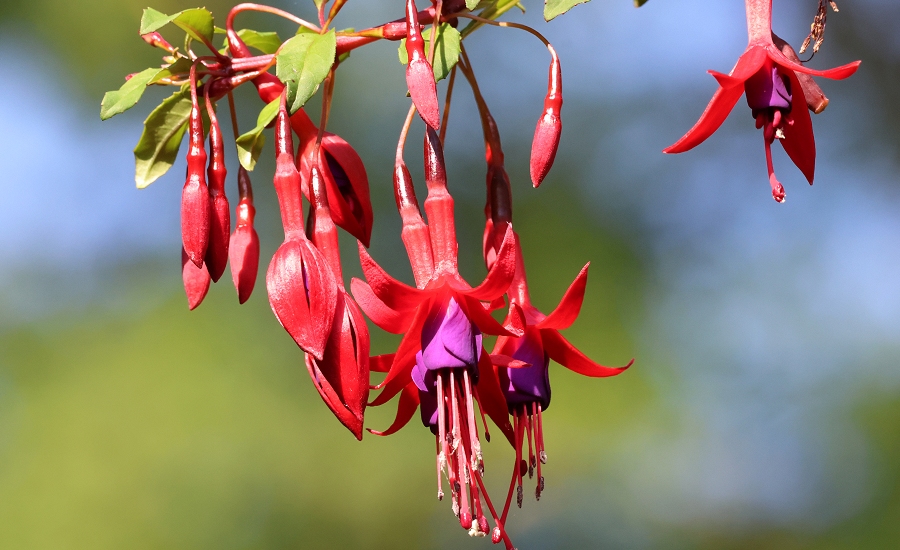
The schoolroom, in which the proceedings took place, presented a strikingly ornate appearance. Opposite the entrance was a collection of hot-house plants, and in the background were arranged asters of various hues on a bed of moss, fuchsias, geraniums, &c., the effect produced being very pretty; while each of the windows was tastefully decked with various plants, moss, and multi-coloured flowers; and altogether it was evident much time and care had been expended in order to give the room as attractive an appearance as possible.
Fuchsias, but not from Waters Upton in 1889! Photo by the author.

As the article continues, some idea of the extent of the support network enjoyed by Waters Upton becomes clear. Some of the people named were residents of the parish, and some were the neighbouring parishes of Ercall Magna and Bolas Magna (a few of them may be familiar if you have read Late Victorian Christmases in Waters Upton). Many however were from further afield…

The proceedings commenced shortly after two o’clock, by which time the room was crowded by those in sympathy with the undertaking, among those present at the opening stage, or subsequently, being the following:—The Rev. J. B. and Mrs. Davies (The Rectory), the Rev. W. T. Burges, R.D. (Newport), the Rev. and Mrs. Thomas (Tibberton Rectory), the Hon. Mrs. and Miss Herbert (Orleton), Mrs. and Miss Noble (Child’s Ercall Rectory), Mrs. Juckes (Tern), Mr. and Mrs. Taylor (Burleigh), Miss Rylands (Banshee House, Newport), Mr. and Mrs. Cornes, Mr. Cornes, jun., Mr. B. Steedman, Mrs. Steedman, and Misses Steedman, Mr., Mrs., and Miss Rider (Edgboulton), Mrs. Instone (Bolas House), Mrs. Cotton (Wall Farm), Mr. and Mrs. H. F. Percival, Miss Groucock, Mr. and Mrs. Jefferies (Bolas Mill), Mr., Mrs., and Misses Heatley (Eaton), Mr. and Mrs. Davies (London), Mrs. Taylor (The Hall), Miss Wright (Cold Hatton), Mr. and Mrs. Shakeshaft, Mr. and Mrs. Rider (Crudgington), Mrs. Davies and family, Mrs. Rider (Wellington), Mr. Wase Rider, Mr. J. V. T. Lander, Mr. and Mrs. Adney (Rowton), Miss Brookes (Rowton), Miss Price (Rowton), Mr. W. A. R. Ball, &c.

With the scene set, and the supporting cast introduced, the Reverend John Bayley Davies takes centre stage. The indefatigable rector was, I believe, the driving force behind the establishment, and the success, of Waters Upton’s school. He was soon talking about the subjects that I have expressed interest in…

The Rev. J. B. Davies, in opening the proceedings, said his first duty as rector of the parish and as one of the managers of the school was to give all who had kindly come forward to assist them in their object that day, a hearty welcome, especially to those who lived outside the parish, and he must say that Waters Upton had often received most valuable help during the past 20 years from their immediate friends and neighbours.
Proceeding, he said that 20 years ago, as perhaps some of them would remember, there was no school in the parish, nor any place in which a child could be taught, and he feared that many the children grew up very imperfectly educated. The Education Act of 1870, however, put them all upon their mettle, and they were resolved to do something.

There are a few things to unpack from the above, especially the second paragraph. First of all, was there really no school in the parish back in 1869? That depends on how you define ‘school.’ It is certainly true that at the time in question, there was no educational establishment in Waters Upton receiving Government funding and inspection.

Yet, if you look at the census returns for Waters Upton up to 1871 (and at other sources for the years before the 1841 census) there were teachers in the parish. Most, I believe, were teaching in what were termed ‘dame schools.’ The establishment run by Mrs Anne Walker (assisted by her daughter Sarah by the time of the 1871 census) was probably a step up from the others, and survived well beyond the opening of the village school. Several of Rev Davies’ predecessors also took in boarding pupils, for a fee, at the rectory.

So, there were certainly places within the parish where children could be taught – and if we look just a little beyond the parish boundary there were at least a couple more educational facilities that some from Waters Upton might have attended.
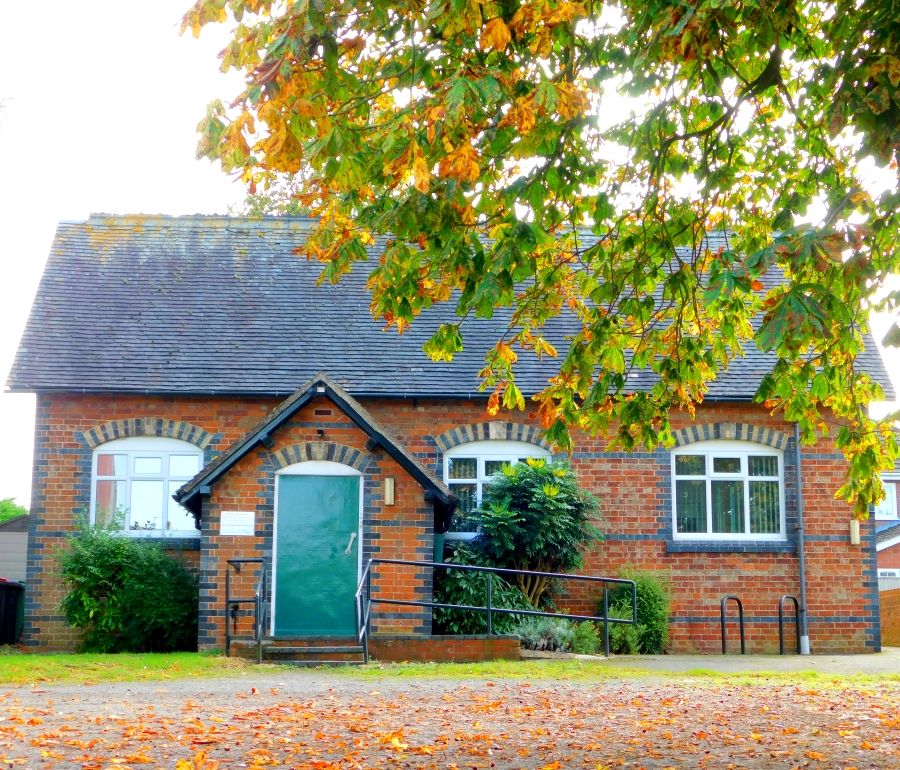
Waters Upton School in its present-day incarnation as the village hall. Photo by the author.

I will write in more detail about these various schools and teachers at another time; for now I will just say that the Rev Davies probably had good grounds for fearing “that many the children grew up very imperfectly educated”! And the rector was absolutely right to say that the Education Act of 1870 🡕 “put them all upon their mettle”. Under that Act, in 1873 the Education Department issued a notice that galvanised Rev Davies, and his supporters within and beyond the parish, into action.

That notice basically gave the residents of Waters Upton, Cold Hatton and neighbourhood an ultimatum. In a nutshell it said: A school for 100 children is needed in your area. If one is not provided voluntarily (for example, a ‘National School’ like the many others already established elsewhere by the Church of England) a ‘Board School’ (non-denominational, managed by an elected board, and paid for in part from the rates) will be established. A ‘voluntary’ school, tied to the Church, which would receive Government grants (and inspections) but not impose upon the ratepayers, was seen as the way to go. This took some determination. A lot of help was required – and was readily given…

Some difficulty was experienced in providing a school, in consequence of the small number of landowners in the parish, and the small extent of the parish, and because there were no very large incomes; but by uniting together, and with the help of others outside, they succeeded in effecting their purpose. (Applause.)
The school was built in 1874, and amongst others his late respected friend, Mr. Samuel Minor, of Meeson, gave them very valuable assistance. He prepared the plans, so that they needed no architect, superintended the building of the school, and gave other valuable help which it would have been impossible do without. (Cheers.)

John Bayley Davies then mentioned the bazaar held in 1876 to clear the initial debt on the newly-built school, and praised the “excellent teacher” then in place (Amelia “Minnie” Amos, who would soon be leaving – her story, and those of the other teachers at the school, will be told in due course).
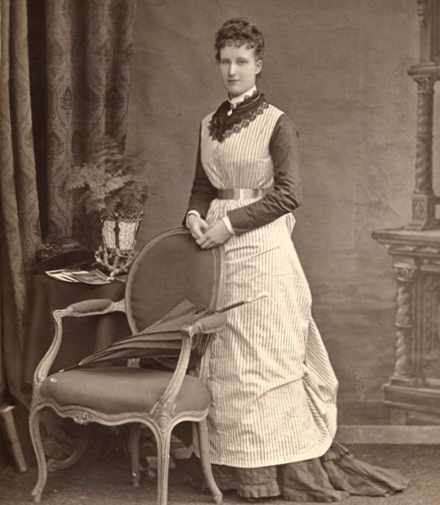
Lady Mabel Bridgeman, as she was before her marriage to Colonel Kenyon-Slaney. Photo from Forgotten Ancestors 🡕 (where you can read more about Lady Mabel), and used by the kind permission of Helena Cowell.

After the conclusion of Rev Davies’ speech the sale of work was formally opened: “Lady Mabel Kenyon-Slaney came forward amid considerable applause, and in a few neatly-chosen words, declared the sale open, and wished the promoters every success.” (This was followed by many more words from her husband, Colonel William Kenyon-Slaney, the local MP.)

According to the Wellington Journal, “Business was then briskly proceeded with, the ladies using their proverbially persuasive powers with highly satisfactory results.” Including donations, £89 18s. 8d was raised over the two days of the sale. If you would like me to share the details, by reproducing the rest of the newspaper article, leave a comment and I will add a Part 2 to this post!
Waters Upton in World War 2: Dorothy Tudge, Land Girl – Part 2

🡐 Part 1

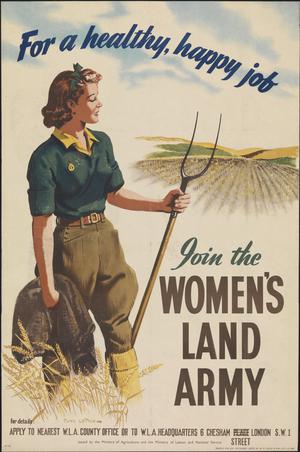
Women Needed for Land Army
If war should come the work on the land would have to continue, and women would largely take the place of men. At the request of the Board of Agriculture and Fisheries a Shropshire Women’s Land Army Committee has been formed, with Viscountess Boyne, Bridgnorth, as chairman […] Already there has been a good response from the Shropshire women. Applicants are being interviewed, and short holiday courses arranged for those who have little or no knowledge of farm work. […]
Shrewsbury Chronicle, 7 July 1939, page 16.
Image: IWM (Art.IWM PST 6078 🡕)

I have little doubt that Dorothy Tudge was one of the first Shropshire women to volunteer for the Women’s Land Army. Pinning down exactly when she became a ‘Land Girl’ is tricky though, given that the date is not shown on her WLA index card. Also, that card recorded Dorothy’s age as 29, which if accurate (hint: I’m pretty sure it wasn’t!) would mean that she joined in 1936, well before pre-WW2 recruitment had started.

There’s a little more to be gleaned from that index card. Dorothy’s WLA number was 3872, and her address was her family home: Whittingslow, Marshbrook, Shropshire. Her occupation when she joined was ‘Poultry worker’; her qualifications were “6 years practical experience in poultry work, specializing in laying battery work.” Evidently she had moved on from the dairy work she trained for in the mid-1920s.

Waters Upton

Dorothy expressed a preference for ‘mobile’ rather than local service, and she was duly placed on a farm at the other end of the county; her stint as a poultry worker at Waters Upton was most likely her first ‘posting.’ She was recorded on the National Identity Register on 30 September 1939 at The Grange, where she lived with 70-year-old widow Edith Moore and Edith’s daughter Eileen.

This type of accommodation for Land Girls 🡕 was known as private billets. Treatment of WLA ‘guests’ in such billets varied – I hope Dorothy’s experience was towards the ‘one of the family’ end of the scale. I suspect that her farming background would have counted very much in her favour.

While part of me wonders about the specifics of what her poultry work involved, another part of me wants to know how Dorothy spent her time when she was wasn’t working. Did she explore the local countryside? Take walks into the village to visit the shop or post letters, engaging in cheery exchanges of greetings or conversation along the way? Take part in evening social functions in the old school room (though these seem to have mainly taken the form of whist drives!)? She would almost certainly have accompanied Mrs Moore and her family to church services on Sundays.

I’ll write in more detail about the Moore family at a later date. Suffice to say for now that the 1934 Kelly’s Directory showed Edith’s husband Robert Edward Moore, farmer, at the Grange Farm; he died in 1935 and the 1937 Kelly’s Directory lists his son Robert Henry Moore in his stead. From the 1939 Register we can see that Edith continued living at The Grange, while her son Robert was based, with his wife and children, at The Grange Cottage (a little further down Catsbritch Lane). Robert was described in the Register as a ‘Mixed Farmer.’ I suspect that he did not have a poultry unit himself – I think it more likely that a tenant renting one of his cottages did, on a piece of land that went with the cottage.

There were three cottages, and nearly 190 acres of land, attached to The Grange Farm. All of this property was sold in September 1941 when the Moores moved on from Waters Upton. Perhaps that was when Dorothy departed too.

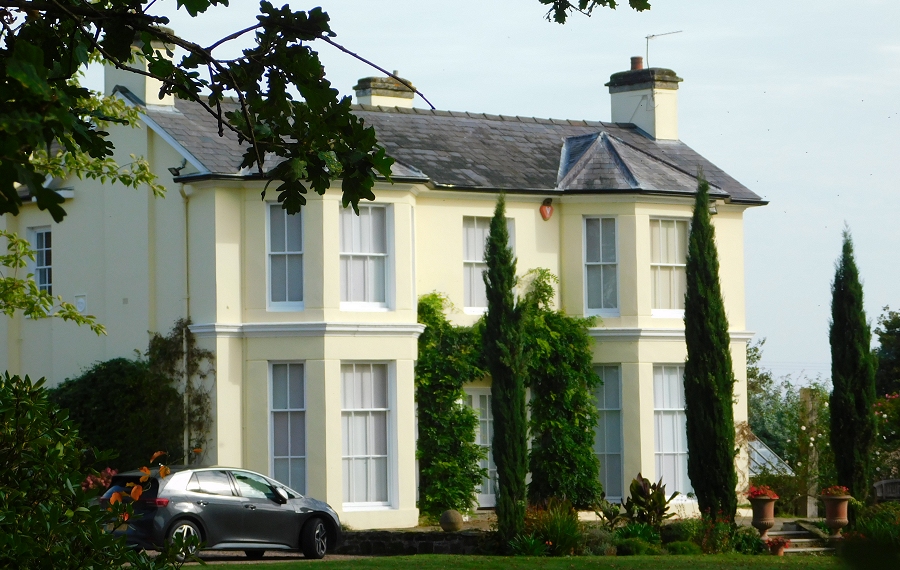
Waters Upton Grange as it appears today. Photo by the author.

Much Wenlock, then Whittingslow once more

By July 1942, Dorothy was based on the other side of Wellington from Waters Upton, at Bradley Farm, just North of Much Wenlock. I know this because of a lengthy report in the Shrewsbury Chronicle of 23 October 1942 (page 8) headlined “Petrol Rationing Offences.” Miss Constance Jean Conroy was at the centre of this case, as the person who illegally received and used petrol coupons; she was fined £40 in respect of eight offences. Dorothy Tudge, one of the parties who had transferred coupons to Miss Conroy, was fined a grand total of £1!

Meanwhile, other members of the Tudge family were also involved in the war effort. Dorothy’s father William was a Lieutenant in the Whittingslow Home Guard Platoon (Shrewsbury Chronicle, Fri 21 May 1943, page 4). Her brother Herbert meanwhile had joined the RAF. His active service was sadly short-lived…

From All Round The Wrekin
News of Missing R.A.F. Officer
A few weeks ago Squadron-Leader A. J. [= H. J.] Tudge, son of Mr. W. B. Tudge, of Whittingslow, Marshbrook, was reported missing from an operational flight over Northern France. During the present week he has been officially reported to be a prisoner of war. The news has come as a great relief to squadron Leader Tudge’s relatives and friends in South Shropshire. […]
Shrewsbury Chronicle, 1 Aug 1941, page 4.

While confirmation that Herbert was a prisoner of war was good news considering the alternative, this meant that he spent most of the war in Stalag Luft III. The Shrewsbury Chronicle of 22 December 1944 (page 5) conveyed the news that Herbert’s parents had received a photo showed Herbert and other officers taking part in a play staged at the prison camp, “Blithe Spirit,” in which Herbert played a female part. A copy of the photo appeared in the paper’s edition of 12 January 1945 (page 6).

Notices in the Shropshire press towards the end of 1944 suggest that Dorothy Tudge was by then back on ‘home turf’ and had, along with her cousin Helen Maybery, turned her hand to rearing pigs. Those notices (including one on the front page of the Shrewsbury Chronicle of 13 Oct 1944) related to the annual sale of pedigree and commercial pigs at Shrewsbury, scheduled for 27 October. Those entering animals to the sale included “Misses Tudge and Maybery, Marshbrook (Large Blacks)”. After that, news on Dorothy’s whereabouts and activities is hard to find for a while. Let’s return to her obituary to pick up the latter part of her story.

Wadhurst

In 1953 she and her mother, who survives her, came to live in Wadhurst, where they made many friends. Miss Tudge was active member of the Women’s Institute, of which she was branch treasurer for several years, and was a supporter of many other local activities. She also worked for a number of charities and was a regular member of Tidebrook church […]
The Courier (Tunbridge Wells), 17 Dec 1976, page 22.
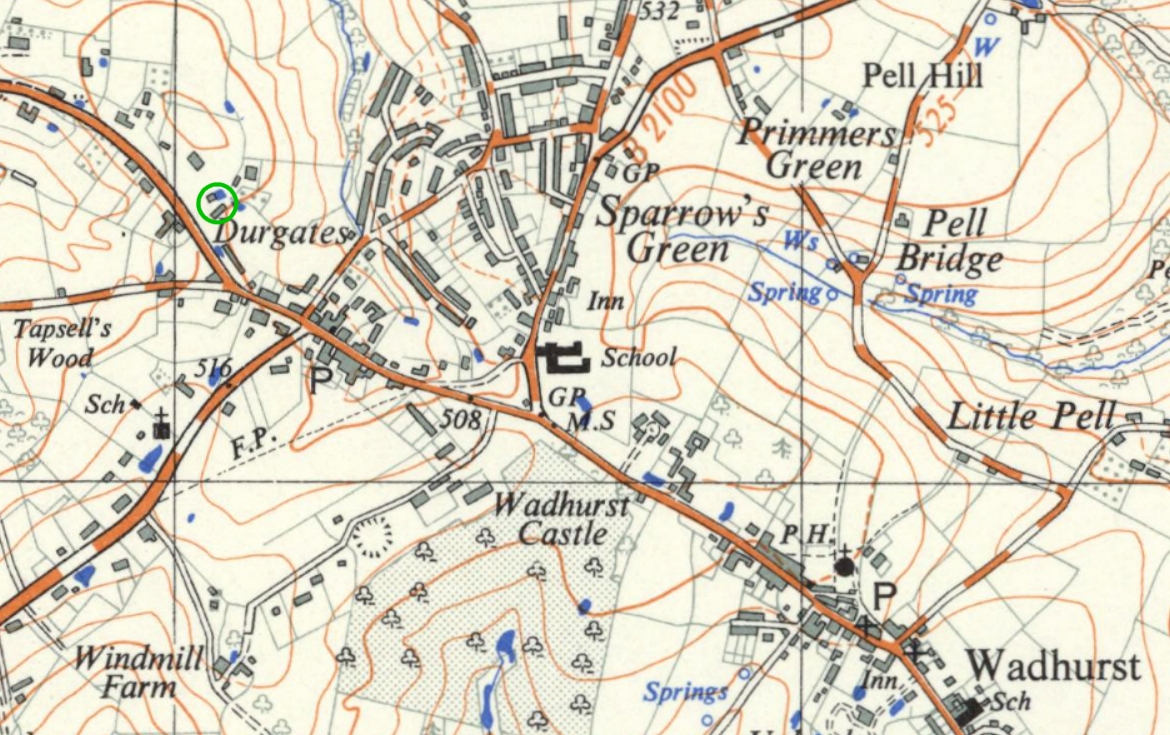
Extract from a 1:25,000 scale Ordnance Survey Map covering Durgates, Sparrow’s Green, and Wadhurst. I have added a green circle to highlight Great Durgates Farm. Map reproduced with the permission of the National Library of Scotland 🡕 under a Creative Commons licence 🡕. Click on the image to view a larger version.

Dorothy’s father William Tudge went to Wadhurst too. He was included in the household at Great Durgates Farm on the 1955 electoral register for the East Grinstead Constituency. Sadly, he had died by the time the register came into force in February that year. The Wadhurst burial register shows that he was buried at the parish church on 10 December 1954.

Dorothy, as her obituary shows, became an active member of the local community she had joined. I have not found any information about the ‘other local activities’ she supported, or which charities she worked for. Her involvement with the local Women’s Institute, however, can be tracked – in part – via newspaper reports.

The earliest such report that I’ve discovered dates from June 1965, when Dorothy was one of three WI members who got full marks in the competition “My prettiest piece of china” (Kent & Sussex Courier, 4 June, page 16). Dorothy is recorded as Treasurer in 1969 (same title, 21 February, page 13), and in 1973 her efforts to collect information and photographs relating to the early years of Wadhurst WI were publicised (same title, 1 June, page 2, and Sussex Express, 5 October, page 20). The final snippet that I’ll share appeared in the Sussex Express, 30 December 1976, page 26:

WADHURST Women’s Institute held its Christmas fair at St George’s Hall. It opened on a sad note, when silence was observed in memory of Miss D. M. Tudge, a great worker for the branch for many years, who died recently. […].
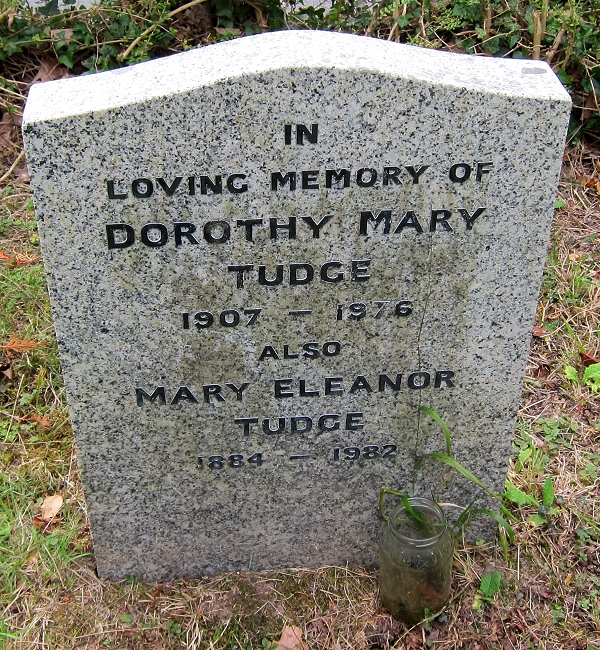
Photo from Find a Grave 🡕 – my grateful thanks to Rebecca Stewart for permission to use it here.

Dorothy’s obituary in The Courier concluded by noting that her funeral took place on 13 December 1976, at Tidewell. Her mother, after dying at the age of 97, joined her there in 1982.

A gravestone in Tidewell churchyard marks the spot where the former Land Girl of Waters Upton and her Mum lie together in eternal and well deserved rest.

Waters Upton in World War 2: Dorothy Tudge, Land Girl

Miss Dorothy Tudge, of Great Durgates, Wadhurst, died at the Kent and Sussex Hospital on Wednesday of last week. She was 69. Born into a farming family in Shropshire, Miss Tudge lived there for much of her early life and served through the Women’s Land Army throughout the war. […]
– The Courier (Tunbridge Wells), 17 Dec 1976, page 22.

Recently I looked again at one of the people recorded at Waters Upton when the National Identity Register was compiled at the end of September 1939. Dorothy M Judge, born 15 January 1907 – why could I find no other records for her? Looking again at an image of the register page, the answer dawned on me: I had misread Dorothy’s surname, the ‘J’ was in fact a ‘T’. Oops. (The transcribers working for Ancestry and Findmypast made the same mistake; I have submitted corrections to both.)

With Dorothy’s true name established I could finally find and link together records relating to her, and piece together what remains of her story. Where better to start than at . . . the end? Well, it struck me that Dorothy’s obituary, the ‘potted history’ of her life shared by way of remembrance just after her death, provides a framework upon which a more detailed account could be constructed – and can now be shared.

Stepaside

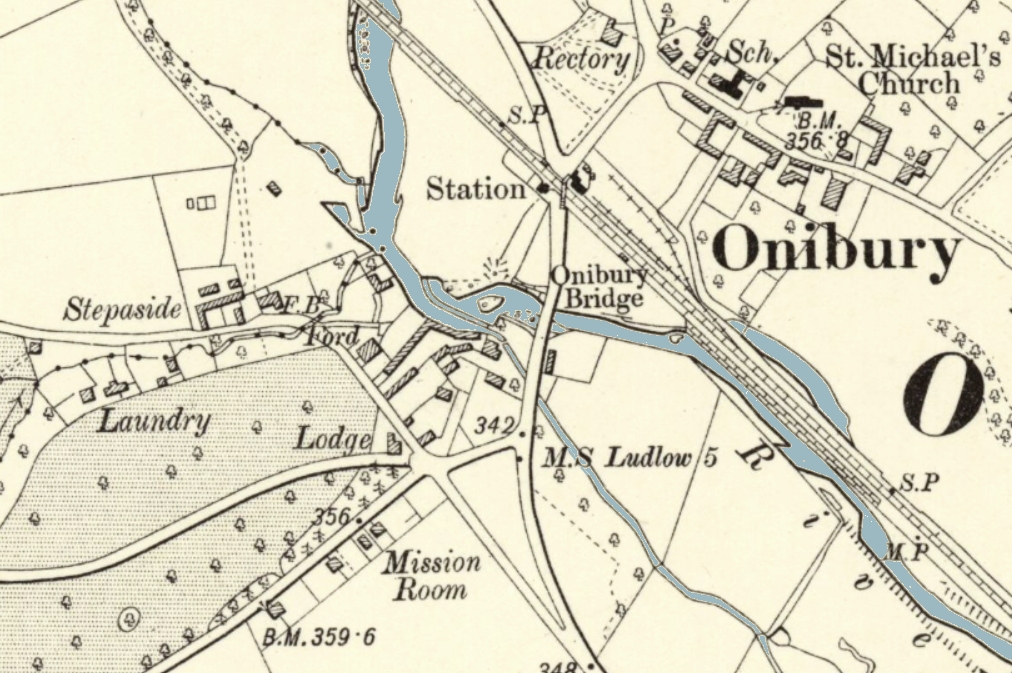
As we have seen, Dorothy Mary Tudge was born in January 1907, in Shropshire. I think the exact location was most likely the place where she and her family were enumerated on the 1911 census: Stepaside. This lies on the edge of the parish of Stokesay, then part of the Ludlow Registration District 🡕 in which Dorothy’s birth was duly registered 🡕. It also lies right next to the village and parish of Onibury.

The village of Onibury and nearby Stepaside, on a large scale Ordnance Survey map. Extract reproduced with the permission of the National Library of Scotland 🡕 under a Creative Commons licence 🡕. Click on the image to view a larger version.

The household at Stepaside recorded on the 1911 census was headed by Dorothy’s father William Bradford Tudge, aged 29, a farmer born at Leominster in the neighbouring county of Herefordshire. William’s wife was Mary Eleanor, 26, a native of nearby Wistanstow. She had been married to William for five years (their wedding took place at Stokesay on 14 March 1906 🡕) and two children had been born of their union. Dorothy, then 4, we know about of course. The other child was a very new addition to the family: Herbert John Charles Tudge, age “under one month.” Enumerated with the Tudges were a maternity nurse, a ‘lady help,’ a general domestic servant, and a cowman.

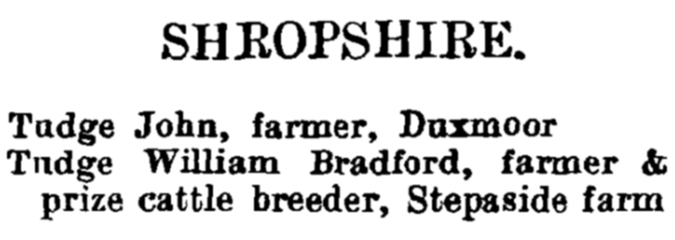
Stepaside Farm was still this family’s home in 1913, when William Bradford Tudge, “farmer & prize cattle breeder,” was listed in that year’s Kelly’s Directory of Shropshire 🡕 as part of the entry for Onibury (the snippet from the directory, on the University of Leicester website 🡕, is used under a Creative Commons licence 🡕). His details appeared just below those of his father John, who farmed at Duxmoor. These listings were repeated in the 1917 directory (viewed at Ancestry: Herefordshire and Shropshire Directories, 1917).

By 1921, William Bradford Tudge had taken his family to live with his parents John (71) and Helen (68) at ‘Duxmore’. William’s occupation was given as “Assisting Father.” Dorothy, then aged 14, was not with her family however. She was instead boarding elsewhere in the county.

Wellington

Hiatt Ladies’ College in Wellington was Dorothy Tudge’s home away from home, presumably for several years. This institution was established in 1847 🡕 by Mrs Elizabeth Hiatt, née Keay (whose Crudgington-born father John, incidentally, was baptised in November 1801 at Waters Upton). Allan Frost, author of a book on the history the college, is quoted by the Shropshire Star in 2019 🡕 as saying that it was “the first college intended purely for the education of young ladies in the country.”

It appears that the college did an excellent job too. A list of students with top educational attainments published in The Educational Times of 1 February 1906 (pages 91 🡕 and 92) includes five names from Elizabeth Hiatt’s establishment, and there are other examples to be found.

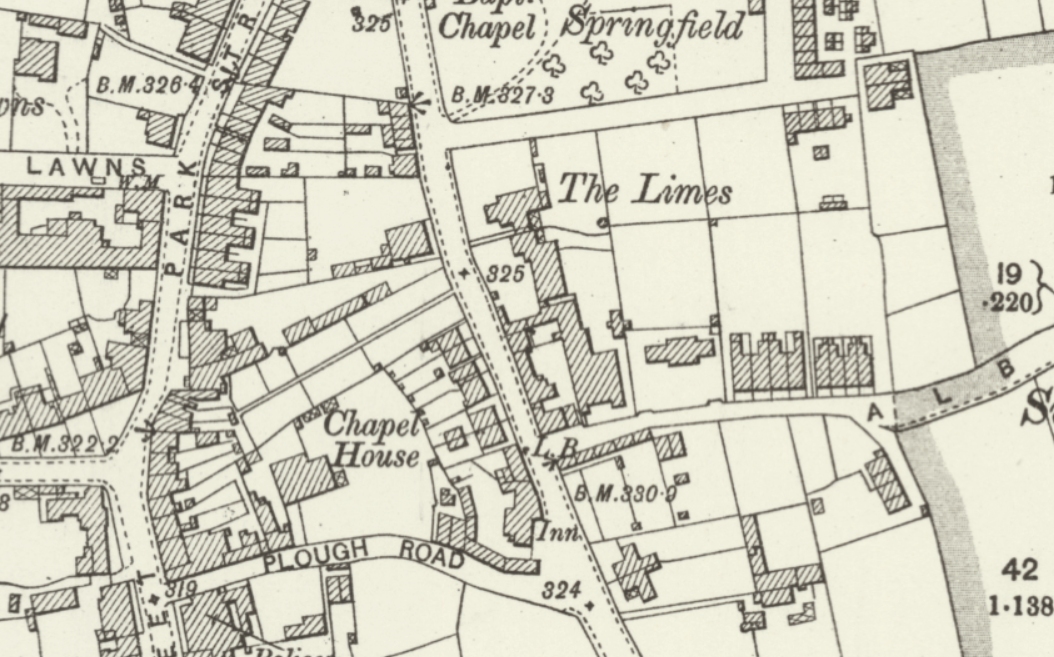
King Street, Wellington (running North-South down the centre of this map extract) as shown by large-scale Ordnance Survey mapping. Mrs Hiatt used to live at The Limes; the college buildings lay immediately to the South, down to the junction with Albert Road. Map reproduced with the permission of the National Library of Scotland 🡕 under a Creative Commons licence 🡕. Click on the image to view a larger version.

The census of 1921 shows that in addition to the head, May Margaret Daniels, there were 11 other mistresses, teaching English, French, science, history, music, art, and gymnastics. In addition the college had a matron, an assistant matron, and a nurse. Dorothy Tudge was one of 55 pupils, aged from 10 to 17, most of whom came from Shropshire and the neighbouring counties of Cheshire, Staffordshire and Warwickshire.

I would love to know what Dorothy’s educational accomplishments were during her time at the college, not to mention her other experiences and how she adjusted to a very different way of life after her childhood on a farm. Who were her friends? What did they get up to when not in class? Did they break the rules, and if so, were they caught?

Cwm Head, Radbrook, and Whittingslow

As for the length of time Dorothy attended Hiatt Ladies’ College, my guess is that she was there from around 1917 to about 1923. A report in the Wellington Journal of 19 January 1924 (page 5) then places her back in the South of Shropshire, and pursuing an interest in dairy work. The report, covering a meeting of the Salop Agricultural Committee, noted that:

Dairy scholarships of the value of £15 each tenable for ten weeks at the Shropshire Technical School for Girls, Radbrook, near Shrewsbury, had been awarded to the following:— […] Marshbrook Butter-making Class— […] Miss Dorothy M. Tudge, Cwm Head House, Church Streeton; […]
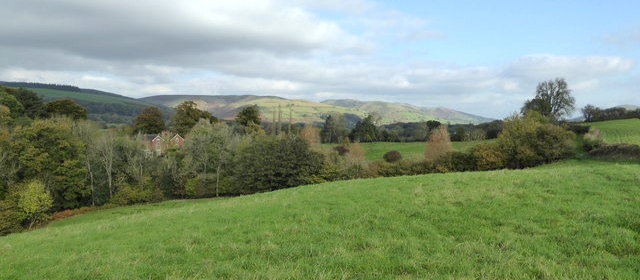
View from above Cwm Head Farm. Photo © Jeremy Bolwell, taken from Geograph 🡕 and modified, used, and made available for re-use under a Creative Commons licence 🡕.

Did Dorothy delay taking up her ten week scholarship? Or did she stay at Radbrook for a lot longer than ten weeks? Some 18 months after the above report, the same newspaper carried (on 25 July 1925, page 5) details of the distribution of prizes at Radbrook Technical School. Amongst those presented with certificates and prizes by Lady Harlech was Miss D Tudge, who received a school certificate for dairy work – first class.

Over nearly all of the following 15 years, Dorothy seems to have ‘flown under the radar’ as far as the press was concerned. In complete contrast, her father and her maternal aunt, Mrs (Katie) Maybery, were regularly in the local newspapers thanks to their prize-winning herd of dairy Shorthorn cattle. From earlier examples of this media coverage (including the Shrewsbury Chronicle, 8 Apr 1932, page 8) it appears that the herd was established at Cwm Head around 1926, before the operation moved (in about 1929 I believe) to nearby Whittingslow Farm, Marshbrook. Though she spent time away from her family, these farms – especially Whittingslow – were home.

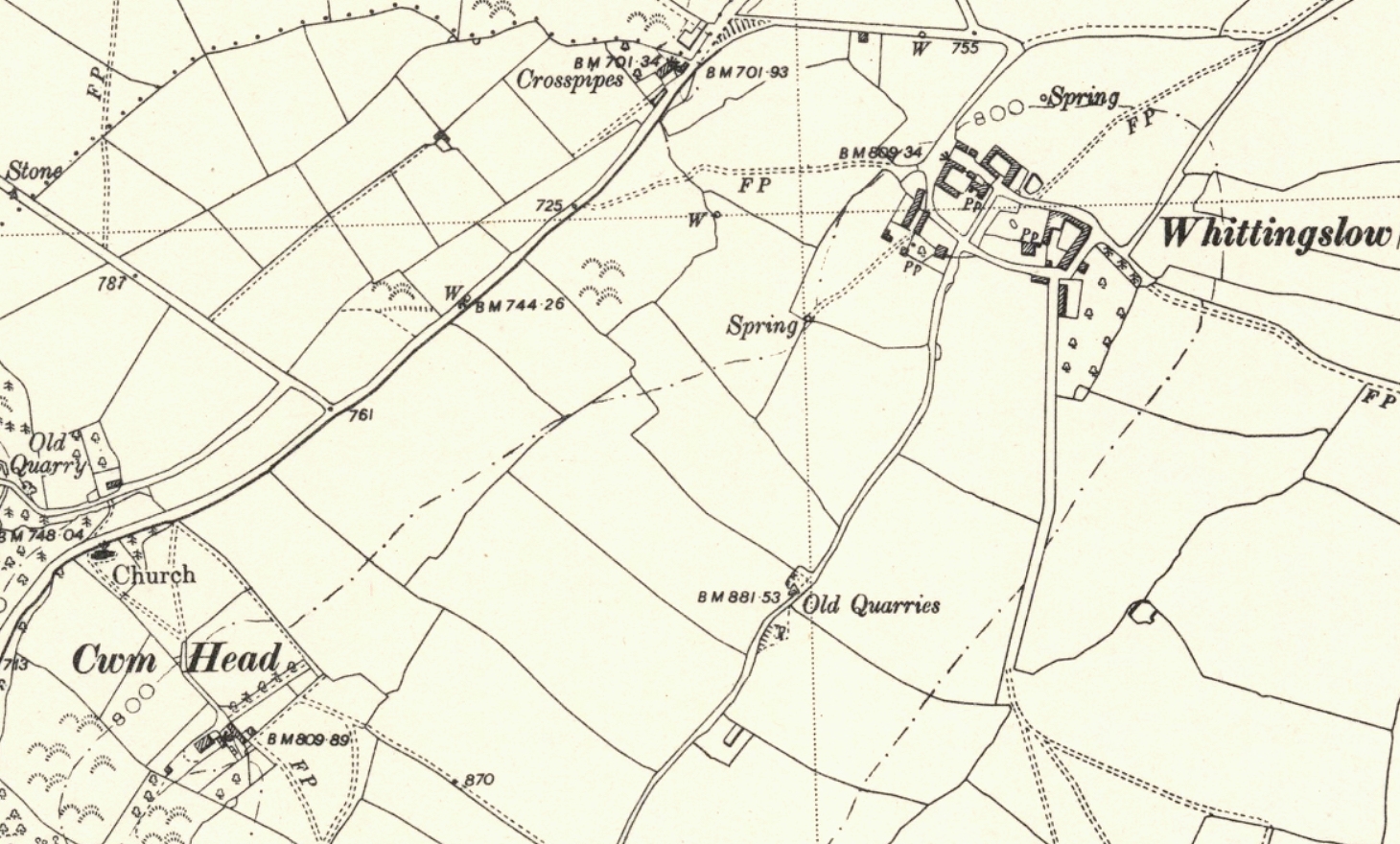
Cwm Head and Whittingslow, as shown on large scale Ordnance Survey mapping. Map extract reproduced with the permission of the National Library of Scotland 🡕 under a Creative Commons licence 🡕. Click on the image to view a larger version.

Surrey, and back to Shropshire

Dorothy spent at least part of this time living – and presumably working – in Surrey. Electoral registers record her there in 1930 and 1931 living at 75 Langley Park Road, Sutton, with Ada and Caroline Absale (sadly, she probably didn’t make jokes about them descending vertical rock faces or the sides of tall buildings with the aid of ropes). She also appeared in a 1933 electoral register, at Chalklands, Woodland Road, Little Bookham, with Thomas and Edith Weaver.

Those few occasions when Dorothy’s name did appear in the papers during this period were sad ones – the funerals of her grandparents. The last of these events was the interment of Dorothy’s paternal grandmother Helen Tudge, who died in on the 4th, and was buried on the 8th, of February 1937. Reporting on Helen’s death and funeral, the Shrewsbury Chronicle (12 Feb 1937, page 16) noted that she was a member of the local Women’s Institute and the Women’s Conservative Association, as well being a “fervent church woman”. At least one of those things would rub off on Dorothy.

Two years later, Britain was at war, and members of the Tudge family stepped up to play their parts. For Dorothy, this would include working at Waters Upton.

Part 2 🡒

A Man Found: Thomas Plant, of the Parish of Waters Upton

🡐 Part 1 (A Man Missing)

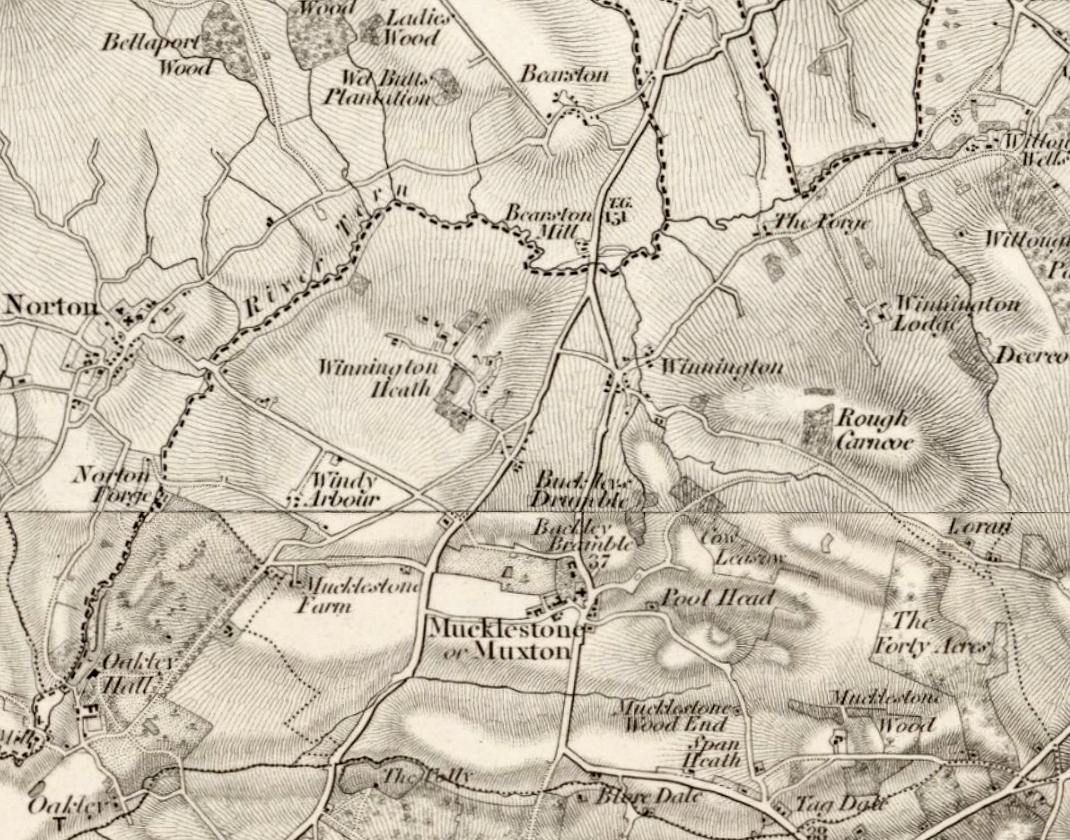
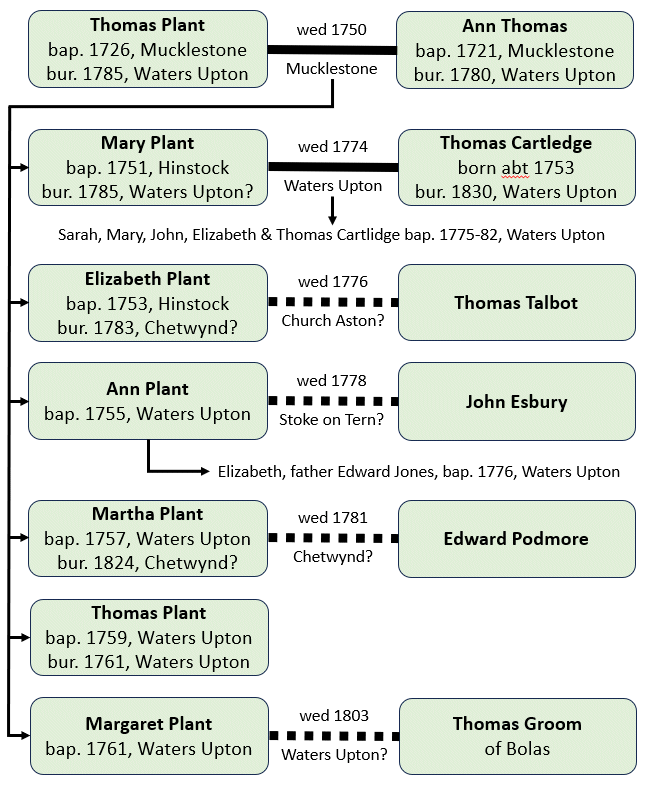
It appears that Thomas Plant of Waters Upton originated from Mucklestone, a parish which back then included parts of both Shropshire and Staffordshire. The baptism of “Tho: Plant Son of John Plant & Eliz: his wife” took place on 18 September 1726 🡕 (making Thomas just under 50 rather than “upwards of” that age at the beginning of 1776). Then, on 4 September 1750 🡕 and also in Mucklestone, the wedding of “Thomas Plant & Ann Thomas both of this Parish by Banns” took place.

Mucklestone and nearby settlements, as mapped in the 1800s. Image created from two maps, reproduced with the permission of the National Library of Scotland 🡕 under a Creative Commons licence 🡕. Click on the image to view a larger version.

The Thomas Plant who was baptised in 1726 would have been 23 or maybe 24 years old when the above marriage took place, so I think the chances are good that he was the groom. What, though, are the odds that he was also the Thomas Plant who, with wife Ann, had children at Waters Upton a few years later and, later still, went a-wandering just before the snowfall of the century?

Another question: there was a gap of about five years between the marriage of Thomas Plant and Ann Thomas in 1750, and the first baptism of a child of Thomas and Ann Plant at Waters Upton in 1755 – were there any children born in that gap who might belong to this family?

In my attempt to answer the second question, I turned to Findmypast. This website has excellent collections of digitised and indexed parish registers from both Shropshire and Staffordshire (although oddly, while there are images of the register containing Thomas Plant’s baptism, that register has not been indexed). In addition, they have a very useful way for subscribers to search for vital events from across their record sets. This allows us to look for events falling within a range of distances from a particular place.

“Daughter[s] of Thomas & Ann Plant of Chetwyn Parish”

After using this search functionality I found myself focussing on two of the baptisms it revealed, both falling in the period from 1750 to 1755, and both at Hinstock (about seven miles away from Mucklestone, as the crow flies). First, on 6 Aug 1751 🡕, there was Mary. Then, on 20 May 1753 🡕, there was Elizabeth. Each of these girls was described in the parish register as being a “Daughter of Thomas & Ann Plant of Chetwyn Parish”.

For ‘Chetwyn,’ by the way, read Chetwynd: the Plant family had probably, erm, planted themselves somewhere in the north of that parish, such as Sambrook. At that time Hinstock’s church would have been closer than the one in Chetwynd village (Sambrook St Luke 🡕, shown on the map below, was not built until 1856).

Depending on exactly where in the northern part of Chetwynd parish the Plants were living, the distance by road from their abode to Waters Upton might have been somewhere between six and eight miles, or thereabouts. Did the Plant family of Chetwynd travel those roads and become the Plant family of Waters Upton? After researching their children, I believe they did.

Hinstock and parts of the neighbouring parishes of Childs Ercall and Chetwynd, as mapped in the late 1800s. Map reproduced with the permission of the National Library of Scotland 🡕 under a Creative Commons licence 🡕. Click on the image to view a larger version.

My attempts to find out what happened to the Plant children have met with mixed results. The fate of Thomas Plant junior was all too easy to determine. Turn over a leaf of the Waters Upton parish register, from the pages showing his baptism in 1759, and you find the burial of the same “Thomas Plant the Son of Thomas and Ann Plant”. He was laid to rest on 11 August 1761, his second birthday having been his last. As for the sisters of this unfortunate boy, I’ll look at them in order, from the youngest to the eldest.

Margaret Plant was baptised in the month following her brother Thomas’s burial. It appears that she may have married in her home parish – at the age of 42. Banns of marriage between “Thomas Groom of the Parish of Bolas, Bachelor, & Margaret Plant of this Parish, Spinster” were published on three successive Sundays, May 1, 8 and 15, prior to the nuptials at Waters Upton on Monday 16 May 1803.

I have looked for baptism records for any children who may have been born of this union, in case the bride was another, younger Margaret Plant, but have found none.  Neither, sadly, have I found death or burial records that I can link with any certainty to Thomas or Margaret, confirming their ages.

Even more speculative are my conclusions regarding Martha Plant. She may have married Edward Podmore at Chetwynd on 29 December 1781 🡕. If she did, she might have ended her days in that parish: Martha Podmore of Chetwynd End, age 70, was buried at Chetwynd on 6 December 1824 🡕.

“Elisabeth, the base-born Daughter of Ann Plant”

For Ann, there is another entry in the Waters Upton parish register besides her baptism which almost certainly relates to her – and to her daughter. On 7 March 1776 “Elisabeth, the base-born Daughter of Ann Plant by Edward Jones of Kidderminster” was baptised.

I am not at all certain what happened to baby Elizabeth, although I hope she survived, thrived, and was supported financially by the man who fathered her out of wedlock. I don’t think Ann married Edward Jones. She may have been the Ann Plant who wed a man whose name has been transcribed as John Esbury, at Stoke Upon Tern on 23 June 1778 🡕.

Further guesswork is all that I can offer in the case of Ann’s sister Elizabeth Plant. She was possibly the bride of Thomas Talbot, in a marriage solemnised at Church Aston on 28 December 1776 🡕. She might then have been the widowed Elizabeth Talbot of Chetwynd Heath who was buried 6 April 1783 🡕 at Chetwynd.

For the firstborn child of Thomas and Ann Plant I believe I can offer greater certainty. Following the publication on 20 and 27 November and 4 December 1774 of Banns between “Thomas Cartledge and Mary Plant both of this Parish”, that couple were married at Waters Upton shortly afterwards on 15 December. Both parties made their marks rather than signing the register. One of the witnesses who likewise made her mark was Ann Plant, who was likely to have been either the mother or the younger sister of the bride.

Mary, you might remember, was one of the two Plant girls baptised at Hinstock. This marriage, I think, confirms her (and her sister Elizabeth) as part of the Plant family of Waters Upton. In which parish Thomas and Mary Cartledge remained after their wedding. Five children, Sarah, Mary, John, Elizabeth and Thomas, were born to this couple, all baptised in the church of St Michael in the latter half of the 1770s and the early 1780s, the surname in each case written as Cartlidge.

“Thos. Plant a Pauper”

Let’s return to the parents of these children, Thomas and Ann. There are burials for both of them in the Waters Upton register. “Ann, the Wife of Thomas Plant, aged 62” was interred on 9 May 1780. Despite the slight age discrepancy, I think that makes her “Ann ye daughter of John Thomas of [probably Napley – part of the page is missing] Laborour”, baptised 30 January 1720/21 🡕 at Muckleton.

Notice that the register entry for Ann’s burial refers to her as the wife, not the widow, of Thomas Plant. Thomas did survive the spectacular snowfall of January 1766, and at some point he did return to Waters Upton. His burial, on 27 December 1785, was entered in the parish register as “Thos. Plant a Pauper, aged”. Possibly the clerk meant that Thomas was aged as in old, but more likely I think is that Thomas’s age was never ascertained and the register entry was left incomplete.

Wait though – Thomas, a farmer in 1776, was a pauper at the time of his death? This is entirely possible. He may have been what we would now call a smallholder, renting and cultivating (and/or grazing livestock on) a  relatively small acreage. And he may have suffered a setback, in the form of crop failure, diseased livestock, or personal ill-health for example, which left him unable to keep the farm and support himself in his later years.

Perhaps Thomas’s trip to Staffordshire (or wherever he actually went!), followed by his failure to return home for a couple of months or more, was the first sign that things were not well with him, with his farm, or with his finances. In which case, a cynic might take the view that Thomas’s ‘afflicted friends’ were actually creditors trying to track down the man who owed them money.

I prefer to believe that Thomas had friends who genuinely cared about him. Friends within his local community who were so concerned by his disappearance in the dreadful winter weather of January 1776, that they were prepared to pay for notices in newspapers in the hope of finding him alive and reuniting him with his family. Thomas Plant, the blue-suited ‘stout made man’ of Waters Upton, may have ended his days financially impoverished, but well off in that priceless commodity known as friendship.

A Man Missing: Thomas Plant, of the Parish of Waters Upton

A Man Missing:
THOMAS PLANT, of the Parish of Waters-Upton, in the County of Salop, Farmer, having left his Family early upon Friday Morning, the 5th of January last, in Order (as he said) to Visit his Friends in Staffordshire for a few Days; and not having been heard since, though diligent Enquiry has been made after him: This is to request the Favor the Public, if they know any Thing of him, to give immediate Notice thereof to the Printer of this Paper, who will take Care to Inform his afflicted Friends. […]
Shrewsbury Chronicle, 9 Mar 1776, page 3.

Imagine being the “afflicted Friends” – or indeed the family – of Thomas Plant. Off he went one day, saying he was visiting friends in the next county, but two months later he had not returned and no word had been received as to his whereabouts. Concern for Thomas’s wellbeing was heightened by the severe winter weather that followed his departure. The above notice in the Shrewsbury Chronicle continued:

It is feared that, as he went away just before the great fall of Snow, he Perished therein.
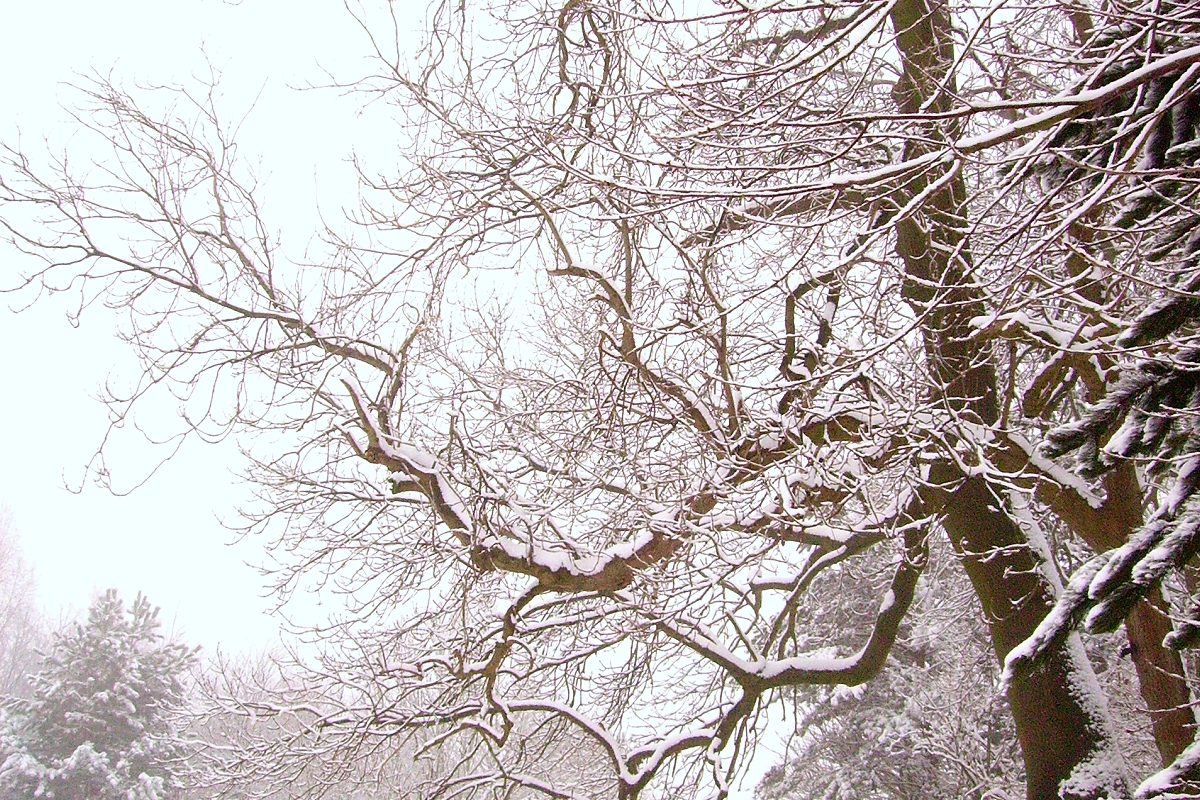
Trees with snowy branches. Photo by the author.

“there never was known in this kingdom so deep a snow”

The description of the snowfall, and the fear expressed that it may have proved to be terminal for Thomas, were not exaggerations. Back on Saturday 13 January, the Shrewsbury Chronicle had reported (on page 3) that “the amazing fall of snow on Saturday night and Sunday last” had rendered the roads from Wolverhampton to Birmingham, and from there through Coventry to London, “intirely impassable.” Furthermore, a woman had been found dead in the snow in Worcestershire.

By the following Saturday, more reports of people lost in the snow had been received, and the Chronicle’s editor stated (again on page 3):

From the best accounts we can collect, there never was known in this kingdom so deep a snow as the present. The communications with London and other places, not only by carriages, but even by horses, were entirely shut for several days. The London mails due on Monday and Thursday last week, did not arrive here till Monday morning last.

Difficulties were still being experienced during the ensuing week. Along with snow-related reports from around the country however, the Shrewsbury Chronicle of 27 January also carried (on page 3 once more) news of local acts of charity. In Shrewsbury itself, William Pulteney and John Corbet, esquires, had paid for nearly 40 wagonloads of coal to be distributed among the poor of the town. A similarly generous helping of coal was also given to the poor of Shrawardine and Montford, by Lord Clive. And thanks to Lord Pigot, “a loaf and cheese were given to every person in Bridgnorth that would accept of them”  – that edible offering was accepted by nearly 900 people!

“The Wings of small Birds were so frozen that they fell to the ground”

Another source of information on the severity of the weather in Shropshire at the beginning of 1776 is the parish register of Whittington. In that register the rector, Reverend William Roberts, liked to record far more than just baptisms, weddings and burials. His entries for 1776, which I have transcribed from copies of the original register at Findmypast (another transcript can be found on Mel Lockie’s website 🡕) began:

The New Year is set in with a dreadful fall
of Snow wch began on the 6th at night blown
in drifts by a brisk Easterly Wind, that It lies
in several parts seven feet deep, & has render’d
it impossible for the Mails to pass […]

After a couple of baptisms, Rev Roberts’ weather observations continued at the end of January and into February:

30th         The Snow continues so deep & the Frost so
severe that the London Mails have not yet
come in regularly. The 21st was remarkable for
intense cold, and the 27th nearly as keen.
Feb: 1st    A drizzling Rain wch. fell partly in Icicles, and
froze as it fell, many accidents happen’d from the
slippery surface of the paths wch. were
perfectly glazed. Travellors Cloaths instead of being
wet, were So stiffly congealed about them, that It
was with difficulty They were got off. The Wings
of small Birds were so frozen that they fell to the
ground, many were pick’d up & others
Feb: 2d     died frozen to the ground. The next day a gentle
Thaw began to discover the face of the earth, wch
had been hid for so long a time.
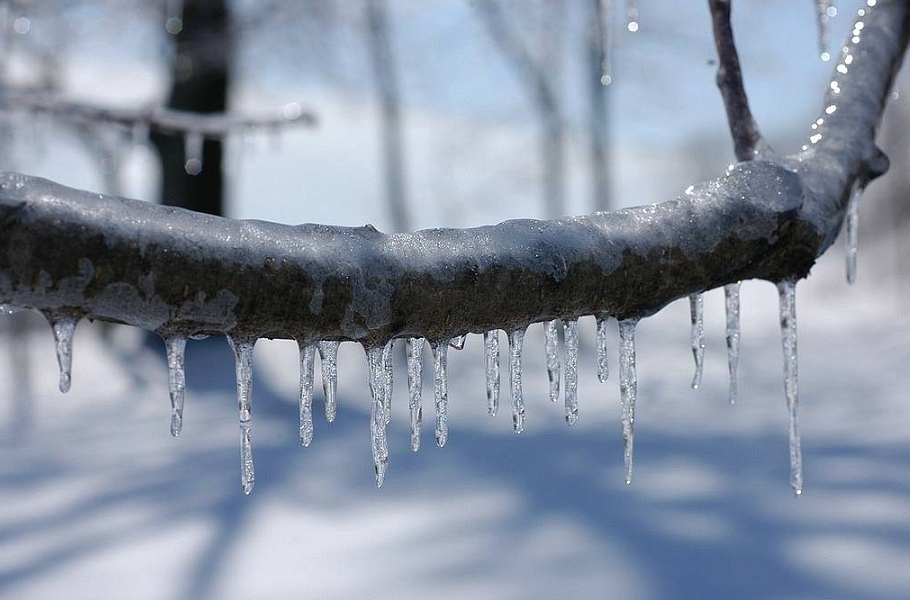
An ice-covered branch. Public domain image from Pixabay via Picryl.

I think you can now fully appreciate the severity of the weather which descended upon Shropshire and many other parts of England, on the evening of the day after Thomas Plant left his home in Waters Upton in January 1776. Was he lost, or can we find the poor man?

To clarify: I’m not suggesting that we invent time travel and go back to look for our missing man. What I am wondering is, can we find Thomas in the records, and can we determine whether or not he survived, and returned to Waters Upton?

“A stout made Man”

Sadly I’ve found nothing about Thomas in the newspapers following the appeal that was made two months after he set off for Staffordshire. However, that appeal (a version of which also appeared on page 3 of Aris’s Birmingham Gazette on 11 Mar 1776) concluded with information about Thomas, to aid in his identification:

The above-named THOMAS PLANT is a stout made Man; upwards of 50 Years of Age; 5 Feet 9 Inches high; of a dark Complexion, with black Hair turning grey; He had on when he left Home, a Suit of blue Cloaths, with Basket Buttons of the same Colour, and wears his Hat turned up on the Sides, but not close cocked; rather Stoops in his Walk, and has an awkward Gait. Waters-Upton, March 9th, 1776.
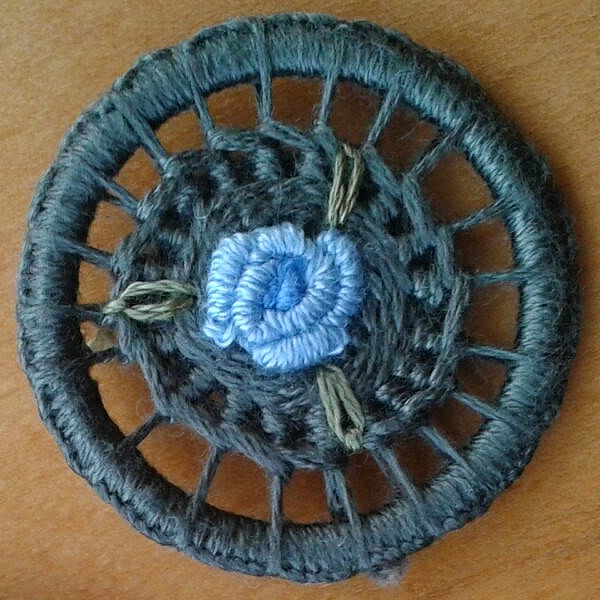
A Dorset crosswheel button. Adapted from a photo by Abigail Seabrook @Moretta Designs and modified, used, and made available for re-use under a Creative Commons licence.

How fantastic to have this pen-picture of our wanderer from Waters Upton! If, by the way, you are intrigued (as I was) by the ‘Basket Buttons’, they were often known as Dorset buttons 🡕 and were hand-made by “repeatedly binding yarn over a disc or ring former.” Very popular in the 18th century apparently. Not that this helps us in tracking down Thomas!

A more useful piece of information for our purposes is Thomas’s age. It’s a little vague, and might not have been entirely accurate, but it helps to narrow down the field when searching for him in the records. In addition, we know that although he lived in Shropshire, he (supposedly) left home to visit friends in Staffordshire. Might he have had family in that county too?

To the above leads, I can add more from my abstracts of baptisms at Waters Upton. There are four, in the latter half of the 1750s and another in 1761 which are of particular interest. Anne, Thomas, and Margaret, children of Thomas and Ann(e) Plant, were baptised on 18 May 1755, 25 March 1759, and 26 April 1761 respectively. In between the first two of those children, with no parents named but almost certainly another child of Thomas and Ann, there was Martha Plant, baptised on 2 October 1757. I think it is reasonable to conclude that these were children of the man who went walkabout from Waters Upton in 1776.

This information allows a search not only for Thomas Plant’s own baptism, but also for his marriage to Ann. Carrying out such a search, I soon spotted parish register entries which very likely recorded both of these events.

Part 2 (A Man Found) 🡒